DNA Study Changes Everything About the Anasazi — They Didn’t Disappear
FORGOTTEN CIVILIZATION SURVIVES IN LIVING DESCENDANTS DEFYING VANISHING MYTH
Deep in the sun-scorched canyons of northwestern New Mexico, where towering sandstone cliffs stand sentinel over ruins that once housed thousands, a scientific revelation has shattered one of archaeology’s most enduring mysteries.
The Anasazi—those master builders of multi-story stone palaces, intricate road networks, and celestial observatories—did not vanish into thin air around 1300 AD as textbooks have long claimed.
Instead, their DNA tells a gripping story of resilience, migration, and unbroken continuity that pulses through the veins of modern Native American communities today.
For generations, the narrative was dramatic and haunting: a sophisticated civilization, known formally as the Ancestral Puebloans, flourished for centuries across the Four Corners region—spanning parts of modern Utah, Colorado, Arizona, and New Mexico—only to abandon their grand settlements seemingly overnight.
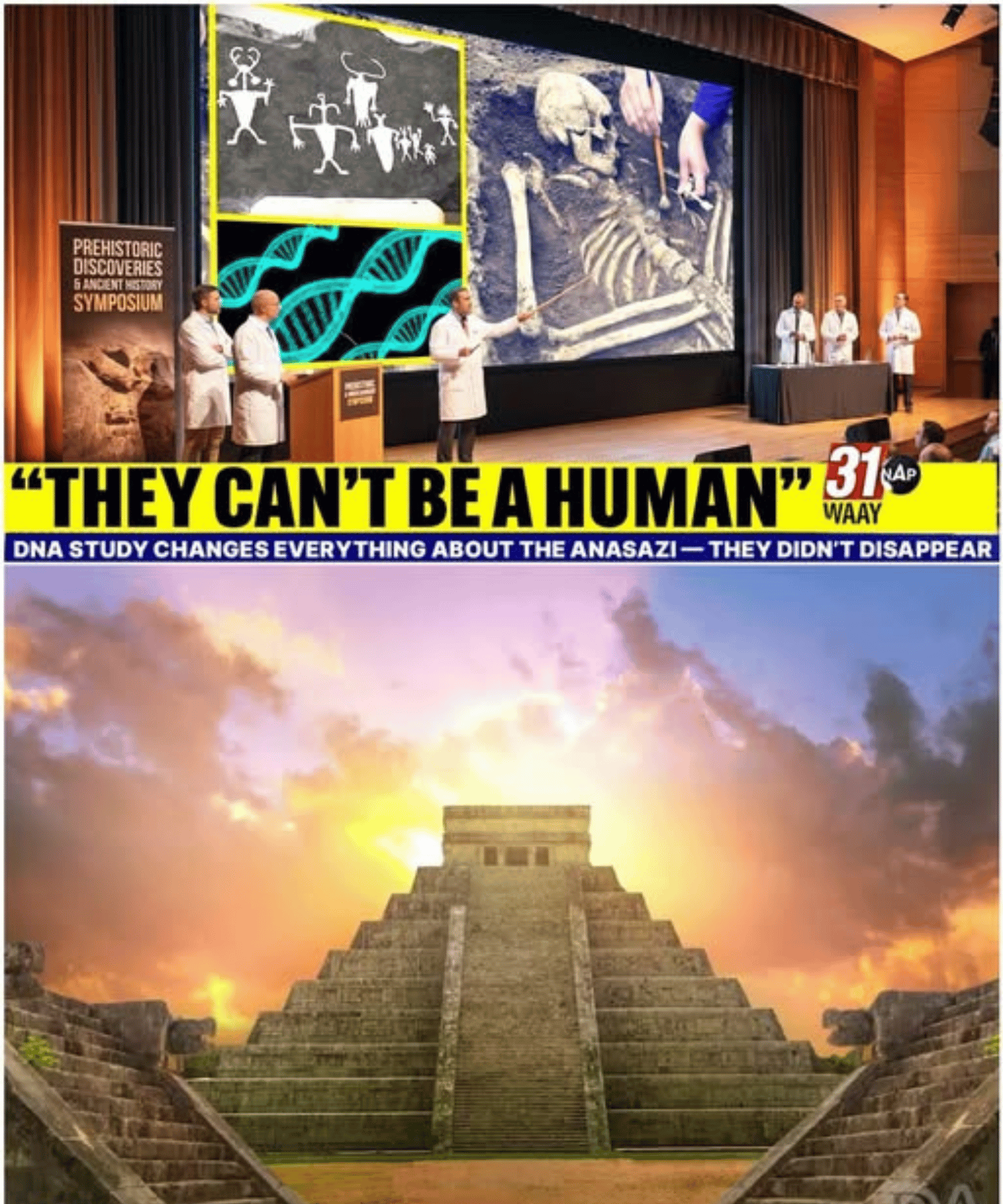
Cliff dwellings like those at Mesa Verde, the vast complex at Chaco Canyon with its Pueblo Bonito great house, and countless other sites stood empty, their inhabitants swallowed by the desert as if erased by some cataclysm.
Drought, warfare, resource depletion, even whispers of cannibalism or external invasion—the theories piled up like layers of dust on abandoned kivas.
But a groundbreaking 2025 DNA study, published in the journal Nature, has flipped the script entirely, proving the Anasazi didn’t disappear.
They endured, adapted, and live on in the genetic tapestry of today’s Pueblo peoples.
The study, led in collaboration with members of the Picuris Pueblo—one of the oldest continuously occupied communities in the Americas—represents a historic first: a federally recognized U.S.
Tribe co-authoring and directing ancient DNA research on its own ancestry.
Researchers sequenced DNA from 13 living Picuris Pueblo members and compared it to genetic material from 16 ancient individuals buried at the pueblo between 500 and 1,500 years ago.
They then linked these profiles to previously analyzed remains from Pueblo Bonito in Chaco Canyon, the epicenter of Ancestral Puebloan power between roughly 850 and 1150 CE.
The results were unmistakable: a direct, deep genetic connection spanning a millennium.
Modern Picuris people cluster genetically closer to Chaco Canyon’s ancient inhabitants than to any other group.
This isn’t just a minor match on a family tree.
The continuity shines brightest in maternal lines—mitochondrial DNA passed from mothers to children across countless generations.
These threads of inheritance reveal that the people who engineered Chaco’s sophisticated society, with its astronomical alignments, turquoise trade networks stretching to Mexico, and monumental architecture rivaling anything in pre-Columbian North America, didn’t fade away.
They migrated, integrated, and preserved their lineage through upheaval, drought, and cultural transformation.
Oral histories from Pueblo communities had long asserted this truth: “We have always been here.
We moved, but we never vanished.”
Science has now caught up, validating centuries of indigenous knowledge that archaeologists once overlooked.
To understand the seismic shift, rewind to the height of Ancestral Puebloan glory.
By the 11th century, Chaco Canyon pulsed as a ceremonial and economic hub.
Pueblo Bonito, the crown jewel, rose to five stories with over 800 rooms, housing elites whose burials—especially in Room 33—revealed a powerful matrilineal dynasty that dominated for roughly 330 years.
Elaborate roads radiated outward like spokes of influence, connecting outlying communities.
Great kivas hosted rituals under star-studded skies.
Populations swelled, supported by sophisticated agriculture in a harsh high-desert environment.
Then, by the late 1200s, the great houses emptied.
Tree-ring data screams of prolonged drought.
Skeletal evidence hints at violence and nutritional stress at some sites.
But the “disappearance” was never total annihilation—it was dispersal.
Earlier DNA work laid the groundwork.
Studies from the early 2000s onward on mitochondrial haplogroups—clusters of genetic markers inherited maternally—showed strong continuity between ancient Southwestern remains and modern Pueblo populations.
Haplogroup B, dominant in the region, appears consistently from Anasazi sites to today’s Hopi, Zuni, and Rio Grande Pueblos.
A 2017 analysis of turkey DNA even traced domesticated birds from Mesa Verde to the northern Rio Grande, mirroring human movements as people carried their flocks—and their genes—south and east.
The 2025 Picuris study cranks this evidence to maximum intensity.
By integrating ancient Chaco samples with both historic and contemporary Picuris DNA, researchers demonstrated not just broad regional links but specific, tight-knit ancestry.
Picuris ancient and modern individuals form a distinct genetic cluster, pulling closest to Chaco than to other Ancestral Puebloan groups.
This suggests targeted migration from the Chaco heartland into northern New Mexico pueblos, where communities adapted by building smaller, more sustainable settlements amid environmental pressures.
No mass extinction.
No lost tribe wandering into oblivion.
A strategic repositioning that preserved knowledge, language, and bloodlines.
The drama deepens when considering what this means for long-debated aspects of Anasazi society.
Chaco wasn’t a utopia of peaceful farmers alone.
Evidence points to social complexity, possible hierarchy, and even ritual violence.
Yet the genetic continuity underscores resilience over collapse.
Descendants didn’t forget their origins; they carried forward architectural techniques, pottery styles, agricultural wisdom, and spiritual traditions.
Today’s Pueblo dances, kachina beliefs, and communal structures echo those ancient rhythms.
The DNA confirms what elders maintained through storytelling: the ancestors walked these same paths, under the same vast skies.
This revelation lands amid broader shifts in how we understand Native American history.
For too long, colonial lenses framed indigenous societies as static or doomed to fade, amplifying myths of mysterious vanishings to justify land claims or romanticize the “vanished” other.
The Picuris-led research flips that power dynamic.
Tribal members didn’t just participate—they drove the science, ensuring ethical handling of remains and interpretations rooted in living culture.
It sets a precedent for indigenous sovereignty over ancestral narratives, blending genomics with oral tradition in a powerful synergy.
Imagine standing in Chaco Canyon at dawn, light piercing the great house windows aligned with solstices.
The wind whispers through empty rooms once filled with laughter, ceremony, and debate.
Now, thanks to DNA, those voices feel closer than ever.
They echo in the pueblos along the Rio Grande, in Hopi mesas, and Zuni lands—places where families trace lineages back through centuries of adaptation.
Severe droughts forced relocation, but kinship networks absorbed the migrants.
Smaller villages allowed tighter community bonds.
Trade continued.
Knowledge endured.
Critics of earlier “disappearance” theories always noted the obvious: modern Pueblos share pottery motifs, building styles, and cultural practices with the Anasazi.
But genetics provides irrefutable proof.
Earlier mtDNA studies across Utah, Colorado, and Arizona sites consistently aligned with Southwestern patterns, showing no major influx from distant Mesoamerican groups that would suggest replacement.
Instead, gradual regional movements, genetic drift, and intermarriage paint a picture of dynamic continuity amid challenge.
The implications ripple outward.
For land rights, repatriation, and cultural preservation, this data strengthens Pueblo claims to ancestral sites.
Chaco Canyon, a UNESCO World Heritage Site, holds sacred meaning; genetic ties bolster arguments for greater tribal involvement in its management.
It challenges simplistic collapse narratives, highlighting human adaptability—lessons urgent in our era of climate volatility.
If Ancestral Puebloans navigated centuries of aridity by dispersing and reforming, what strategies might their descendants offer today?
Yet mysteries linger, fueling the thrill of ongoing discovery.
While Picuris links shine bright, finer connections between specific Chaco lineages and individual modern pueblos require more samples.
Elite dynasties at Pueblo Bonito may show distinct patterns from commoners.
Violence at outlier sites like Cowboy Wash raises questions about internal conflicts during stress periods—yet survivors carried the culture forward.
Broader Southwest genomics, including Fremont and Mogollon influences, continue revealing a mosaic rather than a single thread.
This isn’t closure; it’s a new chapter bursting with potential.
Advanced sequencing techniques promise deeper insights into disease resistance, dietary adaptations, and social structures encoded in ancient genomes.
As more tribes lead similar projects, the full portrait of pre-Columbian North America sharpens—complex, interconnected, enduring.
The Anasazi saga, once a tale of haunting loss, now inspires awe at survival.
Their stone ruins stand not as tombs of a lost people but as monuments to ancestors whose legacy thrives in living communities.
DNA has bridged the chasm of centuries, proving that in the American Southwest, the past never truly dies—it flows onward, resilient and unbroken, into the future.
The cliffs and canyons hold their secrets no longer.
The bloodline persists, defiant against time itself, reminding us that true civilizations don’t vanish.
They transform, endure, and call us to remember.