A Secret Hidden in the Nefertiti Bust for 3,000 Years Was Just Revealed—And It’s Terrifying
A Secret Hidden in the Nefertiti Bust for 3,000 Years Was Just Revealed—And It’s Terrifying
The secret was not written in a tomb or carved into a curse. It was hidden under her perfect face.
For more than a century, the Bust of Nefertiti has stared out from behind glass like a queen who knows something the modern world still has not earned the right to hear. Her face is calm, symmetrical, almost impossible in its beauty. The long neck, the painted crown, the arched brows, the high cheekbones, the full lips, the one living eye staring forward while the other remains empty—everything about her seems designed to stop the viewer in silence. People do not simply look at Nefertiti. They stand before her as if entering the presence of a surviving power.
But then scientists looked beneath the surface.
And the mask began to speak.
For generations, the world believed it was looking at one face: the famous queen of Amarna, the Great Royal Wife of Akhenaten, the woman whose name means something like “the beautiful one has come.” She was the face of Egyptian elegance, the icon of ancient beauty, the image reproduced on books, posters, documentaries, museum banners, jewelry, and postcards. In Berlin’s Neues Museum, she is displayed almost like a sacred object, isolated under careful light, protected from cameras and crowds by glass, watched by people who have crossed continents to see her.
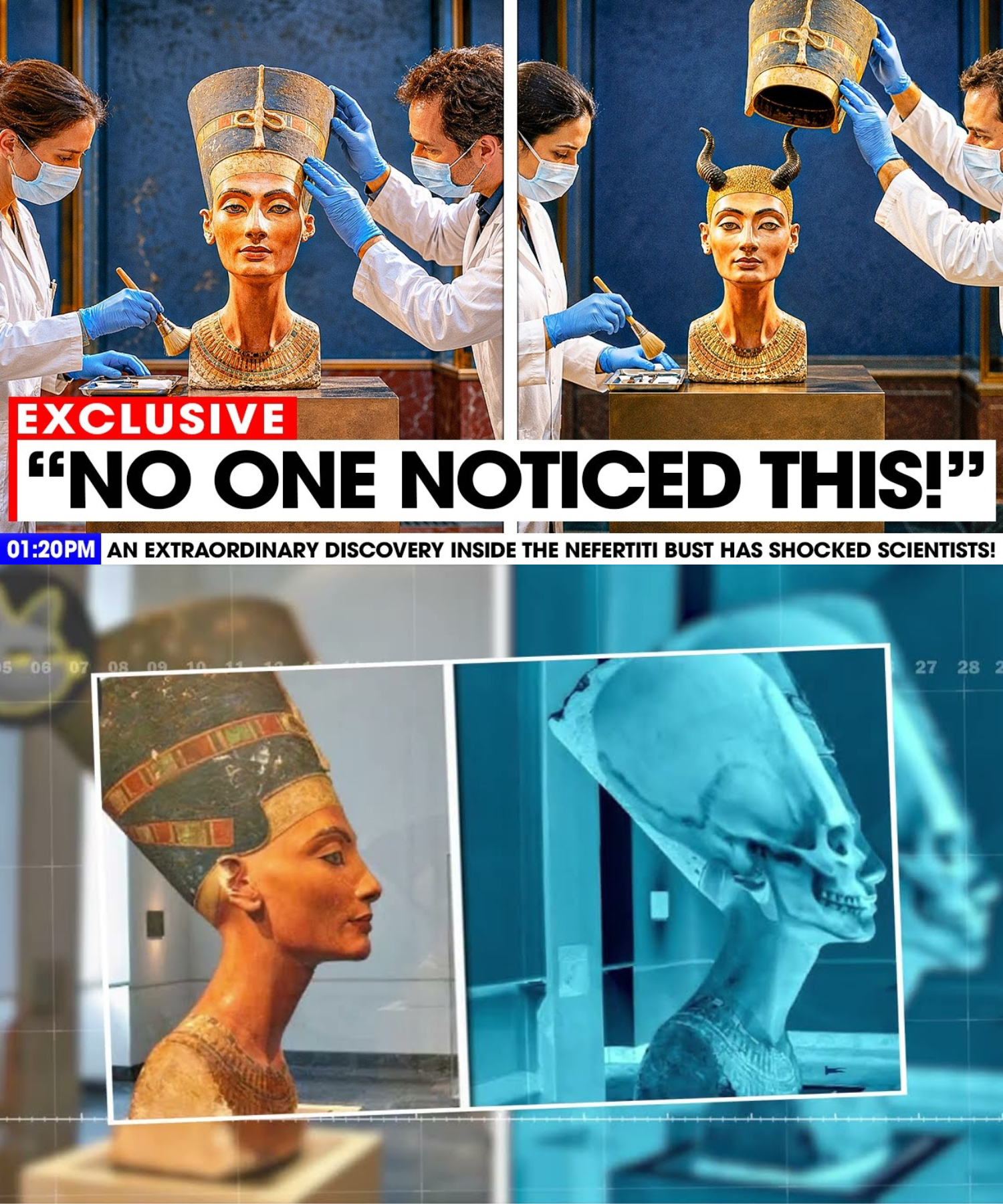
Yet when CT scans examined the bust, they revealed that the face everyone knows is not the only face.
Beneath the painted stucco layer lies a carved limestone core. Not a crude block. Not a rough base. A real inner face, delicately shaped by the sculptor before the final surface was added. This hidden face resembles the Nefertiti we know, but it is not identical. It has softer imperfections. Slight creases. A less polished structure. A subtle bump along the nose. A human face beneath the royal face.
That is the terrifying secret.
Nefertiti’s perfection may have been built over something more real.
The bust is not merely a portrait. It is a transformation. The sculptor did not simply reveal a queen. He edited her. He refined her. He smoothed reality into authority. He covered the living signs of age, flesh, and individuality with a controlled outer skin of beauty. What the world worships today may not be the woman as she was, but the queen as power needed her to be.
That is more disturbing than any curse.
Because it means the ancient Egyptians understood something modern people still understand too well: beauty can be manufactured, perfection can be political, and a face can become propaganda.
The Bust of Nefertiti was not found in a royal tomb. It was discovered in the workshop of the sculptor Thutmose at Amarna, the short-lived capital built by Akhenaten during one of the strangest religious revolutions in Egyptian history. Akhenaten turned Egypt toward the worship of the Aten, the sun disk, elevating a new religious vision and reshaping royal imagery in radical ways. In that world, art was not decoration. It was theology. The royal family was not simply painted and carved for memory. They were made into visible instruments of sacred order.
Nefertiti stood at the center of that revolution.
She was not merely a beautiful wife behind a strange king. In Amarna art, she appears with unusual prominence: worshipping the Aten, riding in chariots, standing beside Akhenaten, shown with daughters, sometimes even depicted in poses of power traditionally associated with pharaohs. Her image was part of the new religious language of the age. To shape her face was not just to flatter a woman. It was to shape the appearance of divine legitimacy.
That is why the hidden inner face matters.
If the outer face is more perfect than the inner one, then the bust becomes evidence of a controlled royal ideal. It shows us the difference between a person and an image. Between flesh and power. Between memory and manufacture. The sculptor’s hand did not only preserve Nefertiti. It corrected her.
Imagine the workshop at Amarna.
Dust in the air. Tools on benches. Plaster casts. Unfinished heads. Royal models lined along shelves. Artists working under the pressure of a court where images mattered deeply. The queen’s bust sits before them, not yet the perfect icon the world knows. A limestone face has already been carved. It is skilled, elegant, recognizable. But then comes the stucco. Thin in some places, thicker in others. The final modeling begins. A crease is softened. A nose line refined. Cheek structure adjusted. The face becomes less mortal, more serene, more royal, more impossible.
The woman disappears slightly.
The queen emerges.
This is the secret hidden inside the bust: not that Nefertiti was ugly, not that the bust is fake, not that it contains a curse or a hidden message from another world. The real secret is subtler and colder. The world’s most famous face of ancient beauty was engineered.
That word feels modern, but the act is ancient.
Every civilization has edited its rulers. Kings are made taller in reliefs. Queens are made serene. Warriors are made fearless. Emperors are made youthful. Saints are made luminous. Dictators are photographed from below. Celebrities are retouched. Influencers use filters. Political leaders choose angles, lighting, makeup, symbols, and slogans. Human power has always known that the face is not only identity. It is weapon, promise, mask, and throne.
Nefertiti’s bust proves that this was already true more than three thousand years ago.
The terrifying part is not that ancient people were different from us.
The terrifying part is that they were exactly like us.
We still live under the tyranny of the edited face. We still mistake polished images for truth. We still worship beauty that has been corrected, lit, painted, smoothed, filtered, and staged. We still build public identities over private wounds. We still look at perfection and feel inferior to something that never fully existed.
Nefertiti’s hidden face is an ancient warning about the violence of beauty.
Not physical violence. Symbolic violence. The kind that teaches entire generations that power must look flawless, that age must be hidden, that the human body must be corrected before it can be seen, that authority requires distance from ordinary flesh.
The queen’s inner face, with its small signs of humanity, may be the most honest part of the sculpture.
And it was buried.
The famous missing left eye adds another layer to the mystery. The right eye is inlaid, giving the bust its unforgettable sense of life. The left eye remains empty. For years, people wondered whether the inlay had fallen out or was lost. But studies suggest it may never have been inserted. This gives the bust a strange unfinished tension. One eye sees. One eye is blank. One side watches the world. The other side withdraws into silence.
That emptiness has helped make Nefertiti feel almost supernatural.
She is not complete, yet she feels more powerful because of it. The missing eye becomes a void the viewer fills with imagination. Was the bust a sculptor’s model? A workshop prototype? A finished object with an unfinished element? A royal image used for veneration? A teaching piece? The uncertainty keeps her alive. She refuses to be explained completely.
Perhaps that is why people still describe her as haunting.
The bust sits between life and object, between portrait and ideal, between queen and goddess, between archaeology and obsession. It is beautiful enough to attract worship and damaged enough to invite fear. It gives the impression of a person sealed behind an image, as if the real Nefertiti is somewhere behind the painted surface, aware of everyone who stares.
The CT scans deepened that feeling.
They did not remove the mystery.
They doubled it.
Now, when we look at the bust, we know there is another Nefertiti underneath. The visible queen is only the final version. Beneath her is an earlier version, carved and then covered. A face within a face. A memory sealed inside a masterpiece.
That idea is almost unbearable.
Because everyone understands what it means to have an inner face and an outer face.
The outer face is what the world demands. Calm. Beautiful. Strong. Successful. Composed. Acceptable. Royal. The inner face carries fatigue, fear, age, pain, uncertainty, and truth. Nefertiti’s bust becomes terrifying because it shows that this division is ancient. Humans have been covering the inner face for thousands of years.
The Amarna period itself was a time of masks and transformations. Akhenaten tried to change Egypt’s relationship with the divine. He moved the capital. He elevated the Aten. He altered artistic conventions. Royal bodies became elongated, intimate, strange, and expressive in ways earlier Egyptian art rarely allowed. Nefertiti’s image belonged to this experiment. She was part of a new visual theology.
But the experiment did not last.
After Akhenaten’s death, Egypt turned away from his religious revolution. The old gods returned. Amarna was abandoned. The memory of the heretic king was attacked. Names were erased. Images were damaged. The royal dream of the sun disk collapsed into history’s dust. Nefertiti herself vanished into uncertainty. Scholars still debate her final years, her political role, and whether she ruled under another name.
Her fate is unclear.
Her face survived.
That may be the strangest part of all.
The city failed. The revolution failed. The royal family’s experiment failed. The sculptor’s workshop was buried. Akhenaten’s memory was hated. Yet Nefertiti’s face endured so powerfully that modern people made her an icon greater than many kings. The image outlived the system that created it. The mask survived the empire’s attempt to forget.
But what exactly survived?
The woman?
The queen?
The propaganda?
The artwork?
The edited ideal?
The answer may be all of them at once.
The bust is terrifying because it refuses purity. It is not simply beauty. It is beauty shaped by power. It is not simply portraiture. It is portraiture adjusted into ideology. It is not simply a woman’s face. It is a royal object made in a court obsessed with divine visibility. It is not simply ancient art. It is ancient image control.
And now, because science has looked inside it, the object has become even more human.
We can no longer pretend the face appeared whole and perfect from the stone. It was constructed in stages. The limestone core was shaped. Stucco was applied. Paint transformed it. The eye was inlaid. The surface was corrected. Every layer added control. Every layer moved the face away from raw stone and toward eternal image.
This is why the hidden face is not a minor technical discovery.
It changes the way we see the entire bust.
Before the scans, Nefertiti’s beauty seemed absolute. After the scans, her beauty becomes a decision. A process. A strategy. The sculptor’s corrections become visible even while remaining physically hidden. We now know the outer surface is not innocent. It is a final draft.
That makes the bust feel less like a passive artifact and more like an ancient act of editing still working on us.
We are still being persuaded by it.
Every viewer who stands before the glass and whispers about perfection is responding to choices made in a workshop more than three thousand years ago. The curve of the mouth. The smoothness of the cheeks. The line of the nose. The calm expression. The painted colors. The one completed eye. The tall crown. None of these is accidental. Together, they produce authority.
Nefertiti does not plead for attention.
She receives it.
That is power.
Modern viewers often describe her as timeless, but that word hides something dangerous. Nothing human is truly timeless without being made so. The bust’s timelessness was created. It required materials, labor, pigment, design, protection, excavation, museum display, photography, scholarship, politics, and global reproduction. Her face became eternal because many systems—ancient and modern—helped make it so.
That is another terrifying truth.
Icons are not born.
They are built.
And once built, they can rule the imagination for centuries.
The debate over where the bust belongs adds one more shadow. Egypt has long wanted Nefertiti returned. Germany has insisted on the legality of its possession and the fragility of the object. The bust has become not only an artwork but a political symbol, tied to colonial archaeology, national pride, museum authority, and cultural memory. Nefertiti’s face is still contested because beauty attracts ownership. Everyone wants to claim the queen.
But perhaps no one can fully possess her.
Not Berlin.
Not Cairo.
Not the museum.
Not the archaeologists.
Not the public.
Not even the sculptor who made her.
Because the real woman has escaped them all.
That may be the final terror of the bust. The more the image survives, the more the woman disappears. We know the face, but not the full life. We know the beauty, but not the voice. We know the crown, but not the private thoughts. We know the icon, but not the soul. Nefertiti has become one of the most famous women in history, yet she remains almost unreachable behind the very image that made her famous.
The hidden face beneath the stucco becomes a metaphor for that loss.
There was always another woman under the surface.
The queen the world sees may not be the queen who lived.
Archaeology often promises to bring the dead closer, but sometimes it reveals how far away they still are. A tomb can preserve bones but not a laugh. A statue can preserve a face but not a conscience. A name can survive while the person behind it dissolves into speculation. Nefertiti’s bust is so vivid that it tricks us into thinking we know her. The scans remind us we do not.
We know an image.
We know layers.
We know corrections.
We know a masterpiece.
But the living Nefertiti remains hidden.
That is why the secret is terrifying.
Not because a monster was found inside the bust.
Because a human being was.
A more human face, buried under perfection. A reminder that power edits memory. A warning that beauty can become a mask. A confession from the ancient world that rulers were manufactured then just as public identities are manufactured now.
The bust still looks serene.
But now the serenity feels less innocent.
Now, when the light strikes her painted face, we can imagine the limestone beneath it: the first version, the covered version, the face with small imperfections sealed away for thousands of years. We can imagine the sculptor leaning close, adding stucco, smoothing, refining, deciding which traces of humanity must remain and which must disappear.
In that moment, the terrifying secret is not hidden anymore.
The Nefertiti Bust does not only show us an ancient queen.
It shows us what civilization does to truth when truth is not beautiful enough for power.
It covers it.
It paints it.
It lights it.
It places it behind glass.
And then it invites the whole world to worship the mask.