Did giants build these gates high on this mountain in the inaccessible Sierra of Oaxaca?
Did giants build these gates high on this mountain in the inaccessible Sierra of Oaxaca?
Deep within the rugged, vertical topography of Oaxaca, Mexico, a quiet revolution in archaeology is taking place not with shovels and brushes, but via remote-controlled props and high-definition lenses. For decades, the sheer limestone cliffs of the Southern Sierra Madre have guarded secrets inaccessible to traditional foot surveys, hiding architectural anomalies that defy conventional historical timelines. Recently, a daring drone exploration near the isolated community of San Andrés Mixtepec has captured footage of complex, cliffside structures—including doors hanging open over thousand-foot drops—forcing both independent researchers and academic institutions to reconsider who, or what, colonized the most treacherous vertical real estate in Mesoamerica.
The Vertical Architecture of Mixtepec
The journey to San Andrés Mixtepec is an exercise in geographic isolation. Located roughly four hours south of Oaxaca City, near the regional hub of Miahuatlán de Porfirio Díaz, the landscape transitions from fertile valleys into a chaotic maze of jagged peaks and precipitous canyons. It is a region steeped in Zapotec history, but the ruins discovered clinging to the sheer rock faces of these mountains suggest a structural tradition far more mysterious than the stone palaces of Mitla or the grand plazas of Monte Albán.
Operating from a baseline kilometers away, an independent investigator recently deployed a drone on a precise, multi-kilometer reconnaissance flight, aiming the camera sensor at a series of massive cavities pockmarking an isolated cliff face. What the 4K video feed revealed was not a collection of simple mud-brick animal pens or basic storage granaries, but highly sophisticated, defensive, or residential architecture built directly into the living rock.
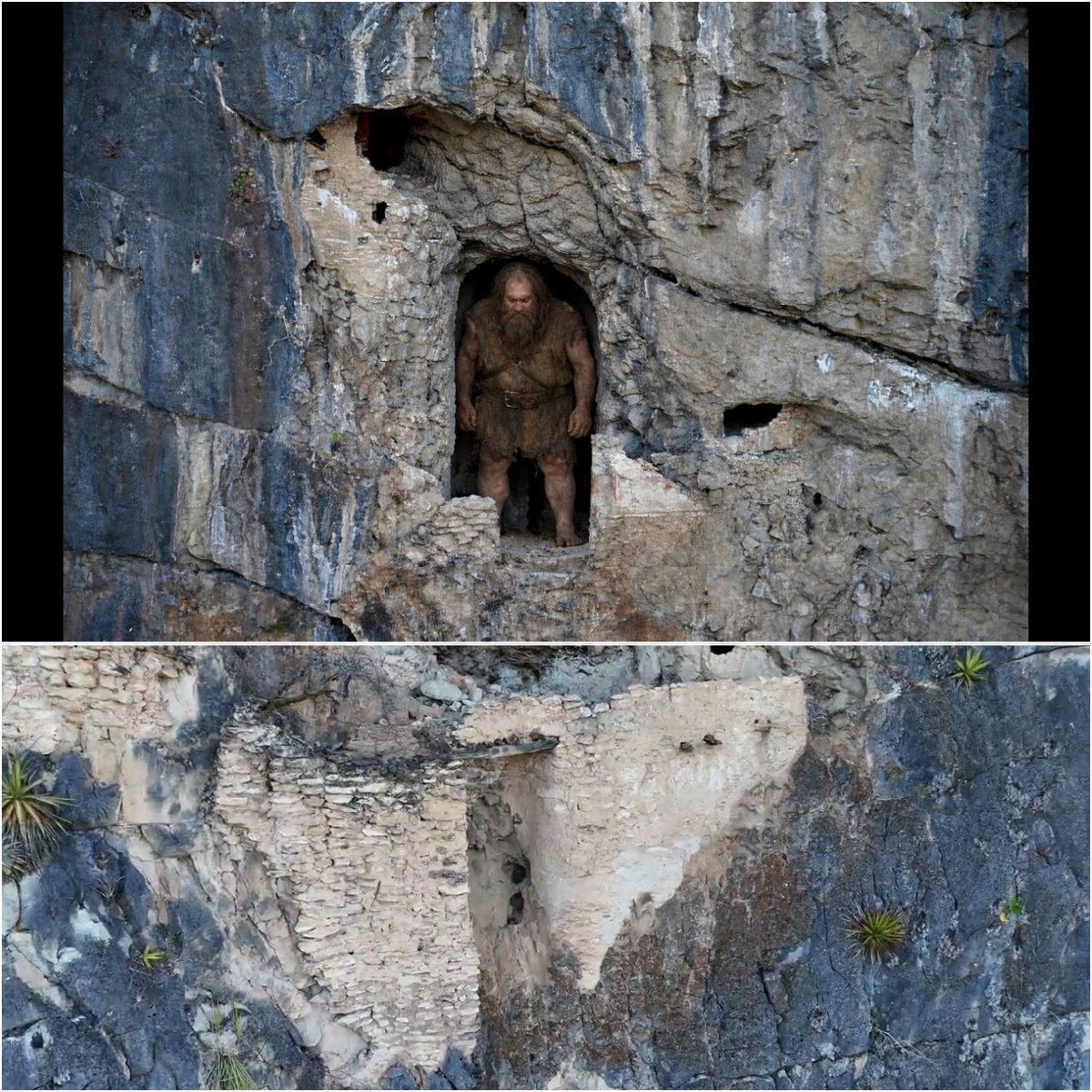
The most shocking element of the find is a series of fully realized doors and windows structured flush with the vertical precipice. One prominent frame captures a meticulously plastered doorway opening directly into a massive void—a literal portal to a thousand-foot drop. The craftsmanship is undeniably deliberate; the builders utilized a durable mud-and-clay stucco mix to flatten the exterior rock face, finishing the structure with a reddish-ochre mineral paint that has miraculously survived centuries of environmental exposure. To find such specialized finishing techniques applied to an inaccessible cliffside structure challenges the baseline logic of ancient construction.
The Timber and the Plaster: An Engineering Anomaly
To appreciate the architectural impossibility of the Mixtepec ruins, one must look closely at the structural materials preserved within the dry, sheltered microclimate of the caves. As the drone hovered inches from the crumbling masonry, adjusting its exposure settings to illuminate the deep shadows of the interior chambers, it captured something that structural engineers have found deeply puzzling: the extensive use of preserved wooden beams.
Thick, hand-hewn wooden logs remain embedded in the upper thresholds of the doors and windows, acting as load-bearing lintels to support the immense weight of the overhanging stone. In several sections, horizontal timber planks are laid tightly together, covered by a thick layer of compacted clay to form an exterior balcony or architectural overhang—a literal mezzanine suspended over the abyss.
The inclusion of wood introduces a complex timeline variable. While rock-cut caves and simple stone-stacking could theoretically be attributed to nomadic pre-Hispanic groups, the mastery of timber framing, exterior stucco flattening, and decorative painting points to a highly organized society possessing an advanced understanding of structural physics.
Furthermore, the location of these ruins complicates the regional narrative. Similar, though smaller, “cliff houses” (often locally referred to as casitas de los duendes, or “goblin houses”) have been documented roughly five hours away in the Mixteca region. Finding a larger, more architecturally complex variation deep within historically Zapotec territory suggests that this vertical building tradition was far more widespread, or standardized, than modern Mexican archaeology has ever recorded.
The Hypotheses: Rebels, Giants, and Prehistoric Sentinels
In the absence of official academic studies or state-sponsored excavations, a vibrant debate has ignited among historians, locals, and online analysts trying to decipher the purpose of these gravity-defying settlements. The theories range from the strictly utilitarian to the wildly speculative, each attempting to answer a fundamental question: Why build a home where a single misstep means death?
The Revolutionary Hideout
The most conservative explanation favors a relatively modern timeline, placing the construction of the walls during the turbulent years of the Mexican Revolution or the nineteenth-century reform wars. Proponents of this theory argue that rebel forces or displaced indigenous families fled into the high sierra to escape marauding federal armies, constructing the walls to fortify natural caves against artillery and long-range rifle fire.
However, skeptics quickly point out the sheer logistical flaw in this narrative. A displaced army of rebels on the run lacks the time, the tools, and the stability required to haul massive timber beams up vertical cliffs, mix tons of structural mortar, and meticulously apply decorative plaster coat finishes. The Mixtepec structures bear the hallmarks of permanent, deliberate occupation, not the frantic masonry of refugees hiding from a passing infantry division.
The Defensive Pre-Hispanic Outpost
A more historically sound hypothesis dates the ruins to the late Postclassic period of Mesoamerica, an era characterized by intense, bloody conflicts between the expanding Aztec Empire and the native Zapotec and Mixtec kingdoms. In this context, the cliff houses served as elite military watchtowers or fortified granaries.
From their high vantage points, sentinels could observe the entire valley floor for miles, tracking enemy troop movements while remaining entirely immune to conventional siege tactics. By pulling up retractable rope ladders or utilizing hidden, internal mountain tunnels, a handful of defenders could hold off an entire army indefinitely. The doors facing the void may have functioned as hoisting platforms, allowing supplies to be winched up from the canyon floor via complex pulley systems.
The Indigenous Myth of the Quinametzin
Among the older generations living in the villages surrounding San Andrés Mixtepec, the explanations bypass modern military history entirely, tapping instead into a deep reservoir of oral mythology. When shown the footage of the towering doorways and the steep, unscalable paths, locals frequently invoke the legend of the Quinametzin—a race of giants who, according to Aztec and Zapotec lore, inhabited the earth during a previous creation epoch before being destroyed by cosmic cataclysms.
To the traditional mind, the scale of the cliffs is not an obstacle if the builder possesses a physical stature of twelve to fifteen feet. “For us, it is impossible to walk those ridges or scale those walls without ropes and modern gear,” notes one regional commentator. “But for an ancestry of different strength, different height, and an entirely different relationship with the mountains, these heights were simply normal terrain.” While mainstream anthropology dismisses the giant hypothesis as pure folklore, the persistence of these legends across diverse Mexican cultures underscores the profound psychological impact these ancient ruins have on the modern communities living in their shadows.
The Challenge to Modern Archaeology
The discovery of the Mixtepec cliffside structures highlights a growing friction between institutional archaeology and the democratization of exploration via consumer technology. For decades, official entities like Mexico’s National Institute of Anthropology and History (INAH) have operated under constrained budgets, focusing their limited resources on high-profile, tourism-driving sites like Chichén Itzá, Palenque, or Teotihuacán. Consequently, thousands of remote anomalies tucked away in the rugged interiors of states like Oaxaca, Guerrero, and Chiapas remain completely unmapped and unstudied.
The drone pilot who captured the Mixtepec footage noted that upon consulting with regional historical experts, he was informed that no academic papers, surveys, or official registrations exist for this specific cliffside site. It is a blank space on the archaeological map, preserved only by its sheer physical hostility and the quiet respect of the local Zapotec communities.
This lack of institutional documentation has transformed independent drone pilots into the vanguard of modern exploration. A consumer drone can accomplish in twenty minutes what a traditional ground expedition would require weeks of dangerous, high-risk vertical climbing to achieve. By adjusting digital exposure levels on the fly, flying directly into dangerous thermal crosscurrents, and capturing stable 4K reference footage, these amateur explorers are building a decentralized archive of human history that the public can access instantly.
The Promise of the Interior
The exploration of San Andrés Mixtepec is far from concluded. The pilot has already announced plans for a follow-up expedition—one that will trade the safety of the drone controller for the physical grit of rappelling gear. The objective is to safely enter the interior chambers of the cliff houses to search for tangible diagnostic artifacts: ceramic shards, charcoal remnants for carbon-14 dating, or organic fibers from the mortar mix that can provide a definitive scientific timeline for the site.
Until those physical samples are secured, the cliff houses of Oaxaca will remain a haunting, beautiful enigma. They stand as a testament to human resilience, engineering ingenuity, and an era when our ancestors—or whoever constructed these fortresses—looked out at the terrifying, vertical voids of the earth and chose to build their homes directly into the sky. In a world that feels increasingly small and entirely mapped, the silent doors of Mixtepec prove that the wilderness still knows how to hide its secrets in plain sight.