Youtuber Travels To Israel & Discovers He’s Been Lied To This Entire Time!
Youtuber Travels To Israel & Discovers He’s Been Lied To This Entire Time!
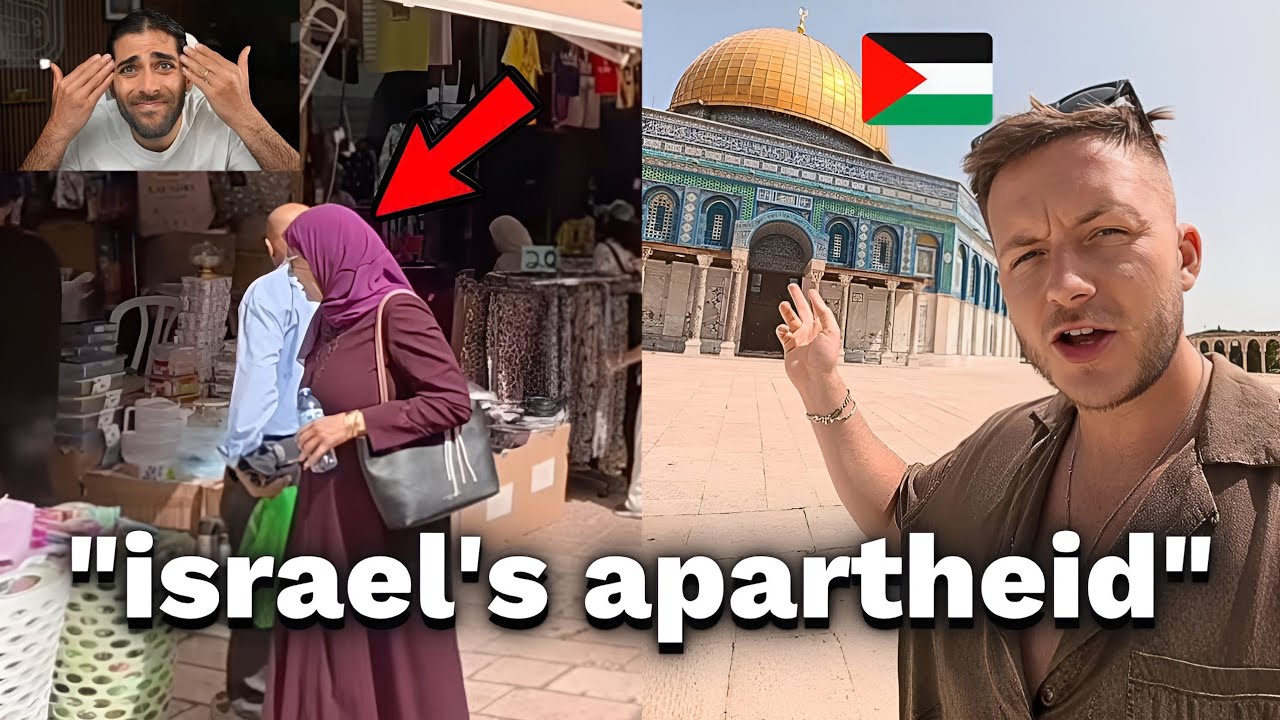
A travel video filmed in Jerusalem has ignited a fierce online debate after viewers watched a foreign YouTuber walk through some of the world’s most contested streets while an Israeli commentator reacted in real time. What began as a simple journey through markets, holy sites, street food stalls, and nearly empty tourist areas quickly turned into a politically charged argument about apartheid accusations, religious history, Palestinian access, tourism after war, and the way social media turns one walk through a city into evidence for an entire worldview.
The video opens with a pointed observation: street signs in Jerusalem appear in Arabic, English, and Hebrew. For the commentator, this becomes an immediate rebuttal to accusations that Israel operates an apartheid system. His sarcasm is sharp. If Arabic is visible in public spaces, if Arab shopkeepers are working, if Muslim women can walk freely in hijabs and niqabs, if foreign workers and Black or South Asian visitors can move through the streets, then, in his view, the accusation collapses. He treats the visual reality of daily life as proof that the outside world is lying about Israel.
But the controversy begins precisely there, because Jerusalem is not a city that can be understood through one street sign or one market walk. It is a city where everyday coexistence and deep political inequality can exist side by side. A visitor may see Arabic signs, mixed crowds, generous shopkeepers, and religious diversity in a single afternoon. Another person may point to checkpoints, residency issues, restrictions after security crises, land disputes, and unequal political rights. Both may be describing something real, but neither alone captures the full picture.
That is what makes Jerusalem so difficult and so emotionally powerful. It is not merely a tourist destination. It is a sacred city for Jews, Christians, and Muslims. For Jews, it is tied to the ancient temples, the Western Wall, and thousands of years of prayer and longing. For Christians, it contains places associated with the crucifixion, burial, and resurrection of Jesus. For Muslims, it is home to Al-Aqsa Mosque and the Dome of the Rock, sites revered across the Islamic world. Few cities on earth carry so much spiritual meaning in such a small physical space.
The traveler, Harry, appears to understand that weight. He describes Jerusalem as beautiful, divided, spiritual, and emotionally overwhelming. He does not walk through the city like someone pretending it is ordinary. He knows he is moving through a place where history is not dead. It is present in stones, walls, alleys, prayers, food stalls, soldiers, pilgrims, and empty shopfronts. His tone is often curious and respectful, though the commentary layered over his video pushes the discussion into much sharper political territory.
One of the first human encounters in the video is with a Jewish man from Vancouver who moved to Israel, served in the army, and now studies tourism. Their conversation captures a common tension in Israeli society after October 7 and the war that followed. He describes daily life as hectic but manageable. He says most people are good, while extremists exist on both sides. He expresses openness to visiting different communities, including the West Bank, and suggests that peace requires seeing both sides. Yet even within that hopeful language, exhaustion is visible. He speaks of repeated reserve duty, delayed studies, and a population tired of war but still convinced it must remain vigilant.
The commentator reacts to parts of this conversation with approval and disagreement. When the traveler refers to settlements in the West Bank, the commentator questions the language, arguing that Jews had historic ties to the land long before modern political boundaries. This is one of the central disputes in the Israeli-Palestinian conflict: what counts as indigenous presence, what counts as occupation, what counts as legal settlement, and whose history carries political authority today. The traveler uses common international terminology. The commentator rejects it as unfair framing. That difference alone shows how language has become one of the conflict’s battlefields.
The food scenes briefly soften the atmosphere. The traveler eats manakish and compares the bread to Lebanese and Syrian versions. Shopkeepers speak with him warmly. There are jokes, greetings, small purchases, and ordinary human exchanges. In those moments, Jerusalem looks less like a headline and more like a living city. People are working, selling, laughing, translating, bargaining, and trying to survive a terrible economic downturn. The market is not a theoretical debate. It is a place where business has slowed, tourists have disappeared, and families depend on the few visitors still willing to walk through.
That economic emptiness becomes one of the most striking parts of the video. The traveler repeatedly notes how few tourists are present compared with what the city might have seen before 2023 or 2024. Shopkeepers confirm that business is bad. Streets that once drew international pilgrims and travelers now feel thinly populated. The commentator mocks international outrage against Israel by pointing to the visible presence of Arabs, tourists, Christian visitors, South Asians, and foreign caregivers, but the deeper image is more somber: a city built on pilgrimage has been wounded by war, fear, travel warnings, and global polarization.
The video then moves toward the Western Wall, where Jewish men and women pray in separate areas, touching and kissing the ancient stones. The traveler explains that the wall is connected to the Second Temple and remains one of Judaism’s holiest accessible sites. Nearby are Al-Aqsa Mosque and the Dome of the Rock, which sit on the Temple Mount/Haram al-Sharif, perhaps the most contested religious platform in the world. The traveler appears struck by the physical closeness of the three faiths’ sacred spaces. The commentator, however, focuses on the historical argument: if the Jewish temples stood there before the Islamic structures, he asks, why are Jews called colonizers?
That question is emotionally powerful for many Jews and many supporters of Israel, because Jewish attachment to Jerusalem is ancient and undeniable. But the political problem does not end with proving ancient connection. Many peoples can carry deep historical attachment to the same land. Muslim and Christian communities also have centuries of lived history in Jerusalem. Palestinians, whether Muslim or Christian, have family histories, neighborhoods, cemeteries, homes, and cultural memory tied to the city. Acknowledging Jewish history does not erase Palestinian presence. Acknowledging Palestinian presence does not erase Jewish history. The tragedy is that political debate often demands one memory defeat the other.
The traveler’s attempt to enter Al-Aqsa introduces another layer of complexity. Non-Muslim visitors are allowed at specific times through a controlled route, but access is restricted and heavily managed. The traveler accidentally gets caught near a group of religious Jewish activists, followed by police, who appear to be making a point about Jewish access to the holy site. The guide warns him not to stay with them. The scene feels tense even without violence. Everyone understands the sensitivity. A step, a prayer, a flag, a chant, or even a rumor can ignite anger around this place.
The commentator frames the Jewish activists as making a reasonable point: if the site is the holiest place in Judaism, Jews should be allowed to enter and pray freely. Others would answer that the delicate status quo exists precisely because any perceived change to the site’s religious balance can trigger mass unrest. This is the central paradox of Jerusalem’s holiest ground. Religious freedom, historical justice, public order, and political sovereignty all collide in one place. Every side believes it has a legitimate claim. Every change feels existential to someone.
At Al-Aqsa, the traveler describes the mosque as beautiful and expresses gratitude for being able to visit. He also notes the sadness of seeing so few tourists. His tone is reflective, even reverent at times. The commentator interrupts with skeptical and dismissive remarks about Islamic tradition, including claims that are insulting toward Muslim belief. A responsible account of the video must acknowledge this without amplifying it. The commentary is not neutral religious analysis. It reflects a hostile viewpoint shaped by the wider conflict. Such statements may appeal to viewers already angry at Islam, but they also deepen division and reduce a complex faith followed by more than a billion people to a caricature.
The same problem appears when the discussion turns to Palestinians. The commentator disputes Palestinian national identity, presenting it as a modern political invention designed to undermine Jewish claims. This argument circulates frequently in pro-Israel spaces, but it is deeply contested and deeply inflammatory. National identities often develop through modern political struggle. That does not make them meaningless. Israeli identity itself was shaped through ancient memory, modern nationalism, migration, war, state-building, and international recognition. Palestinian identity was shaped through land, family, displacement, resistance, culture, and collective experience. Denying an identity does not make the people who hold it disappear. It usually hardens the conflict.
The traveler also discusses the Green Line in Jerusalem, explaining that before 1967, West Jerusalem was under Israeli control while East Jerusalem was under Jordanian control, and that after the Six-Day War Israel took control of East Jerusalem, the West Bank, and Gaza. The commentator corrects him sharply when he uses the phrase “Palestinian-Jordanian control,” insisting that East Jerusalem had been under Jordanian control, not Palestinian sovereignty. That correction has historical basis in formal state terms, but it does not settle the moral or political dispute. Many Palestinians lived there, lost access, gained restrictions, or experienced changes in legal status. State control and people’s lived reality are not the same thing.
One of the traveler’s strongest observations is that before 1967, Jews could not access the Western Wall under Jordanian rule, while today multiple faith communities can access many holy sites under Israeli control, though with important restrictions. The commentator argues this is the fairer framing: Israel allows broader access than previous authorities did. Critics would respond that Palestinian access to Jerusalem and Al-Aqsa has often been limited by permits, closures, security restrictions, and political status, especially during periods of violence. Both points matter. Jewish exclusion before 1967 was real. Palestinian restrictions today are also real. A serious discussion cannot use one injustice to erase another.
The video becomes especially sensitive when the traveler reflects that religion should bring people together but often appears to divide them. The commentator responds with a sweeping attack on Islam, portraying it as a faith that creates fear rather than unity. This is one of the places where the commentary becomes most harmful. It is fair to criticize religious extremism, violent movements, supremacist interpretations, or political ideologies that use religion to justify domination. It is not fair or accurate to reduce all Muslims or Islam itself to violence and hostility. Jerusalem’s Muslim communities include families, shopkeepers, scholars, worshippers, workers, and ordinary people trying to live. Their faith cannot be judged solely through the worst actions committed in its name.
The traveler’s walk through the markets offers a corrective to this kind of simplification. He meets people from Britain, Sri Lanka, the Philippines, and local communities. He buys dates and sweets. He receives a complimentary drink from a Jewish-run stand that accepts donations but appears open to anyone. He talks with caregivers from abroad who have lived and worked in Israel for years. The commentator uses these images to argue that Israel cannot be an oppressive society if so many different people move freely and work there. That argument has emotional force, but it is incomplete. Everyday diversity does not automatically disprove structural inequality. Many countries with real social or legal inequalities also have visible diversity in public life. The question is not whether people of different backgrounds exist in public spaces, but what rights, protections, mobility, and political power they have.
Advertisements
This is why the word “apartheid” remains so divisive. Supporters of the term use it to describe unequal systems of control affecting Palestinians in the occupied territories and, in some critiques, broader legal and political structures. Opponents argue the term is false, inflammatory, and ignores the citizenship rights of Arab Israelis, the complexity of security threats, and the diversity visible in Israeli cities. The video does not resolve that debate. A walk through Jerusalem cannot prove or disprove a legal and political accusation of that magnitude. What it can do is challenge simplistic images. It shows that Jerusalem is not a cartoon of separation. It is also not a simple model of harmony.
The most useful part of the video may be the way it shows contradiction. Arab shopkeepers speak warmly with a Western traveler while describing terrible business conditions. Jewish worshippers pray at the Western Wall while Muslim sacred sites rise above it. Non-Muslim visitors enter Al-Aqsa under strict time windows while Muslim access from the West Bank or Gaza may be restricted. Foreign workers earn money and move through the city while Palestinians face different legal and security realities depending on residency, citizenship, location, and political status. Tourists find beauty while residents carry fear. Every image contains another truth just outside the frame.
The commentator praises the traveler for doing his job properly, reading, asking questions, and trying to understand the country instead of arriving with a fixed agenda. That praise is deserved in one sense. Travel journalism at its best is built on curiosity. It allows viewers to see places beyond slogans. But commentary layered on top can still turn curiosity into propaganda if it mocks entire religions, denies whole identities, or treats selective scenes as final proof. The traveler appears to be learning in real time. The commentator often appears to have already decided what everything means.
That contrast is the heart of the viral debate. Is Jerusalem best understood by walking through it and observing daily life? Or by placing every observation inside a political argument already formed? The answer is both and neither. Walking matters because it humanizes. It shows faces, food, exhaustion, kindness, and contradiction. But walking alone can mislead if the traveler does not understand legal systems, permit regimes, historical trauma, and political power. Analysis matters because it provides context. But analysis can become dangerous when it stops seeing people and sees only proof.
Jerusalem demands humility from anyone who tries to explain it. Too many people approach the city as if it exists to confirm their ideology. Some arrive determined to prove Israel is uniquely evil. Others arrive determined to prove every criticism of Israel is a lie. Some erase Jewish history. Others erase Palestinian identity. Some reduce Muslims to extremists. Others reduce Jews to colonizers. Every version is incomplete, and every incomplete version feeds the conflict.
The empty streets in the video may be the most honest image of all. Tourism has collapsed not because Jerusalem lost its beauty, but because fear has entered the global imagination around the region. Pilgrims hesitate. Travelers cancel. Shopkeepers suffer. Workers wait. The city continues, but thinner, quieter, more anxious. Behind every ideological battle are people who need customers, salaries, safety, and hope.
In the end, the video is valuable not because it proves one side right, but because it reveals how hard it is to see Jerusalem clearly. One person sees Arabic signs and says apartheid is a lie. Another sees restrictions and says the signs are cosmetic. One person sees Jewish prayer at the Western Wall and remembers centuries of longing. Another sees Al-Aqsa under armed control and feels occupation. One person sees foreign workers and says Israel is open. Another sees Palestinians unable to enter and asks open for whom.
The truth is that Jerusalem is all of these things at once: sacred and political, beautiful and wounded, welcoming and restricted, ancient and modern, shared and divided. Anyone who claims the city can be explained in a single sarcastic line is not revealing Jerusalem. They are revealing their own need for certainty.
The traveler came looking for holy places and human encounters. The commentator came looking for arguments. The viewers received both. What they do with that tension matters. They can turn the video into another weapon in the endless online war over Israel and Palestine, or they can recognize something more difficult: Jerusalem cannot be understood by denying anyone’s pain.
Its streets are written in Arabic, Hebrew, and English because its history has never belonged to one voice alone. Its tragedy is that too many people still want only one voice to count.