Something Kept Opening The Door While We Slept at The Widow’s Cabin (We Couldn’t Explain It)
Something Kept Opening The Door While We Slept at The Widow’s Cabin
We Couldn’t Explain It
The first time the door opened by itself, none of us screamed. We just sat up in our sleeping bags, staring into the dark, listening to the old hinges cry like something wounded was standing on the other side.
The cabin belonged to a widow named Mrs. Harlan, though nobody in town called it that anymore. They called it the widow’s cabin, as if her grief had become part of the wood, the roof, the moss-covered porch, and the narrow trail that vanished into the pines behind it.
It sat two miles above a forgotten logging road, tucked against the side of a mountain where the trees grew so close together that sunlight barely touched the ground. There was no phone signal. No electricity except for a small generator that coughed more than it worked. No neighbors. No passing headlights. Just the lake below, the forest around us, and that front door with its rusted latch.
We had gone there for a weekend because Caleb thought it would be funny.
Caleb was always chasing strange places. Abandoned churches. Empty hospitals. Mines with warning signs. Old houses with stories attached. He said fear made people honest. I think he just liked watching everyone else get nervous.
There were four of us: Caleb, his younger sister Mara, my friend Joel, and me.
Mrs. Harlan had died twelve years earlier. Before that, she lived alone in the cabin after her husband disappeared in the woods. The story was simple enough at first. Mr. Harlan went out during a storm to check on a broken fence and never came back. Searchers found his lantern near the tree line, still upright in the mud, but no body, no tracks, no sign of an animal attack.
After that, Mrs. Harlan never left the cabin.
People said she kept setting the dinner table for two. Said she opened the front door every night at midnight and waited for her husband to come home. Said even after she died, the door still opened.
Caleb loved that part.
“That’s the whole reason we’re going,” he told us. “If the door opens, we get it on camera.”
Joel laughed and said, “And if it doesn’t?”
Caleb grinned. “Then we open it ourselves and make the internet believe it did.”
That should have been the first warning.
We reached the cabin just before sunset. The place looked smaller than I expected, but heavier somehow. The logs were dark with age. The windows were dusty. A broken wind chime hung from the porch roof, turning slowly even though there was barely any wind.
Inside, everything smelled like old smoke, wet wood, and something faintly sweet, like dried flowers left too long in a closed room.
The cabin had one main room, a kitchen corner, a stone fireplace, and a narrow bedroom in the back. Most of the furniture was still there. A round table. Two chairs. A cracked mirror. Shelves lined with jars. A faded quilt folded neatly at the foot of the bed.
And on the table, covered in dust, were two plates.
Mara noticed them first.
“Okay,” she said quietly. “That’s creepy.”
Caleb immediately pulled out his camera.
“Perfect.”
I remember feeling uneasy in a way I couldn’t explain. Not terrified. Not yet. Just watched. Like the cabin had been empty until we stepped inside, and now something in it had woken up.
We set our sleeping bags in the main room. Caleb wanted the camera facing the front door. Joel placed another one near the fireplace. Mara took photos of the old bedroom. I checked the latch on the front door because the whole reason we were there suddenly seemed much less funny when the sun disappeared.
The latch was simple: a metal hook that dropped into a loop. Old, but solid.
I locked it.
Then I pulled the door twice.
It didn’t move.
“Happy?” Caleb asked.
“No,” I said. “But at least we’ll know if someone opens it.”
He laughed.
By ten, the generator had died. We sat around the fireplace with flashlights and a battery lantern, eating cold sandwiches and pretending the woods outside weren’t pressing closer to the windows.
Caleb told the story again, adding details none of us had heard before. He said Mrs. Harlan used to hear knocking at night after her husband vanished. Three knocks. Always three. She believed it was him. She told people he was out there, trying to come home, but something wouldn’t let him cross the threshold.
“Then why open the door?” Mara asked.
Caleb lowered his voice. “Because she thought if she opened it fast enough, she could catch him before whatever had him pulled him back.”
Joel rolled his eyes, but I noticed he kept glancing at the door.
Around midnight, we heard the first sound.
Not a knock.
A scrape.
Slow.
Soft.
Like fingernails dragging across the outside of the door.
Everyone went silent.
The sound came again.
Scrape.
Then nothing.
Caleb lifted the camera, his eyes wide with excitement. Mara whispered his name, but he held up one hand, telling her to stay quiet.
Then came three knocks.
Not loud.
Not dramatic.
Just three dull taps against the wood.
Joel swore under his breath.
Caleb aimed the camera at the door.
Nobody moved.
For several seconds, the cabin was so quiet I could hear my own breathing. Then the latch lifted.
I saw it happen.
The metal hook rose slowly out of the loop.
No hand touched it.
No wire. No trick. No sudden gust.
It lifted by itself.
The door opened inward about six inches.
Cold air slid into the room.
The lantern flickered.
Beyond the gap was nothing but black forest.
Mara started crying.
Joel jumped up and slammed the door shut. I rushed over and dropped the latch back into place. My fingers were shaking so badly I nearly missed the loop.
Caleb was still filming.
“Did you get it?” Joel snapped.
Caleb didn’t answer. His face had gone pale.
That scared me more than the door.
Because Caleb always had something to say.
We stayed awake for another hour, arguing in whispers. Joel said the latch was loose. Mara said someone was outside. Caleb replayed the footage again and again, zooming in on the latch as it rose by itself.
“There’s no one there,” he whispered.
I didn’t want to look at the screen, but I did.
The footage showed the door. The latch. The darkness.
Then, right before the latch moved, the camera audio caught something none of us had heard in the room.
A woman’s voice.
Soft.
Very close to the microphone.
“Don’t let him in.”
Mara heard it and covered her mouth.
Joel said, “No. No, absolutely not. We’re leaving.”
But we didn’t.
That sounds stupid now. Maybe it was. Maybe fear makes people freeze in place. Maybe part of us didn’t want to walk through those woods after hearing what we heard. Maybe the cabin, in some quiet way, convinced us that staying inside was safer than going out.
So we pushed the table against the front door.
Joel wedged one of the chairs under the handle.
Caleb set all three cameras to record.
Eventually, exhaustion took over.
I didn’t sleep deeply. None of us did. I drifted in and out, waking at every creak, every snap of wood in the fire, every whisper of wind along the walls.
Then, sometime after three in the morning, I woke to the sound of the table moving.
At first, I thought I was dreaming.
A slow scrape across the floor.
Wood against wood.
I opened my eyes.
The table was sliding away from the door.
Not tipping.
Not being shoved violently.
Sliding.
As if someone on the other side was calmly moving it aside.
Joel woke next. He sat up and stared.
The chair under the handle began to tremble.
Mara whispered, “Please don’t.”
The latch lifted.
The chair fell backward.
The door opened again.
This time wider.
Cold air poured in.
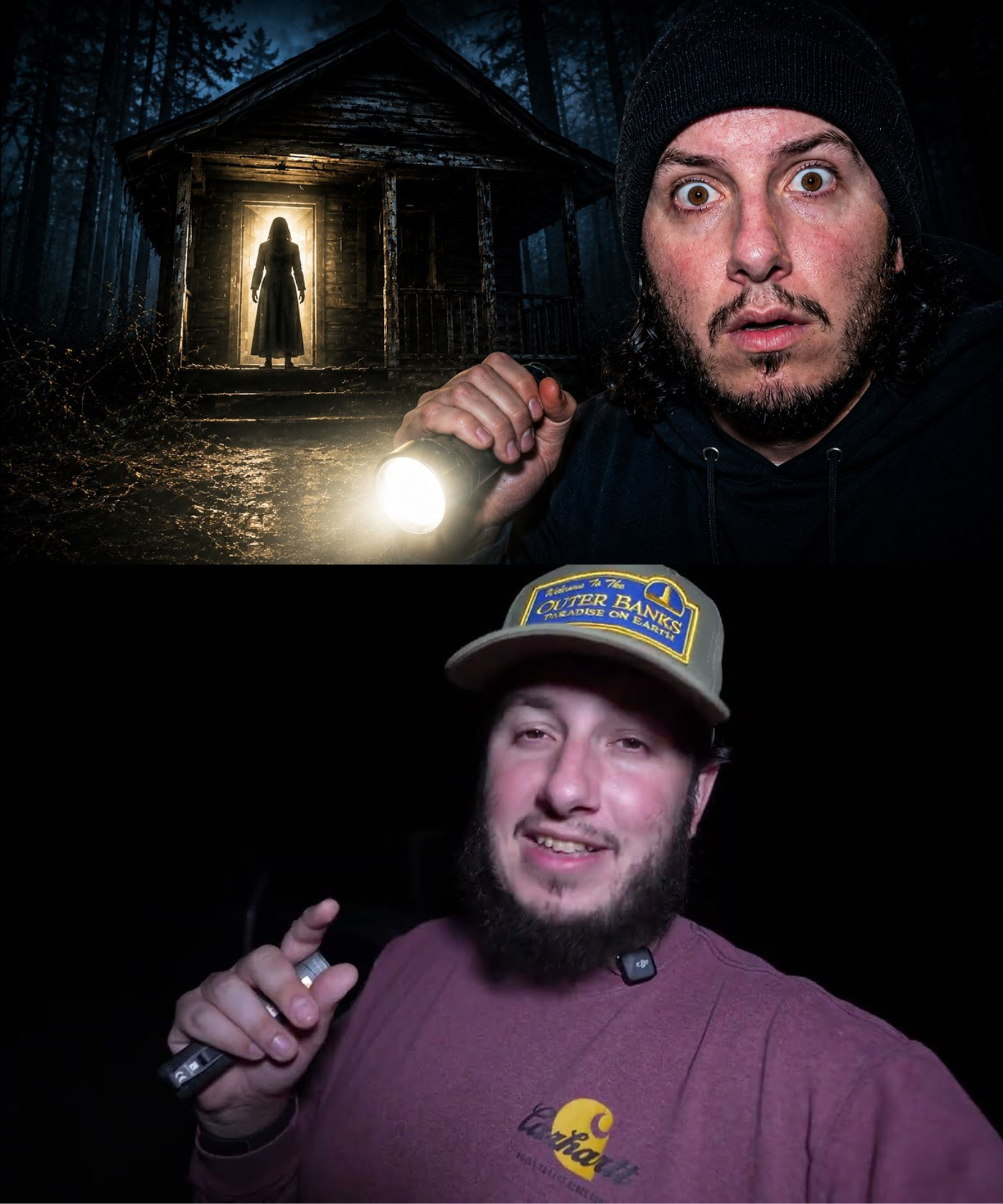
And standing beyond the threshold was a shape.
Not fully visible. Not clear enough to describe like a person. It was tall, thin, and darker than the forest behind it. The porch boards creaked beneath its weight, though I couldn’t see feet. Its head was tilted slightly, as if listening.
Caleb’s camera light caught the edge of it for half a second.
Something pale flashed where a face should have been.
Mara screamed.
The door slammed shut so hard the whole cabin shook.
The latch dropped back into place by itself.
Then the woman’s voice came again, not from the camera this time.
From the bedroom.
“I told you not to let him in.”
Nobody spoke.
Nobody breathed.
Then we heard footsteps.
Inside the cabin.
Slow steps across the bedroom floor.
But there was no one in there.
Caleb finally broke. He grabbed his flashlight and shouted, “Who’s there?”
No answer.
He moved toward the bedroom before any of us could stop him.
I followed because I didn’t want him going alone.
The bedroom was colder than the main room. Our flashlight beams moved over the bed, the cracked mirror, the old quilt. Nothing moved. Nobody stood there.
Then Joel, still near the fireplace, yelled, “Guys.”
We turned.
He was pointing at the round table.
The two dusty plates were no longer dusty.
They were clean.
Set neatly.
And between them sat a third object.
A muddy lantern.
Old. Rusted.
Still dripping water onto the table.
Caleb stopped filming.
For the first time all night, he looked truly afraid.
“That wasn’t there,” he whispered.
Nobody needed to answer. We all knew.
Mara backed toward the wall, shaking her head. “That’s his lantern.”
Then came another sound from outside.
Not knocking this time.
Dragging.
Something heavy being pulled across the porch.
Then a wet thump against the door.
Once.
Twice.
Three times.
The latch lifted again.
Joel grabbed it with both hands, forcing it down.
“Help me!”
I ran to him. Caleb joined. All three of us held the door shut while something on the other side pushed.
Not hard at first.
Almost gently.
Then harder.
The wood bent inward.
Mara was sobbing behind us, whispering prayers.
The woman’s voice filled the cabin again.
But now it sounded angry.
“You opened the way.”
The pressure stopped.
Silence.
Then the bedroom door, which had been open the whole time, slammed shut.
A second later, something scratched from inside the bedroom wall.
Not outside.
Inside.
Like it had moved through the cabin.
Like the front door had never been meant to keep it out.
Caleb whispered, “We have to go.”
Joel laughed once, a sharp broken sound. “Go where?”
Before anyone could answer, the fireplace went out.
Not slowly.
Not from lack of wood.
The flames just collapsed, leaving the room in darkness.
All our flashlights flickered at once.
Then the front door opened.
No latch this time.
No slow creak.
It burst open with such force that Joel and I fell backward.
Cold fog rolled across the floor.
On the porch stood the figure again.
Behind it, barely visible among the trees, were more shapes.
Several of them.
Tall.
Still.
Waiting.
And then, from the table, the lantern lit by itself.
A small yellow flame appeared inside the glass.
The figure at the door leaned forward.
For one terrible second, I saw its face.
It was not a monster’s face.
It was a man’s face.
Or what was left of one.
Gray skin. Hollow cheeks. Eyes sunk deep into black sockets. His mouth hung open as if he had been calling for help for years and no sound had ever come out.
Mara whispered, “Mr. Harlan.”
The thing turned its head toward her.
And smiled.
That was when we ran.
Not toward the trail. Not toward the road. We ran out the back window because the front door was no longer an exit. Caleb smashed the glass with a chair, cutting his hand badly, and we climbed through one by one into the freezing dark.
Branches tore at our clothes. Mud swallowed our shoes. We ran downhill with no sense of direction, guided only by panic and the pale strip of moonlight over the lake.
Behind us, the cabin door kept opening and slamming.
Again.
Again.
Again.
Like something was furious we had escaped.
We reached the logging road near dawn. A hunter found us walking barefoot and bleeding along the shoulder. He said we looked like we had crawled out of a grave.
When police went back to the cabin, the front door was closed.
The table was in place.
The plates were dusty.
There was no lantern.
No footprints on the porch.
No sign anyone had been there except us.
Caleb gave them the footage. At least, he tried.
The cameras had recorded everything until the moment the lantern appeared on the table.
After that, all three files turned black.
Only the audio remained.
For twenty-seven minutes, there was nothing but wind, static, and a woman crying.
Then, at the very end, a man’s voice whispered:
“Open the door, Elsie. I’m home.”
Mrs. Harlan’s first name was Elsie.
None of us knew that until later.
Caleb never posted the video. He stopped visiting abandoned places. Mara refused to speak about the cabin at all. Joel moved out of state within six months.
As for me, I tried to forget.
But sometimes, late at night, when the house is quiet and every room feels too still, I hear it.
Three soft knocks.
Not at the front door.
At my bedroom door.
And every time, I remember what the widow’s voice said.
Don’t let him in.