The Miracle of Corpus Christi That Changed Church History (The Proof Still Exists)
The Miracle of Corpus Christi That Changed Church History — The Proof Still Exists
Part 1
The proof arrived in New York City at 2:19 in the morning, sealed inside a narrow silver case that had crossed the Atlantic under diplomatic escort, then disappeared beneath Manhattan through the freight entrance of the American Museum of Sacred History. Outside, rain dragged itself down the glass towers like the city was trying to wash off its own exhaustion. Inside, beneath cold conservation lights, Dr. Miriam Cole watched two Vatican archivists place the case on a steel table and step back as if even touching it too long might be an act of arrogance. The label was plain, written in Latin, Italian, and English: Corporal fragment, Eucharistic miracle tradition, Orvieto-Bolsena dossier, restricted study copy and fiber sample set.
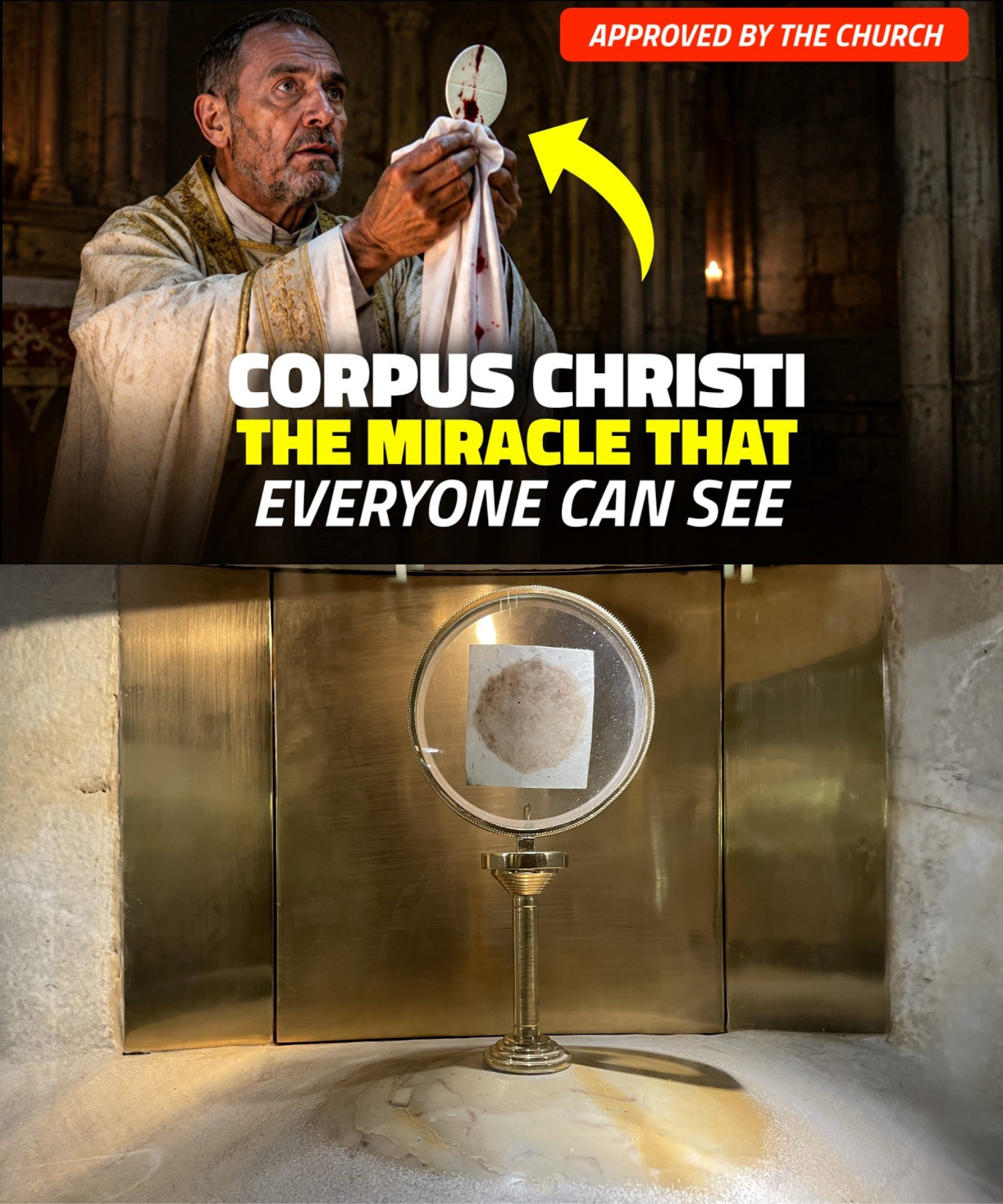
Miriam had spent twenty years studying miracles that became institutions and institutions that forgot the trembling that birthed them. She knew the story every Catholic history student learned: a priest struggling with belief, a Mass in the Italian town of Bolsena, blood appearing on the corporal, the linen carried to Orvieto, Pope Urban IV, the feast of Corpus Christi, and a Church forever changed by a miracle centered not on a throne, army, or empire, but on bread, blood, and the fragile faith of a priest at the altar. The proof, Catholics said, still existed. Not as an idea. Not as a metaphor. Linen. Stains. Memory. A cloth preserved because something happened that refused to remain private.
The New York project was supposed to be careful. A limited historical and scientific review, requested for a major American exhibition on Eucharistic devotion, would examine approved fibers, archival images, medieval witness records, and later conservation history. Nobody in the room was there to prove God under a microscope. Miriam had forbidden that phrase in every meeting. Faith was not a suspect forced into lab lighting. But neither was matter irrelevant. Christianity, at its scandalous center, claimed God entered flesh. A faith of incarnation could not pretend cloth, bread, wine, blood, body, touch, and memory were secondary.
Then the first scan appeared.
The stain pattern on the high-resolution image did not behave like later decoration. It followed fiber absorption, old folding lines, and irregular spread consistent with liquid entering linen under pressure and gravity. That did not prove a miracle. Miriam repeated that inwardly. It did not prove consecration, Real Presence, or divine intervention. But it did challenge the comfortable modern assumption that every medieval miracle story could be safely dismissed as theater, politics, or pious embroidery.
Beside her stood Dr. Caleb Ward from Ohio State University, a materials scientist who had been invited precisely because he annoyed believers and skeptics equally. He leaned toward the monitor and said, “The cloth has been handled, conserved, exposed, folded, revered, repaired, and interpreted for centuries. Anybody who says the science will be simple should be banned from microphones.”
A Vatican archivist nodded.
From Los Angeles, Naomi Reyes watched the feed remotely. She was a documentary filmmaker known for refusing to make sacred stories stupid. Her producer had already suggested titles like The Blood Cloth That Forced the Vatican to Create a Feast and The Eucharistic Proof They Cannot Explain. Naomi hated both.
Then Miriam read aloud from the medieval testimony file, her voice low in the cold lab.
“He doubted whether Christ was truly present. Then the Host bled upon the linen.”
No one spoke.
The room did not feel like a laboratory anymore.
It felt like a chapel where doubt had been caught still kneeling.
By sunrise, someone leaked a still image. By noon, the headline was everywhere:
The Miracle of Corpus Christi That Changed Church History — The Proof Still Exists.
And America, hungry for proof but allergic to reverence, rushed toward the cloth before it had learned how to kneel.
Part 2
Ohio held the first public argument because Ohio had Caleb, and Caleb had no patience for either easy faith or lazy disbelief. The exhibition team brought copies of the scans and archival materials to a Catholic university outside Cleveland, where clergy, scientists, students, skeptics, historians, and ordinary parishioners gathered in an auditorium that smelled faintly of coffee, old hymnals, and winter coats. Ruth Bell came too, because Ruth went wherever powerful people might mishandle holy things. She was eighty, Baptist by upbringing, Catholic by temperament when she wanted order, and universally feared by committee members who spoke too long.
Caleb began with the science. The linen was old. The stains were old. The conservation history was complicated. Biological claims required caution because centuries of handling, environmental exposure, and devotional practice could alter everything. Some tests could indicate blood-like chemistry, iron-bearing compounds, protein traces, and organic residues, but none could force a theological conclusion. “Science can tell us something about material history,” he said. “It cannot consecrate the conclusion.”
A young man stood immediately. “So does it prove the Eucharist?”
Caleb sighed. “No instrument proves the Eucharist. That is not because faith is weak. It is because the Eucharist is not a lab result.”
A woman in the front row raised her hand. “Then why study it?”
Miriam answered this time. “Because love studies what it touches. The Church preserved the cloth because matter mattered. Study can be reverent if it knows its limits.”
Then Father Gabriel Moreno from Queens stood and spoke as a priest. He was old, gentle, and blunt in a way that made people sit straighter. “The miracle of Bolsena did not invent the Real Presence,” he said. “The Church believed before the stain. But the miracle became a summons. It helped awaken devotion. It helped shape the feast of Corpus Christi. It reminded the Church that Christ does not give Himself as an idea. He gives Himself as food.”
Ruth leaned toward Naomi’s camera and whispered, “That one can preach.”
Naomi smiled.
The Ohio forum changed when a college student named Marcus asked the question nobody expected. “Why would Jesus do a miracle for a doubting priest? Shouldn’t priests already believe?”
The room softened.
Father Gabriel looked at him. “Perhaps that is why the miracle matters. Christ did not shame the priest’s doubt. He met it at the altar.”
That line moved through the auditorium like warmth.
Miriam added, “The history of Corpus Christi is not only triumph. It is vulnerability. A priest struggling to believe. A Church needing to remember. A people needing a feast because ordinary eyes forget what ordinary bread hides.”
Outside, winter rain began falling. Inside, the argument stopped being science versus faith and became more personal. Who had doubted? Who had approached Communion with a divided heart? Who had gone through ritual while hunger for Christ had gone cold? Who wanted proof because trust felt too dangerous?
That night, Naomi wrote a new title for her film:
The Feast Born From Doubt.
Jonah, her editor in Los Angeles, called it too quiet.
Naomi answered, “Good. The Host is quiet too.”
Part 3
Los Angeles tried to turn the miracle into a courtroom. A streaming company released a trailer before Naomi had finished filming the Ohio forum. It showed dark church vaults, red-stained linen, medieval priests, dramatic whispers, and the line: Science finally confronts the blood that created Corpus Christi. Naomi watched it in her studio and stopped the video halfway through.
“They made the Eucharist look like evidence in a murder documentary,” Jonah said.
“They made reverence into suspense,” Naomi replied.
The trailer claimed the cloth “changed church history overnight,” which was almost true and therefore dangerous. The feast of Corpus Christi had deeper roots: visions, theology, Eucharistic devotion, St. Juliana’s longing for a feast honoring the Body of Christ, papal decisions, liturgical development, and the miracle tradition that intensified everything. History rarely comes from one moment alone. The miracle mattered, but the Church did not become Eucharistic because of a stain. The stain revealed what the Church already confessed and often forgot.
Naomi went to Los Angeles parishes to see what Americans did with Corpus Christi now. In one wealthy church, the procession moved under embroidered canopy, incense, brass, white veils, and polished marble. It was beautiful, but Naomi noticed the homeless man outside the gate watching the monstrance pass from a distance. In East L.A., a bilingual parish processed through cracked sidewalks, past taco trucks, murals, apartment balconies, and women making the Sign of the Cross from laundromat doors. Children threw flower petals badly. An old man cried when the priest lifted the monstrance toward a street corner where his son had been shot years earlier.
Naomi filmed both.
Then she interviewed Angela Brooks, a Catholic outreach worker under the 101 freeway. Angela watched footage of the medieval corporal scans and then looked at the encampment behind her.
“If Catholics believe that bread becomes the Body of Christ,” Angela said, “then they should be the last people on earth to ignore bodies.”
That became Part Three’s center.
The film shifted. It would not only investigate whether the proof still existed. It would ask whether the proof still accused the Church. Corpus Christi had changed church history by drawing attention to the Eucharist, but Eucharistic devotion without love of the wounded body could become ceremony without conversion. The miracle of blood on linen asked a terrible question: what do Christians do when Christ’s Body appears where they cannot control the setting?
In New York, Miriam found a medieval sermon connected to the feast. It spoke of Christ carried through streets so that “the city may know the one hidden on the altar is Lord also of alleys, markets, wounds, and poor houses.” She sent it to Naomi with a note: The procession was never meant to stay ornamental.
Naomi read it twice.
Then she cut from the stained linen to Los Angeles feet walking through gutter water behind the monstrance.
Proof still existed.
But proof, if received rightly, did not end at the glass case.
It moved into the street.
Part 4
New York hosted the exhibition opening under heavy tension. The museum had arranged the gallery carefully: medieval documents, maps of Bolsena and Orvieto, images of the corporal, explanations of Eucharistic theology, accounts of St. Juliana, Pope Urban IV, Thomas Aquinas’s hymns, processions, controversy, devotion, and modern questions of science and faith. Miriam insisted on one design choice that annoyed donors. The cloth images would not be displayed first. Visitors would first enter a small room with one sentence on the wall:
He doubted at the altar, and Christ met him there.
Some donors wanted blood first. Miriam wanted mercy first.
The line changed the whole exhibit.
People entered expecting mystery and found themselves implicated. A priest stood before the sentence for ten minutes. A young woman cried. A man whispered to his wife that he had not received Communion in years because he felt unworthy. A teenager asked if priests were allowed to doubt. Father Gabriel, standing nearby, answered, “Priests are men. The question is whether doubt becomes hiding or prayer.”
The high-resolution image of the corporal came later, displayed without sensational lighting. No red glow. No thunder audio. No dramatic reenactment. Just linen, stains, magnified fibers, history, and the silence of something preserved because generations believed it mattered.
Caleb’s scientific commentary was printed beside it: Material analysis may illuminate age, composition, stain behavior, and conservation history. It cannot adjudicate Eucharistic doctrine. The object must be approached neither as a laboratory trick nor as an excuse to avoid inquiry.
Ruth read the label and said, “Almost human. Good work.”
The exhibition’s final room was the most controversial. Miriam called it The Body Outside the Case. It showed Corpus Christi processions in American cities: New York, Chicago, Los Angeles, Cleveland, immigrant neighborhoods, prison chapels, hospital corridors, nursing homes, rural roads. It also showed food pantries, shelters, hospice care, migrant legal clinics, and volunteers washing feet. The point was not to reduce Eucharistic devotion to charity. The point was to refuse their separation.
A bishop from the Midwest viewed the room and said it felt “politically charged.”
Ruth, who had no fear of bishops, said, “Bodies are always political when somebody would rather not feed them.”
The bishop looked at Miriam for help.
Miriam did not rescue him.
Then came the private moment Naomi almost missed. A young priest from Ohio entered the first room, read the sentence about doubt, and sat down. His name was Father Daniel Mercer. He had been quietly considering leaving the priesthood because he no longer felt anything at Mass. He told Naomi later that the miracle had frightened him as a seminarian because he thought holiness meant certainty. Now, standing before the story of a priest whose doubt became the doorway for a feast, he felt not accused, but found.
“I thought Christ would be angry with me,” he said.
Naomi asked, “And now?”
Daniel looked toward the image of the linen.
“Now I think He may have been waiting on the altar the whole time.”
That became the heart of Part Four.
Part 5
Ohio became the place where the miracle stopped being historical and became pastoral. Father Daniel returned to Mercy Ridge after the New York exhibition, carrying a copy of the corporal image and a burden he could no longer hide. His parish was small, tired, and divided in ordinary American ways: old Catholics angry about changes, young Catholics angry about irreverence, converts hungry for beauty, cradle Catholics running on habit, families exhausted by bills, teenagers bored by everything, and elderly women who kept the parish alive while men debated what counted as tradition.
On the feast of Corpus Christi, Daniel planned a procession through town. Ruth planned the practical parts because priests who enjoy incense cannot always be trusted with traffic cones. The route passed the church, the food pantry, the nursing home, the closed factory, the opioid recovery center, the county jail, and the river where floodwater had nearly taken several homes. Daniel wanted a beautiful procession. Ruth wanted one that did not ignore where the Body of Christ was already suffering.
The morning of the feast, rain threatened. Daniel nearly moved everything inside. Ruth said, “If Christ can handle the cross, He can handle drizzle.” The procession went forward.
At first, it was awkward. The canopy leaned. The children dropped petals in clumps. The choir could not agree on tempo. A man livestreamed until Ruth told him to carry water bottles or leave. But as the procession moved past the recovery center, men stepped outside and knelt, some because they believed, some because they remembered, some because grief pulled them down before doctrine could catch up. At the nursing home, an old woman reached for the monstrance and whispered, “Don’t forget me.” Daniel almost broke.
Then they reached the county jail.
The sheriff had allowed the procession to pause outside but not enter. Daniel lifted the monstrance toward the barred windows. No one expected anything. Then men inside began singing. Not loudly. Not well. A hymn many had learned as children, some in Catholic homes, some in Protestant churches, some in places where grandmothers sang while cooking. The sound came through concrete and glass, thin but unmistakable.
Father Daniel stood in the rain holding the Eucharist, and for the first time in years, he wept at Mass without fear.
Afterward, he told Naomi, “I thought the miracle of Corpus Christi was that blood appeared on cloth. Today I understood another part. The Host makes hidden hunger visible.”
In Mercy Ridge, the procession became an annual practice. Not a performance. A route of remembrance. Every stop asked a question. Who is hungry? Who is imprisoned? Who is sick? Who is forgotten? Who is doubting? Who is Christ asking us to see?
The parish changed slowly. Eucharistic adoration increased, but so did pantry volunteers. Confession lines grew, but so did recovery support. People stopped treating reverence and mercy as rival factions. Ruth called it “finally having both knees and hands.”
Part Five of Naomi’s film became The Procession Through Wounds.
She cut the medieval corporal beside the Ohio monstrance in rain.
The proof still existed.
But in Ohio, the proof had started walking.
Part 6
Los Angeles received the film before the final cut and argued with it immediately. Some Catholic influencers wanted more science. Some wanted more Eucharistic theology. Some wanted less emphasis on poverty, fearing it made the miracle feel like a social-justice documentary. Some skeptics said the film remained too reverent. Some believers said it was not reverent enough. Naomi took that as a sign she was near the truth.
The Los Angeles chapter followed a different Corpus Christi procession—one that began inside a cathedral and ended under a freeway. The archbishop carried the monstrance through downtown streets while cars honked, people filmed, tourists stared, and homeless residents watched from tents. Angela Brooks had worked for months to make the route include not only symbolic public witness but actual preparation: medical tents, food distribution, confession, prayer, legal aid, water stations, and follow-up care. “Do not process past people like they are scenery,” she said. “Either Christ is passing by them, or Christ is being carried to meet Himself.”
That sentence nearly made the final title.
During the procession, a young man named Peter shouted at the priest from the sidewalk. He was drunk, angry, sunburned, and convinced the Church only showed up for cameras. Security moved toward him, but Angela stopped them. She walked over, listened, and learned his mother had died in a Catholic hospital during the pandemic. He had not been allowed to say goodbye. He hated the Church because the Church was the last institution whose name he remembered from that day.
The procession paused.
Not officially. Not liturgically. Humanly.
The priest carrying the monstrance turned toward Peter. No argument. No defense. Just silence before the Host. Peter stopped shouting. His face collapsed. He sat on the curb and cried into both hands.
Naomi did not film his face.
She filmed the monstrance reflected in a puddle near his shoes.
Later, Peter entered recovery through Angela’s outreach network. He did not become Catholic overnight. He did not become a perfect testimony. But months later, he told Naomi, “The day they stopped for me, I thought maybe God was not in a hurry to get past me.”
That became Part Six’s ending.
The film’s thesis sharpened: the miracle that changed church history was not only a miraculous sign preserved in Orvieto. It was the ongoing claim that Christ’s Body is given for the life of the world. The proof still exists in linen, yes. But if Catholics believe what they say they believe, proof must also exist in how they handle bodies in the street, at the border, in the hospital, in prison, in the womb, at the end of life, in poverty, in doubt, and at the altar.
The Eucharist did not need America’s defense.
America needed Eucharistic conversion.
Part 7
The documentary premiered in New York on the eve of Corpus Christi. The museum auditorium was full of Catholics, skeptics, priests, nuns, historians, scientists, seminarians, journalists, doubters, and people who had come because the trailer promised “proof.” Naomi worried about that word. She had not chosen it. The public had. Her film would challenge it.
The title appeared on screen:
The Feast Born From Doubt.
It opened with the New York case arriving before dawn, then moved backward through the medieval story: the doubting priest, the Mass, the stained corporal, Orvieto, papal action, the feast, hymns, devotion, doubt, and the long history of Catholics carrying the Eucharist into public streets. Then it moved forward: Ohio’s rain procession, Los Angeles under the freeway, New York’s exhibition, science’s limits, faith’s hunger, and the question of whether proof can exist without possession.
The film did not declare what science could not declare. It did not say a microscope proved transubstantiation. It did not reduce the miracle to chemistry. It let the historical tradition stand with reverence and caution. Then it asked viewers whether they wanted proof because they desired Christ or because they feared trust.
After the screening, nobody spoke for a moment.
Then Father Daniel stood. “I almost left the priesthood,” he said, voice shaking. “Not because I stopped believing every doctrine. Because I stopped believing Christ wanted me near His altar. This story did not answer every doubt. It showed me He had met doubt before.”
A young woman asked Miriam whether the miracle was real.
Miriam answered carefully. “The Church has received it as a Eucharistic miracle. The cloth and tradition are historically powerful. The science can study matter, not command faith. But the deeper question is what kind of reality the miracle opens. If it leads us to adore Christ more deeply and love His Body more faithfully, then it is bearing the fruit miracles are meant to bear.”
Ruth took the microphone next. “Translation: stop trying to win arguments with bloodstains and go feed somebody after adoration.”
The room laughed, then applauded.
The film spread through parishes, seminaries, Catholic schools, Eucharistic congresses, prison ministries, hospital chaplaincies, and skeptical circles. Some criticized Naomi for not being triumphalist enough. Others criticized her for being too Catholic in tone. She accepted both. The point was not to make the Eucharist usable to everyone. The point was to show how a miracle, if approached rightly, refuses to be used.
On the feast of Corpus Christi that year, processions across America changed subtly. Not everywhere. Not perfectly. But in many places, routes widened. They passed shelters, jails, hospitals, nursing homes, immigrant neighborhoods, recovery centers, and places where the Body of Christ had long been waiting under ignored forms.
The proof still existed.
And the proof was walking.
Part 8
Years later, people still used the headline: The Miracle of Corpus Christi That Changed Church History — The Proof Still Exists. It remained true, but incomplete. The proof did still exist, preserved in cloth, devotion, memory, and the solemn witness of a Church that had carried the story for centuries. The miracle of Bolsena and the corporal of Orvieto remained a sign that had shaped Eucharistic devotion and helped deepen the feast that honored the Body of Christ. But those who had watched Naomi’s film understood that proof is a dangerous word when it stops at display.
New York kept the exhibition open longer than expected. The room with the sentence about doubt became the most visited part. Priests sat there. Teenagers sat there. Converts. Fallen-away Catholics. Skeptics. People who wanted to believe and people afraid they already had. The museum eventually placed a guest book outside. One entry read: I came to see blood. I found mercy for doubt.
Ohio kept the procession through wounds. Mercy Ridge became known not for perfect liturgy, but for refusing to separate adoration from service. Father Daniel stayed in the priesthood. His Masses became quieter, not more theatrical. He told seminarians, “Do not fear doubt that brings you to the altar. Fear certainty that makes you cold.”
Los Angeles kept the freeway procession. Angela’s outreach grew. Peter entered the Church five years later, not because a procession argued him into belief, but because, as he said, “The Host stopped for me before I knew how to stop running.” Ruth, very old by then, said that was one of the few conversion lines that did not make her roll her eyes.
Naomi’s documentary became a quiet classic in Catholic circles and beyond. It was shown during Eucharistic Revival events, theology courses, Catholic worker houses, prison retreats, and hospital chaplain trainings. Its most famous line came not from a bishop or scholar, but from Angela: “If Catholics believe the Body is on the altar, they should recognize Him when He is on the sidewalk.”
On the tenth anniversary of the New York exhibition, Miriam, Caleb, Naomi, Father Gabriel, Father Daniel, Angela, Peter, and Ruth gathered in Mercy Ridge for Corpus Christi. Ruth was in a wheelchair now, wrapped in a blanket despite warm weather. The procession moved slowly through town. Children dropped flowers badly, as children always do. The canopy tilted. The choir was slightly sharp. Rain threatened but did not fall.
At the jail, men sang again.
At the nursing home, an old woman reached out.
At the recovery center, Peter knelt.
At the pantry, Ruth lifted one trembling hand as the monstrance passed.
Naomi stood behind the camera and cried quietly.
The proof still existed in Orvieto, in linen and stain, preserved for the Church. But here, in an Ohio town under a gray American sky, the proof existed in another way too: in bread adored, bodies served, doubt met, wounds not avoided, and Christ carried into streets where people had forgotten He wanted to go.
The miracle had changed church history.
But perhaps the greater question, still open in every generation, was whether it would change the Church again.