My Dad Was a Fire Lookout Above Harrison Lake—At The End He Spoke Of Sasquatch That Came Each Summer
My Dad Was a Fire Lookout Above Harrison Lake—At The End He Spoke Of Sasquatch That Came Each Summer
My father did not believe in monsters until the summer they started coming back.
For most of my life, I thought the fire lookout made him lonely. That was the explanation my mother gave whenever I asked why Dad came home from the mountain quieter each September than he had been in June. She would say the isolation got into his bones, that a man could only spend so many nights above Harrison Lake listening to wind and radio static before he started hearing things that were not there. I believed her because I was young, and because the alternative was too frightening to carry.
The tower stood high above the eastern side of Harrison Lake, buried in a stretch of British Columbia wilderness where the slopes rose steep and dark from the water. From up there, Dad could see miles of forest folding into itself, green ridges turning blue in the distance, the lake shining like steel when the weather changed. His job was simple in the way dangerous jobs often sound simple: watch for smoke, report fires, track storms, keep the radio working, and stay alive until relief came.
He loved it at first.
In old photographs, he looked like another man. Younger, leaner, grinning in a faded canvas jacket, one boot on the tower steps, his hair pushed sideways by mountain wind. He used to tell me the lookout was the closest a person could get to flying without leaving the earth. He said mornings there felt holy. Fog would lift off the lake in long white sheets, eagles would circle below the tower, and the first sunlight would strike the snowfields far away before reaching the trees below him. To hear him speak of it then, the mountain was not a lonely place. It was a kingdom.
But by the time I was twelve, he no longer talked that way.
The summer shifts grew harder on him. He still packed carefully, still sharpened his pencils, still checked the batteries, still folded his maps with the same patient hands. But each year, before he left, I saw him watching the tree line behind our house as if the forest had followed him home. And each year, when he returned, he seemed to bring part of that forest back inside him.
He became sensitive to sounds. A branch breaking outside the kitchen window would make him stop mid-sentence. He hated knocking noises. If someone tapped twice on a table, his jaw tightened. He slept badly in August, even when he was home. Sometimes I would pass his bedroom late at night and find him sitting on the edge of the bed, fully awake, staring at the dark glass of the window.
When I asked what was wrong, he always gave the same answer.
“Just listening.”
I did not understand then that listening can become a kind of fear.
After he died, I found his final lookout journal in a locked metal box under his workbench. The box smelled like oil, dust, and old paper. Inside were field notebooks, folded maps, weather reports, Polaroids, cassette tapes, and a bundle of letters he had written but never sent. Most of them were addressed to me.
The first few notebooks were ordinary. Wind direction. Cloud movement. Smoke sightings. Lightning strikes. Supply lists. Animal notes. A black bear near the lower trail. Deer moving early. Owls calling before midnight. Normal things. Practical things. The writing was neat and steady, the handwriting of a man who trusted what he saw.
Then, in the journal from 1987, the tone changed.
July 18. Heard wood knocks below west ridge. Three strikes. Pause. Two strikes. No hikers reported. No logging crews in area. Sound carried up from timberline after dusk.
July 19. Same knocks again. Closer. Answered by one from north slope. Not echo.
July 21. Found stones on lower steps this morning. Three of them. Placed, not fallen. No tracks on steps. Bear unlikely.
I remember reading those entries and feeling the air in the garage grow colder, even though it was July and the door was open behind me. My father had never mentioned stones. He had never mentioned knocks. He had never said anything about the tower except practical details and weather. Yet here, in his own handwriting, was the beginning of a story he had carried alone for decades.
The next notebook made it worse.
By 1989, the events had become seasonal. They began in late June or early July and continued until the first cold rains of September. Dad did not call them Sasquatch at first. He called them “visitors.” Then “the ridge movement.” Then “unknown primates,” though he underlined the word unknown twice. Only years later did he begin using the name people whispered around campfires and tourist shops near the lake.
Sasquatch.
He did not use it dramatically. He did not write like a man trying to convince anyone. That made the journals more disturbing, not less. His notes were careful, restrained, almost scientific.
August 3, 1991. Saw large upright figure cross burn scar below lookout at 05:42. Estimated height over seven feet based on stump reference. Dark brown or black. Moved downhill fast without stumbling. No pack. No clothing. Arms long.
August 5. Strong odor near supply shed. Wet animal, spoiled meat, cedar rot. Dog refused to leave helicopter pad during resupply. Pilot joked about bear. Not bear.
August 9. Vocalization from south basin after sunset. Deep, rising call. Followed by shorter reply from west ridge. Hair on arms stood up before sound finished.
My father had worked alone in that tower for twenty-two summers.
According to the journals, he had not been alone for most of them.
The first clear photograph was tucked between two pages in a yellow envelope marked DO NOT SHOW YOUR MOTHER. It showed the tower from below, taken from the trail facing upward. In the background, beyond the support beams, something stood between two fir trees. The image was grainy, and the figure was partly hidden, but its size was immediately wrong. It was too tall, too broad, too dark against the trees. One arm hung low beside its body. The head seemed set forward on massive shoulders.
On the back, Dad had written: July 29, 1994. Came to edge of clearing. Watched me gather water. Did not retreat until I spoke.
I turned the photo over and over, trying to make it into something else.
A stump.
A shadow.
A man in a coat.
But every explanation felt forced.
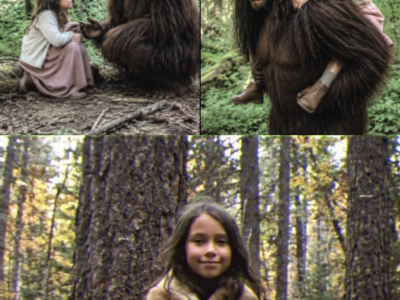
There were more photographs. Not many, but enough. Footprints in mud beside a creek. A broken sapling twisted at a height no bear could comfortably reach. A line of stones placed across the trail. A dark shape standing on a ridge in morning fog. Long hair caught in the rough bark of a cedar. A handprint in dust on the tower window, huge and smeared, with fingers spread wider than any human hand I had ever seen.
That photograph nearly made me close the box.
The print was on the outside of the glass.
At that height, nothing should have been able to reach it.
I found myself thinking of all the summers Dad had come home and stood silently in our kitchen while Mom fussed over him, telling him he looked too thin, asking if he had eaten enough, asking why his hands were shaking. He would always smile and say the same thing.
“Just tired.”
Now I wondered how many times he had nearly told us the truth.
The letters explained why he never did.
The first was dated August 14, 1998. It began with my name.
Evan,
If I ever tell you this out loud, you will think the mountain ruined me. Maybe it has. Maybe that is the easiest version. But I need this written somewhere, because if something happens to me up here, I do not want people saying I went crazy from isolation.
There is a group of them.
Not one.
A group.
They come every summer when the berries ripen and the lake warms. They stay high during the day, mostly in the timber and above the creek basins, but at night they move near the tower. I do not think they are hunting me. I think they are watching me because I am in their place.
The letter went on for six pages.
Dad wrote that he believed there were at least four of them. One large male he called “the old one,” a smaller adult, and two younger ones that appeared irregularly over the years. He described their behavior with a kind of reluctant respect. They avoided direct contact at first. They moved silently when they wanted to, but sometimes made noise deliberately. They knocked on trees. They threw small stones near the tower but never at him. They left objects on the steps: bones, stones, once a dead grouse. He interpreted these not as gifts exactly, but as signals.
He believed they knew when he arrived each summer.
He believed they knew when he left.
And he believed they remembered him.
That last idea was the one that seemed to break something in him.
In later journals, his tone shifted from fear to a strange, uneasy familiarity. He began writing about them the way someone might write about difficult neighbors. He noted when they were active, when they stayed away, when they seemed agitated. During wildfire seasons, they moved differently. During drought years, they came closer to the tower. When helicopters flew low, they vanished for days.
Then, in 2006, he wrote the sentence that made me sit down on the garage floor.
The old one stood at the clearing this morning. Gray around face now. Same as me.
I read that line again and again.
Same as me.
My father had aged with whatever came to that mountain each summer.
The journals after that became more personal. He no longer pretended he was only observing. He admitted he spoke to them sometimes, not in the hope of conversation, but because silence felt disrespectful. He would stand on the tower steps at dusk and say ordinary things into the trees.
“Storm coming.”
“Fire crews below the ridge tomorrow.”
“Leaving in three days.”
The strange part was that after he began speaking aloud, the stones stopped hitting the roof. The night knocks moved farther away. The odor near the shed became less frequent. He believed, rightly or wrongly, that the boundary between them had stabilized.
Respect, he wrote in 2011. Not friendship. Never that. Respect is safer.
But the final journal was different.
It covered the summer of 2017, his last season above Harrison Lake. He was sixty-eight then, though he had lied to the department doctor about how strong he still felt. By that time, his handwriting had grown uneven. Some entries wandered. Others were sharp and clear. The first strange note appeared on July 2.
They came early.
July 5. Old one at west ridge before sunset. Watched tower for long time. Did not knock. Did not move. Looks thinner.
July 10. Dreamed of breathing outside window. Woke and heard it for real.
July 12. Found three stones on steps. Same pattern as first year. Circle, line, circle. Why repeat now?
By late July, the entries grew darker. Dad believed the old male was dying. He wrote that it moved slowly, favoring one side, appearing alone more often. The younger ones stayed farther back, hidden among trees. The knocks became irregular. Sometimes there was only one heavy strike, then silence.
On August 1, Dad wrote:
He came close enough today for me to see his eyes.
No more details.
Just that sentence.
The cassette tapes were at the bottom of the box. I bought an old player online because I could not make myself throw them away, and because by then I needed to hear whatever he had heard. Most of the recordings were weather notes and radio chatter. Some captured wind slamming against the tower. Some were empty except for insects, creaking wood, distant birds, and the soft hiss of analog tape.
Then I played the tape labeled August 9, 2017.
For the first two minutes, there was only nighttime forest. Then my father’s voice, low and tired.
“It’s below the tower again. I can hear it near the steps.”
A long silence followed.
Then came a sound I have never forgotten.
Breathing.
Not close to the microphone, but close enough. Deep, slow, enormous. The kind of sound that makes the human body understand size before the mind can argue. I heard wood creak. My father whispered something I could not make out. Then there was a low vocalization, not a growl, not a roar, but a heavy rumbling note that seemed to vibrate through the tape itself.
Dad spoke again.
“I know,” he said softly. “I know you’re tired.”
That broke me.
Not because it was frightening, though it was. Not because it proved anything, though maybe it did. It broke me because I heard compassion in his voice. My father, alone in a tower in the dark, speaking gently to something the world would have mocked him for believing in.
The final tape was dated September 3, 2017.
It began with rain.
For several minutes, there was nothing else. Rain ticking against glass. Wind moving around the tower. A chair creaking. Then my father coughed and began speaking, not to the recorder, but to whatever was outside.
“I won’t be back next summer.”
Silence.
“I don’t think I can make the climb again.”
Another silence.
Then, from somewhere beyond the tower, a single knock sounded through the rain.
Dad laughed once. It was not a happy laugh. It was the sound of a man trying not to cry.
“I know,” he said. “I’m sorry.”
A second knock came, softer.
Then my father said the words my mother told me he whispered in the hospital two weeks before he died.
“They come each summer.”
At the time, we thought he was confused. The medication was strong. His fever rose and fell. He kept asking whether the tower windows were locked. He told my mother not to answer if something knocked after dark. She cried quietly and told the nurses he had worked alone too long. I believed that, because it was easier than believing he was saying goodbye to something real.
Now I am not sure.
The last thing on the tape was not my father’s voice.
It was a sound from outside the tower, rising through the rain. Long, mournful, almost human in its sadness, but too deep to belong to any person. It lasted nearly fifteen seconds. When it ended, the tape continued recording rain until it clicked off.
I have listened to it only twice.
Once alone.
Once with my wife, who asked me to turn it off before it finished.
The cabin, the tower, the lake, the ridge — all of it still exists. The old lookout has been decommissioned now, locked and weathering above the timber. I know because I went there the summer after I found the journals. I told myself I needed closure. That is what people say when they are about to do something foolish for emotional reasons.
The hike was harder than I expected. The trail had grown over in places, and the air smelled of cedar, dust, and distant water. Harrison Lake shone far below, cold and bright between the mountains. By the time I reached the tower clearing, clouds had begun sliding over the ridge.
The structure looked smaller than it had in my imagination.
Older too.
The steps were gray and splintered. The windows were dusty. The door was locked with a rusted chain. I stood there for a long time with my father’s final journal in my backpack and the strange feeling that I had arrived at the edge of someone else’s secret.
I found three stones on the lower step.
Circle.
Line.
Circle.
They were smooth lake stones, dark with moisture, though there had been no rain that day.
I did not touch them.
Instead, I sat on a stump at the edge of the clearing and looked into the trees. For nearly an hour, nothing happened. The forest made ordinary sounds: wind, insects, distant birds, branches shifting. I almost felt embarrassed. Grief had brought me there, not evidence. I had taken a dead man’s journals and turned them into a haunting because I needed my father’s silence to mean something.
Then the smell came.
Wet fur.
Cedar rot.
Something sour beneath it.
My hands went cold.
From the timber below the west ridge came a single heavy knock.
I stood up slowly.
Another knock answered from farther north.
I did not call out. I did not knock back. I did not take out my phone. The thought of filming felt suddenly obscene, like raising a camera at a funeral. I only stood there, heart pounding, while the forest held its breath around me.
For a moment, between two cedars, I saw movement.
Not a clear figure. Not proof for the world. Just a tall darkness shifting where no shadow should have moved, then disappearing behind the trees.
I left before sunset.
On the hike down, I understood my father better than I ever had while he was alive. I understood why he kept the secret. Not because he was ashamed. Not because he was mad. But because some truths become smaller when dragged in front of people who are determined to laugh. He had lived with something enormous, and he had chosen respect over spectacle.
I still have the journals.
I still have the photographs.
I still have the tapes.
People ask why I do not release them. The answer changes depending on the day. Sometimes I tell myself I am protecting my father’s memory. Sometimes I tell myself the evidence would never be enough anyway. Sometimes I think of the old one on the ridge, gray around the face, aging summer by summer alongside my dad. Sometimes I think of those three stones waiting on the step after the tower had been abandoned.
But mostly, I think of the final line in my father’s last unsent letter.
If you ever go up there, Evan, do not go as a hunter, and do not go as a believer. Go as a guest.
That is what he learned above Harrison Lake.
The forest was not empty.
The summer visitors were not a story.
And the man I thought had been broken by loneliness may have spent the last years of his life keeping a quiet agreement with something older than fear.
I do not know whether they still come each summer.
But every June, when the weather turns warm and the mountains begin to darken with evening storms, I find myself listening for knocks.
Not because I want proof.
Because somewhere high above Harrison Lake, in the shadow of an old fire lookout, my father may still be remembered.