Voyager Found a Wall Where the Solar System Ends — And It Shouldn’t Be There
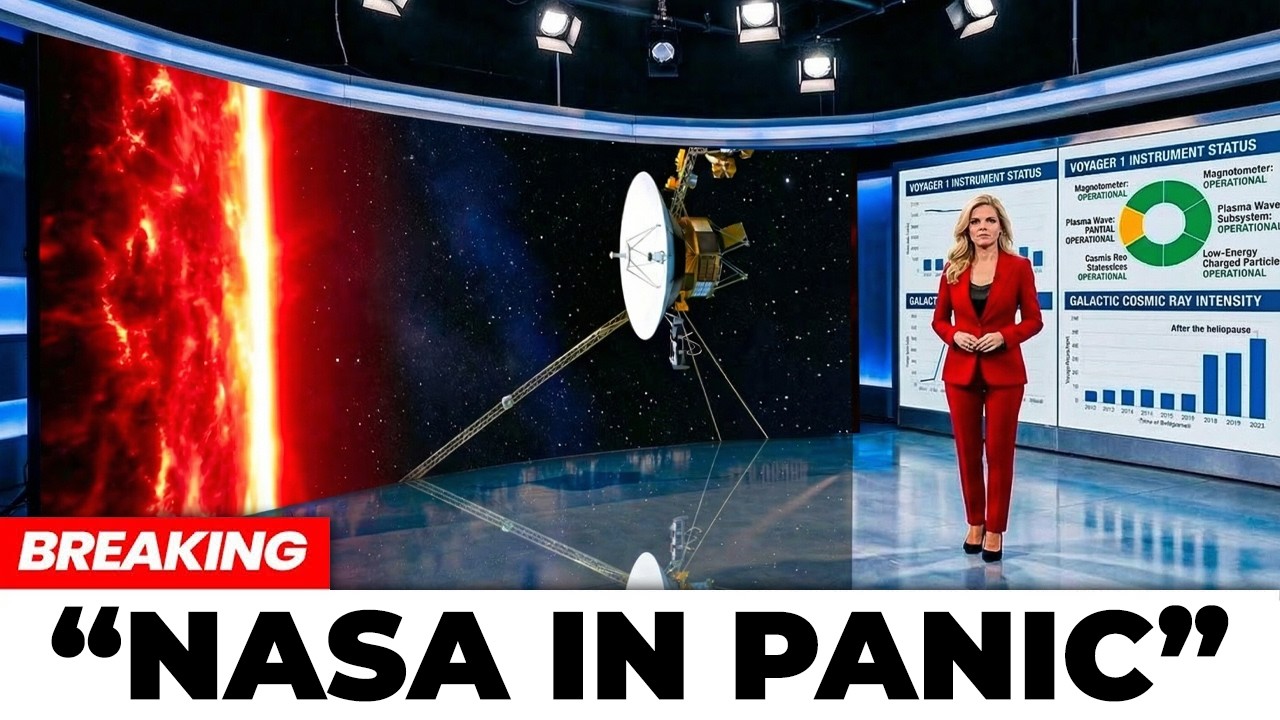
Voyager 1’s Impossible Discovery at the Edge of the Solar System
In the darkness beyond every planet, beyond every known destination humanity has ever reached, a lone spacecraft is still speaking to Earth.
More than 15 billion miles away, Voyager 1 continues sending signals across a distance so vast that each message takes nearly two days to complete a round trip. For almost half a century, it has traveled farther than any human-made object in history. Then something strange happened. The spacecraft began transmitting data that didn’t make sense. Instruments were reporting conditions no scientist expected. Signals appeared corrupted. Measurements contradicted decades of theories about what existed beyond the edge of the solar system.
What researchers eventually uncovered wasn’t merely a technical problem. It was evidence that the frontier between our Sun and the galaxy is far stranger, more violent, and more complex than anyone imagined.
And it all started with a spacecraft that refused to die.
A Machine Built for Four Years
When Voyager 1 launched on September 5, 1977, nobody expected it to become one of humanity’s greatest scientific achievements.
The mission was originally designed to study Jupiter and Saturn. Engineers gave the spacecraft an expected operational life of about four years. Its primary objective was simple: fly past the giant planets, collect data, and send it home.
Instead, Voyager 1 continued operating decade after decade.
It photographed volcanic eruptions on Jupiter’s moon Io. It revealed intricate details of Saturn’s rings. It captured the famous “Pale Blue Dot” image that showed Earth as a tiny speck suspended in a sunbeam. Then, after completing its planetary mission, it kept going.
Far beyond the orbit of Pluto, Voyager entered territory no spacecraft had ever explored.
What it discovered would change our understanding of the solar system forever.
The Invisible Bubble Around the Sun
To understand Voyager’s discoveries, we first need to understand the enormous structure surrounding our solar system.
The Sun is not simply a giant glowing sphere sitting quietly in space. It constantly releases a stream of charged particles known as the solar wind. These particles race outward at speeds exceeding one million miles per hour, carrying the Sun’s magnetic field with them.
The solar wind expands in every direction.
It sweeps past Mercury.
Past Earth.
Past Jupiter.
Past Neptune.
And far beyond the outermost planets.
This creates a vast bubble around the solar system known as the heliosphere.
Every planet, moon, asteroid, and comet orbiting the Sun exists inside this enormous protective cocoon. The heliosphere acts like a shield, helping block many of the dangerous cosmic rays that travel through interstellar space.
For decades, scientists believed they understood how this bubble ended.
According to theoretical models, the solar wind would gradually weaken as it traveled farther from the Sun. Eventually, its outward pressure would become equal to the inward pressure of the interstellar medium—the thin gas and dust that fill the space between stars.
At that point, the Sun’s influence would simply fade away.
The boundary separating these two regions was called the heliopause.
Most researchers expected it to be relatively smooth and predictable.
They were wrong.
Reaching the Edge
By 2012, Voyager 1 had traveled farther than any spacecraft in history.
Scientists eagerly watched its instruments as it approached the heliopause. The expectation was straightforward: solar particles would gradually decrease, galactic cosmic rays would slowly increase, and the magnetic field would rotate to match the larger magnetic environment of the Milky Way.
Instead, the transition happened with shocking speed.
On August 25, 2012, Voyager crossed the heliopause.
Within days, solar wind particles plummeted.
At the same time, galactic cosmic rays surged dramatically.
The change was so abrupt that some engineers initially suspected equipment failure. Nature simply wasn’t supposed to behave that way.
Yet repeated measurements confirmed the result.
Voyager had crossed a boundary unlike anything scientists anticipated.
Rather than a gentle transition, the spacecraft encountered something that resembled a cosmic cliff.
The edge of the Sun’s influence appeared far sharper than decades of models had predicted.
But the biggest surprise was still to come.
The Magnetic Mystery
Scientists expected the magnetic field outside the heliosphere to look completely different from the one inside it.
The Sun’s magnetic field is shaped by solar rotation and carried outward by the solar wind. The galaxy’s magnetic field operates on a vastly larger scale and points in different directions.
Crossing the heliopause should have produced a clear change.
It didn’t.
To the astonishment of researchers, Voyager found that the magnetic field outside the heliosphere remained closely aligned with the Sun’s magnetic field.
The expected rotation never occurred.
Instead, the two magnetic environments appeared tangled together.
The boundary wasn’t a clean dividing line.
It was a region where solar and galactic magnetic fields interacted in complicated ways.
This discovery forced scientists to reconsider some of their most fundamental assumptions about the structure of the heliosphere.
The edge of the solar system wasn’t behaving like a border.
It behaved more like a battlefield.
Voyager 2 Confirms the Impossible
One surprising observation can sometimes be dismissed as an anomaly.
Two identical observations cannot.
In November 2018, Voyager 2 crossed the heliopause as well.
Unlike its twin, Voyager 2 still had a functioning plasma science instrument capable of directly measuring the surrounding environment.
Its findings matched Voyager 1 almost perfectly.
The heliopause was thin.
It was dynamic.
It fluctuated constantly.
And it was far more complicated than any theoretical model had predicted.
Two spacecraft crossed the boundary six years apart and reported essentially the same thing.
The evidence was undeniable.
Scientists were looking at a structure nobody had fully understood.
The Giant Magnetic Bubbles
Even before crossing into interstellar space, the Voyager probes had begun uncovering strange phenomena.
In the outer region of the heliosphere, known as the heliosheath, both spacecraft detected enormous magnetic structures.
These weren’t small disturbances.
Some stretched roughly 100 million miles across.
Researchers described them as giant magnetic bubbles formed by twisted and folded magnetic fields compressed under pressure from interstellar space.
Nobody had predicted their existence.
No computer model had forecast them.
They were discovered only because two aging spacecraft happened to pass through the region at exactly the right time.
The finding suggested that the outer heliosphere was far more turbulent than previously believed.
Instead of a calm transition zone, it resembled a stormy ocean filled with invisible currents and magnetic vortices.
And beyond the boundary, conditions became even stranger.
The Hum of Interstellar Space
In 2021, scientists analyzing data from Voyager identified an unexpected signal.
The spacecraft was detecting a faint but persistent hum.
This wasn’t a sound in the traditional sense. Space is nearly a vacuum, and sound cannot travel through it the way it travels through air.
Instead, the hum represented oscillations in interstellar plasma.
By measuring its frequency, researchers could calculate the density of electrons surrounding the spacecraft.
The results were surprising.
Interstellar space near our solar system was denser than expected.
Even more remarkably, the density appeared to increase as Voyager traveled farther away.
For decades, scientists had pictured interstellar space as an almost empty void.
Voyager revealed a different reality.
The region beyond the heliosphere possessed structure.
It had measurable properties.
It wasn’t empty at all.
Solar Storms That Refused to Stop
Another discovery further blurred the distinction between the solar system and the galaxy.
Voyager detected plasma waves generated by solar eruptions that had occurred years earlier near the Sun.
These shock waves had traveled billions of miles.
They crossed the heliopause.
They entered interstellar space.
And they were still moving when Voyager measured them.
This meant the boundary between the heliosphere and interstellar space was permeable.
Energy could cross it.
The Sun could still influence regions beyond the edge of its protective bubble.
Likewise, forces from interstellar space could affect conditions inside the heliosphere.
The solar system and the galaxy were not isolated environments.
They were constantly interacting.
The frontier between them was alive.
The Wall at the Edge of the Solar System
For years, media reports described Voyager’s discoveries as evidence of a “wall” surrounding the solar system.
The reality is more nuanced, but the metaphor captures something important.
Scientists once imagined the heliosphere ending through gradual weakening.
Instead, Voyager found evidence of compression.
The outward-moving solar wind collides with material flowing through interstellar space.
Where these opposing forces meet, plasma becomes compressed and heated.
Pressure builds.
Magnetic fields twist and interact.
The result is a turbulent region unlike either environment on its own.
Some researchers compare it to the bow wave forming in front of a ship moving through water.
The Sun itself is traveling through a region known as the Local Interstellar Cloud.
As it moves, interactions with surrounding gas and magnetic fields shape the heliosphere from the outside.
The entire structure becomes distorted.
Compressed on one side.
Extended on another.
Dynamic rather than static.
Voyager revealed that the solar system exists within a constantly changing cosmic environment.
Why This Discovery Matters
The significance of Voyager’s findings extends far beyond academic curiosity.
Future missions traveling toward interstellar space will rely on the data Voyager collected.
Radiation levels measured directly by the spacecraft provide invaluable information for spacecraft design.
Understanding how magnetic fields interact at the heliopause helps researchers develop better models of cosmic radiation shielding.
The discoveries also influence our understanding of other star systems.
Our Sun is not unique.
Nearly every star produces stellar winds and magnetic fields.
That means countless stars throughout the Milky Way likely possess their own versions of heliospheres.
The boundary Voyager explored may exist around billions of stars.
By studying our own cosmic frontier, scientists gain insight into stellar environments across the galaxy.
In a very real sense, Voyager’s journey transformed one spacecraft’s observations into a framework for understanding the Milky Way itself.
The Final Years of Voyager
Despite its extraordinary longevity, Voyager’s mission is approaching its final chapter.
Both Voyager spacecraft are powered by radioisotope thermoelectric generators fueled by plutonium-238.
Each year, their available power decreases.
Engineers have already shut down numerous systems to conserve energy.
Around 2030, there may no longer be enough power to operate any scientific instruments.
When that happens, Voyager will not be destroyed.
It will simply fall silent.
The spacecraft will continue drifting through interstellar space at roughly 35,000 miles per hour.
Its journey will continue long after communication ends.
In about 40,000 years, Voyager 1 will pass within approximately 1.6 light-years of another star.
Afterward, it will orbit the center of the Milky Way for hundreds of millions of years.
Long after cities vanish.
Long after continents change shape.
Long after human civilization becomes unrecognizable.
Voyager will still be traveling.
Humanity’s Message to the Cosmos
Attached to Voyager is one final reminder of where it came from.
The Golden Record.
This 12-inch gold-plated copper disk contains greetings in 55 languages, sounds from Earth, images of humanity, and music ranging from Bach to Chuck Berry.
It was created under the direction of astronomer Carl Sagan.
The probability that another civilization will ever find it is extraordinarily small.
Yet that was never the point.
The record represents something deeper.
It is a message from a species that looked into the darkness, crossed every known frontier, and decided to say hello.
A Silent Ambassador
Voyager 1 was designed for four years.
It has operated for nearly half a century.
It survived long enough to become the first human-made object to enter interstellar space and directly investigate the frontier between the Sun and the galaxy.
What it found there overturned decades of assumptions.
Instead of a quiet boundary, it discovered turbulence.
Instead of emptiness, it found structure.
Instead of separation, it revealed interaction.
The edge of the solar system turned out not to be an ending at all, but a living frontier where cosmic forces collide across billions of miles.
And somewhere in that immense darkness, beyond every planet and every known destination, Voyager 1 continues its journey—still carrying humanity’s voice into a galaxy we are only beginning to understand.