The Antikythera Shipwreck Is Hiding More Than We Thought — New Excavation Reveals All
MYSTERIOUS ANCIENT SHIPWRECK OFF GREECE REVEALS STRANGER FINDS THAN EXPECTED
Deep beneath the clear waters of the Aegean Sea, off the coast of Greece, one of the most extraordinary archaeological sites ever discovered is once again rewriting human understanding of ancient civilization.
The wreck known as the Antikythera shipwreck discovery has already stunned historians for over a century, but new excavation efforts are now revealing evidence that suggests the site may hold far more complexity, and far more unanswered questions, than previously believed.
The shipwreck was first discovered in 1900 by sponge divers near the island of Antikythera, and what they initially found appeared to be an ordinary ancient wreck.
But it quickly became clear that the cargo was anything but ordinary.
Statues of marble and bronze, glassware, jewelry, and luxury artifacts hinted at a wealthy Roman-era vessel carrying high-value goods across the Mediterranean.
But the most shocking discovery was yet to come.
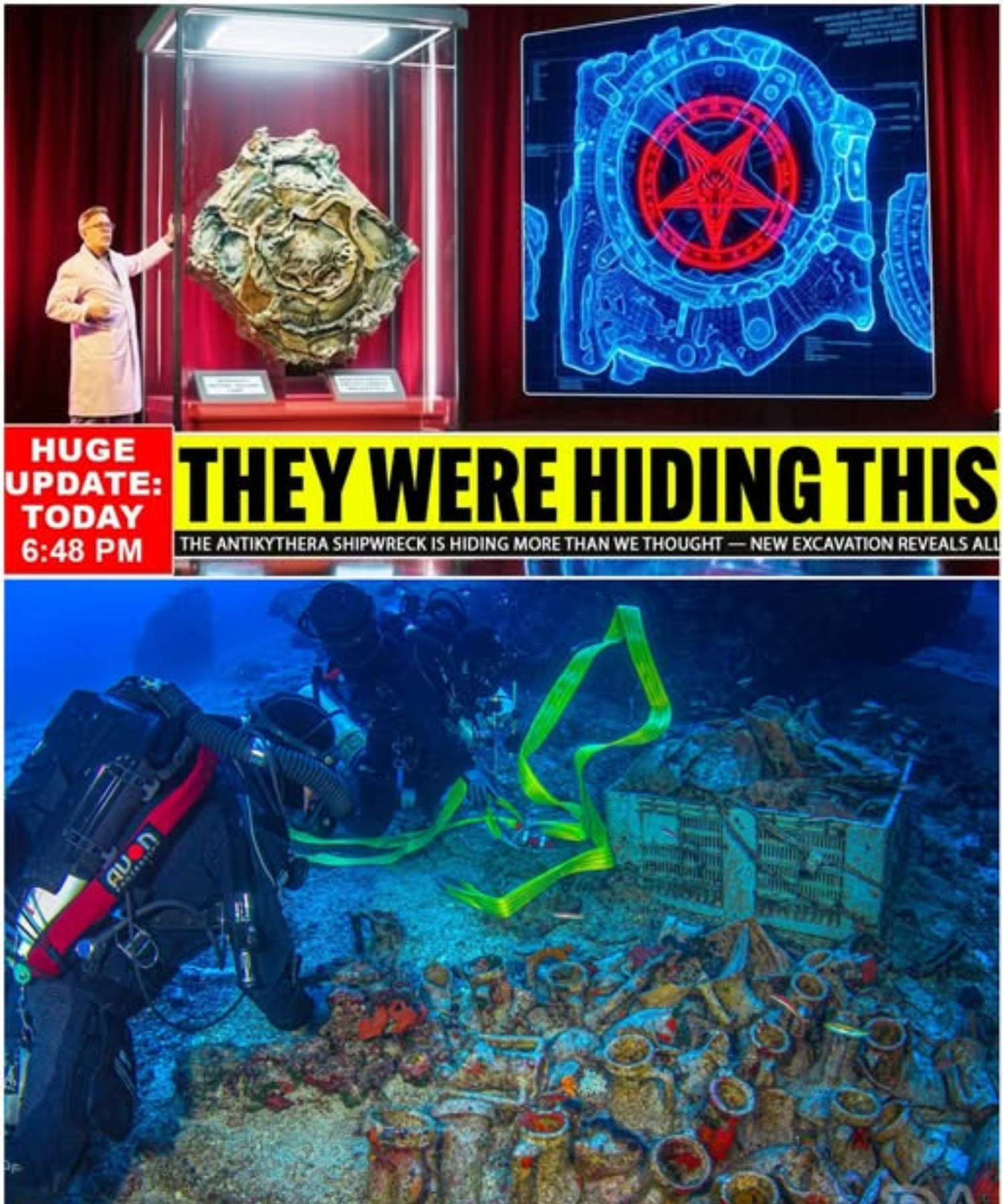
Hidden among the wreckage was a corroded bronze mechanism that would later become known as the Antikythera Mechanism — a device so advanced that it would challenge the timeline of technological development in human history.
Often described as the world’s first analog computer, it was capable of predicting astronomical positions, eclipses, and complex celestial cycles with astonishing precision.
For decades, scholars have debated how such a sophisticated device could exist in antiquity.
It suggested that ancient Greek engineering and scientific knowledge may have been far more advanced than previously assumed.
Now, more than a century after the original discovery, renewed underwater excavations at the Antikythera wreck site are revealing that the story may be far from complete.
Using modern deep-sea robotics, advanced sonar mapping, and high-resolution imaging technology, archaeologists have begun re-examining the seabed surrounding the original discovery zone.
What they have found is reshaping long-held assumptions about both the ship and its cargo.
According to researchers involved in the latest expedition, the wreck site appears significantly larger than previously mapped.
Early 20th-century divers only recovered objects from a limited area due to technological constraints and dangerous diving conditions.
But modern surveys suggest that large sections of the ship may still remain buried beneath layers of sediment and rock.
This revelation has sparked intense excitement among archaeologists, as it raises the possibility that entire sections of the ship’s cargo hold remain untouched for nearly two thousand years.
Initial findings from the new excavation indicate additional clusters of bronze fragments, marble debris, and ship structure remains extending far beyond the original recovery zone.
Some of these objects appear to be consistent with high-status Roman trade goods, reinforcing the idea that the vessel was part of a major commercial or diplomatic voyage.
But it is the unusual distribution of artifacts that is generating the most discussion.
Rather than a single concentrated wreck site, researchers are observing what appears to be multiple debris fields spread across the seabed.
This has led to speculation that the ship may have broken apart in stages, possibly during a violent storm or structural failure while at sea.
However, another theory is emerging among some members of the excavation team.
They suggest that the ship may not have been a single vessel carrying standard cargo, but rather something more complex — potentially a transport for multiple high-value collections, scientific instruments, or even assembled knowledge systems from different regions of the ancient world.
While this theory remains speculative, it has gained attention due to the unusual nature of artifacts already recovered from the site.
The Antikythera Mechanism itself remains central to this mystery.
Despite extensive research, 3D imaging, and reconstruction efforts, parts of its function are still not fully understood.
Its intricate system of gears, dials, and calibrated scales reflects an engineering sophistication that seems far ahead of its time.
Some researchers argue that it represents a lost tradition of advanced mechanical knowledge that was not widely preserved in surviving historical records.
Others believe it may be the product of a small group of elite engineers whose knowledge was not passed down through mainstream ancient technological development.
The new excavation has reignited this debate because additional mechanical fragments have reportedly been identified near the original find site.
While still under analysis, these fragments may be related to similar devices or components, suggesting that the mechanism may not have been a unique artifact.
If confirmed, this would dramatically shift historical understanding of ancient Greek engineering capabilities.
Beyond mechanical artifacts, the excavation team has also uncovered remains of wooden structural elements preserved in sediment pockets.
Though fragile, these remains could provide valuable insight into shipbuilding techniques used during the Roman era.
Early analysis suggests construction methods consistent with large merchant vessels designed for long-distance Mediterranean trade routes.
However, the preservation conditions at the site are highly unusual.
The wreck lies at a depth where oxygen levels are low, slowing decomposition and allowing organic materials to survive longer than in most underwater environments.
This has made the Antikythera site one of the richest and most challenging archaeological locations in the world.
Every dive and robotic scan reveals new fragments of history, often in unexpected states of preservation.
Yet despite over a century of study, the full layout of the ship remains uncertain.
Some archaeologists believe that earlier recovery efforts only captured a fraction of what lies beneath the seabed.
Modern scanning technology supports this idea, showing anomalies that could indicate buried structures extending beyond the current excavation zones.
If confirmed, this would mean that the original discovery represented only a partial glimpse into a much larger and more complex shipwreck.
The implications are enormous.
It suggests that countless artifacts may still remain undiscovered, potentially including additional scientific instruments, artistic works, and trade goods that could further illuminate ancient Mediterranean commerce and knowledge exchange.
The renewed excavation has also revealed evidence of human presence associated with the wreck.
Fragments believed to belong to crew belongings have been identified, including ceramics, personal items, and structural remains that may relate to living quarters.
These findings offer a rare glimpse into the human story behind the ship’s final voyage.
While the cargo has always dominated attention, understanding the lives of those aboard the vessel could provide crucial context for interpreting the wreck’s significance.
How did such a valuable and technologically advanced cargo end up at the bottom of the sea?
Was the ship caught in a sudden storm?
Was it part of a larger fleet movement?
Or did something more complex occur during its journey across the ancient Mediterranean world?
These questions remain unanswered.
As excavation continues, researchers are also employing digital reconstruction techniques to visualize the expanded wreck site.
Using 3D mapping and photogrammetry, they are attempting to rebuild the seabed layout in virtual space, allowing for a more comprehensive understanding of artifact distribution.
Early models already suggest that the site may extend significantly farther than previously documented.
This has led to renewed calls for expanded protection zones around the wreck to prevent accidental damage from fishing activity or unregulated diving.
The Antikythera site is not only archaeologically important but also fragile.
Every disturbance risks damaging artifacts that have survived untouched for nearly two millennia.
Despite the excitement surrounding new discoveries, researchers remain cautious in their interpretations.
Many of the most dramatic claims circulating online about the wreck are not yet confirmed by peer-reviewed analysis.
However, even conservative assessments acknowledge that the site continues to exceed expectations.
Few underwater archaeological sites in the world have produced such a combination of artistic, technological, and historical significance.
The presence of the Antikythera Mechanism alone ensures its place as one of the most important discoveries in the history of science.
But if new evidence confirms that additional similar devices or extended cargo remains exist, the site could fundamentally reshape understanding of ancient technological capacity.
For now, the excavation continues slowly and carefully.
Each dive brings new fragments to the surface.
Each scan reveals hidden structures beneath the seabed.
And each discovery deepens the mystery of a ship that sailed across the ancient world carrying knowledge, craftsmanship, and luxury goods — only to vanish into the sea, leaving behind questions that modern science is still struggling to answer.
More than two thousand years later, the Antikythera shipwreck still refuses to give up all its secrets.
And with every new excavation, it becomes increasingly clear that what has already been found may be only a fraction of what still lies hidden beneath the Mediterranean, waiting silently in the darkness for the next revelation to bring it back into human history.