30 Famous People Who Died While Performing
30 Famous People Who Died While Performing
The lights were on. The audience was watching. The cameras were rolling. And then, in the middle of the performance, life ended without warning.
There is something uniquely haunting about performers who die while doing the very thing that made them famous. A singer mid-song. An actor in costume. A wrestler entering the ring. A racer on the final lap. A stuntman in the air. A comedian delivering jokes while the audience laughs, not yet realizing the laughter has become tragedy. These deaths stay with us because they collapse two worlds at once: the world of illusion and the world of mortality. One second, the crowd believes it is witnessing art, sport, entertainment, or spectacle. The next, the stage becomes real in the most devastating way possible.
The following stories are not just shocking because of how these famous people died. They are powerful because each one reveals the strange bargain performers make with the public. They give their bodies, voices, timing, discipline, courage, and sometimes their lives to the moment. Some died in front of thousands. Some were injured on film sets. Some collapsed after finishing a final song or scene. Some were victims of accidents no one saw coming. Others were taken by violence, illness, or fatal miscalculation.
Together, these thirty stories remind us that performance is never as safe as it looks from the seats.
1. Molière
The French playwright and actor Molière became one of history’s most famous examples of a performer dying in connection with his own work. In 1673, while playing the title role in The Imaginary Invalid, he suffered a violent coughing fit during the performance. He managed to finish the show, but died shortly afterward. The bitter irony is unforgettable: one of the greatest comic minds in theater history was portraying a hypochondriac when real illness overtook him.
2. Sam Patch
Long before modern stunt culture, Sam Patch was an American daredevil famous for dangerous jumps. In 1829, he attempted a leap into the Genesee River’s High Falls in Rochester, New York. He had successfully jumped there before, but this time the stunt went wrong. Patch vanished into the water and died. His death turned him from a living daredevil into a legend, proof that audiences have always been drawn to people willing to risk everything in public.
3. Chung Ling Soo
William Ellsworth Robinson performed under the stage name Chung Ling Soo and became famous for illusion and mystery. In 1918, during his bullet-catch trick, the illusion failed catastrophically. A real projectile struck him, and he collapsed onstage. His final performance exposed the deadly risk behind magic’s polished deception. The audience had come to see a man pretend to cheat death. Instead, they watched the trick become real.
4. Lillian Leitzel
Lillian Leitzel was one of the most celebrated circus aerialists of the early 20th century. Her act required immense strength, grace, and trust in her equipment. In 1931, while performing in Copenhagen, a brass swivel in her rigging broke. She fell from a great height and died from her injuries. Leitzel’s death devastated the circus world because she had seemed almost untouchable in the air, a performer whose control made danger look beautiful.
5. Louis Vierne
French organist and composer Louis Vierne died in a place that defined his life: at the organ of Notre-Dame Cathedral in Paris. In 1937, during his 1,750th organ recital, he collapsed while performing. The scene was almost poetic in its sadness. A musician who had spent his life filling one of the world’s greatest cathedrals with sound died at the instrument he loved, in the middle of the music.
6. Harry Einstein
Comedian Harry Einstein, known as Parkyakarkus, had just performed at a Friars Club event in 1958 when he returned to his seat and collapsed. The room was full of entertainers, including some of the biggest names in comedy. What began as a night of laughter turned suddenly silent. Einstein’s death is remembered not only because it happened in show-business company, but because he had just made the crowd roar before his final moment arrived.
7. Tyrone Power
Tyrone Power was one of Hollywood’s great leading men, known for adventure films, romance, and classic screen charisma. In 1958, while filming a dueling scene for Solomon and Sheba in Spain, he suffered a massive heart attack. He died before the film could be completed. His death shocked Hollywood because it came while he was still working, still in costume, still physically engaged in the kind of dramatic role that had made him famous.
8. Leonard Warren
In 1960, Metropolitan Opera baritone Leonard Warren was performing in Verdi’s La forza del destino when he collapsed onstage. He had just sung words connected with death when he suffered a fatal heart attack. Opera is already a world of heightened emotion, fate, and mortality, but Warren’s death made the drama unbearable. The audience had come for tragedy in music; they witnessed tragedy in life.
9. Joseph Keilberth
German conductor Joseph Keilberth died in 1968 while conducting Wagner’s Tristan und Isolde at the Bavarian State Opera. The opera itself is saturated with longing and death, which made the moment even more haunting. Conductors often seem like forces of control, shaping an entire orchestra with gesture and breath. Keilberth’s collapse during such an intense work reminded audiences that even the person guiding the music is not beyond mortality.
10. Les Harvey
Les Harvey, guitarist for Stone the Crows, died in 1972 after being electrocuted onstage in Swansea, Wales. He touched a poorly grounded microphone while performing, and the shock killed him. Few deaths are more terrifying for musicians because the stage equipment itself became the danger. Harvey’s death remains a grim reminder of how live performance depends not only on talent, but on invisible technical safety.
11. Lee Morgan
Jazz trumpeter Lee Morgan was a brilliant musician whose career had already shaped modern jazz by the time he died in 1972. He was shot at Slugs’ Saloon in New York during a performance night. The killing was personal, sudden, and devastating. Morgan’s death cut short one of jazz’s most distinctive voices, turning a club performance into a tragedy that still haunts music history.
12. Sid James
British actor and comedian Sid James collapsed onstage in 1976 while performing in The Mating Season at the Sunderland Empire Theatre. At first, some audience members reportedly believed it was part of the comedy. That delay between performance and realization is one of the most chilling elements in many onstage deaths. The audience laughed because laughter was what Sid James had trained them to do.
13. Karl Wallenda
Karl Wallenda, patriarch of the famous Flying Wallendas, died in 1978 during a high-wire walk between buildings in San Juan, Puerto Rico. He was 73 years old and still performing the kind of dangerous act that had defined his family name. When he fell, the world saw the terrible cost of a life spent defying gravity. Wallenda’s death became one of the most famous fatal moments in stunt performance history.
14. Tommy Cooper
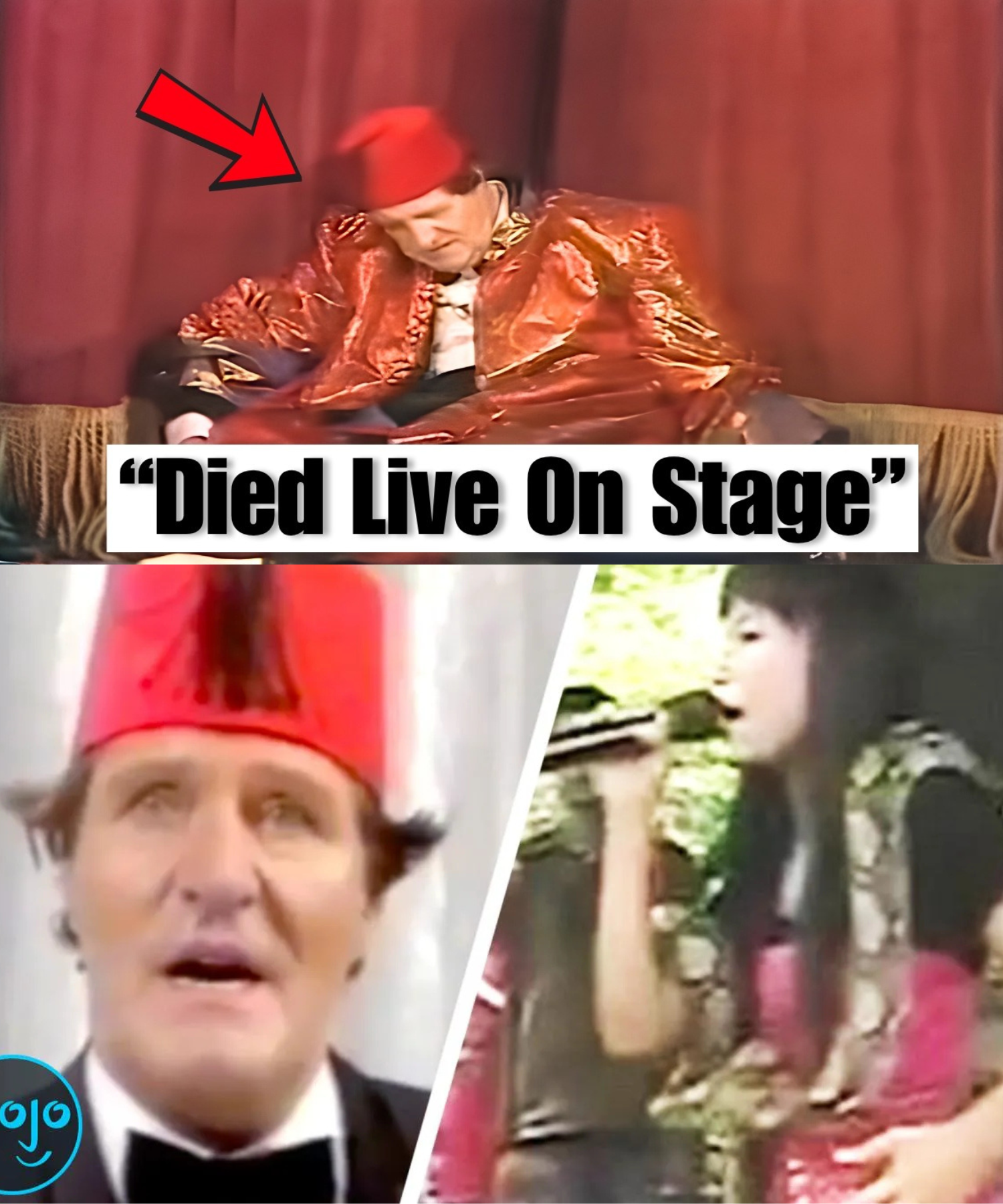
Tommy Cooper’s death remains one of the most surreal in television history. In 1984, the beloved British magician-comedian collapsed during a live TV performance. Because his act depended on deliberate failure, awkward timing, and comic collapse, the audience initially laughed. They thought it was part of the routine. The laughter continued for precious moments before people understood that Cooper was dying in front of them.
15. Dick Shawn
American comedian Dick Shawn died onstage in 1987 during a performance at the University of California, San Diego. Like Cooper, Shawn was a comic performer whose audience did not immediately realize something was wrong. He lay motionless as some thought the act was continuing. The tragedy reveals one of the cruelest risks for comedians: their audience is trained to interpret even disaster as performance.
16. Vic Morrow
Actor Vic Morrow died in 1982 while filming Twilight Zone: The Movie. During a night scene involving pyrotechnics and a helicopter, the aircraft crashed, killing Morrow and two child actors, Myca Dinh Le and Renee Shin-Yi Chen. The accident became one of Hollywood’s most infamous production disasters and changed discussions about safety, child actors, and the responsibilities of directors and producers on dangerous sets.
17. Brandon Lee
Brandon Lee, son of Bruce Lee, was fatally wounded in 1993 while filming The Crow. A prop gun accident caused a real projectile fragment to strike him during a scene. He died at only 28. The tragedy became even more haunting because The Crow was already a dark story about death, grief, and return. Lee’s final role became inseparable from the fatal accident that ended his life.
18. Ayrton Senna
Formula One legend Ayrton Senna died during the 1994 San Marino Grand Prix at Imola. He was one of the greatest drivers in racing history, admired for his speed, intensity, and almost spiritual approach to competition. His fatal crash shook the sporting world and led to major safety reforms in Formula One. Senna died in the arena where he had built his legend: at racing speed, in front of millions.
19. Richard Versalle
In 1996, tenor Richard Versalle died onstage at the Metropolitan Opera during The Makropulos Case. The moment became eerily famous because he collapsed after singing the line, “Too bad you can live only so long.” He was standing on a ladder when the fatal heart attack struck. The coincidence between lyric and death made the incident one of opera’s most chilling real-life tragedies.
20. Tiny Tim
Tiny Tim, remembered for his falsetto voice and “Tiptoe Through the Tulips,” collapsed during a performance in 1996. He had already suffered health problems, but he insisted on performing. After singing his signature song, he experienced a fatal heart attack. His death felt strangely fitting and sad: a performer tied forever to one unforgettable song leaving the world just after singing it again.
21. Johnny “Guitar” Watson
Johnny “Guitar” Watson was a blues, soul, and funk musician with a fierce stage presence and lasting influence. In 1996, he collapsed while performing in Yokohama, Japan, and died of a heart attack. His final words were reportedly connected to the show itself, as if his mind remained on the performance until the end. Watson’s death became a painful reminder that musicians can give everything to the stage, even their last breath.
22. Mark Sandman
Mark Sandman, lead singer and bassist of Morphine, collapsed onstage in Italy in 1999 during a performance. He died of a heart attack. Sandman’s music was known for its smoky, low, hypnotic sound, and his sudden death gave his final performance an almost ghostly afterlife. Morphine ended soon afterward, leaving fans with the feeling that a uniquely dark and elegant musical world had closed in an instant.
23. Owen Hart
Professional wrestler Owen Hart died in 1999 during WWF’s Over the Edge pay-per-view event. He was being lowered from the rafters for a ring entrance when his harness system failed, causing him to fall into the ring. Hart’s death is one of the most disturbing tragedies in wrestling history because it happened during a live entertainment spectacle. The line between scripted danger and real danger vanished.
24. Dale Earnhardt
NASCAR icon Dale Earnhardt died during the final lap of the 2001 Daytona 500. Known as “The Intimidator,” Earnhardt was one of racing’s most beloved and feared competitors. His fatal crash shocked fans because it happened at the sport’s most famous race, with the finish line close and his legacy already secure. His death helped push major safety changes across NASCAR, making his final race part of motorsport history forever.
25. Ty Longley
Ty Longley, guitarist for Great White, died in the 2003 Station nightclub fire in Rhode Island. The fire began during the band’s performance after pyrotechnics ignited flammable soundproofing material. Longley was among 100 people who died. His death is part of one of the worst concert disasters in American history and remains a devastating warning about venue safety, pyrotechnics, and overcrowded performance spaces.
26. Dimebag Darrell
Dimebag Darrell, former Pantera guitarist and member of Damageplan, was murdered onstage in Columbus, Ohio, in 2004. A gunman rushed the stage during the opening song and shot him while he was performing. The attack horrified the music world because the stage, usually a place of connection between artist and audience, became a scene of violence. His death remains one of rock and metal’s darkest nights.
27. Steve Irwin
Steve Irwin, the beloved “Crocodile Hunter,” died in 2006 while filming the documentary Ocean’s Deadliest on the Great Barrier Reef. A stingray struck him in the chest with its barb. Irwin had built his life around bringing dangerous wildlife closer to audiences while preaching conservation and respect. His death shocked the world because he had survived countless encounters with famously dangerous animals, only to be killed in a rare accident.
28. Dawn Brancheau
SeaWorld trainer Dawn Brancheau died in 2010 during a live “Dine with Shamu” show at SeaWorld Orlando. The orca Tilikum pulled her into the water, and she drowned. Brancheau’s death became a turning point in public debate about captive orcas, marine parks, trainer safety, and animal performance ethics. It was not only a personal tragedy, but an event that changed how many people saw live animal entertainment.
29. Mike Scaccia
Guitarist Mike Scaccia, known for his work with Rigor Mortis, Ministry, and Revolting Cocks, collapsed onstage in 2012 during a Rigor Mortis performance in Fort Worth, Texas. He was later pronounced dead from a heart attack. Scaccia died during a show celebrating music, friendship, and metal history, making the loss especially painful for fans and bandmates who saw him fall in the middle of doing what he loved.
30. Sarah Guyard-Guillot
Sarah Guyard-Guillot, an acrobat in Cirque du Soleil’s Kà, died in 2013 after falling during a performance in Las Vegas. Cirque du Soleil is built on beauty, precision, danger, and trust in complex aerial systems. Her death shattered the illusion of effortless grace that such performances create. Behind every breathtaking acrobatic moment is real risk, real human strength, and equipment that must work perfectly every time.
These thirty stories are tragic for different reasons. Some involve medical emergencies. Some involve violence. Some involve technical failure. Some involve stunts, animals, vehicles, or live equipment. But they all share one unsettling truth: performance does not pause death. The stage lights can be bright, the audience can be cheering, the cameras can be rolling, and still the final moment can arrive without warning.
There is a strange tenderness in remembering these people together. They were not all the same kind of performers. Some were singers, actors, comedians, athletes, racers, stunt artists, wrestlers, musicians, trainers, or illusionists. Some were global icons. Others became famous partly because of how they died. But each one gave something of themselves to an audience in their final moments.
For fans, these deaths become frozen scenes. Tommy Cooper collapsing while people laughed. Leonard Warren falling at the Met. Owen Hart’s entrance turning into catastrophe. Dimebag Darrell playing the first song of the night. Dale Earnhardt entering the last turn at Daytona. Steve Irwin filming in the ocean. Sarah Guyard-Guillot suspended above the stage. Each image is difficult because it catches a person between craft and mortality.
Maybe that is why these stories continue to fascinate. They remind us that fame does not protect anyone. Talent does not bargain with death. Applause does not guarantee tomorrow. The people who entertain us are not immortal, even when their performances make them seem larger than life.
And yet, in another sense, the performance does continue.
The songs remain. The films remain. The jokes remain. The races, recordings, broadcasts, stories, and memories remain. The moment of death may be final, but the work keeps moving through the world.
That is the paradox of dying while performing.
The body stops.
The audience goes silent.
But the last act is remembered forever.