He Kept the Sabbath in a Chinese PRISON — And Preached the Gospel to Every Man Inside
He Kept the Sabbath in a Chinese PRISON — And Preached the Gospel to Every Man Inside
I owe that to my creator. He has made the Sabbath day holy. No matter the cost, I cannot dishonor him.
I already made my decision. The weight of that decision is on me. Crying Most of you know by now why I am in this prison.
Advertisements
I am a preacher incarcerated because I met regularly with fellow believers to worship the Lord God of heaven and earth.
Cannot bring dishonor on my God. Where there is a conflict between my country and my God, I must obey God rather than men.
Advertisements
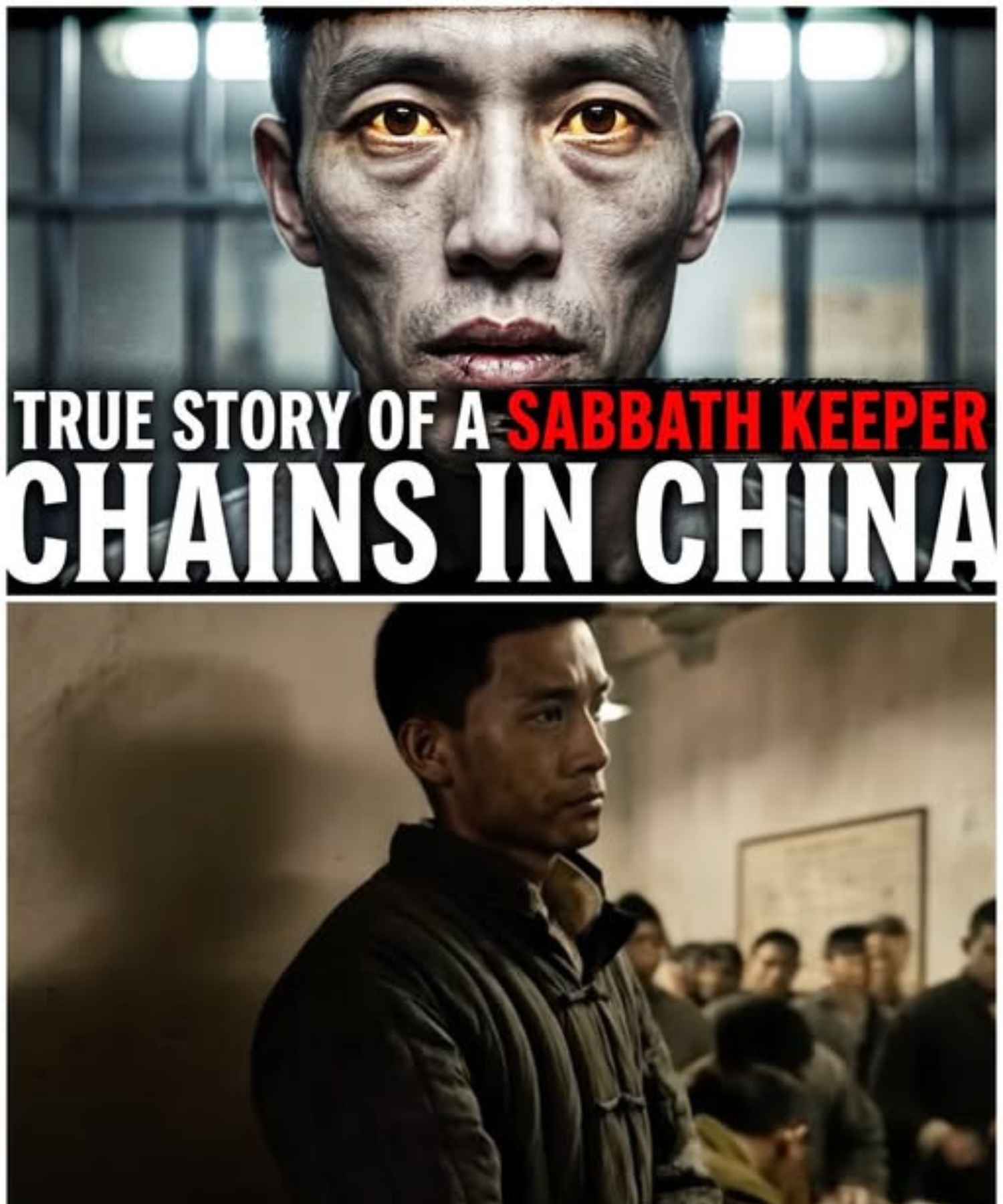
A man sits on a filthy straw mat in a Chinese prison cell, his bones pressing through his skin like tent poles under a threadbare canvas.
40 prisoners surround him in a space no larger than a modest living room, crammed together on a cold cement floor.
Advertisements
The air is thick with the stench of an open latrine just centimeters from where he sleeps.
Advertisement
A single feeble light bulb burns overhead, never turned off, not even at night. And this man, this walking skeleton, is doing the one thing the guards have told him he must never do again.
His lips are moving, his eyes are open because they have beaten him for closing them.
Advertisement
But his lips are moving. He is praying to a God the government says does not exist.
He is praying to the creator of heaven and earth, and no chain, no guard, no dictator on this planet can make him stop.
Advertisement
His name is Chen. And this is his story. Chen was born in 1927 in Ningbo, China, to parents who loved God and served the church with everything they had.
His father was a traveling evangelist who moved the family constantly, and that constant uprooting made normal schooling almost impossible for young Chen.
He could never stay in one school for more than a few months at a time.
His sporadic attendance destroyed his grades and kept him from advancing, a disadvantage that would haunt him for years.
By 15, he had left school entirely and gone to work in a Shanghai shoe factory, making boots for soldiers during World War II.
It was hard, thankless labor, but deep in his bones, he always knew God had something more for him.
His parents had always wanted him to be a pastor. His father had even dedicated him to the service of God as a child.
On the morning of his 18th birthday, Chen walked to army headquarters to register for military service, as the law required.
He didn’t want to carry a gun. He believed the Bible taught him to save lives, not take them, and he knew military service would force him to violate the Sabbath, the sacred day of rest God had set apart at creation.
But the law was the law, and he would obey it, trusting God with the outcome.
That very evening, his uncle handed him a letter from the church in Shanghai inviting him to become a full-time Bible worker, going door to door selling Bibles and sharing the gospel.
Chen accepted with all his heart, but warned them he could be drafted at any moment.
And then God moved in a way no one predicted. On August 6th, 1945, the United States dropped an atomic bomb on Hiroshima.
Three days later, Nagasaki was bombed. Japan surrendered. The war was over. Chen would never carry a gun.
Instead, he would fight in a different army, carrying a Bible instead of a rifle, waging the great spiritual war between good and evil.
And that war, Chen knew, had already been won the day Jesus died on the cross.
Chen threw himself into the work with everything he had. He studied scripture day and night, walked the streets of Shanghai selling Bibles and religious books.
And when people could not afford to buy, he gave the books away. How can I leave their homes without giving them something to read?
He once asked his pastor. His entire earthly possessions were a bicycle and a few nice shirts.
After 2 years, he was an excellent Bible worker with a passion for the gospel that burned hotter with every passing day.
He proposed translating important Christian books from English into Chinese so believers across the country could read them affordably, an idea that would soon fuel an underground publishing movement the government would try and fail to destroy.
It was during these days that Chen met the woman who would break his heart.
Ruolan walked into his church one Sabbath invited by a friend, and the room seemed to brighten.
She was exciting, intelligent, and so full of life that Chen found himself looking forward to each weekend just to see her.
Her name meant orchid, a name her father had given her as a baby saying, With a name like that, she will always be beautiful.
Chen had to agree. Week by week their friendship deepened into something he could not resist.
They rode bicycles together, walked in the parks, and cooked their favorite dishes. But there were warning signs Chen chose not to see.
Ruolan loved the warmth of the church community, but she showed little desire to share her faith outside of it.
Her Christian roots were shallow, planted in excitement rather than conviction. Worse, she had deep communist political loyalties and argued bitterly with Chen about government policy.
Friends warned him, urged him to slow down, but he was thinking with his heart and not his head.
They married quickly. Then in 1949, the communist government of Mao Zedong seized power. And for Christians everywhere in China, there could have been no greater disaster.
Churches were forced underground. Believers met in secret, always watching for government spies who pretended to be converts.
Chen’s faith thrived under persecution. But Ruolan’s shallow roots could not hold. When she gave birth to their son Xian, the cracks in their marriage split wide open.
Chen took a job at a pharmaceutical factory to support his family. The communist government required workers to labor 6 days a week, including Saturdays.
Chen asked for his Sabbaths off, and his first manager agreed. For over a year, he worked 5 days at full salary with every Sabbath free to worship.
His testimony at church was one of pure praise for God’s blessing. But when a new manager named Mr.
Jiang arrived, a stocky man with a face that looked like it had never smiled, everything changed.
A notice appeared on the bulletin board. Chen could no longer miss work on Saturdays.
His supervisor gave him an ultimatum. Chen chose the Sabbath. I owe that to my creator.
He has made the Sabbath day holy and asked that I rest on that day and worship.
No matter the cost, I cannot dishonor him. But when Monday came, Mr. Jiang had a trap waiting.
He picked up the phone and dialed a number. Comrade Rulan, your husband is here.
You may speak to him now. The Communist Party had been working on Rulan for weeks, even threatening something involving their young son.
Now she delivered her ultimatum over the phone, her voice like ice. If Chen signed the resignation, he could sign away his marriage, too.
She had already drawn up divorce papers. I’ll not have a husband who chooses his religion over his wife and son.
She snorted. The manager smirked. She has finally come to her senses. I don’t know what kind of a Christian she was, but she is a very good communist.
By the end of that single day, Chen had lost his job, his wife, his son, and his home.
All because he refused to work on the Sabbath. That night, lying on the floor of a friend’s house, staring at the dancing shapes of shadows on the ceiling, Chen wrestled with God in the deepest chambers of his soul.
The words of scripture cut to his bone. A man’s foes shall be they of his own household.
He that loveth son or daughter more than me is not worthy of me. And he that taketh not his cross and followeth after me is not worthy of me.
Matthew 10:36-38. Chen did not sleep that night. But by morning, he knew he had made the right choice, even if the price was everything he loved.
Pastor Lin David took Chen back in. The shuttered church building in Shanghai became a secret publishing center.
In a windowless room lit by a kerosene lamp, Chen and Pastor Lin typed through the night translating Christian books from English into Chinese.
Chen had completed 300 pages and still had 400 to go. His fingers were raw from the rusty keys.
When he made a mistake, he scraped the carbon ink off with a razor blade.
In exchange for a cot in the corner, he served as the church’s security guard.
A moth fluttering near his lamp reminded him that the light of the gospel draws those who search for truth.
Bible workers were risking their freedom every day to distribute these books. Some had been in prison, some had paid with their lives, yet the underground church was growing one dangerous page at a time.
One evening, Chen heard shouting in the alley. Through a small high window, he saw Pastor Lin surrounded by four government police with red armbands.
Chen acted instantly. He pulled up loose floorboards, jumped into the crawl space, and loaded Bibles and translated books into his shoulder pack.
Clears throat He grabbed the manuscripts, covered the hiding place, and escaped out the front door into darkness.
By noon the next day, all 10 church leaders had been arrested. An elderly sister named Mrs.
Alam took him in for one night, fed him wonton soup, and gave him a place to sleep.
But he could not stay without putting her in danger. With almost no money and a dozen cabbage rolls she pressed into his hands, Chen boarded an intercity bus.
Take me where you need me, Lord, he whispered as the bus pulled away from Shanghai forever.
At a quiet village called Wuxi, Chen stepped off the bus. Neat streets with red tiled roofs, children in narrow lanes, not a police officer in sight.
Something stirred deep in his spirit. When the bus pulled away, he was not on it.
He stood on a street corner with everything he owned in a backpack, a stranger in a strange town, and felt the unmistakable pull of heaven drawing him forward.
Be thou faithful unto death, and I will give thee a crown of life. Revelation 2:10 That first Sabbath in Wuxi, Chen walked the quiet streets and heard a familiar hymn drifting from a small house.
Jesus is coming again. The voices sang, and Chen’s heart leaped in his chest. He moved toward the door, and when a little girl spotted him through the window, the singing stopped.
They let him in cautiously as anyone would during these dangerous times, but within hours, this small group of six families had found their pastor.
Chen’s knowledge of scripture made him an instant leader. Two people were ready for baptism.
By the end of the day, they had asked him to stay. An elderly couple named Jinhai and Liu took him into their home and treated him like a son.
The congregation offered him a small stipend, and Chen promptly spent most of it on others.
When a child needed shoes, Chen hired a cobbler. When an old man needed medicine, Chen got it for him.
He visited the sick in their homes, read the Bible to them, prayed for them, and sometimes recommended changes in their diet to improve their health.
Young and old, Christian and Buddhist, everyone in Wuxi came to know Chen as a man touched by something far greater than himself.
Then came the day that shook the village. A church member called Chen to the bedside of his mother-in-law, Yun, who had been bedridden for 6 months with an illness no doctor could explain.
For decades, Yun had served as the village fortune teller, channeling dark supernatural forces just as her mother and grandmother had before her.
Now, the scripture speaks of such things. It tells us that the powers of darkness are real, that Satan and his agents work through those who open their lives to occult practices.
The whole village had revolved around Yun’s counsel, coming to her for every decision. But, the dark powers she had served were now destroying her.
She suffered seizures, heard voices, and held conversations with unseen presences that terrified her family.
Chen knelt by her bed and laid his hand on her forehead. The room grew cold.
Her body shook violently. Her voice turned heavy and unnatural. What do you want with us here?
Chen felt the raw power of evil pressing against him, and his skin crawled. But, he did not flinch.
He prayed, Help me, Lord. I am powerless against the forces of darkness. You have rebuked Satan before.
Do it again today. Then, he spoke with authority. He that dwelleth in the secret place of the most high shall abide under the shadow of the almighty.
Psalm 91:1. Sister Yun, in the name of Jesus, I ask that Satan torment you no more.
He recited the 23rd Psalm. Yea, though I walk through the valley of the shadow of death, I will fear no evil, for thou art with me.
Psalm 23:4. The demon shook her one last time, and she lay still. The family held their breath.
Then, her eyes opened. She smiled. Has supper been started? She was completely healed. The family tried to pay Chen.
He refused. How can I take wages for something only God can give? Salvation is free.
That night, a verse explained everything. Therefore, they that were scattered abroad went everywhere preaching the word.
Acts 8:4. God had not destroyed the church in Shanghai. He had scattered it so the gospel could reach villages like Wuxi.
By 1958, Mao Zedong’s Great Leap Forward had crushed religious freedom across China. All assembly for worship was forbidden.
Evangelism was outlawed. Of all believers it was said, Those who worshiped on the seventh day were the most likely to proselytize.
The village magistrate confronted Chen. You must stop your preaching. The government is watching you.
When Chen did not stop, the magistrate banished him to an abandoned Buddhist temple on the mountain above Wuxi to live among the sheep and nine elderly monks still inhabiting the crumbling shrine.
You can preach to the sheep. He laughed. But Chen saw a mission field. Within days, he was carrying firewood, repairing the temple roof, and milking sheep alongside the monks.
He won their trust through humble service. An old monk named Bohai became Chen’s closest companion.
They sat on the grassy slopes watching sheep graze while Bohai explained the Buddhist pursuit of freedom from suffering.
Chen listened respectfully, then asked a question Bohai could not answer. You believe in many gods.
If they do not always agree, how do you know which one to listen to?
Chen told him of the one true God who created all things, who sent his only son to die, and who is coming again to take his children home.
Bohai searched the sky as if looking for this God somewhere among the clouds. I think I could believe in your God if he is everything you say he is.
Chen smiled. My God is your God because he created you, Bohai. And he never changes.
Not ever. Meanwhile, Chen’s church members climbed the mountain every Sabbath to worship with him in the old temple.
If he could not go to them, they would come to him. In late September 1960, after Chen conducted a wedding in the village, military police arrived at the temple.
Before they took him, Chen sat with Bohai one last time. God created you in his own image, Bohai.
He loves you so much that he sent his only son to die so you could have eternal life.
The old monk lifted his hands. Will you teach me to pray to the God of heaven?
And so they prayed together on the temple floor where thousands before them had prayed to Buddha.
Both feeling the power of the living God fill that ancient pagan shrine. Then the police shackled Chen’s hands, called him a parasite, a disease that could not be stopped, and marched him down the mountain.
They drove him to the local prison in a jeep. A guard pulled Chen out and he fell face-first into the dirt.
Get up, dog! The guard shouted, jerking him to his feet. They pushed him through the gate, down darkened corridors reeking of decay, and into cell number four.
Bad luck in anybody’s book! The guard laughed wickedly. Over 40 men were crammed into a space 6 m by 4.
Every inch of floor was covered with stinking straw mats and bug-infested blankets. Near the gate was an open latrine and a gutter with a chamber pot.
The stench filled the place beyond human endurance. Flies buzzed in clouds. The prisoners sat in total silence because talking was forbidden.
Some looked like walking skeletons. Others had the dead, hollow eyes of men who had been broken by months of confinement.
Chen sat down on his assigned mat, the one nearest the latrine, his heart hammering in his chest.
He was terrified, but then the psalmist’s words came like a shaft of light cutting through darkness.
Save me, O God, by thy name, and judge me by thy strength. Hear my prayer, O God.
Give ear to the words of my mouth. Psalm 54:1-2. A calm settled over him.
God was here. Even in this pit of death, God was here. The food was thin, gray-green corn porridge served cold three times a day.
It smelled like a barnyard and looked worse. Prisoners were forbidden from talking, exercising, or reading.
There was nothing to do but sit on the cement floor and stare at iron bars.
Chen could not bring himself to eat for 2 days, but he made a discovery that changed everything.
In the enforced silence of that cell, he could pray more deeply than ever before.
He recited memorized scripture for hours, verse after verse pouring through his mind like rivers of living water.
His father had always told him to memorize the Bible. It may be the only thing you have someday if you are in prison.
Those words had never been more true. Chen found a scrap of paper and a pencil stub in his pocket.
He wrote Bible verses in characters so tiny they could barely be read and hid the paper inside his pillow.
One day, a guard saw him with his eyes closed and lips moving. What are you doing?
The officer shouted through the bars. I was praying. Chen admitted. Praying is not allowed.
There is no God. The honorable Mao Zedong has taught us that. The guard stormed in and locked Chen’s hands behind his back in rusty handcuffs so tight they cut into his wrists.
He could not feed himself, use the latrine, or sleep on his back. But he would not stop praying.
Like the prophet Daniel who prayed three times a day knowing the punishment, Chen adapted.
Eyes open, hands unfolded, prayers silent. And the God of heaven heard every word. Be careful for nothing, but in everything by prayer and supplication with thanksgiving let your requests be made known unto God.
And the peace of God, which passeth all understanding, shall keep your hearts and minds through Christ Jesus.
Philippians 4:6-7. The warden interrogated Chen repeatedly, demanding he renounce his faith and confess loyalty to Chairman Mao.
Officers from Shanghai questioned him for hours. They mocked his Sabbath. They demanded to know about his power to cast out demons.
Chen answered simply, I don’t cast out the evil spirits. Only God can do that.
I merely speak for him. The interrogators fell silent. Then came a shakedown. A prisoner, hoping for an extra cup of porridge, betrayed Chen’s hiding spot.
The warden found the scrap of Bible verses in the pillow lining and nearly danced with joy.
We’ve got it. Even in prison, you are an enemy of the revolution. Chen’s punishment: miss a meal and make a public confession before every prisoner that evening.
The warden expected a broken man to grovel. He got something very different. Chen stood before the entire prison that night and spoke with a clarity that silenced every man in the building.
Most of you know by now why I am in this prison. I’m a preacher incarcerated because I met regularly with fellow believers to worship the Lord God of heaven and earth.
The written words of the Bible have been used against me because I dared to write them on a small scrap of paper.
And yet, these words give me hope and a reason to live each day. They tell me of a savior named Jesus who left the glory of heaven to come into our broken world to suffer alongside men like us and to die on a cross so that every person who believes in him can live forever.
He looked at the hollow faces before him, men who had forgotten what hope felt like.
I must confess that I am guilty of being a sinner before God. But Jesus died to save me, to make me clean inside for all the things I have done wrong.
If we confess our sins, he is faithful and just to forgive us our sins and to cleanse us from all unrighteousness.
First John 1:9. For God so loved the world that he gave his only begotten son that whosoever believeth in him should not perish but have everlasting life.
John 3:16. He drew a breath and looked the warden straight in the eye. I do not want to dishonor Chairman Mao, but I cannot bring dishonor on my God, either.
Where there is a conflict between my country and my God, I must obey God rather than men.
A heavy silence fell over the prison. Every man had heard the gospel, many for the first time in their lives.
The warden stood shell-shocked, momentarily moved by something he could not name before catching himself.
He punished Chen by moving him back to the spot nearest the latrine, but it was too late.
The seeds of the gospel had been planted in every heart in that building and no warden on earth could dig them up.
On Chinese New Year, the most anticipated holiday of the year, the prison served every man a generous bowl of boiled pork alongside the regular corn gruel.
For half-starved prisoners who had not tasted protein in months, it was a feast beyond imagination.
The cell erupted in hand clapping and cheers. But Chen could not eat it. The Bible was clear.
God had declared certain animals unfit for food, and the pig was among them. The swine is unclean to you.
Of their flesh shall ye not eat. Leviticus 11:11 – 8. And it also taught that the human body is sacred, a temple of the living God.
Know ye not that ye are the temple of God, and that the spirit of God dwelleth in you?
1 Corinthians 3:16. Chen’s hands shook as he held the bowl. His body screamed for nourishment.
His bones were showing. His teeth were loosening. Every cell in his starving body craved the protein.
But he handed the bowl back to the guard. I’m sorry. I can’t eat the meat.
My God has asked that I not eat pork. Every prisoner in the cell stopped chewing and stared.
A starving man in a communist prison had just refused the greatest delicacy in China.
The guard took the bowl. Minutes later, he returned with something else, tofu. The warden himself had sent it.
A new grudging respect was born in that prison. And that decision saved him weeks later.
A prisoner’s sticky rice treats were stolen during the night. All eyes turned to Chen and Deming who slept on either side of the victim.
The accusation was poison. Then someone remembered the sticky rice contained pork. Chen would never eat pork, let alone steal it.
He had refused it on New Year’s Day in front of everyone. He was immediately cleared.
Deming was exposed. The biblical health principle that Chen had obeyed at the cost of his own starvation had shielded him from false accusation when it mattered most.
Faithfulness in the smallest things had become his greatest protection. Outside the prison walls, China’s Great Famine was killing millions.
Catastrophic mismanagement under Mao Zedong’s policies, combined with devastating floods and droughts, would claim an estimated 30 to 40 million lives, making it the deadliest famine in recorded human history.
Inside the prison, food portions shrank to almost nothing. The corn gruel grew thinner and thinner until it was barely colored water.
Prisoners began to waste away before Chen’s eyes. Anemia, rickets, and scurvy swept through the cells.
Men who had been strong on arrival became hollow-eyed ghosts within weeks. Chen’s own body was deteriorating rapidly.
His face was gaunt, his ribs like a washboard, his abdomen grotesquely swollen from infected bowels.
His teeth loosened from malnutrition, a deep cough rattled in his chest. During these darkest months, a man named Mr.
Shi arrived, a former government official jailed for refusing to interrogate an elderly Buddhist monk.
He’s a good old soul and never hurt a flea in his life, Mr. Shi had told his superiors.
Why should I put him through that indignity? For that act of compassion, he had been thrown into a cell with criminals.
In stolen whispers between guard shifts, Chen shared the promises of scripture. Eye hath not seen, nor ear heard, neither have entered into the heart of man, the things which God hath prepared for them that love him.
1 Corinthians 2: 9. One day, with the quiet conviction of a man who had spent his whole life searching for the truth, Mr.
Shi said, You asked us why we would not believe in such a god. I am here to say, I believe.
It is the most logical thing I have ever said. Then a prisoner died. They carried him out on a stretcher, face still twisted with pain.
Chen watched in silence. Would he be next? Some days he almost wished death would come as a friend.
He’d been caged for 8 months with no books, no sunlight, no hope of release.
His body was failing. His clothes hung on him like rags on a scarecrow. But then a verse would rise in his mind like a sunrise.
The Lord is my rock and my fortress and my deliverer. 2 Samuel 22:2. And Chen would remember whose he was and lift his open eyes to heaven once more and pray.
After 8 months without bathing, the prisoners were allowed one shower. When water cascaded over their bodies, hardened criminals wept like children.
Chen could not walk to the showers alone. Mr. Shearer had to support him. When the prisoners undressed, they looked like walking skeletons.
Chen’s condition was the worst. Every rib visible, arms like sticks, skull nearly bald. Then he began bleeding internally.
The prison doctor gave him penicillin. It did not work. He was sent to the village hospital for 5 days.
The doctors could not stop the bleeding. They could not explain why he was still alive.
He was returned to prison. The warden moved Chen to the infirmary cell and allowed him to write a letter.
Experienced prisoners told him what this meant. When a dying man is allowed to write home, the prison wants his family to collect him before he dies on their watch.
You may die, but at least you get to die free. Two days passed. Chen was spitting up blood constantly.
He could barely eat the extra gruel they were giving him. Then on the third day, the warden came.
Gather up your belongings. At the front gate stood Chow and Enlai, two young people from his church.
When they saw him, Chow gasped and burst into tears. The man before them was a skeleton in filthy rags weighing barely 55 kg.
His eyes were sunken into dark hollows. His arms and legs were like toothpicks. His clothes reeked of a place no human should have to endure.
Chen broke down. Great heaving sobs shook his frail frame as 10 months of suffering crashed over him like a wave.
He had nothing to carry, not a single possession. The warden handed him a food coupon and puffed out his chest.
You are a normal person now, and I am a good man to let you go.
No one can call me less than a humanitarian. Chen walked out the front gate, and the sunshine that poured over him felt like the very hands of God lifting him from the grave.
Chen’s church family cared for him 2 days, feeding him warm cabbage soup and letting him sleep on a soft mattress for the first time in almost a year.
Then they sent him by train to his parents. His mother wept uncontrollably when she saw him.
The doctor diagnosed severe anemia and pulmonary disease, prescribed good food, vitamins, and rest, and told the family the outcome was uncertain.
A neighbor recommended a specialized lung hospital, and Chen made the painful journey. Even there, flat on his back, coughing blood, he could not stop sharing the gospel with every patient in his ward.
For God so loved the world that he gave his only begotten son, that whosoever believeth in him should not perish, but have everlasting life.
John 3:16. The men in that hospital had never met a prisoner so cheerful about his suffering.
It was in that hospital of the dying that he met Majun. She was young, barely in her 20s, a university student who had arrived alone, terrified, and spitting blood.
No family nearby, no visitors, no hope. Chen came to her bedside, prayed with her, and spoke words she had never heard in her life.
God is our refuge and strength, a very present help in trouble. Psalm 46:1. He loves you with an everlasting love.
You are a daughter of the living God, Majun. He made you in his image.
That is why he loves you. Something cracked open inside her. By the time her health returned, Majun had given her heart to Jesus.
She invited Chen to her mountain village of Yulin for recovery. The dry air did what medicine could not.
They studied the Bible daily, hiked the trails together, and before long, Majun told Chen she wanted to marry him.
He resisted. He was an ex-convict. His first marriage ended in betrayal. Her brother was a military officer.
He listed every obstacle. Majun swept them all aside. Your bitter life will be mine.
Your people, my people. We have the same ideas about sharing the gospel, and that is what is most important.
They laughed so hard they nearly fell off the log they were sitting on. Two finches flew away in alarm.
Chen could no longer argue. They exchanged simple vows with family and began a new life in the mountains.
In their second year of marriage, Majun gave birth to a baby boy named Ping.
The joy was indescribable, but 18 days later she felt a stabbing pain in her chest.
She could not breathe. The doctor diagnosed acute cardiac failure, a complication from her lung disease.
He pulled Chen aside. Majun has only days to live. Her death is inevitable. Chen fell into a chair.
He signed the form releasing the hospital from responsibility, his hand trembling so badly he could barely write.
Then he went to her room, dropped to his knees beside her unconscious body, and prayed through the longest, darkest night of his life.
The forces of evil pressed in. His faith buckled. His heart raged. Why will you not hear my prayers?
He cried into the silence. For hours heaven seemed like iron above him. But then, in the blackest hour before dawn, Chen remembered.
He remembered the prison, the corn gruel and the handcuffs and the freezing floor. He remembered how God had sent him a verse every single time he thought he could not survive another minute.
He remembered Mr. Shear’s words, Your God will not abandon you. Slowly, like the first rays of morning light, the peace of heaven settled upon him.
The anger drained. Chen bowed his head and surrendered. God’s ways are always best, he whispered.
Whatever you choose, I trust you. Dawn broke. The darkness lifted. And Meixian opened her eyes.
Thank you for staying with me, she smiled as if nothing had happened. Chen stared at her, unable to speak.
Then the words exploded from him. You’re alive! You’re alive! Thank you, Jesus, for bringing Meixian back to me.
He clutched at her hands and buried his face in the bedsheet, weeping the tears of a man who has watched God reach into the jaws of death and pull back someone he loves.
The commotion brought the nurses, and then the doctor rushed in. He ran every test he had.
He listened to her heart. He examined her lungs. He checked the valves that had been failing just hours before.
And then he stood there shaking his head, a look of astonishment on his face.
No trace of cardiac failure, no scarring in the heart valves, no damage to the lungs or organs.
No evidence of the disease that had been killing her 12 hours before. In all my days as a doctor, Dr.
Fu Wa said, I have never seen such a miraculous transformation. It defies all the explanations of modern medicine.
Your God is truly amazing. I have no other explanation. Nurses ran through the corridor shouting, Mei Zhen is awake!
Mei Zhen’s God has healed her and made her well again. And Mei Zhen spoke softly from her bed, Jesus did this.
He is the great physician, and I must give credit to no one else. Chen never returned to prison.
Government officials continued to watch him, but his reputation for integrity and genuine love for his neighbors earned him something persecution could not destroy, the respect of an entire community.
He planted a church in Mei Zhen’s hometown and won many converts to Jesus. He was called to minister to the sick and dying, and many were healed miraculously.
When the town leaders discovered he was an exceptional calligrapher, they hired him to write inscriptions on public buildings, giving him a way to support his family while he led his growing congregation.
In 1976, Mao Zedong died, and churches that had been shuttered for decades began reopening across China.
Chen returned to his hometown, reopened his church for worship, and the congregation grew so quickly it had to split into smaller groups.
His story of faithfulness spread far and wide, and believers of every denomination invited him to share the good news that had carried him through the fire.
Pastor Chen lived to be 89 years old. On October 27th, 2021, he closed his eyes for the last time, peacefully in his sleep in Hong Kong.
And the hands that had typed Bibles in secret, healed the sick in Jesus’ name, refused pork and starvation, and held Myzena back from the grave, finally rested.
His life was a testament to a single, unbreakable truth. A man who plants himself in the word of God and refuses to be moved will bear fruit in every season.
And nothing in this world, not persecution, not poverty, not prison, not even death itself, can make his leaf wither.
Blessed is the man that walketh not in the counsel of the ungodly, nor standeth in the way of sinners, nor sitteth in the seat of the scornful.
But his delight is in the law of the Lord, and in his law doth he meditate day and night.
And he shall be like a tree planted by the rivers of water, that bringeth forth his fruit in his season.
His leaf also shall not wither, and whatsoever he doeth shall prosper. Psalm 1:1-3.