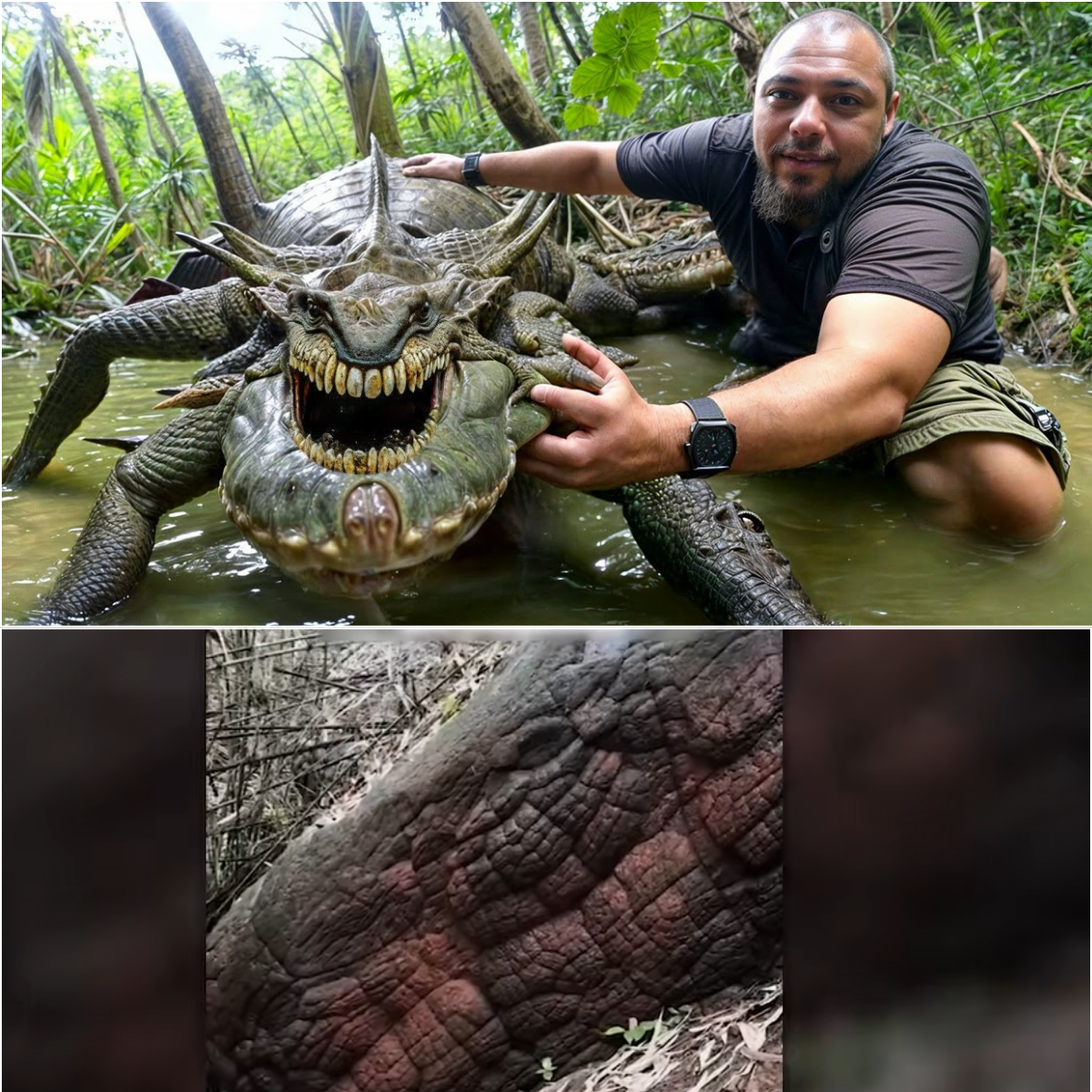
You Won’t Believe What This Man Captured in The Amazon!
You Won’t Believe What This Man Captured in The Amazon!
The world’s remaining primeval forests do not merely grow; they harbor secrets, breathing with the weight of untold centuries where the boundary between evolutionary marvel and ancient myth blurs into twilight. Deep within these untamed canopies, where sunlight rarely touches the forest floor, nature plays a perpetual game of misdirection, leaving us to wonder if the bizarre shapes caught on camera are undiscovered branches of the evolutionary tree or remnants of a world we thought long buried.
Part I: The Living Evolution of the Deep Jungle
For centuries, naturalists have stepped into the dense thickets of the Amazon Basin and the remote archipelagos of the Pacific expecting to find trees, only to return with accounts of creatures that defy conventional biology. The human mind seeks patterns, and when confronted with the hyper-specialization of isolated ecosystems, our first instinct is often to cry “alien” or “monster.” Yet, reality is frequently far more fascinating than fiction.
Consider the Common Potoo (Nyctibius griseus), a bird native to the American tropics that has perfected the art of physical invisibility. To the untrained eye of a passing traveler, a potoo perched at the tip of a dead branch is nothing more than a jagged piece of rotting wood. Its plumage is a masterpiece of mottled greys, browns, and blacks, perfectly mimicking the texture of rough tree bark. The potoo remains completely motionless for hours, its eyes closed to tiny slits that still allow it to monitor its surroundings through microscopic gaps in its eyelids. It is only when an intruder steps too close that the “bark” suddenly opens a pair of enormous, glowing yellow eyes and a cavernous, yellow-lined beak in an unsettling glare designed to startle predators. It is an evolutionary acrobat, transforming from an inanimate object into a haunting presence in a fraction of a second.
Further into the dense river networks of the Amazon swims another evolutionary paradox: the Hoatzin (Ophisthocomus hoazin). Known locally as the reptile bird or the “stinkbird,” the hoatzin looks and behaves like a living fossil. Crested with blue facial skin and a jagged crown of feathers, its most bizarre trait belongs to its chicks, which possess two functional claws on each wing. If a predator approaches the nest, the young hoatzins drop straight into the river below, swim expertly underwater to evade danger, and then use their wing-claws to climb back up the tree trunk into the canopy. Furthermore, the hoatzin is the only bird in the world that utilizes a foregut fermentation system to digest leaves—a process nearly identical to that of cows and other ruminants—which gives the bird a distinct, manure-like odor. It is a creature that flies, swims, climbs with its wings, and digests like a mammal, proving that the jungle requires no supernatural intervention to produce things that seem fundamentally unnatural.
+-------------------------------------------------------------------------+
|                          THE HOATZIN PARADOX                            |
+-------------------------------------------------------------------------+
|  Dietary System:   Foregut fermentation (unique among avian species)    |
|  Juvenile Trait:   Functional claws on digits for canopy climbing      |
|  Locomotion:       Capable of flight, tree-crawling, and diving        |
+-------------------------------------------------------------------------+
When we move from the branches to the water’s edge, the scale of life expands exponentially. Reports of giant serpents have fueled indigenous legends and explorer journals for generations. While stories of 15-meter “Monster Anacondas” crossing muddy tributaries often stretch the limits of herpetological record books, the biological reality of the Green Anaconda (Eunectes murinus) remains terrifyingly massive. A mature female can weigh over 200 kilograms and reach lengths exceeding six meters. When such a titan consumes a substantial meal—such as a capybara or a caiman—its midsection swells into a grotesque, undulating bulge that slows its movement down to a tortuous crawl. To a witness catching a fleeting glimpse of this massive shape resting in murky waters, the sight is indistinguishable from a prehistoric monster, sparking rumors of surviving primeval species or bizarre anomalies hidden from modern science.
Part II: Cryptids, Camouflage, and the Digital Twilight Zone
As technology has advanced, the mysteries of the wilderness have migrated from campfire tales onto social media feeds. Pixels and low-resolution lenses have given rise to a new era of cryptozoology, where genuine natural phenomena are frequently reinterpreted as encounters with the supernatural.
One of the most persistent phenomena captured by wilderness explorers is the “slithery dragon” or “pink mountain serpent.” Across various mountainous and dense forest regions, hikers have documented elongated, pinkish organisms winding their way through rocks or tree roots. While internet commentators speculate about unidentified reptilian species or mythical drakes, biologists point to the incredible diversity of macro-invertebrates. The world of land planarians (flatworms) and specialized subterranean blind snakes contains creatures that possess translucent, vibrant pink skins that gleam under damp conditions. When moving with a fluid, undulating motion, a giant land planarian can look uncannily like a miniature dragon, its lacks of distinct facial features only adding to its alien mystique.
Similarly, the internet regularly fractures over footage of what appears to be a “baby woolly mammoth” wandering through northern woods or dense bamboo thickets. In these video clips, a small, incredibly hairy, reddish-brown quadruped with an apparent trunk is seen foraging in the brush. While romantic minds leap to the conclusion that a remnant population of the Pleistocene epoch has survived in isolation—or that clandestine scientific laboratories have successfully resurrected the extinct giant—the mundane truth usually points toward severe animal pathology or rare genetic mutations. A young elephant suffering from hypertrichosis (excessive hair growth) or an Asiatic black bear calf afflicted with a severe case of sarcoptic mange can exhibit radical alterations in body shape, skin texture, and movement. A bear with advanced mange loses the hair on its limbs and lower back, causing it to drag its hindquarters or walk with an uncharacteristic, lumbering gait that looks entirely non-ursine to a frightened observer.
“The line between a new species and a misidentified regular animal is almost always drawn by the quality of the lens and the distance of the observer.”
This digital distortion is clearly evident in legends surrounding creatures like El Hombre Bestia (The Beast Man) or the Nagwa (a variation of the Mesoamerican Nagual or shape-shifter). In remote villages bordering the rainforests of Mexico and South America, locals and travelers occasionally capture footage of dark, humanoid shapes standing on two legs behind trees, or strange, furry masses curled in a fetal position on abandoned cabin floors. In Mexican folklore, the Nagual is a powerful shaman capable of transforming into an animal form, often a jaguar or a wolf. When modern cameras capture a blurred image of a large animal standing on its hind legs to scratch a tree or forage for fruit—such as a spectacled bear or a giant anteater—the visual layout matches the exact cultural blueprint of the shape-shifter. The giant anteater, when standing on its hind limbs to defend itself or reach an insect nest, presents a bizarre, elongated silhouette with long claws and a hair pattern that can easily be mistaken for a hunched, faceless humanoid in the dim evening light.
Part III: Anomalies of the Deep Waters and Ancient Mud
If the canopy hides its secrets through camouflage, the aquatic underworld hides them through depth and stasis. Rivers and coastlines across the globe host creatures that have mastered survival strategies so ancient they appear completely alien to our modern environment.
In the seasonal wetlands of Africa and parts of South America, the changing of the seasons triggers one of the most remarkable transformations in the animal kingdom: the estivation of the Lungfish (Protopterus). When the dry season arrives and the muddy rivers evaporate into cracked earth, the lungfish does not perish. Instead, it digs deep into the wet mud using its mouth, secreting a thick layer of mucus around its entire body. This mucus dries into a hard, protective cocoon, leaving only a tiny opening for the fish to breathe air directly into its specialized lungs.
   [Dry Season Begins] ---> Fish burrows into river mud
   [Mucus Secretion]   ---> Creates an airtight, protective cocoon
   [Metabolic Drop]    ---> Functions at 1/60th of normal metabolic rate
   [Rainy Season]      ---> Cocoon dissolves; fish returns to water
For months—and in some cases, years—the lungfish remains in a state of suspended animation, its metabolism dropping to a mere fraction of its normal rate. When local villagers or explorers dig into the hard baked clay to harvest mud or clear channels, they occasionally crack open these earthen spheres to find a living, breathing, solid-bodied fish encased within the stone. To someone unfamiliar with avian or lungfish biology, cracking open a rock to find a living animal feels like witnessing a prehistoric miracle, a petrified giant waking from an epoch-long sleep.
Meanwhile, professional anglers like Jeremy Wade and scientific research teams continue to document river monsters that require no digital enhancement to shock the public. The rivers of the Americas and Asia hold giants like the Alligator Gar (Atractosteus spatula) and the Giant Catfish. The alligator gar is a living relic of the Cretaceous period, possessing a dual row of sharp teeth, a snout resembling an alligator, and ganoid scales that are heavy, diamond-shaped, and locked together like an interlocking suit of chainmail armor. These scales are so dense that indigenous peoples historically used them for arrowheads and armor plating. When a specimen reaches over two and a half meters in length, its sudden appearance in a quiet river pool is enough to convince anyone that a prehistoric predator has returned to claim the waters.
Further down the evolutionary scale, invertebrates achieve sizes that challenge our understanding of biological limits. The depths of the Indo-Pacific and the hidden streams of the southern continents hold organisms like the Giant Salamander and massive arthropods:
The Chinese Giant Salamander (Andrias davidianus): Reaching lengths of nearly two meters, this critically endangered amphibian has a flat head, mottled skin, and a crying sound that resembles a human infant, earning it the local nickname “the infant fish.”
The Giant Millipede & Centipede Species: In dense tropical zones, species like the Amazonian giant centipede (Scolopendra gigantea) can grow to over thirty centimeters in length. Equipped with modified claws called forcipules that inject a potent venom, these invertebrates actively hunt lizards, mice, and even bats in mid-air, moving with a terrifyingly smooth synchronization of dozens of leg pairs.
Part IV: The Mechanics of the Hoax and the Power of Myth
To truly understand why the world remains obsessed with these bizarre sightings, we must look at the mechanics of the internet hoax. Not every monster caught on a smartphone is a misidentified animal; many are deliberate creations designed to exploit our collective desire for mystery.
A classic archetype of the digital age is the “transparent alien bug” or the “dissolving river worm.” Videos frequently circulate showing a completely clear, glass-like creature glowing with internal neon luminescence as it glides through water. When touched with a stick, the creature appears to instantly liquefy or vanish into thin air. In many cases, these videos are the result of clever material science rather than biological discovery. Polyacrylamide hydrogels—commonly known as “superabsorbent polymers” or water beads—have a refractive index nearly identical to that of liquid water. When molded into the shape of a worm or an insect and saturated, they become completely invisible when submerged. If a prankster manipulates one of these clear gel models with a fishing line and then applies pressure, the gel breaks apart instantly, creating the flawless illusion of a solid creature dissolving into nothingness.
+-----------------------------------------------------------------------------+
|                      THE ANATOMY OF A DIGITAL HOAX                          |
+-----------------------------------------------------------------------------+
|  Visual Effect:      A perfectly transparent, glowing aquatic entity.      |
|  The Mechanism:      Hydrogels with a refractive index matching H2O.        |
|  The Disappearance:  Mechanical shearing under pressure looks like         |
|                      molecular dissolution.                                 |
+-----------------------------------------------------------------------------+
Other times, the mystery is entirely botanical or fungal. Explorers often report finding “pre-flood artifacts” or “petrified giant body parts” in the deep woods—such as a massive, seven-inch-tall mushroom that seems to have a strange, porous structure, or a green, elongated skull covered in ancient glyphs. In reality, the kingdom of Fungi contains anomalies like the Veiled Lady Mushroom (Phallus indusiatus) or massive Polypores that can grow for decades, absorbing minerals from their environment until they turn rock-hard and take on the appearance of ancient, carved stone. Furthermore, natural erosive forces can shape jade, basalt, or limestone into uncanny replicas of skeletal remains, which are then adorned with algae growth that resembles deliberate inscriptions.
Yet, despite the high probability of hoaxes and misidentifications, humanity refuses to abandon its belief in the unknown. Why? Because the history of science proves that sometimes, the myths are real. For centuries, the western world dismissed stories of a giant, fur-covered mountain man in Central Africa as native folklore, until the scientific community officially documented the mountain gorilla in 1902. The coelacanth, a prehistoric fish believed to have gone extinct 66 million years ago, was found alive and well in a fishing net off the coast of South Africa in 1938.
The Amazon Rainforest covers over five and a half million square kilometers. Its canopy is so dense that it can take ten minutes for rainfall to penetrate the thick layers of leaves and reach the forest floor. Thousands of species of insects, fungi, and small vertebrates are discovered there every single year. When we look into those dark spaces, our fear of the unknown mixes with our capacity for wonder. Whether it is a common potoo pretending to be a tree branch, a lungfish waiting out the dry season in a tomb of mud, or an unidentified apex predator waiting for its moment to be found, the wilderness reminds us of a fundamental truth: our planet is still vastly larger, older, and more complex than our current knowledge can encompass.