NASA Just Flew Inside the Sun — What They Discovered Will Shock You
430,000 MPH Into Hell — NASA’s Historic Dive Into the Sun’s Atmosphere
On December 24th, 2024, while most of the world was busy celebrating Christmas, NASA achieved what scientists once called physically impossible.
A small spacecraft, roughly the size of a car, plunged directly into the atmosphere of the Sun.
Not near it.
Not close to it.
Into it.
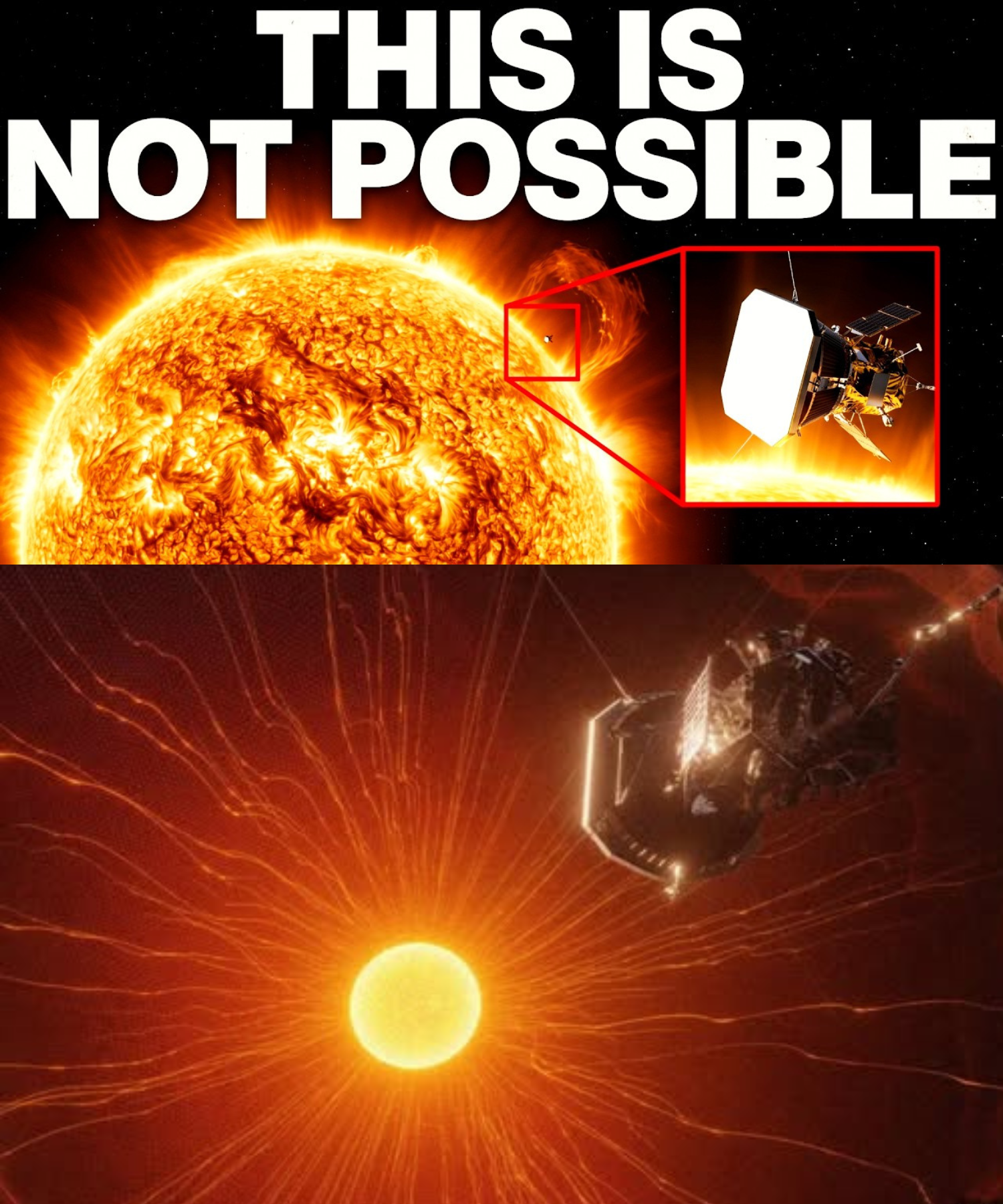
Traveling at an astonishing 430,000 miles per hour, it became the fastest human-made object in history.
At that speed, it could cross from New York to Los Angeles in just 20 seconds.
As the probe disappeared behind the Sun, all communication with Earth went dead.
The team at mission control could only wait in tense silence, unsure if their creation had survived the journey through hell itself.
This is the remarkable story of how humanity literally touched a star and the groundbreaking discoveries that followed.
Most people believe the Sun is dangerous simply because it is extremely hot.
Its visible surface burns at around 10,000 degrees Fahrenheit, already far beyond anything humans can truly imagine.
Yet the real danger lies not on the surface, but in the corona — the Sun’s outer atmosphere.
This massive, invisible envelope of plasma stretches millions of miles into space.
And its temperature is shockingly, almost impossibly high.
While the Sun’s surface sits at 10,000 degrees Fahrenheit, the corona reaches between one and three million degrees Fahrenheit — up to 300 times hotter than the layer directly below it.
This completely defies basic thermodynamics.
Normally, the farther you move from a heat source, the cooler it becomes.
But with the Sun, the opposite happens.
As you leave the surface and enter the corona, temperatures skyrocket.
For more than 80 years, this coronal heating problem stood as one of the greatest unsolved mysteries in astrophysics.
The stakes are far higher than pure science.
The corona is where the solar wind is born — a relentless stream of charged particles racing outward at 200 to 500 miles per second.
When this wind slams into Earth’s magnetic field, it can trigger powerful geomagnetic storms capable of disabling satellites, knocking out GPS, disrupting communications, and even collapsing entire power grids.
The spacecraft that achieved this miracle is named after a legend.
In 1958, young astrophysicist Eugene Parker wrote a revolutionary paper predicting the existence of solar wind.
His work was initially rejected as contradicting established physics, but it was eventually published thanks to the intervention of a future Nobel laureate.
Years later, measurements proved Parker right.
When NASA prepared to send a probe into the Sun’s atmosphere, they took the unprecedented step of naming it after a living person.
Eugene Parker, then 91, watched his namesake rocket launch.
He passed away in 2022 at age 94, knowing his life’s work had reached the star he studied for decades.
Building a spacecraft capable of surviving inside a star presented enormous engineering challenges.
During close approaches, the sun-facing side of the Parker Solar Probe endures temperatures around 2,500 degrees Fahrenheit — hot enough to melt steel and titanium.
Yet the sensitive instruments behind the shield remain at a comfortable 85 degrees Fahrenheit.
The secret lies in an incredibly sophisticated thermal protection system just 4.
5 inches thick.
Made of carbon-carbon composite panels sandwiching a carbon foam core that is 97 percent air, it is one of the most effective insulators ever flown in space.
A special white coating reflects most of the Sun’s intense energy.
Surprisingly, the million-degree corona does not vaporize the probe because temperature and heat are different.
Although particles in the corona move at extreme speeds, the region is almost a perfect vacuum with very few particles.
The actual heat transferred to the spacecraft remains manageable.
Additionally, at such blistering speeds, the probe faces immense structural stress.
Engineers designed flexible joints so the spacecraft could bend rather than snap under intense forces.
Launched in August 2018, the Parker Solar Probe could not head straight for the Sun.
It used seven gravity-assist flybys of Venus over six years to gradually tighten its orbit.
Each pass slowed the probe and pulled it closer, setting new records for proximity to the Sun.
Even before its final daring dive, the spacecraft made major discoveries.
It revealed that the solar wind near the Sun is far more turbulent than expected.
It detected mysterious zigzagging magnetic reversals called switchbacks in surprising numbers.
It also flew through coronal mass ejections and measured them from the inside for the first time.
The final Venus flyby occurred in November 2024.
On Christmas Eve, the probe began its closest approach, plunging to just 3.
8 million miles from the Sun’s surface — more than seven times closer than Mercury ever gets.
Communication blackout was inevitable due to intense radiation.
For two days, the spacecraft operated completely alone on autopilot.
Then, on December 26th, a simple beacon tone reached Earth.
The control room erupted in emotion as engineers realized their probe had survived.
When full data arrived in early January 2025, scientists were stunned.
The Wide-field Imager for Solar Probe captured the birth of the solar wind in real time — plasma streams accelerating outward from the corona.
They also witnessed a never-before-seen phenomenon: the solar wind U-turn.
During coronal mass ejections, some plasma loops back toward the Sun, pulled by its magnetic field, influencing future eruptions.
This feedback mechanism is key to understanding why some solar storms become exceptionally powerful.
Most importantly, the data points strongly toward switchbacks and magnetic reconnection events as major drivers of the coronal heating mystery.
After 80 years, scientists may finally be close to solving it.
The Parker Solar Probe has continued its record-breaking orbits throughout 2025, operating during the peak of the Sun’s 11-year activity cycle.
Its findings are crucial for practical reasons.
Currently, warnings for major solar storms give us only minutes to hours.
The new data could extend that to days, potentially protecting trillions of dollars in infrastructure and preventing catastrophic blackouts similar to the 1859 Carrington event.
On that historic Christmas Eve in 2024, a human-built machine flew into the atmosphere of a star, survived conditions that should have destroyed it, and returned with knowledge that is already rewriting textbooks.
What was once considered untouchable is now within our reach.
The Parker Solar Probe has not only advanced science — it has given humanity powerful new tools to safeguard our civilization from the fury of our own star.