A Hunter Rescued An Injured Bigfoot From A Grizzly Bear Attack, And The Creature Followed Him Home
A Hunter Rescued An Injured Bigfoot From A Grizzly Bear Attack, And The Creature Followed Him Home
The first thing Mason Hale heard was not the bear. It was the scream.
It ripped through the timber like something ancient being torn out of the earth, deep and human enough to freeze his blood, yet wild enough to make every bird in the valley burst from the trees at once. Mason had hunted the northern Montana backcountry for thirty years. He knew the sound of elk, wolves, cougars, wounded deer, and angry grizzlies. But this was different. This was not a normal animal in pain. This was something bigger, something desperate, something that should not have been hidden in those woods at all.
Mason had been tracking a bull elk since dawn. The morning was cold, the kind of cold that turned breath into smoke and made the pine needles glitter silver beneath the rising sun. He had gone farther than usual, crossing a ridge most hunters avoided because the land dropped sharply into a forgotten drainage locals called Blackwater Hollow. People said strange things happened there. Dogs refused to enter. Trail cameras went dead. Once in a while, ranchers found cattle spooked half to death, staring toward the forest as if something had watched them all night.
Mason never cared much for stories. He was a practical man, a former logger, a widower, and a hunter who believed the woods were dangerous enough without inventing monsters. But when that scream came again, followed by the unmistakable roar of a grizzly bear, he stopped breathing.
Then the trees exploded.
A massive shape crashed through the brush fifty yards below him, breaking branches as thick as fence posts. For one terrible second Mason thought it was the bear. Then he realized the creature was running upright.
It was enormous.
Covered in dark brown hair matted with mud and blood, the figure stumbled between the trees on two legs, one arm hanging awkwardly at its side. It moved like a man and an animal at once, powerful but wounded, frantic but intelligent. Behind it came the grizzly, a huge silver-backed male, roaring so loudly Mason felt it in his ribs.
The creature slipped on loose stones near the creek bed and went down hard.
The bear was on it instantly.
Mason raised his rifle before he knew he had made a decision.
He had never fired on a grizzly unless there was no other choice. They were protected, respected, and feared for a reason. But what he saw next removed all doubt. The wounded creature lifted its good arm, not to attack, but to shield its face. Its eyes, wide and amber beneath a heavy brow, locked onto Mason’s for half a heartbeat.
There was fear in them.
Not animal panic. Not blind instinct.
Fear. Pleading. Recognition.
Mason fired.
The shot cracked through the hollow. The grizzly reared, startled, then turned toward him with a furious roar. Mason fired again into the dirt near its front paws, then a third time into the deadfall beside it. The bear hesitated, snapping its jaws, torn between rage and caution. Finally, with a thunderous huff, it backed away into the timber, vanishing behind the dark line of spruce.
Silence fell so sharply it felt unnatural.
Mason lowered his rifle, his hands shaking.
The creature lay motionless by the creek.
For a long moment, he stood there telling himself to walk away. He told himself no good would come from going closer. He told himself that whatever he had just saved was not his problem, not his business, and possibly not something any man was meant to see.
But then the creature groaned.
It was a low, heartbreaking sound.
Mason climbed down the slope.
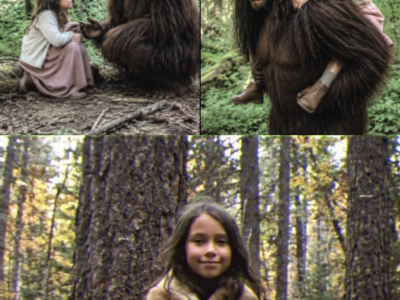
Up close, it was even larger than he had thought. Nearly eight feet long even curled on its side, with shoulders broader than any man’s and hands twice the size of Mason’s. One leg was badly injured, the thigh marked with deep claw wounds from the bear. Blood darkened the fur around its ribs. Its left arm seemed dislocated or broken. Yet its face was what stunned Mason most.
It was not human.
But it was not simply an ape either.
The brow was heavy, the jaw powerful, the nose broad and flat, but the eyes were aware. Pain-filled. Watching. Measuring. Trying to understand whether Mason was another threat or something else entirely.
Mason swallowed hard.
“Easy,” he whispered, though he had no idea if it understood. “I’m not here to hurt you.”
The creature’s lips pulled back slightly, revealing large teeth. Mason froze. But it did not lunge. Instead, it made a rumbling sound deep in its chest, almost like a warning mixed with exhaustion.
Mason backed away slowly and took off his pack.
He had a first-aid kit, a canteen, a roll of clean cloth, and painkillers meant for emergencies. None of it was made for something like this. Still, he worked carefully, speaking in a low voice the entire time. He cleaned what wounds he could reach. The creature flinched violently at first, nearly knocking him over with one twitch of its arm. But after a few minutes, it seemed to understand.
Or maybe it was simply too tired to fight.
When Mason poured water over the worst claw marks, the creature let out a sharp bark of pain that echoed off the rocks. Mason paused, heart pounding, but its huge hand only dug into the dirt. He wrapped the wound as best as possible, using strips from an old flannel shirt he carried in his pack. The bandage looked ridiculous against that massive leg, but the bleeding slowed.
The creature watched every movement.
At one point, Mason reached for his canteen. The creature’s eyes followed it. He held it out carefully, expecting nothing. To his shock, one massive hand closed around it with astonishing gentleness. It sniffed the metal bottle, then drank, spilling half the water down its chest.
Mason stared.
No hunter, no scientist, no skeptic could have explained that moment away. This was not a bear standing weird. This was not a man in a costume. This was something alive, injured, intelligent, and hidden from the world.
The sun was sinking by the time Mason stood.
“I have to go,” he said, feeling foolish for talking to it. “You stay here. Rest.”
The creature’s eyes narrowed.
Mason pointed toward the deeper forest. “Stay.”
Then he climbed back up the slope, retrieved his rifle, and began the long walk home.
He made it nearly two miles before he heard the first branch snap behind him.
Mason stopped.
The forest stopped with him.
He turned slowly.
Nothing.
He walked again.
Another branch snapped.
This time, closer.
Mason’s mouth went dry. He gripped his rifle but did not raise it. The shadows were thick now, stretching between the trees. Whatever was following him moved carefully, staying just out of sight. He could feel it, heavy and silent, matching his pace from the timberline.
“You shouldn’t be doing this,” Mason called.
No answer.
Only the soft crunch of something massive stepping over dead leaves.
By the time Mason reached his cabin, the moon had risen over the ridge. His house stood alone in a clearing, a weathered two-room structure with a woodstove, a small barn, and a porch his late wife had painted blue twenty years earlier. He stepped inside, locked the door, and stood in the dark listening.
For several minutes, there was nothing.
Then something moved outside the window.
Mason turned off the lantern.
A shape stood at the edge of the clearing.
The creature had followed him home.
It remained near the trees, half-hidden in moonlight, swaying slightly from exhaustion. Mason could see the white strips of cloth tied around its leg. It had walked miles on a wounded body, through cold forest and darkness, not to attack him, but to remain near him.
That thought unsettled him more than fear would have.
He opened the door.
The creature did not move.
Mason stepped onto the porch, holding a blanket in one hand and a bucket of water in the other. He placed them at the bottom of the steps, then backed away.
For a long time, nothing happened.
Then the creature limped forward.
The boards creaked under Mason’s boots as he stood frozen on the porch. The creature bent awkwardly, picked up the bucket, and drank. Then it touched the blanket, sniffed it, and dragged it toward the tree line.
Before disappearing into the woods, it looked back once.
Mason did not sleep that night.
By morning, he convinced himself it would be gone. But when he stepped outside, he found something lying near the porch.
A dead rabbit.
Placed carefully beside the empty bucket.
Mason stared at it for nearly a minute before the meaning struck him.
Payment.
Or thanks.
The next three days changed Mason’s life completely.
The creature stayed near the cabin, never fully entering the clearing in daylight, but always close enough to be seen between the trees. Mason began leaving food near the woodpile: apples, dried meat, fish, and water. Each morning, something was left in return. A rabbit. A bundle of strange roots. Once, a polished stone unlike anything Mason had seen in the area, smooth black with a thin white line running through its center.
The creature’s wounds slowly improved.
Mason started calling it “Calder,” after the old creek behind the cabin. He did not know if the name meant anything to the creature, but after a while, when Mason said it aloud, the shadow in the trees would turn its head.
There were rules between them, unspoken but clear. Mason did not approach too quickly. Calder did not come too close to the cabin. Mason never pointed the rifle at him. Calder never showed his teeth.
But trust, strange as it seemed, began to grow.
On the fifth evening, Mason was splitting wood when the creature stepped fully into the clearing for the first time.
The axe slipped from Mason’s hands.
Calder stood in the fading light, towering over the grass, his massive chest rising and falling beneath the thick fur. The bandage on his leg had torn loose. The wound was healing, but not cleanly. Mason understood why he had come.
He went inside, retrieved his kit, and sat on the porch step.
“Come on then,” Mason said softly.
Calder approached.
Every instinct in Mason’s body screamed at him to run. The creature was close enough now that Mason could smell earth, pine sap, wet fur, and blood. But Calder lowered himself slowly onto the grass and extended his injured leg.
Mason cleaned the wound again.
This time, Calder did not flinch.
That was when Mason noticed the scars.
Not just from the grizzly. Older scars covered Calder’s body. Long pale marks beneath the fur. A healed puncture wound near the shoulder. A circular burn near the ribs. Mason had seen enough injuries in animals and men to know some were not from predators.
Some looked like traps.
Some looked like bullets.
Mason’s stomach tightened.
“You’ve had a hard life, haven’t you?” he murmured.
Calder looked at him with those amber eyes and made a low sound, softer than before.
That night, Mason wrote everything down in an old notebook. He described the attack, the rescue, the wounds, the behavior, the gifts. He sketched the footprint he found near the creek: sixteen inches long, wide at the toes, with a midfoot break no human boot could fake. He did not plan to show anyone. Not yet.
But secrets do not stay hidden in small towns.
The first person to notice something strange was Mason’s neighbor, Eli Rawlins, who lived five miles down the gravel road. Eli found enormous tracks near his cattle fence and called Mason before calling wildlife control.
“You seen anything weird up your way?” Eli asked.
Mason looked out the window.
Calder was crouched near the barn, watching a raven hop across the roof.
“No,” Mason lied.
Two days later, a game camera on public land captured a blurry image of a towering figure moving through the trees near Mason’s property. By sunset, the photo was online. By morning, three trucks had parked near the old logging road, carrying men with cameras, rifles, and too much excitement in their voices.
Mason knew trouble had arrived.
He found Calder near the creek and spoke more urgently than he ever had.
“You need to go,” he said. “People are coming. Bad people.”
Calder watched him, silent.
Mason pointed toward the mountains. “Go. Deep woods. Now.”
Calder did not move.
That evening, the first shot rang out.
It was not aimed at Mason. It came from the far side of the clearing, where two trespassers had pushed through the brush with flashlights. Mason heard one of them shout, then another shot cracked across the trees.
Calder roared.
The sound shook the cabin walls.
Mason grabbed his rifle and ran outside. The trespassers stumbled backward from the tree line, terrified, one dropping his flashlight in the grass. Calder stood between them and the cabin, taller than any nightmare, his teeth bared, his injured arm lifted defensively.
“Get off my land!” Mason shouted.
The men ran.
But the damage was done.
By the next afternoon, local deputies came to Mason’s door, followed by wildlife officers and a man in a government jacket who never introduced himself properly. They claimed they were investigating reports of a dangerous animal. Mason told them they were wasting their time.
The man in the jacket studied Mason’s porch, the disturbed grass, the huge prints near the woodpile.
“You live alone, Mr. Hale?” he asked.
“Yes.”
“You sure about that?”
Mason said nothing.
The search began at dawn the next morning. Helicopters circled the ridge. Drones moved over the trees. Men with tranquilizer rifles crossed the creek. Mason stood on his porch, helpless and furious, listening to the forest fill with machines.
Calder did not appear.
For hours, Mason hoped he had finally left.
Then a roar erupted from Blackwater Hollow.
The forest exploded with shouting.
Mason ran.
He found them near the same creek bed where it had all begun. Calder had been cornered against the rocks by three men with nets and rifles. One dart already hung from his shoulder. Another struck his chest as Mason stumbled into view.
“No!” Mason shouted.
Calder staggered.
His eyes found Mason’s through the chaos.
There was no accusation in them. Only confusion. Betrayal. Fear.
Mason stepped between the men and the creature.
“Back off!” he yelled.
One officer grabbed his arm. “Sir, move away!”
“You don’t understand what he is!”
The man in the government jacket appeared behind them, calm as stone. “We understand enough.”
Calder dropped to one knee.
Then the grizzly returned.
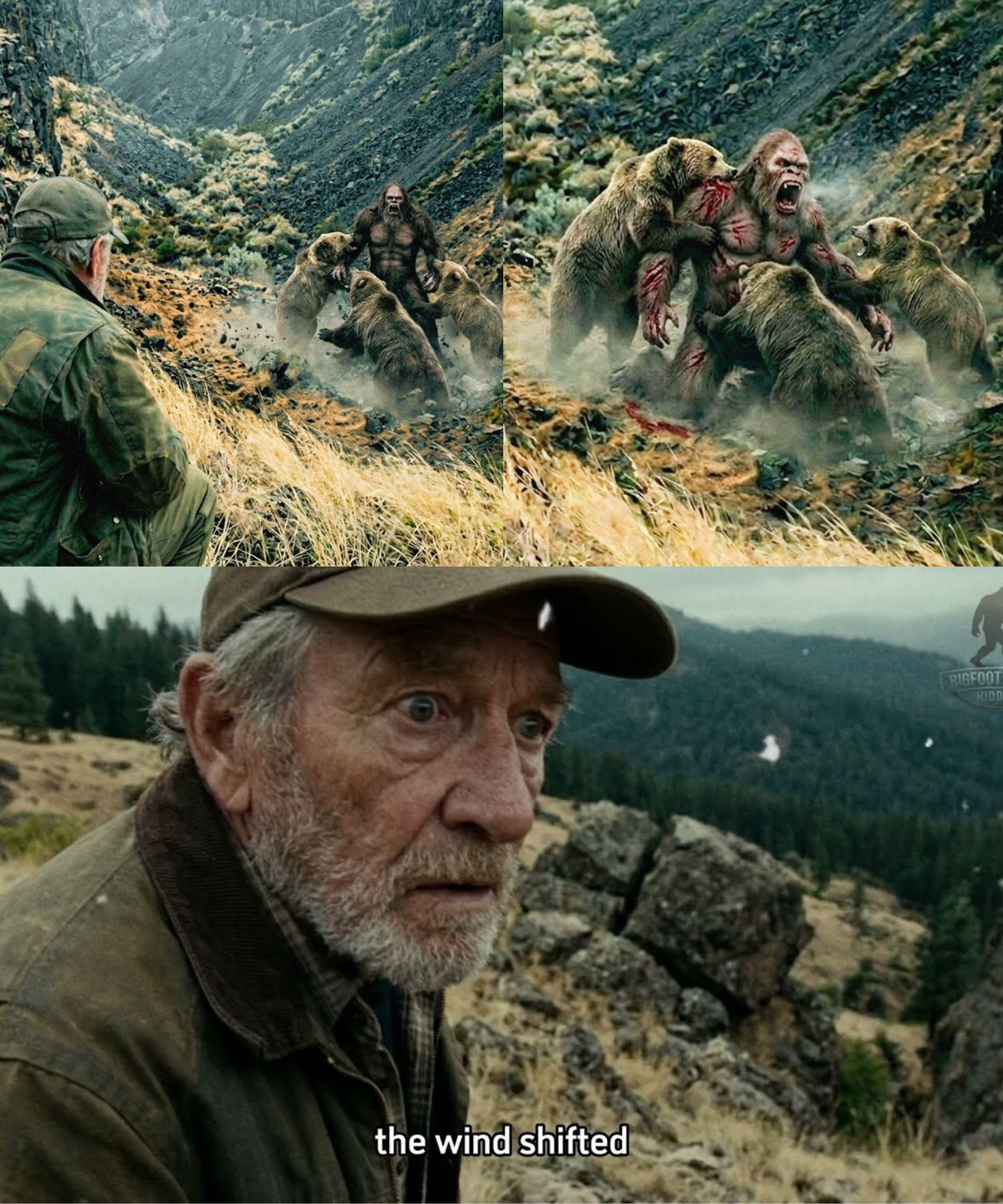
It came from the timber like a freight train, roaring, wounded from its earlier encounter and maddened by hunger or rage. The men scattered. One fell into the creek. Another fired wildly into the air. The bear charged straight toward the group.
Mason raised his rifle, but he was too slow.
Calder was not.
Drugged, wounded, and barely able to stand, the creature surged forward with a final burst of impossible strength. He slammed into the grizzly from the side, driving it away from Mason and the fallen men. The two giants crashed into the brush, tearing through saplings and rocks. The sound was terrifying: roars, cracking branches, heavy bodies striking earth.
Then silence.
Mason ran into the trees.
He found Calder lying near a fallen cedar. The grizzly was gone, retreating deeper into the hollow. Calder’s breathing was ragged. Blood darkened his fur again. His amber eyes fluttered open when Mason knelt beside him.
“You saved us,” Mason whispered.
Calder’s huge hand lifted slowly.
For a moment Mason thought he was reaching for help. Instead, the creature touched Mason’s chest with two fingers, right over the heart.
Then he pointed toward the mountain.
Mason understood.
Home.
Not Mason’s cabin.
Not the clearing.
The deep place beyond Blackwater Hollow, where his kind still lived, hidden from men and guns and cameras.
Mason turned to the officers.
“You want your proof?” he said, voice breaking. “Then watch this.”
He helped Calder rise.
No one stopped them. Maybe they were too shocked. Maybe they had finally seen enough to understand that capturing him would be a crime against something older than law.
Step by painful step, Mason walked beside the creature into the trees. They crossed the creek. Climbed the slope. Reached the dark mouth of an old ravine hidden behind hanging moss and stone. Calder paused there.
From somewhere deep inside the ravine came another sound.
A low call.
Then another.
Mason saw movement in the shadows. Tall shapes. Watching.
Calder was not alone.
He turned back once more.
Mason could barely speak. “Go on.”
The creature gave a soft rumble, almost like farewell.
Then he disappeared into the darkness.
After that day, the official report said the search had found no confirmed evidence of an unknown primate. The blurry photos were dismissed. The tracks were blamed on hoaxes. The men in government jackets left town before sunrise.
But Mason kept the notebook.
He kept the black stone.
And every winter, when the snow fell heavy and the forest went silent, something would appear on his porch.
A bundle of fresh cedar.
A deer antler.
A smooth river stone.
Once, during Mason’s final winter in the cabin, when age had bent his back and made his hands tremble, he woke to find enormous footprints circling the house. Not one set.
Several.
They had come quietly in the night.
Not to threaten him.
To remember him.
And sometimes, when the wind moved through Blackwater Hollow, locals still claimed they heard a deep call rolling down from the mountains. They said it sounded like grief. Or warning. Or maybe gratitude carried through the trees by something the modern world was never meant to capture.
Mason Hale never tried to prove what happened.
He did not need to.
Because some truths are not meant to be dragged into the light, measured, caged, and displayed. Some truths are meant to remain in the wild, where only the brave, the broken, and the merciful ever come close enough to see them.
And somewhere beyond the forgotten creek, in the dark timber where no road reaches, a creature once hunted by men survived because one man chose compassion over fear.