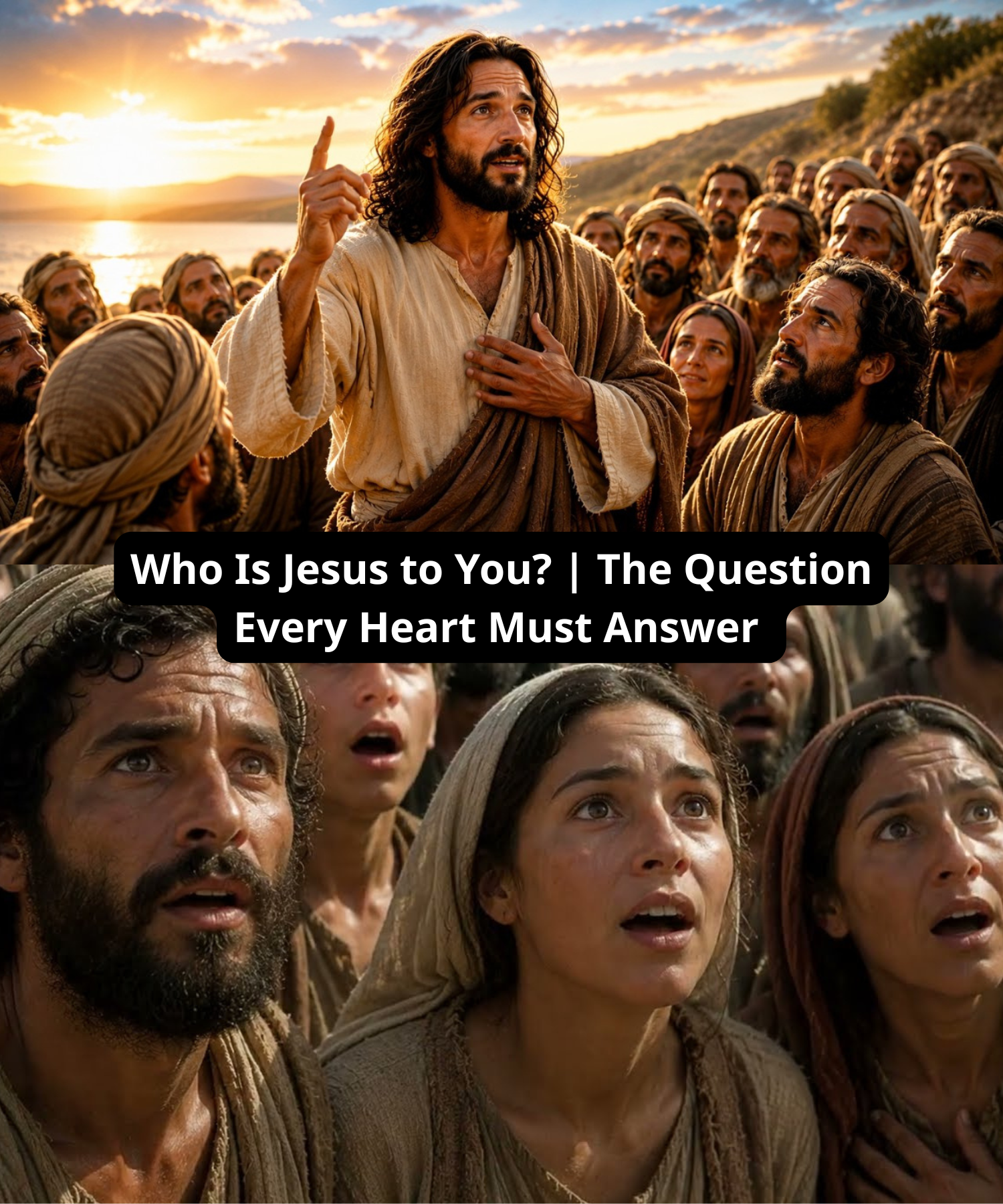
Who Is Jesus to You? | The Question Every Heart Must Answer
Who Is Jesus to You? — The Question Every Heart Must Answer
Part 1
The question first appeared in New York City at 3:16 in the morning, not on a church wall, not in a dream, not in the sky, but across every digital billboard in Times Square at once. The advertisements vanished without warning. The perfume models, stock apps, Broadway posters, luxury condos, political slogans, and streaming trailers all went black. For seven seconds, the most expensive screens in America showed only a single sentence in plain white letters: Who is Jesus to you? Then the ads returned as if nothing had happened, and Manhattan tried to keep moving.
But New York had already been interrupted.
The first people to notice were not pastors or scholars. They were cab drivers, delivery cyclists, night-shift nurses, tourists with dead phone batteries, police officers, homeless men sleeping under scaffolding, and a janitor named Luis Alvarez who was mopping the floor of a fast-food restaurant across from the square. Luis had not been to church in eleven years. He had grown up Catholic in Queens, had worn a cross as a boy, had stopped praying after his wife died in a hospital hallway while he was working overtime. When the question appeared, he stood with the mop in his hands and felt anger rise before wonder did.
“Who is Jesus to me?” he whispered bitterly. “The one who didn’t show up.”
Across town, in an apartment near Columbia University, Dr. Miriam Cole woke to dozens of messages. Miriam was a biblical historian, known for explaining Jesus in classrooms with care, nuance, and footnotes. She had spent twenty years studying the Gospels, early Christianity, Jewish messianic expectations, Roman crucifixion, and the way Americans kept remaking Jesus into a mirror of their politics, pain, and ambitions. Her students often asked whether she believed. She usually answered, “I know too much to answer quickly.” It sounded clever. It also protected her from saying anything costly.
At 3:22, her phone lit up with a video from Times Square. The question filled the screen: Who is Jesus to you?
Miriam sat upright in bed, heart pounding in a way scholarship could not explain.
By sunrise, the question had appeared in Ohio too. Not on billboards, but on the sign outside a closed factory in Mercy Ridge, a small town outside Cleveland where rusted gates, broken windows, and weed-choked parking lots still stood like monuments to abandoned labor. The factory sign had read Harlan Precision Components — Building America’s Future since the 1980s, though the building had been empty for six years. That morning, the slogan was gone. In its place, painted in letters no camera had captured being made, were the words: Who is Jesus to you?
Ruth Bell saw it first. She was seventy-three, retired from the school cafeteria, known locally for running the food pantry with a voice that could bend metal. She stood outside the factory gate with grocery bags in both hands and stared at the words. Her grandson Marcus, seventeen years old and angry at everything holy, looked at the sign and snorted.
“Jesus?” he said. “To this town? A closed church, a food line, and people telling us to have hope while they leave.”
Ruth did not scold him. She looked at the abandoned factory, then at the food pantry down the street.
“Maybe,” she said, “that’s why He asked.”
In Los Angeles, the same question appeared not in lights, but in silence. At exactly 12:16 a.m. Pacific time, every screen inside a Burbank editing studio froze on a single frame: a homeless woman under a freeway holding a cup of water. Then, across the image, the question appeared: Who is Jesus to you? Naomi Reyes, the documentary filmmaker working there, froze in her chair. She knew the woman in the frame. Her name was Angela Brooks. Years earlier, Naomi had filmed her for a documentary and cut her story because it made the film less clean.
Naomi leaned closer to the monitor, unable to breathe.
The question was no longer public.
It had become personal.
Part 2
By midmorning, America was arguing. Cable news asked whether the Times Square incident was a hack. Tech analysts said the synchronization across multiple systems was nearly impossible without high-level access. Conspiracy channels claimed government psyops. Atheist influencers mocked religious panic. Pastors rushed to record reaction videos. Politicians posted carefully worded statements about faith and national values. Christian influencers turned the question into merchandise before lunch. A shirt appeared online reading: Who Is Jesus to You? underneath a stylized crown and American flag.
Father Gabriel Moreno saw the shirt on his phone and immediately closed the app. He was the pastor of St. Michael’s Church in Queens, where the basement food pantry fed more people than the Sunday congregation could comfortably admit. He had spent the morning answering calls from parishioners who wanted to know whether the question was a sign. He had no official answer. But he knew enough about signs to know they were dangerous when people wanted spectacle more than conversion.
At noon, he opened the church doors.
People came in waves. Some were devout. Some were curious. Some were frightened. Some were angry. Luis Alvarez came still wearing his janitor uniform, though he stood near the back with his arms crossed, ready to leave if anyone tried to comfort him too quickly. Miriam came too, not because she wanted confession, but because she wanted to observe. That was what she told herself. Observation was safer than prayer.
Father Gabriel stood before the congregation and did not give them a theory.
He gave them the question.
“Who is Jesus to you?” he said. “Not to America. Not to your political party. Not to your favorite preacher. Not to your childhood memories. Not to your enemies. To you.”
The church was silent.
He continued, “Some will answer Teacher. Some will answer Prophet. Some will answer Savior. Some will answer Myth. Some will answer Judge. Some will answer Stranger. Some will answer Wound. But I ask you to be honest before you become religious. Because the wrong answer spoken honestly may be closer to grace than the right answer used as a costume.”
Luis looked up.
Miriam felt the words hit harder than she wanted.
In Ohio, Ruth opened the Mercy Ridge food pantry early. The painted question on the factory sign had drawn reporters, but Ruth refused to let them film hungry families without permission. “If your camera sees cans before faces, get out,” she told a local news crew. Marcus watched from the doorway, amused despite himself.
A young reporter asked Ruth, “What does Jesus mean to you?”
Ruth did not hesitate. “He is the one who keeps making me feed people I’m tired of feeding.”
The reporter blinked, unsure whether that was inspirational.
Marcus laughed.
But later, when the pantry line stretched down the sidewalk, Marcus noticed something strange. People who usually came silently were talking. A laid-off welder said Jesus was the only reason he had not given up. A single mother said she did not know whether she believed anymore but hoped Jesus still believed in her. An old man said Jesus was the man on the cross his grandmother prayed to when rent was due. A teenager said Jesus was “church people yelling at me.” Ruth heard that and said, “Then you met church people. Maybe not Jesus.”
In Los Angeles, Naomi drove to the underpass where Angela Brooks still volunteered twice a week. Angela was no longer homeless. She lived in transitional housing, worked part-time at a recovery center, and handed out water to people who still slept where she once had. When Naomi arrived, Angela recognized her immediately.
“You cut me,” Angela said.
Naomi nodded. “Yes.”
“Why?”
“Your story didn’t fit my film.”
Angela stared at her for a long moment.
Then she said, “Maybe Jesus didn’t fit it either.”
Naomi had no answer.
The question followed her all the way home.
Part 3
The second wave of signs came that night, and this time they did not appear on public screens. They appeared where each person had avoided answering.
For Miriam, it came in the margins of her lecture notes. She had been preparing a class on the historical Jesus, with sections on first-century Galilee, Roman occupation, Jewish apocalyptic hope, messianic titles, and the development of early Christology. She had taught the material so many times that she could lecture half-asleep. But when she opened her notes, the first page had changed. Across the top, in her own handwriting, was written: You know what others said about Him. What do you say?
She dropped the folder.
For years, Miriam had hidden behind the difference between history and confession. She could tell students what the Gospels claimed, what Paul wrote, what councils defined, what scholars debated, what skeptics rejected, what believers worshiped. But she had built a small locked room inside herself where the question of Jesus remained professionally interesting but personally postponed.
That night, there was no postponing.
In Ohio, Marcus found the question inside an old shoebox under his bed. He had been looking for a phone charger when he found his father’s Bible. His father, Daniel, had died from an overdose when Marcus was twelve. Ruth had kept the Bible, though Marcus had once told her to throw it away. Now it lay in the box, worn, underlined, smelling faintly of cigarette smoke and old paper. Marcus opened it angrily, expecting nothing. A photograph slipped out. It showed his father standing outside a church, thinner than Marcus remembered, smiling awkwardly beside a handwritten note.
The note said: Marcus, if you ever read this, I failed you badly. But Jesus found me in places I hope you never go. I don’t know how to be clean enough to come home yet. Pray I learn.
Marcus sat on the floor, frozen.
On the inside cover, his father had written one sentence: Jesus is the one I run from because He still calls me son.
Marcus closed the Bible and pressed both hands against his eyes.
In Los Angeles, Naomi found her sign in raw footage from a documentary she had abandoned years earlier. She opened the file after leaving Angela and saw the interview she had cut. Angela, thinner then, face marked by exhaustion, sat under the freeway and answered a question Naomi had forgotten asking.
“Who is Jesus to you?” Naomi’s younger voice said off camera.
Angela had looked straight into the lens.
“Jesus is the one who sat with me when Christians wanted a cleaner testimony.”
Naomi stopped the video.
She had cut that line because it made the film uncomfortable. Now it returned like judgment.
The next morning, the question reached Washington, D.C. It appeared silently on the front page of several major news websites after a brief outage: Who is Jesus to you? Government officials demanded cybersecurity reviews. Religious leaders demanded national prayer. Commentators demanded explanations. But in cities across America, ordinary people were no longer waiting for experts. The question had already entered bedrooms, kitchens, hospital rooms, prison cells, classrooms, offices, and cars parked outside churches where people were not yet brave enough to go inside.
Father Gabriel received hundreds of handwritten answers at St. Michael’s. He placed baskets near the altar labeled Teacher, Savior, Stranger, Judge, Wound, Hope, and I Don’t Know. The I Don’t Know basket filled first.
He smiled when he saw that.
“Good,” he whispered. “At least we’ve started telling the truth.”
Part 4
Naomi decided to make a film, but this time she did something unusual: she waited. Her instincts told her to chase the story across America immediately, but Angela’s words had wounded her properly. So she spent the first week volunteering at the underpass before turning on a camera. She handed out water, carried blankets, learned names, listened badly at first, then better. Only after Angela said, “Now maybe you can film,” did Naomi begin.
The film would be called The Question Every Heart Must Answer. It would follow the question through New York, Ohio, and Los Angeles, but not as a supernatural spectacle. Naomi wanted to see what happened when people stopped answering for groups and started answering from wounds.
Her first interview was with Angela.
“Who is Jesus to you now?” Naomi asked.
Angela took a long time before answering. Traffic roared above them.
“He is not my escape,” she said. “I wanted Him to be that. I wanted Jesus to take me out of pain, out of shame, out of memory. But He stayed with me inside it first. That made me mad. Then it saved me. So to me, Jesus is the one who does not leave just because the story gets ugly.”
In New York, Naomi filmed Luis Alvarez after Father Gabriel introduced them. Luis agreed only if she filmed him at work, not in church. So she followed him through a night shift, mopping floors, wiping tables, emptying trash, stacking chairs after people who never looked at his face. Around 2:00 a.m., they sat in the closed restaurant while rain streaked the windows.
“Who is Jesus to you?” Naomi asked.
Luis stared at his hands.
“My wife believed He was everything,” he said. “When she was sick, she prayed like He was in the room. I prayed too, at the end. She died anyway.”
He swallowed hard.
“So for years, Jesus was the one I blamed because blaming emptiness is harder.”
Naomi did not interrupt.
Luis continued, “But after that question appeared, I went to St. Michael’s. Father Gabriel didn’t explain my wife’s death. Thank God. If he had, I would have left. He just said Jesus also asked why He had been forsaken.”
His voice cracked.
“I don’t know what to do with a God who knows that sentence.”
In Ohio, Marcus refused Naomi’s interview twice before Ruth cornered him in the pantry and said, “If you can spend four hours arguing online, you can spend ten minutes telling the truth.” He sat on the loading dock behind the food pantry, his father’s Bible beside him, hoodie pulled low.
“Who is Jesus to you?” Naomi asked.
Marcus laughed bitterly. “The one my dad found too late.”
Then he looked at the Bible.
“Or maybe the one who found my dad when everyone else was done with him.”
He wiped his face angrily.
“I hate that I want that to be true.”
Naomi lowered the camera slightly.
“That may be the truest thing anyone’s said yet.”
The film began spreading before it was finished. Short clips from Angela, Luis, and Marcus moved slowly online, not with the explosive speed of scandal, but with the deeper movement of people sending them privately to someone they loved. The question was no longer a headline. It had become a mirror.
Part 5
The most unexpected answer came from a prison in upstate New York. Father Gabriel received a letter from a man named Peter Lawson, serving a life sentence for murder. Peter had seen the question on a television in the prison common room before the screen went dark. He wrote that the men had laughed at first. Then one of them said, “Jesus is the guy people bring up when they want us to feel bad.” Another said, “Jesus is parole for people who still get to go home.” Peter had said nothing. That night, the question appeared again in his cell, not on a wall, but in his memory.
He remembered his victim.
A twenty-three-year-old man named Elijah Brooks, killed during a robbery Peter had committed thirty-one years earlier. Peter had spent decades saying he accepted responsibility while keeping Elijah abstract enough to survive. But after the question appeared, he dreamed of Elijah as a boy, then as a young man, then as a body. In the dream, Jesus stood beside Elijah and asked Peter, “Who am I to you if I stand with him first?”
Peter woke sobbing.
Naomi visited the prison with Father Gabriel after months of correspondence and approval. She expected hardness. Peter was not hard. He was worse. He was honest. They sat across from him in a small interview room with beige walls.
“Who is Jesus to you?” Naomi asked.
Peter looked at the table.
“He used to be the one I wanted to forgive me without making me look at what I did,” he said. “Now He is the one who stands between me and the man I killed. Not hiding him. Not hiding me. Just standing there with wounds in His hands, refusing to let me call mercy cheap.”
Father Gabriel closed his eyes.
Peter continued, “If Jesus forgives me, He does not do it by pretending Elijah’s blood was light. He does it by carrying weight I cannot carry and still telling me to tell the truth.”
That interview changed the film.
Naomi realized the question did not only comfort. It judged. It did not let the grieving turn Jesus into mere explanation. It did not let the guilty turn Him into escape. It did not let scholars turn Him into subject, activists into slogan, politicians into symbol, artists into content, or churches into possession. Whoever Jesus was, He kept refusing to become useful in the ways people wanted.
In Los Angeles, Naomi screened a rough cut for a small group. Angela watched from the front row. Miriam flew in from New York. Ruth and Marcus came from Ohio. Luis came reluctantly, wearing a clean shirt and looking ready to flee. The room was quiet when the film ended.
Then Miriam stood.
“I need to answer,” she said.
Naomi, surprised, lifted the camera.
Miriam shook her head. “No. Not for the film.”
She faced the small room.
“I have spent my life studying Jesus,” she said. “I have called that devotion, and sometimes it was. But often it was distance. I could explain Him without obeying Him. I could teach His words without letting Him speak to me.”
Her voice trembled.
“So who is Jesus to me? He is the Lord I kept at the front of the classroom so I would not have to kneel.”
No one spoke.
Then Angela whispered, “That’ll do.”
Part 6
The national event happened on Easter morning. Not an explosion, not a voice from the sky, not a miracle that forced belief. At sunrise, across America, church bells rang in places where bells had not worked for years. A boarded church in Detroit. A small chapel in rural Kansas. A cathedral in New York. A mission church in Los Angeles. A flood-damaged parish in Louisiana. A prison chapel in upstate New York. A hospital chapel in Cleveland. Some bells were real. Some were electronic. Some had been disconnected. Yet they rang for exactly three minutes.
In Mercy Ridge, Ruth heard the bell of a closed Methodist church that had been empty since before Marcus was born. She stood on her porch in her robe and whispered, “Well, I guess You’re not subtle today.”
Marcus came outside holding his father’s Bible.
In New York, Luis heard bells while walking home from work. He stopped on the sidewalk as the sound rolled between buildings. For the first time since his wife’s death, he spoke to Jesus without accusation.
“I don’t forgive You yet,” he said. Then he paused. “But I’m listening.”
In Los Angeles, Naomi heard the bells through her apartment window and thought of Angela under the freeway, Peter in prison, Miriam in the classroom, Marcus on the loading dock, Luis in the restaurant. Her film was nearly complete, but now she understood it needed no final answer from her. The question belonged to each viewer.
At St. Michael’s in Queens, Father Gabriel preached to a crowd too large for the church. People stood in the aisles, near the doors, down the steps. Some had come because of the question. Some because of the bells. Some because Easter still pulled on childhood even after belief had thinned.
He read from the Gospel: “Who do you say that I am?”
Then he looked up.
“Jesus asked this before America existed,” he said. “Before our denominations, before our parties, before our screens, before our arguments. He did not ask because He lacked identity. He asked because we do. Every heart eventually answers. Not only with words. With money. With mercy. With forgiveness. With resentment. With courage. With silence. With what we do when nobody claps.”
The church was still.
“You may answer Savior and still refuse to be saved from pride. You may answer Lord and still obey yourself. You may answer Teacher and ignore His lesson. You may answer Myth and still be haunted by His mercy. You may answer I don’t know, and that answer may become a door if you speak it honestly.”
Miriam stood in the back, tears running down her face.
Marcus stood beside Ruth in Ohio, watching the sermon later on a cracked phone.
Angela watched with people under the freeway.
Peter watched from prison.
Luis watched alone in his apartment, holding his wife’s rosary for the first time in years.
The question had crossed America.
Now it waited inside each person.
Part 7
Naomi released the film one month later with no dramatic title effects, no celebrity narration, no thunder, no glowing cross over a skyline. It opened with Times Square going dark. Then the abandoned factory in Ohio. Then Angela’s frozen frame in Los Angeles. Then faces. Not famous faces. Not polished faces. Luis with tired eyes. Ruth with grocery bags. Marcus angry and grieving. Miriam undone by scholarship turned into prayer. Peter in prison. Angela under the freeway. Father Gabriel in the shelter kitchen. A nurse in Cleveland. A firefighter in Brooklyn. A teacher in Chicago. A farmer in Iowa. A mother in Miami. A child in Detroit.
Each answered the question.
Some answered with faith.
“Jesus is my Savior.”
“Jesus is God with wounds.”
“Jesus is the one who found me when addiction had eaten my name.”
“Jesus is the Lord I resisted until mercy became stronger than fear.”
Some answered with uncertainty.
“Jesus is the person I want to believe in.”
“Jesus is the question my grandmother left me.”
“Jesus is the story I keep trying to outgrow.”
“Jesus is either nothing or everything, and I’m scared of both.”
Some answered with anger.
“Jesus is the one people used to shame me.”
“Jesus is the God who didn’t heal my son.”
“Jesus is the name on buildings that locked their doors.”
Naomi left those answers in.
The film did not correct them immediately. It let them stand. Then it showed what happened after. The angry mother joining a grief group where no one explained her pain away. The person wounded by church abuse meeting a Christian counselor who did not defend the institution first. The skeptical teacher volunteering at a shelter because she said Jesus “might at least be right about the poor.” The addict entering recovery after hearing Peter’s interview. The businessman returning stolen wages after hearing Father Gabriel preach about answers made with money.
The film’s final section returned to Jesus’ own question: “Who do you say that I am?” Not as a slogan, but as a confrontation. Naomi cut between Gospel readings and modern faces. Peter confessing guilt. Luis lighting a candle. Marcus visiting his father’s grave. Miriam kneeling in an empty classroom. Angela handing water. Ruth stocking shelves. Father Gabriel washing dishes after Easter breakfast.
The film ended without music.
Only the question on a black screen:
Who is Jesus to you?
Under it, after a long pause, appeared another line:
Your life is already answering.
The response was unlike anything Naomi had made before. It did not go viral in the usual way. People did not simply share it publicly. They sent it privately. To fathers. Daughters. Old friends. Former pastors. Prison chaplains. Teachers. Nurses. People who had left church. People who had stayed but grown cold. People who hated Jesus because of Christians. People who loved Jesus but had stopped following Him beyond words.
Naomi received thousands of messages.
The shortest one came from Luis.
It said: I went back to church. I’m still angry. But I went.
She cried when she read it.
Part 8
Years later, people still remembered the question, though no one ever proved who placed it on the billboards, screens, signs, notes, and hidden places of America. Some said it was a coordinated art project. Some said it was a hack. Some said it was divine intervention. Some said mass suggestion. Some said America had asked itself the question because it was collapsing under the weight of false answers. The debates continued, but the people changed by it no longer cared as much about explaining the delivery. They cared about the answer still unfolding in their lives.
Miriam remained a scholar, but her teaching changed. She still taught history, context, languages, manuscripts, and debate. But on the final day of every course, she asked her students to write privately: Who is Jesus to me, and what answer does my life give? She did not collect the papers. That was the point.
Luis began volunteering at St. Michael’s once a week after his night shift. He still missed his wife. He still had questions no one could answer without insulting grief. But he stopped speaking of Jesus only as absence. One night, while serving soup, he told Father Gabriel, “I think Jesus was in the hallway when she died. I don’t know why He didn’t stop it. But maybe He was there.” Father Gabriel said, “That is not a small faith.” Luis answered, “It feels small.” The priest smiled. “Most real faith does.”
Marcus became a counselor for teenagers in Mercy Ridge. He kept his father’s Bible in his office, not as decoration, but as evidence that a life can be unfinished and still held by mercy. When angry boys told him Jesus was useless, he did not argue first. He asked who had made them think that. Then he listened.
Angela ran a recovery outreach under the freeway in Los Angeles. Naomi helped fund it anonymously until Angela found out and scolded her for being “secretly dramatic.” Peter remained in prison, but his letters became part of a restorative justice program. He never made his crime smaller. He also never let anyone make mercy smaller.
Ruth died at eighty-one after a morning at the food pantry. At her funeral, the church was packed with people who had eaten because she believed Jesus was the one who made her feed people she was tired of feeding. Marcus spoke through tears. “To my grandmother, Jesus was not an idea. He was an interruption with grocery bags.”
Naomi’s film became a quiet classic, shown in churches, prisons, universities, shelters, and homes where families had forgotten how to talk about faith without fighting. She never made a sequel. She said the question already had one. It was called the rest of your life.
On the tenth anniversary of the Times Square blackout, people gathered in New York, Ohio, and Los Angeles. Not for spectacle. For testimony. In Times Square, the screens did not go dark. In Mercy Ridge, the factory sign remained rusted and ordinary. In Los Angeles, the editing studio monitors behaved normally. No new miracle came to replace the old question.
At St. Michael’s, Father Gabriel, now older and slower, stood before the congregation and asked it one more time.
“Who is Jesus to you?”
No one answered aloud.
But after Mass, they went downstairs and served breakfast. Luis poured coffee. Miriam washed dishes. Marcus carried boxes. Angela handed out water. Naomi stacked chairs. A little girl asked why everyone was working so hard.
Father Gabriel looked at her and smiled.
“Because,” he said, “we are still answering.”
Outside, America continued moving: loud, wounded, proud, hungry, faithful, faithless, searching, running, praying, denying, returning. New York shone. Ohio endured. Los Angeles watched itself and sometimes learned to look away from the mirror. And somewhere beneath every argument, every sermon, every doubt, every grief, every act of mercy, the question remained alive.
Not as a slogan.
Not as a billboard.
Not as a film title.
As the question every heart must answer.
Who is Jesus to you?
And what is your life already saying?