It’s Confirmed! 432 Park Avenue Is Sinking Faster Than Anyone Predicted
“A 10-Inch Crack in Its Spine”: How New York’s Most Expensive Tower Became a $3 Billion Nightmare
When 432 Park Avenue opened, it was sold as the building of the 21st century. The tallest residential tower in the Western Hemisphere. The most slender super-tall ever built. Penthouses sold for nearly $90 million. Jennifer Lopez and Saudi billionaires bought in. The developers cleared roughly $900 million in profit before the first residents even moved.
Today, that same tower is facing a 46-page lawsuit alleging 1,893 documented defects — including a 10-inch crack inside its structural core. A penthouse that sold for $87.7 million is now listed at $15 million and still has no buyer. The original developer was foreclosed on by his own partner inside the building he created. The architect is dead.
So how does the most expensive condominium project in New York City history become one of its biggest engineering and financial disasters?
The Vision That Pushed Physics to the Edge
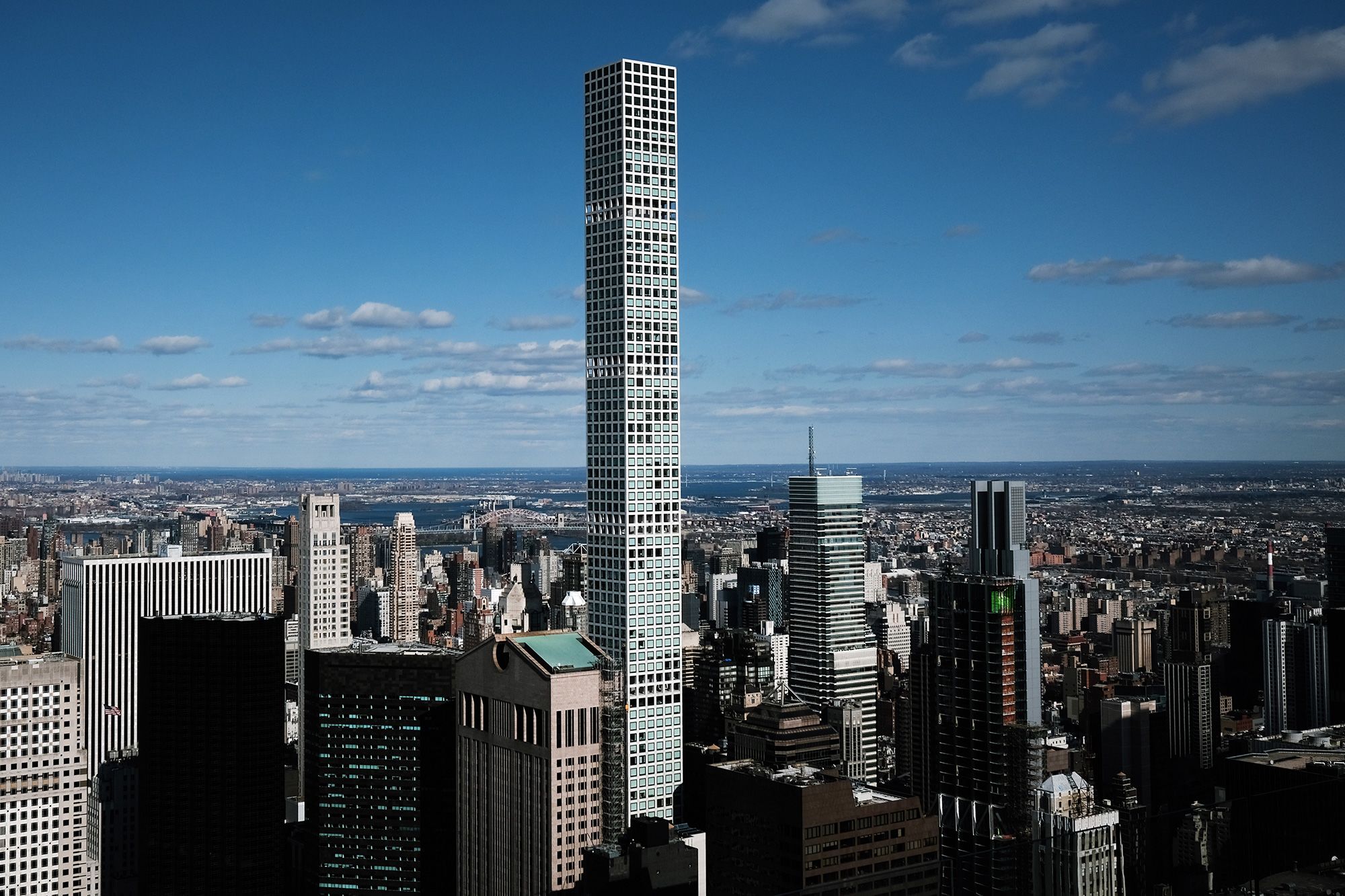
432 Park Avenue is 1,396 feet tall and only about 93 feet wide at the base — a height-to-width ratio of roughly 15 to 1. For context, buildings become wind-sensitive once they cross a 5-to-1 ratio. This tower is three times that threshold.
When wind hits a building this tall and slender, it doesn’t just push. It creates a phenomenon called vortex shedding — alternating swirls of air that peel off either side of the structure. If those swirls match the building’s natural resonance, the entire tower can begin oscillating sideways.
To fight this, the design team cut five open mechanical floors into the tower so wind could pass through. They added structural outriggers. They wrapped the building in a concrete shear frame. They installed two 660-ton tuned mass dampers at the top. And at the center of everything was a 30-foot-square reinforced concrete core with 30-inch-thick walls — the structural spine that holds the entire tower together.
That spine is now alleged to have a 10-inch-deep crack.
The Problems Started Almost Immediately
Residents began moving in during 2015 and 2016. The first signs that something was wrong appeared quickly.
In November 2017, a catastrophic flood hit floors 83 to 86 after pipes burst. In 2018 alone, there were multiple pipe failures, flooding in elevator shafts, and $9.7 million in water damage across 35 apartments. Insurance premiums on the building rose 300 percent in two years.
Residents reported constant creaking, banging, and whistling when the wind picked up. The trash chute — a straight 1,300-foot drop with no brakes — produced impacts that sounded like bombs going off inside apartments. One resident was trapped in an elevator for over an hour during high winds on Halloween 2019. There were electrical explosions. Facade violations were issued by the city.
By 2021, the condo board filed its first lawsuit seeking $125 million. In April 2025, they filed a much larger one.
The Scale of the Alleged Failures
The latest complaint alleges 1,893 defects across the building’s common elements. It claims that 73 percent of the mechanical, electrical, and plumbing systems were not built to specification. It alleges water has been seeping into structural columns and that steel reinforcement inside the concrete is corroding.
Most dramatically, it alleges a 10-inch-deep crack inside the building’s structural core — the reinforced concrete spine that engineers say absolutely cannot be compromised.
Plaintiffs’ counsel described the situation as extending “beyond negligence into a calculated scheme driven by greed.” The developers have denied the claims and said they intend to move to dismiss the complaint. The lawsuit is seeking $165 million in damages, including $100 million just to refurbish the tuned mass dampers at the top of the tower.
The Financial Reckoning
While the legal battle continues, the market has already delivered its verdict.
Units that once sold for tens of millions have lost enormous value. One 84th-floor apartment sold in 2024 for $13.5 million — a roughly 40 percent loss. A unit originally listed at $135 million eventually sold for $65.6 million. The $87.7 million penthouse has been cut to $15 million and remains unsold.
The original developer, Harry Macklowe, was foreclosed on by his own partner, CIM Group, inside the building he created. The architect, Rafael Viñoly, died in 2023 before the worst of the allegations came out in court.
What 432 Park Avenue Actually Represents
This was never just one badly built building. It was the logical endpoint of a design philosophy that treated extreme slenderness as a feature rather than a risk, and treated profit as more important than long-term durability.
The developers reportedly rejected protective coatings on the facade because it would have changed the building’s appearance and hurt sales. They allegedly fired consultants who warned about defects. They allegedly hid problems to complete the sellout.
The result is a tower that was supposed to prove engineering could outrun physics, now facing allegations that physics — and basic construction standards — were compromised for profit.
The building is still standing. It is still the tallest residential tower in the Western Hemisphere on paper. But it is also a building that many of its own wealthy residents are trying to escape, while the rest of the market has decided the risk is not worth the price.
In the end, 432 Park Avenue may be remembered less for its height and more for what it revealed: that even at the highest levels of luxury real estate, when ambition, engineering limits, and greed collide, the building — and the people inside it — are the ones that break.