Sealed Discovery In Petra Shocked Archaeologists

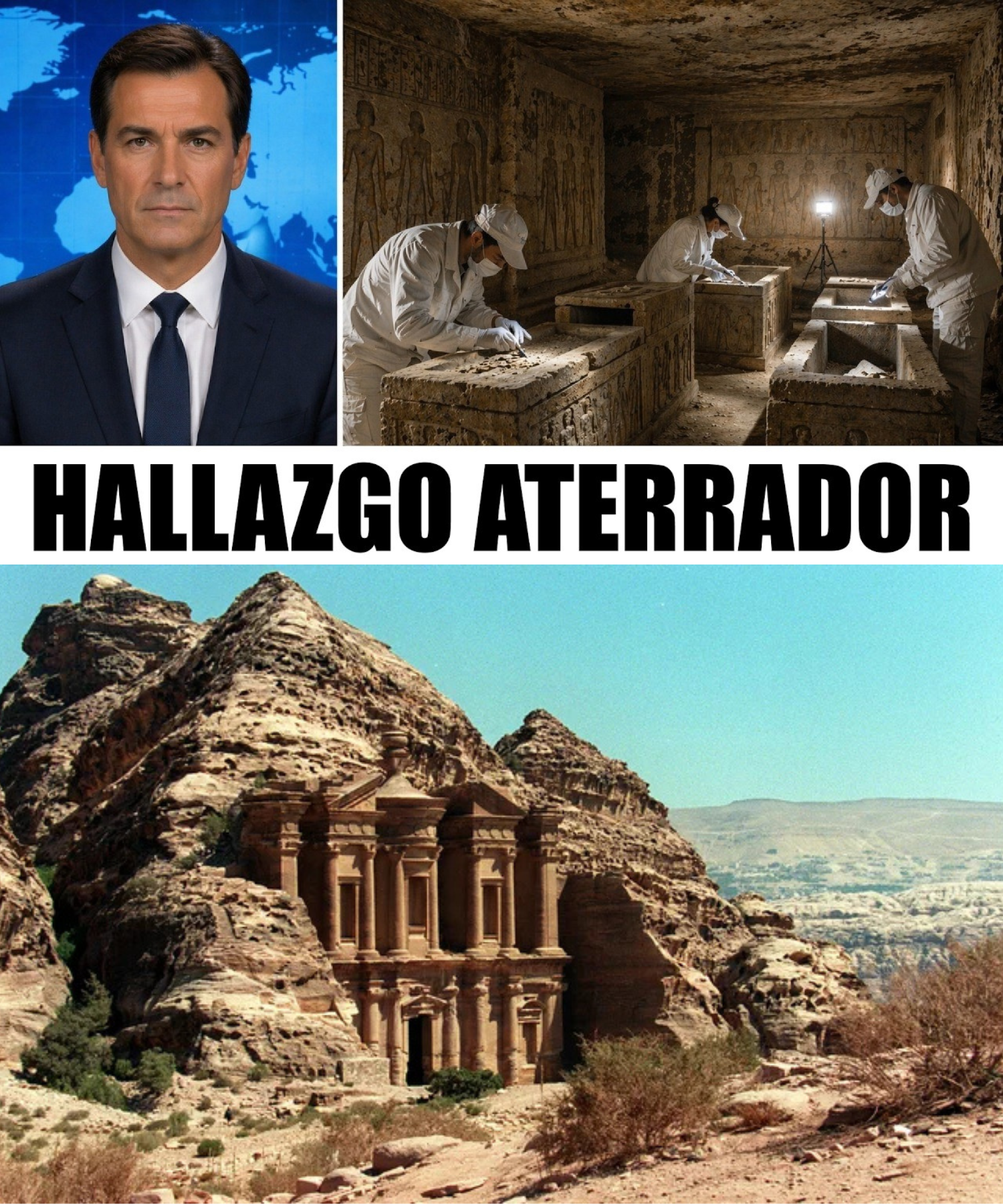
I grounded this in the real Petra context: in 2024, a team working with Jordanian authorities and researchers from institutions including the University of St Andrews found a long-buried tomb beneath Al-Khazneh, the famous Treasury, containing the remains of 12 ancient skeletons. (news.st-andrews.ac.uk) Smithsonian also reported grave goods including bronze, ceramic, and iron artifacts, while UNESCO describes Petra as a major Nabataean caravan city with extraordinary rock-cut architecture and water engineering. (smithsonianmag.com) I kept the tone dramatic, but added caution because some experts said media coverage of the find was overhyped and that the famous “Holy Grail” style object was actually the top of a broken jug. (The Guardian)
Sealed Discovery In Petra Shocked Archaeologists
For centuries, millions of footsteps passed over the secret without knowing it was there.
Beneath the rose-colored cliffs of Petra, under one of the most famous monuments on Earth, a sealed chamber waited in darkness. Tourists came from every corner of the world to stand before Al-Khazneh, the Treasury, staring upward at its carved columns, weathered statues, and impossible beauty. Cameras clicked. Guides told stories. People whispered about kings, lost treasure, and Indiana Jones. But while the world looked at the grand façade above, the real shock was hidden below their feet.
When archaeologists finally opened the long-buried space beneath the Treasury, they did not find gold spilling across the floor. They did not find a cursed idol, a secret royal throne, or a mythical cup glowing in the dust. What they found was quieter, colder, and in many ways more powerful: human remains, ancient grave goods, and the unmistakable evidence that Petra’s most iconic structure may still be holding answers to questions scholars have asked for generations.
The discovery did not feel like an ordinary excavation. It felt like a conversation with the dead.
Petra has always carried the atmosphere of a place that knows more than it says. Hidden in the desert of southern Jordan, surrounded by cliffs, gorges, and passages of red sandstone, the ancient city seems less built than revealed. Its monuments are carved straight from the living rock, as if the mountains themselves were persuaded to become architecture. The most famous of them all, the Treasury, appears at the end of the narrow Siq like a vision: a great classical façade glowing pink, gold, and amber depending on the hour.
For many visitors, that first sight feels almost supernatural.
But archaeologists know that Petra’s beauty is only the surface. Behind the romance lies one of the most complex ancient cities in the world. It was the capital of the Nabataeans, a people who turned desert survival into an art form. They controlled trade routes, moved incense and spices through harsh terrain, carved tombs into cliffs, engineered water systems through dry valleys, and built a city that blended Arabian traditions with Hellenistic and Roman influence. They were merchants, builders, engineers, artists, and political survivors.
Yet they remain mysterious.
That is the strange contradiction at the heart of Petra. The Nabataeans left behind monuments so magnificent that they still stop the modern world in its tracks, but they left behind relatively few written records explaining themselves. Their buildings speak in stone, but their voices are faint. We know they were wealthy. We know they were skilled. We know their city was important. But many intimate details of their society, religion, burial customs, family structures, and beliefs about death remain uncertain.
That is why a sealed discovery beneath the Treasury matters so much.
Every tomb in Petra is more than a burial place. It is a clue. It can tell scholars who mattered, how people were honored, what objects they carried into death, how families expressed identity, and how the living understood the world beyond life. Many tombs in Petra have been disturbed, emptied, looted, damaged, or reused over time. Finding human remains and grave goods still in their ancient context is rare enough to make researchers pay close attention.
The chamber beneath Al-Khazneh was especially compelling because of where it was found.
The Treasury is not just any monument. It is the face of Petra in the global imagination. For decades, people have argued about what it was built for. Was it a royal mausoleum? A temple? A ceremonial monument? A symbolic display of Nabataean power? Its name, “the Treasury,” comes from later legends, not from certainty. The enormous urn carved high above the façade was once believed by some to contain treasure, and bullet marks in the stone tell their own story of people trying to break open myth with weapons.
But the true treasure of the Treasury was never gold.
It was meaning.
The discovery beneath it may bring scholars closer to understanding that meaning. If burials were placed in such a prominent location, then the space around the Treasury may have been part of a larger funerary complex. The people buried there may have held status. Their placement beneath or near the monument suggests that the Treasury was not simply decorative. It may have been tied directly to death, memory, lineage, and power.
When the chamber was opened, the atmosphere must have been extraordinary. Imagine the first beam of light entering a space sealed away from the living world for nearly two thousand years. Dust lifting in the air. Stone walls emerging from darkness. Human bones lying where mourners left them. Artifacts still resting near the dead. A place built for memory suddenly becoming visible again.
To a casual observer, skeletons may seem grim. To an archaeologist, they are biographies written in bone.
The remains of 12 individuals could reveal age, sex, health, ancestry, diet, disease, physical labor, injury, and possibly family relationships. Teeth can preserve chemical signatures of childhood environment and diet. Bones can show stress, illness, trauma, and patterns of daily life. If DNA can be recovered, it may help researchers understand whether the people buried together were related, whether they belonged to local populations, or whether Petra’s trade connections brought people from distant regions into its most important spaces.
That possibility is thrilling because Petra was not isolated. It was a crossroads.
Goods moved through it, but so did people, ideas, styles, beliefs, languages, and customs. The Nabataeans lived in a world connected by caravan routes stretching toward Arabia, Egypt, Syria, the Mediterranean, and beyond. The city’s architecture reflects that blending. Greek-looking columns meet local religious symbols. Desert engineering supports urban life. Tombs become monuments. Water becomes power. Petra was not a lonely desert miracle. It was a network made visible in stone.
The grave goods found with the remains are just as important. Bronze, iron, and ceramic objects may seem modest compared with fantasies of treasure, but archaeologically they can be more valuable than gold. Ceramics can be dated and traced through styles. Metal objects can reveal craft, trade, status, and ritual use. Even broken vessels matter because their placement can tell researchers how the dead were treated. Were objects placed as offerings? Were they personal belongings? Were they symbolic tools for the afterlife? Were they part of a ceremony performed at the time of burial?
One ceramic object drew special attention because it resembled the kind of chalice viewers might associate with Indiana Jones and the Last Crusade, which famously used Petra as a cinematic backdrop. But the serious story is not that archaeologists found a movie-style Holy Grail. The serious story is that even a broken vessel can carry the weight of ancient belief. A fragment of pottery in a tomb may tell us more about real Nabataean life than a golden legend ever could.
That is the difference between archaeology and fantasy.
Fantasy wants the object to be magical.
Archaeology asks why it was there.
The excitement surrounding the Petra discovery also reveals something about modern people. We are still hungry for hidden rooms. We still want the world to contain sealed doors and buried secrets. We want ancient places to surprise us, because surprise means the past is not finished. A sealed chamber beneath the Treasury feels like proof that even the most photographed places on Earth may still be misunderstood.
That thought is thrilling.
It is also humbling.
People have walked through Petra for centuries. Local communities knew its ruins long before Western travelers made it famous. Explorers, scholars, tourists, filmmakers, and photographers all passed through its canyons. And still, beneath one of its most iconic monuments, a chamber could wait. Not invisible because it was magical, but invisible because archaeology is slow, difficult, political, expensive, and dependent on permission, technology, preservation needs, and careful judgment.
Ground-penetrating radar and other remote-sensing tools helped identify possible underground spaces before excavation. That matters because modern archaeology is no longer only about digging. Increasingly, it is about seeing without destroying. Ancient sites like Petra are fragile. Their sandstone is vulnerable to erosion, flooding, tourism pressure, and the simple damage caused by time. Every excavation must balance discovery against preservation. To open the past carelessly is to risk losing it forever.
That is why the sealed chamber beneath the Treasury was not simply broken open like a movie tomb. It had to be studied, documented, and treated with respect. The dead were not props. The artifacts were not souvenirs. The chamber was not a stage set. It was a real burial context that had survived across empires, earthquakes, abandonment, rediscovery, tourism, and global fame.
The deeper significance may take years to understand.
That is another truth people often forget. Archaeological discoveries do not end when the chamber opens. In many ways, that is when the real work begins. Bones must be analyzed. Artifacts must be cataloged. Sediment must be studied. Radiocarbon dating, material analysis, residue testing, 3D scanning, and comparative research may all be needed. The first headline is only the doorway. The real answers come slowly.
And sometimes they are less dramatic than the headline, but more important.
The discovery may not “solve” Petra. It may not reveal the exact identity of the Treasury’s builder. It may not prove that a king was buried there. It may not produce a lost Nabataean scripture or a royal inscription explaining everything. Archaeology rarely gives such clean satisfaction. Instead, it gives fragments. A burial pattern. A vessel type. A bone sample. A construction layer. A clue that shifts probability.
But fragments can change history.
If the remains are early enough, they may help clarify the timeline of the Treasury and its surrounding structures. If the grave goods suggest elite status, they may support theories about the monument’s funerary role. If the skeletons show unexpected ancestry or health patterns, they may reveal the diversity and daily pressures of Petra’s population. If the chamber connects architecturally with other underground spaces, it may show that the Treasury’s forecourt was more complex than previously understood.
Even the fact that the tomb contained complete burials is meaningful.
Many Petra tombs have been looted or disturbed over time. An undisturbed or relatively intact burial context offers a rare chance to see how the Nabataeans arranged the dead before later centuries altered the evidence. That matters because the Nabataeans did not leave behind an easy manual explaining their afterlife beliefs. Their tombs, offerings, architecture, and human remains are some of the best witnesses we have.
The location also raises emotional questions.
Who were these 12 people?
Were they members of a powerful family? Priests? Nobles? Officials? Relatives of whoever commissioned the Treasury? Were they buried at the same time, or across generations? Did mourners return to the tomb repeatedly? Did ceremonies take place in the courtyard above them? Did people walking past the façade understand exactly who lay beneath their feet?
We do not know yet.
But those questions are the heart of the discovery.
There is something deeply human about finding the dead beneath a monument everyone thought they knew. The Treasury’s façade is grand, almost theatrical, built to impress the living. But beneath that stone display were bodies. Not symbols. People. People who breathed desert air, knew Petra’s streets, heard caravan bells, drank water from the city’s channels, watched ceremonies, feared illness, loved family, and died under a sky that looked much like the one above Jordan today.
That is why the discovery is powerful.
It turns Petra from postcard back into city.
Tourists often see ancient monuments as frozen beauty. Archaeology restores movement. It reminds us that Petra was once crowded, noisy, dusty, sacred, commercial, and alive. Animals carried goods through narrow passages. Traders argued over prices. Water flowed through channels. Craftsmen worked stone and metal. Priests performed rituals. Children ran through courtyards. Families mourned their dead. The city was not built for our photographs. It was built for people who believed their world would continue.
Then history moved on.
Earthquakes damaged the city. Trade routes shifted. Political power changed. The desert reclaimed spaces once filled with life. Petra became legend, then destination, then icon. But under the surface, the city kept parts of itself hidden. The sealed tomb beneath the Treasury is one of those hidden memories.
Some experts have urged caution about calling the discovery completely unprecedented. They point out that Petra contains many tombs and that earlier investigations had already found tombs near the Treasury. That caution is necessary. Sensational headlines can exaggerate archaeology until serious work becomes entertainment. But caution does not make the discovery meaningless. It simply places it in the right frame.
The find is not shocking because tombs exist in Petra.
It is shocking because this tomb, in this location, with these remains and artifacts, gives researchers a rare opportunity to examine a major monument from below.
That distinction matters. The discovery is not a fantasy revelation. It is a rare archaeological opening inside one of the world’s most famous ancient landscapes. Its importance lies not in proving legends, but in adding real evidence to a story still full of gaps.
Petra does not need myths to be astonishing.
The real Nabataeans were astonishing enough.
They carved a capital into cliffs. They mastered water in a dry land. They built monuments that fused cultures without losing identity. They created a city that could impress Rome, survive the desert, and haunt the imagination two thousand years later. Yet despite all that, their inner world remains partly hidden. Their gods, family structures, burial meanings, political organization, and self-understanding are still being reconstructed from scattered evidence.
That is what makes the sealed discovery feel so alive.
It is not only about what was found.
It is about what remains possible.
If a chamber could still wait beneath the Treasury, what else lies under Petra’s dust, behind blocked passages, beneath collapsed courtyards, or inside spaces too fragile to enter? What inscriptions remain unread? What organic materials may still survive in dry pockets? What tombs were sealed and forgotten? What stories did the Nabataeans leave in places no one has yet reached?
Every ancient city has secrets, but Petra’s secrets feel especially theatrical because of the landscape itself. The cliffs hide and reveal. The Siq narrows and opens. Monuments appear suddenly. Light changes the stone from red to pink to gold to purple. The whole city feels designed for revelation.
The sealed tomb beneath the Treasury continues that drama.
But the final lesson is not that archaeology is like a movie. It is that real history is stranger, slower, and more moving than movies allow. A film needs a hero to grab the treasure and run. Archaeology asks people to kneel in the dust, label fragments, photograph bones, record layers, compare pottery, test samples, argue responsibly, and wait years for answers.
That patience is where truth lives.
The chamber beneath Al-Khazneh has been opened, but its meaning is not fully open yet. The dead have been found, but their stories have only begun to speak. The grave goods have been lifted from darkness, but their purpose still needs careful interpretation. The Treasury remains magnificent, but now it is more mysterious than before.
That is the true shock.
The discovery did not make Petra smaller by explaining it.
It made Petra larger.
It reminded the world that beneath the famous façade, beneath the tourist photographs, beneath the legends of treasure and cinema, there are still real human lives waiting to be understood. Twelve ancient people lay beneath one of the most recognizable monuments on Earth, carrying with them clues to a civilization that mastered stone, water, trade, and memory.
For centuries, people stood above them and looked upward.
Now archaeology has forced the world to look down.
And in that darkness beneath Petra’s most famous monument, the past finally opened its eyes.