Archaeologists Discovered Strange Magnetic Anomalies Around the Carnac Stones
Archaeologists Discovered Strange Magnetic Anomalies Around the Carnac Stones
The compass did not spin wildly. The ground did not glow. But when researchers scanned the fields around Carnac, the invisible patterns beneath the soil revealed something far more unsettling: the stones above ground may be only a fraction of what was once there.
For thousands of years, the Carnac Stones have stood across the landscape of Brittany like a message no one has fully translated. Rows upon rows of ancient menhirs stretch across fields, hills, and low ridges, some standing tall, others leaning, many weathered by wind, rain, lichen, and time. To visitors, they look like an army of stone frozen mid-march. To archaeologists, they are one of Europe’s greatest prehistoric puzzles.
Why were they placed in such long alignments? Who organized the labor? What rituals unfolded around them? Were they markers of the dead, calendars of the sky, symbols of territory, sacred processional routes, or something stranger? Every generation has offered theories, yet Carnac has resisted final explanation.
Now the mystery has deepened.
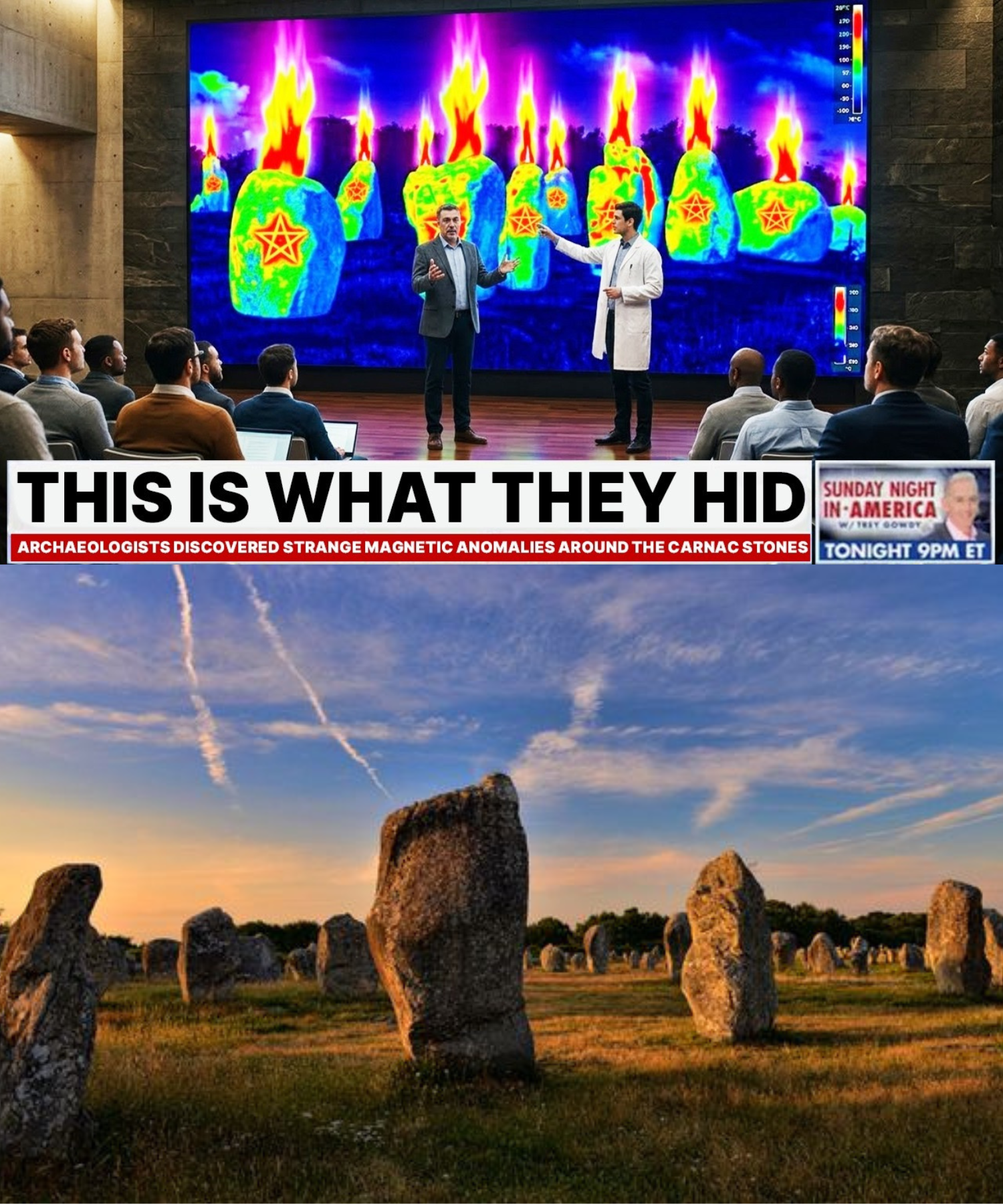
Recent surveys around the Carnac alignments have detected strange magnetic anomalies beneath and around parts of the site. At first, the phrase sounds almost supernatural, the kind of language that invites stories of energy fields, ancient power grids, or forgotten technologies. But the truth is more grounded—and in some ways more astonishing. In archaeology, magnetic anomalies often reveal buried features that cannot be seen from the surface: stone holes, ditches, hearths, pits, walls, burned zones, and even buried stones.
In other words, the land around Carnac may still be hiding parts of the monument.
What appears today as a preserved field of standing stones may actually be the visible remains of a much larger, older, and more complicated sacred landscape. Some stones may have fallen. Others may have been removed. Some may still lie buried under the soil, waiting for instruments to detect what the eye cannot see.
That possibility changes the way we understand Carnac.
For a long time, the site was treated mostly as a spectacular monument to protect and admire. Tourists came. Fences went up. Scholars studied the visible alignments. But the ground itself remained full of unanswered questions. Unlike a tomb that can be opened or a city with walls and streets, Carnac is difficult to interpret because so much of it depends on pattern. The stones are not isolated objects. Their meaning lies in arrangement.
If the arrangement is incomplete, then every theory built from the visible stones alone may be incomplete too.
That is why magnetic survey matters.
A magnetometer does not look for magic. It measures tiny variations in the Earth’s magnetic field caused by differences in buried materials. A ditch filled with soil may produce a different reading from surrounding ground. A hearth may leave a strong signal because fire alters magnetic minerals in the soil. A buried stone may create a detectable contrast. When these readings are mapped, archaeologists can see ghostly outlines of features that have disappeared from the surface.
At Carnac, such methods are especially powerful because excavation is limited. The site is vast, fragile, famous, and protected. Digging everywhere would be impossible and destructive. But non-invasive scanning allows researchers to investigate without tearing the landscape apart. It is like listening to the ground before deciding where to touch it.
And the ground is speaking.
The magnetic anomalies suggest buried features around areas such as Kerlescan and Manio, where known stones may be only the exposed remnant of a broader monument. Some anomalies appear consistent with buried stones or stone-related structures. Others may reflect pits, former foundations, fire-related activity, or other prehistoric features. The results do not provide an instant answer, but they reveal that Carnac’s visible surface is only the first layer of the story.
That is where the discovery becomes genuinely thrilling.
Imagine walking through the alignments at dawn. Mist hangs low over the grass. The stones stand in rows, fading into the distance. You see hundreds of menhirs, maybe thousands across the broader region. But beneath your feet, hidden under soil and root systems, there may be more: vanished lines, missing stones, buried sockets, ritual fires, earlier monuments, forgotten construction phases, and traces of ceremonies older than written history.
The landscape is not dead.
It is layered.
Carnac’s known stones already form one of the largest megalithic complexes in the world. More than three thousand stones are spread across the region, with famous groups such as Ménec, Kermario, and Kerlescan forming long, parallel rows. Their construction dates to the Neolithic, thousands of years before the pyramids of Egypt reached the sky. This was a time when farming communities were reshaping Europe, building tombs, raising stones, organizing labor, and turning landscapes into sacred architecture.
The people who built Carnac left no written explanation. That silence has given the stones their power. Every interpretation must be drawn from archaeology, landscape, comparison, dating, soil traces, and the stubborn physical presence of the menhirs themselves.
The new magnetic signals add another kind of evidence: absence made visible.
A missing stone can matter as much as a standing one. A buried pit can tell us where a stone once stood. A line of anomalies can reveal that an alignment extended farther than we thought. A cluster of signals can suggest activity zones, gathering places, construction areas, or older features later absorbed into the megalithic complex.
This is crucial because Carnac was not built in one simple act. The region’s monuments likely developed over a long period. Some alignments may have been created, modified, abandoned, reused, and reinterpreted across generations. Later people may have moved stones. Farmers may have removed them. Quarrymen may have reused them. Roads, walls, villages, and tourism changed the landscape. What we see today is not the untouched original design.
It is a survival.
The magnetic anomalies may help reconstruct what has been lost.
That reconstruction could answer questions that have haunted researchers for more than a century. Were the rows originally continuous across greater distances? Did the alignments connect to tombs, enclosures, or ceremonial zones? Were some stones arranged around older structures? Did people use fire during construction rituals? Were there processional paths through the stones? Did the monument grow outward from earlier sacred points?
Each hidden feature can shift the answer.
One of the most important recent developments in the Carnac region has been more precise dating. Excavations at Le Plasker in Plouharnel, near Carnac, have shown that parts of the megalithic complex may date to around 4600 to 4300 BC, placing the region among the earliest major megalithic landscapes in Europe. That means the Carnac area was not a late imitation of other European stone monuments. It may have been one of the places where monumental stone-building began to take powerful form.
That alone is astonishing.
But when combined with geophysical survey, the picture becomes even more dramatic. Carnac may not be only a collection of standing stones. It may be a vast prehistoric project built through many phases, with visible and invisible components spread across the land. The stones are not random. The buried signals are not noise. Together, they suggest planning, memory, ceremony, and a relationship with the landscape that modern people are only beginning to understand.
The word “magnetic” tempts the imagination. It makes people wonder whether the ancient builders knew something about Earth forces, energy lines, or invisible fields. Many alternative theories have long suggested that megalithic monuments were placed on powerful energy points. Some claim the stones amplify natural forces. Others imagine lost technologies using magnetism, sound, or vibration.
The scientific evidence does not require those claims.
But it does not make the site less mysterious.
The magnetic anomalies are not proof that the stones were ancient machines. They are proof that the landscape still contains buried architecture or activity invisible to the naked eye. That is powerful enough. The real mystery is not whether the stones generated supernatural energy. It is why Neolithic communities invested so much labor into shaping an entire region with stone.
That question is harder.
A machine has a function.
A sacred landscape has many.
Carnac may have marked the dead. Many megalithic landscapes are connected with tombs, ancestors, and funerary rites. The region includes burial mounds and dolmens, suggesting that death and memory were central to its meaning. If the alignments were connected to ancestors, the rows of stones may have represented more than markers. They may have formed processional routes through a landscape of the dead, where the living gathered, remembered, feasted, mourned, and renewed social bonds.
Carnac may also have been connected to the sky. Long rows of stones naturally invite astronomical interpretation, especially around solstices, moonrise points, or seasonal alignments. Some theories propose that the stones acted as calendars or horizon markers. Others caution that with so many stones spread over such a wide area, it is easy to find alignments after the fact. Still, the sky mattered deeply to Neolithic people. Seasons governed agriculture, herding, ritual, and survival. It would be surprising if celestial cycles played no role at all.
Carnac may have been a place of assembly. Large monuments often bring people together. Building them requires cooperation. Maintaining them requires memory. Gathering around them reinforces identity. The stones may have been the physical proof that scattered communities could act as one. In that sense, Carnac was not just a monument. It was a social engine.
The magnetic anomalies may help reveal which of these roles dominated—or whether the answer is all of them.
If buried stones extend known rows, the landscape may have been far more organized than previously thought. If hidden pits cluster near certain zones, those areas may have hosted rituals, fires, or construction activity. If anomalies connect visible monuments to lost features, Carnac may emerge as a single integrated sacred system rather than separate stone fields.
This would make the site even more impressive.
Ancient people did not have written blueprints, but they had memory, measurement, and shared purpose. They could mark lines across land, coordinate labor, transport stones, dig sockets, raise menhirs, and pass plans across generations. The scale of Carnac suggests not chaos, but continuity. Someone cared enough to keep building. Someone taught the next generation what the stones meant. Someone returned again and again.
That continuity may be the deepest mystery.
Why did they keep going?
To raise one stone is an act. To raise thousands is a worldview.
Every stone required effort. Someone had to quarry or select it. Someone had to move it. Someone had to dig the hole. Someone had to stand it upright. Someone had to decide where it belonged. The labor was not casual. It meant time away from farming, gathering, herding, and daily survival. The builders must have believed the work mattered profoundly.
The magnetic anomalies suggest that even this visible labor may be only part of the total effort.
Some buried stones may represent abandoned plans. Others may be fallen menhirs swallowed by soil. Others may indicate earlier alignments replaced by later ones. The site may have changed through decisions we can no longer hear: extend this row, remove that stone, build over this older feature, mark this ridge, light fires here, gather there.
The ground remembers those decisions.
Technology is now giving archaeologists a way to hear them.
The discovery also reminds us that archaeology has entered a new era. The old image of archaeology is a person with a trowel slowly uncovering buried artifacts. That still matters. But modern archaeology also uses drones, LiDAR, magnetometry, ground-penetrating radar, photogrammetry, chemical analysis, Bayesian dating models, and digital mapping. These tools do not replace human interpretation. They expand it.
At Carnac, they allow researchers to investigate a site too large and fragile for traditional excavation alone. Instead of guessing where to dig, archaeologists can map invisible patterns first. Instead of treating the standing stones as isolated survivors, they can place them inside a hidden network of subsurface evidence.
This changes the emotional experience of the site too.
A visitor sees stones.
A survey sees ghosts.
Not ghosts of spirits, but ghosts of structure: missing menhirs, forgotten pits, erased alignments, buried traces of hands that worked five or six thousand years ago. The field becomes alive with absence.
That is why the discovery feels so haunting.
Carnac has always been mysterious because of what stands there. Now it is mysterious because of what may not stand there anymore.
The anomalies also challenge preservation. If buried features exist around the stones, then the protected area may be more archaeologically sensitive than expected. Foot traffic, farming, roadwork, construction, drainage changes, and tourism could threaten not only visible monuments but hidden remains. A stone lying underground may seem safe, but shallow archaeology can be damaged easily.
This gives the surveys practical urgency. Mapping buried features is not only about solving mysteries. It is about protecting what remains before modern activity destroys it.
Carnac has already suffered losses. Stones were removed in earlier centuries. Some were reused in walls and buildings. Others fell, were buried, or were moved. The site today is magnificent, but it is not complete. If magnetic survey can identify missing elements, it may help restore our understanding of what Neolithic builders actually created.
That is the promise.
But caution remains essential. A magnetic anomaly is not automatically a buried menhir. It is a signal that must be interpreted carefully. Soil conditions, geology, modern disturbances, old ditches, metal debris, heated features, and natural variations can all produce readings. Archaeologists must compare magnetic data with other methods, surface evidence, targeted excavation, and environmental analysis.
The mystery is not solved by a scan.
It begins there.
Still, the results are exciting because they show that Carnac has not finished revealing itself. For a monument studied for generations, that is remarkable. The stones have stood in public view for centuries, yet the ground around them still holds secrets.
The real shock is not that archaeologists found “magnetism” at Carnac. The real shock is that one of Europe’s most famous ancient landscapes may still be partially hidden.
A buried stone changes a row.
A hidden pit changes a plan.
A lost alignment changes the monument.
A newly dated phase changes the history of European megaliths.
Piece by piece, Carnac is becoming larger, older, and more complex than many people imagined.
That is why this story matters. It is not only about strange readings on scientific instruments. It is about a prehistoric world coming back into focus. A world where communities gathered in Brittany before written history, raised thousands of stones, built tombs, burned fires, marked land, and created a sacred geography so powerful that even after millennia of damage, enough remains to astonish us.
The Carnac Stones have always looked like survivors.
Now the magnetic anomalies suggest they may be survivors of something even greater.
The field we see may be the skeleton.
The buried signals may be the missing body.
And if archaeologists can keep listening to the ground, Carnac may finally begin to reveal not one answer, but a more breathtaking truth: the monument was never only the stones above the grass.
It was the entire landscape beneath them.