What Did Jesus Mean When He Said, “I Am the Bread of Life”?
What Did Jesus Mean When He Said, “I Am the Bread of Life”?
Part 1
The question was written on the back of a grocery receipt and left inside a donation basket at a small church in Queens, New York, between two cans of soup and a half-empty bag of rice. Pastor Caleb Ward found it on a bitter February morning when the church basement smelled of coffee, wet coats, and old bread from the food pantry. Outside, New York was moving like it always moved—sirens, buses, delivery bikes, subway thunder, people rushing past one another with faces too tired to be curious. Inside, volunteers were stacking canned beans while a line of hungry families waited in the cold. Caleb reached into the basket, thinking the receipt was trash, then saw the sentence written in blue pen: What did Jesus mean when He said, “I am the Bread of Life”? Because I am hungry, and I still don’t understand.
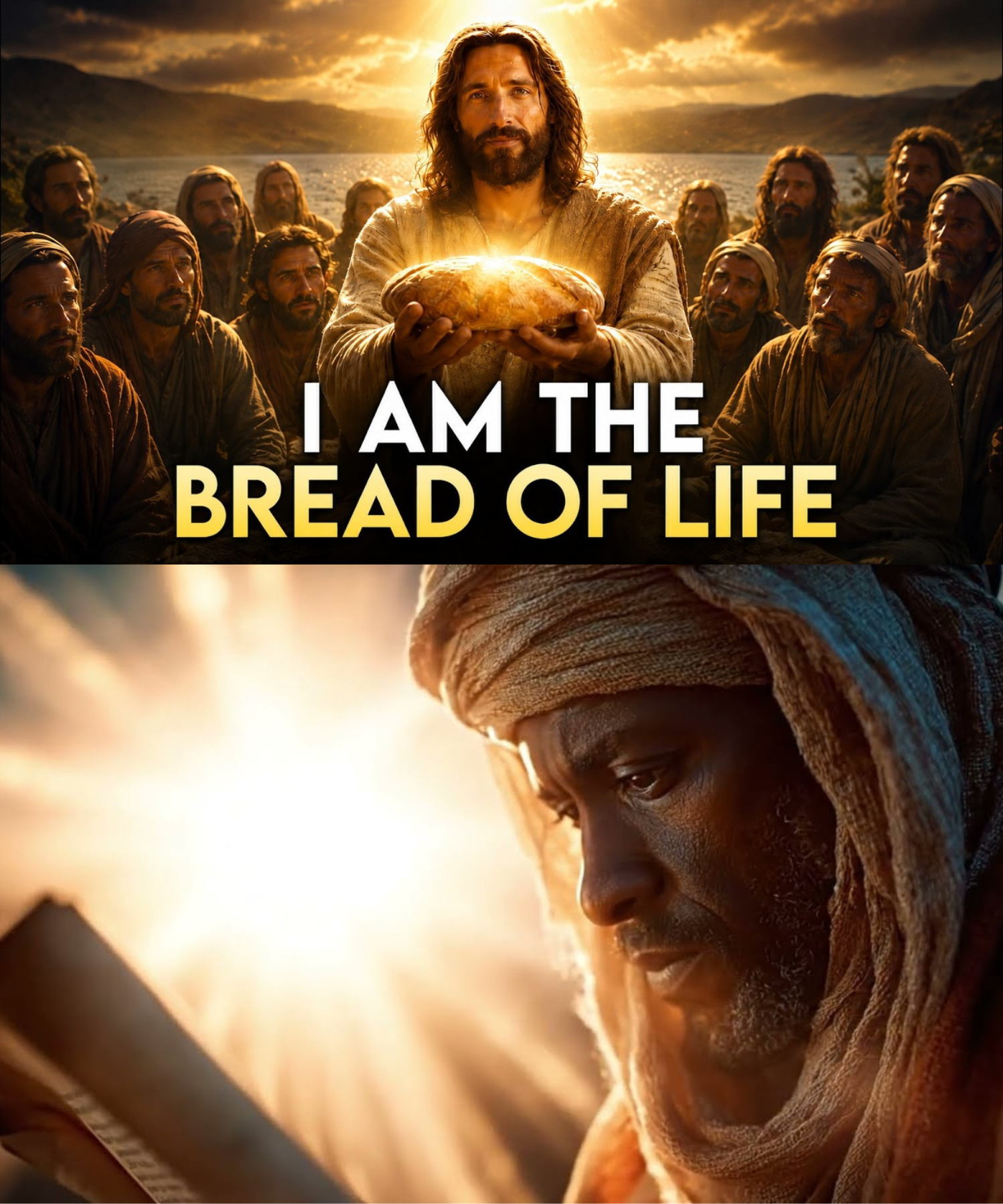
He read it once and felt something in him go still. Caleb had preached that verse a hundred times. He had explained it in sermons, Bible studies, hospital rooms, funerals, and Easter services. Jesus said it after feeding the crowd, after multiplying bread, after people chased Him because their stomachs remembered the miracle. He told them not to work only for food that perishes, but for food that endures to eternal life. He said Moses had not given the true bread from heaven; the Father gives the true bread. Then He said the words that sounded simple until real hunger entered the room: I am the Bread of Life.
But the receipt made Caleb realize how easily church people turned that sentence into poetry while the poor stood outside waiting for actual bread. The person who wrote it did not want an abstract answer. They wanted to know whether Jesus was only talking about souls, or whether He cared about bodies too. They wanted to know why a Savior would call Himself bread in a city where children still went to sleep hungry above million-dollar restaurants. Caleb folded the receipt and put it in his Bible.
The note haunted him all day. At noon, a woman named Marisol came through the pantry line with two children and a face emptied by exhaustion. At three, an old man named Earl asked if there was any fresh bread because canned soup hurt his teeth. At five, a delivery driver dropped off donated rolls from a bakery in Manhattan, still warm enough that steam rose when Caleb opened the bags. People smiled when they smelled it. Not politely. Deeply. Like warmth had entered them before the food did. Caleb watched a child tear into a roll with both hands and understood something he had missed. Bread is not decoration. Bread is survival.
That night, Caleb called his younger sister Hannah in Ohio. She taught theology at a small Christian college outside Columbus, but before that she had run a food program in Cleveland for laid-off factory workers. She listened while he read the receipt aloud. When he finished, she said, “Maybe you should not answer it from a pulpit first.”
“Where should I answer it?”
“In a kitchen,” she said.
The next morning, Caleb announced that the church would host seven nights of bread. No tickets, no sermon series branding, no dramatic lights. Just meals, Scripture, conversation, and one question: what does it mean that Jesus did not only give bread, but called Himself bread? The idea spread faster than he expected. A journalist from Brooklyn wanted to cover it. A Christian filmmaker from Los Angeles asked to record it. A bakery in Manhattan offered leftover loaves every night. Caleb said yes to the bakery, maybe to the journalist, and no to the filmmaker until he learned how to put the camera down.
On the first night, the basement filled with people who had almost nothing in common except hunger. Immigrants, nurses, widows, students, delivery drivers, recovering addicts, rich neighbors who pretended they were there to volunteer but stayed to eat, and a teenage boy who sat alone near the exit with his hood up. Caleb placed the grocery receipt on the table beside a loaf of bread.
Then he said, “Tonight we are not going to talk about bread as a symbol until everyone has eaten real bread.”
No one applauded.
They were too busy reaching for the baskets.
Part 2
The first answer came from a little girl named Sophie, who was six years old and missing her two front teeth. She sat beside her mother, swinging her legs under the folding table, eating buttered bread as if it had been made personally for her. Caleb had just read the scene from John’s Gospel where the crowd asked Jesus for bread like manna in the wilderness, and he asked the room what bread means when you do not have enough of it. Adults gave careful answers. Provision. Sustenance. Daily need. Dependence. Sophie raised her sticky hand and said, “Bread means I don’t have to cry at bedtime.”
The room went quiet.
Her mother looked embarrassed, but Caleb shook his head gently. “That may be the best definition tonight.”
That was where the story began to open. Bread meant the body mattered. The God who fed Israel with manna in the wilderness had not looked at hungry people and told them to pretend hunger was spiritual. The manna came every morning. Not enough to hoard, but enough to trust. Each day taught dependence. Each day taught that life is received before it is achieved. When Jesus called Himself the Bread of Life, He was standing inside that whole history. He was saying that the deepest hunger in humanity was not only for food, but He did not say it in a way that despised food. He had just fed bodies. He had filled stomachs. He had made leftovers.
On the second night, Hannah arrived from Ohio with a canvas bag full of flour from a small mill near her college. She brought stories too. Stories of Cleveland families after factory closures, fathers ashamed to stand in pantry lines, mothers watering down soup, retired men who had worked forty years and still needed donated bread. “People talk about spiritual hunger like it floats above life,” she told the room. “But hunger has rent, teeth, children, shame, bills, and a refrigerator light shining on nothing.”
Caleb saw the teenage boy near the exit listening. His name was Ethan. He had come the first night for food and returned because no one forced him to talk. On the third night, he finally spoke. “If Jesus is the Bread of Life,” he said, “why do people who believe in Him still feel empty?”
No one answered quickly.
Hannah did. “Because receiving bread is not the same as looking at bread. A person can stand in a bakery and starve if he refuses to eat.”
Ethan frowned. “So believing means eating?”
“In John 6, yes,” she said carefully. “Not eating in a shallow way. Receiving Him. Depending on Him. Letting Him become life inside you, not just an idea you admire.”
Caleb added, “A lot of people want Jesus as a teacher, a symbol, a helper, a moral example, a miracle worker, a political mascot, or an emergency contact. But bread is more intimate than all of that. Bread enters you. It becomes strength. Jesus is saying, ‘You do not need only My advice. You need Me.’”
That sentence unsettled people. It should have. Advice can be ignored. A teacher can be admired from a distance. A symbol can be used. Bread must be taken in, or hunger remains.
On the fourth night, the filmmaker from Los Angeles arrived anyway. His name was Jonah Price, and he had made slick religious documentaries that looked beautiful and often felt empty. Caleb recognized him from a streaming series about “lost Bible secrets” and almost asked him to leave. But Jonah came without a crew, only one small camera in his bag. “I don’t want to film yet,” he said. “I think I want to understand why I’m hungry.”
Caleb believed him enough to let him stay.
Jonah sat at the back with Ethan, eating bread from a paper plate. He had grown up in church in California, made a career filming faith, and somehow lost the ability to pray without thinking about lighting. “The Bread of Life,” he said later to Caleb, “always sounded like a metaphor to me.”
“It is a metaphor,” Caleb said. “But not merely a metaphor.”
“What does that mean?”
“It means the metaphor is carrying reality. Jesus does not say, ‘I give you bread-like inspiration.’ He says, ‘I am the bread.’ He is the gift. He is the nourishment. He is the life from heaven.”
Jonah looked down at the half-eaten roll in his hand.
“I have been filming bread,” he said, “and starving beside it.”
Part 3
By the fifth night, the basement had become less like a program and more like a table. People started arriving early to help. Marisol brought soup. Earl brought apples. A young banker from Manhattan brought expensive cheese and apologized because he did not know what ordinary people ate with bread. Ethan came early and carried chairs without being asked. Jonah washed dishes. Hannah taught Sophie how yeast works, telling her that living bread rises slowly, quietly, from the inside. Sophie declared that yeast was “tiny church magic,” and no one corrected her.
That evening, Caleb spoke about the crowd that followed Jesus after the feeding. “They wanted more bread,” he said. “And who can blame them? They were hungry. But Jesus saw that they wanted the gift without understanding the Giver. They wanted full stomachs without surrender. They wanted another miracle meal, but He was offering Himself.”
A woman named Denise, who had lost her job in Queens and was living in a shelter, raised her hand. “Is it wrong to come to Jesus because you need something?”
“No,” Caleb said. “Almost everyone comes because they need something. Healing. Food. Forgiveness. Help. Peace. But love does not let us stop at the thing. Jesus gives bread, then invites the hungry to Himself.”
Hannah added, “Manna in the wilderness kept people alive for a day. Jesus says He is the true bread from heaven because He gives life that death itself cannot finally take away.”
That was where the conversation became harder. Bread of Life meant more than comfort. It meant resurrection. Jesus said those who come to Him will not hunger in the deepest sense, and those who believe in Him will never thirst in the final sense. Yet everyone in the room knew Christians still experienced hunger, thirst, grief, depression, addiction, loneliness, and death. The promise was not that believers would never feel need again. The promise was that their deepest life was now held in Him, fed by Him, raised by Him, and no longer dependent on the fragile bread of this age.
Ethan asked, “So why do I still feel dead inside sometimes?”
Hannah looked at him with real tenderness. “Because the kingdom has begun, but it is not finished in us yet. Bread strengthens a body that is still walking through wilderness. It does not mean the wilderness instantly disappears.”
Caleb nodded. “The Bread of Life is not a snack for people who already feel strong. He is food for the journey. He is life for people who cannot manufacture life in themselves.”
Jonah asked if this connected to Communion. The room shifted. Some were Catholic, some Protestant, some unsure, some barely religious. Caleb answered with care. “Christians understand the Lord’s Supper in different ways, but all serious Christians should tremble at this: Jesus did not give us only ideas to remember Him. He gave us a meal. Bread broken. Cup poured. A table where His death is proclaimed and His life is received by faith. However your tradition explains the mystery, do not make it small.”
Father Gabriel Reyes, a Catholic priest from a nearby parish who had come quietly after hearing about the gatherings, spoke for the first time. “For Catholics, when Jesus says He is the Bread of Life, we cannot avoid the Eucharist. We believe He gives us His true presence under the form of bread and wine. But even before theological debate, there is this: God chose bread to teach nearness. He could have chosen thunder. He chose food.”
Nobody argued. Not because disagreement vanished, but because the room sensed the truth beneath the differences. Bread meant God was not content to remain admired at a distance. Bread meant He came near enough to be received.
That night, Jonah did not take out his camera. He helped Ethan carry trash to the curb. On the sidewalk, New York wind cut through their jackets. Ethan said, “Do you think Jesus gets tired of people only coming to Him when they need stuff?”
Jonah thought about his own life, all the times he had used God as subject matter but not sustenance.
“No,” he said. “I think He gets sad when we take the stuff and leave before we know Him.”
Part 4
The story traveled to Ohio because Hannah insisted that the question could not stay in New York. “Bread does not mean the same thing everywhere,” she told Caleb. “In New York, bread is bagels, bakeries, restaurants, pantry lines. In Ohio, bread is wheat, mills, fields, labor, weather, debt, and farmers praying rain comes before the crop fails.” So on the seventh day, Caleb, Jonah, Ethan, and Marisol traveled with her to a small town outside Columbus where an old grain mill still operated along a cold brown river.
The mill belonged to a man named Peter Shaw, whose family had ground wheat there for four generations. He was not romantic about bread. He knew the cost: seed, machines, fuel, broken belts, bad weather, bank loans, aching backs, and the terror of watching storms flatten a field weeks before harvest. He took them through the mill and showed them wheat becoming flour. Grain crushed between stones. Bran separated. Dust rising in sunlight. “People like warm bread,” he said. “They don’t think about crushing.”
Caleb stopped.
Peter noticed. “What?”
“Nothing,” Caleb said softly. “Just keep talking.”
But everyone heard it. Bread requires crushing. Grain must be broken to feed. Jesus did not call Himself cake, luxury, or decoration. Bread. Common, necessary, broken. Later He would take bread and say, “This is My body, given for you.” The Bread of Life discourse pointed toward the cross, where the life of the world would come through His body offered, His flesh given, His blood poured out. The people wanted bread from heaven, but heaven’s bread would be broken by human sin and divine love.
That evening, they gathered in the mill after closing. Peter’s wife made simple bread from flour ground that morning. No stage, no sound system, no pulpit. Just a wooden table, bowls of soup, and the smell of fresh loaves. Hannah read from John 6 again. When she reached “the bread that I will give for the life of the world is My flesh,” the room became very still.
Marisol, who had been quiet most of the trip, said, “That sounds hard.”
“It is,” Father Gabriel said. He had come from New York by train. “Many disciples found it hard when Jesus said it. Some walked away.”
“Why didn’t He soften it?”
“Because love can be gentle without being vague,” the priest answered. “He was revealing that salvation would not come by admiration, but by His self-giving. The Bread of Life is not only comfort. He is sacrifice.”
Ethan looked at the loaf on the table. “So eating means trusting the sacrifice is for me?”
Caleb nodded. “Yes. Coming to Him. Believing in Him. Receiving what He gives. Not standing outside the bakery arguing about bread while refusing to be fed.”
Jonah finally filmed that night, but only hands: Peter breaking bread, Marisol pouring soup, Ethan passing plates, Father Gabriel blessing the food, Sophie—who had come with her mother—putting too much butter on her slice. No faces. No dramatic music. He titled the file Bread Is Broken Before It Feeds.
The next morning, Peter took them to a field just beginning to green under the Ohio sky. He held a handful of wheat seed and said, “A seed looks dead when it goes into the ground. But burial is not always the end.”
Hannah smiled. “Now you’re preaching.”
Peter shrugged. “Farmers have better sermons than pastors sometimes.”
Caleb looked across the field and thought of Jesus, the Bread from heaven, the grain of wheat falling into the earth, dying, bearing much fruit. The metaphors were not separate. They were all circling one reality: life comes from God through self-giving love.
Ethan picked up a grain of wheat from Peter’s palm.
“It’s so small,” he said.
“So are most beginnings,” Hannah answered.
Part 5
Los Angeles was where the word hunger changed again. Jonah invited the group to the West Coast after admitting that his city had taught him how to confuse appetite with life. They met in a neighborhood far from red carpets, in a church kitchen behind a faded storefront in East L.A., where volunteers cooked meals for actors between jobs, elderly immigrants, students, delivery drivers, recovering addicts, and families living out of cars. Outside, traffic moved under palm trees and billboards selling beauty, fame, food, bodies, escape. Inside, a woman named Lucia Alvarez kneaded dough with strong hands and told them, “People here are starving while eating all day.”
That sounded like Los Angeles. It also sounded like America.
Lucia had run the church kitchen for twenty years. She had fed people who were physically hungry and people who had refrigerators full of expensive food but no one to eat with. “Hunger is not only empty stomach,” she said. “Some people are hungry because nobody knows their name. Some are hungry because they are watched all day but never loved. Some are hungry because they have tasted everything except peace.”
Jonah stood very still. This was his home. His industry. His own heart.
That night, they hosted another bread table. Unlike New York, where people came tired and cold, and Ohio, where people came with the quiet weight of work, Los Angeles brought people who looked composed until they sat down. A young actress confessed she had not eaten bread in years because she was afraid of losing roles. A former pastor admitted he had built a platform around Jesus while privately starving for praise. A food delivery driver said he carried expensive meals to houses where no one looked him in the eye. A teenage girl said, “I don’t know if I want God. I want to stop wanting everyone to want me.”
Caleb read the words of Jesus: “Whoever comes to Me shall not hunger, and whoever believes in Me shall never thirst.” He paused. “Jesus is not promising that every appetite disappears instantly. He is exposing the hunger beneath all hungers. The hunger to be loved without performing. The hunger to be forgiven without pretending. The hunger for life that applause cannot give and death cannot steal.”
Lucia tore a loaf in half. “Then eat,” she said.
It was not a metaphor when she said it. That was why it worked.
Jonah filmed the table, but differently now. He had learned from New York and Ohio that the camera could either consume or serve. He asked permission. He filmed hands, bread, silence, tears, laughter. He filmed himself too, for the first time, admitting into the lens that he had made films about Christ while avoiding Christ. “I have lived near the bakery,” he said, “and called the smell enough.”
The next morning, he took Ethan to the ocean. They sat on the sand near Santa Monica while the Pacific rolled in under a pale sky. Ethan had been quieter since Ohio. Los Angeles overwhelmed him. “Do you think I have to feel full all the time if I believe?” he asked.
Jonah thought carefully. “No. I think you learn where to go when hunger opens up again.”
Ethan nodded. “To Jesus.”
“Yes.”
“And sometimes to people who carry His bread?”
Jonah smiled. “Yes. Don’t separate those too quickly.”
That became the Los Angeles lesson. Jesus is the Bread of Life, and His people are called to become a table, not a billboard. A hungry world does not need Christians who only advertise bread. It needs Christians who have received Christ deeply enough to break their lives open for others.
On the final night in Los Angeles, Lucia asked everyone to write down the false breads they had been living on. Approval. Money. Control. Romance. Outrage. Success. Religious performance. Being right. Being needed. Being seen. They placed the papers in a basket and did not burn them dramatically. Lucia simply threw them away after dinner.
“False bread gets too much ceremony,” she said.
Everyone laughed, but they understood.
Part 6
When they returned to New York, the original grocery receipt was gone. Caleb had kept it inside his Bible for weeks, but one morning he opened to John 6 and found only a few crumbs pressed between the pages. At first he panicked. Then he noticed a new note on the church office desk, written in the same blue pen: I think I understand now. He is not only the bread I ask for. He is the life I was asking bread to give me.
No name.
Caleb sat down and cried.
The seven nights of bread became a monthly table. Then a weekly table. Not a program exactly, though eventually programs grew around it. Food pantry, shared meals, Bible study, Communion services according to each church tradition, recovery dinners, grief meals, youth breakfasts, farmer partnerships, bakery donations. New York sent volunteers to Ohio farms. Ohio sent flour to New York pantries. Los Angeles sent filmmakers who agreed to wash dishes before filming anything. The table widened.
Jonah’s documentary, Bread of Life in America, premiered months later in New York, Columbus, and Los Angeles. It did not pretend to settle every theological debate about John 6. Instead, it followed the question from the receipt through hungry bodies, wounded hearts, wheat fields, bakeries, Communion tables, and people learning that Jesus’ claim was more intimate than inspiration. The film’s central line came from Hannah: “Bread is what you reach for when strength must come from outside yourself.”
That line traveled far.
A Catholic viewer wrote that it helped her receive the Eucharist with new awe. A Baptist pastor wrote that it helped his church stop treating the Lord’s Supper like a monthly add-on. A homeless man in New York told Caleb, “I liked that Jesus didn’t get mad at hungry people. He just didn’t let them stop at bread.” A farmer in Ohio said the film made him pray differently while sowing seed. An actress in Los Angeles said she ate bread for the first time in six years and wept because she realized her body was not her enemy.
Ethan changed slowly, which is the way most real change happens. He did not become instantly confident. He still had dark days. But he began helping at the table every week. One night, Caleb saw him sit beside a new teenage boy near the exit—the same seat Ethan had once claimed—and slide a basket of bread toward him without saying anything. The boy took a piece. Ethan said, “You don’t have to talk yet.”
Caleb looked away so they would not see him crying.
Father Gabriel and Caleb began hosting conversations between Christians of different traditions about the Bread of Life. They did not flatten differences. They spoke honestly about Eucharist, faith, sacrament, symbol, presence, remembrance, and mystery. But they also agreed that Jesus’ words must not be domesticated. He did not say, “I am one helpful resource among many.” He said, “I am the Bread of Life.” He claimed to be the answer to the hunger beneath every hunger. That either becomes the center, or Christianity becomes advice with hymns.
Marisol, the mother from the first pantry line, eventually told Caleb she had written the original receipt. She was embarrassed. “I was angry,” she said. “My kids were hungry, and people kept telling me Jesus satisfies. I wanted to know what that meant if I still needed groceries.”
“What do you think it means now?” Caleb asked.
She looked around the basement: soup steaming, children eating, volunteers praying, bread baskets passing, a Communion table being prepared upstairs for service later that evening.
“I think He feeds souls,” she said. “And then He tells fed souls not to ignore bodies.”
Caleb smiled.
“That is a sermon,” he said.
Part 7
Years passed, and the bread table became part of the city’s hidden infrastructure. Not famous, not glamorous, but known in the way mercy becomes known: through hungry people telling other hungry people where to go. New York changed around St. Michael’s. Stores closed. Rents rose. Families moved. New crises came. Still the table remained. Some nights there was plenty. Some nights there was barely enough. Somehow, enough usually appeared.
In Ohio, Hannah helped create a network of churches and farms called Manna Roads. Farmers donated grain. Mills processed flour at reduced cost. Bakeries made loaves. Churches distributed them with meals and prayer. “Manna was daily,” Hannah reminded everyone. “Do not turn generosity into an annual photo opportunity.” Farmers understood that better than donors.
In Los Angeles, Jonah and Lucia opened a kitchen for people in entertainment who were starving in ways nobody could see. Not only food, though there was food. A place without cameras. A place where performers could be unknown, where pastors could admit burnout, where influencers could sit without posting, where the false bread of being seen was gently taken away. On the wall, Lucia painted: The Bread of Life is not applause.
The theology deepened too. Caleb wrote a book called The Bread We Cannot Become Without Receiving. It argued that Jesus’ statement in John 6 confronts three American lies. First, the lie of self-sufficiency: that we can feed ourselves with achievement, discipline, money, romance, or knowledge. Second, the lie of consumption: that all hunger should be answered by more products, more entertainment, more experiences. Third, the lie of distance: that God saves by sending information rather than giving Himself. Against all three, Jesus says, “I am the Bread.” Not merely “I teach.” Not merely “I provide.” I am.
The book was not a bestseller, but it changed the people who needed it.
Ethan, now older, became director of the New York table. He had a gift for noticing people who hovered at the edge. He married Sophie’s older cousin years later, which everyone joked was proof that buttered bread builds families. At their wedding, the reception meal was simple: soup, roasted vegetables, and fresh bread from Ohio flour. During the toast, Ethan said, “I came to that basement because I was hungry and angry. Jesus did not shame either hunger. He fed one and answered the other with Himself.”
Jonah filmed the wedding badly because he was crying.
Father Gabriel died in old age after years of serving Communion, hearing confessions, blessing meals, and reminding people that God chose bread because He wanted to be received, not merely admired. At his funeral, Caleb preached from John 6. He held up a small loaf and said, “Our brother spent his life believing that Christ is enough—and that those who receive Him become responsible for those who do not have enough.”
After the service, people ate together in the basement.
No one planned it.
It was simply what the community had become.
Part 8
Decades after the receipt first appeared in the donation basket, Caleb returned to the Queens basement as an old man. His beard had gone white. His voice was softer. The city above had changed so much that some streets felt unfamiliar, but the smell of bread still found its way up the stairwell every Thursday evening. Ethan was running the table now. Sophie, no longer toothless and small, was teaching children how yeast works. Marisol’s children were grown and volunteering. Jonah came from Los Angeles with gray hair and no camera. Hannah came from Ohio carrying flour from Peter Shaw’s mill, now run by his granddaughter.
They gathered around the same scarred folding table where Caleb had placed the grocery receipt years earlier. Someone had framed a copy of the question on the wall: What did Jesus mean when He said, “I am the Bread of Life”? Because I am hungry, and I still don’t understand.
Under it, in smaller letters, was the answer the community had learned together:
He meant that every hunger is a doorway, but He is the home. He meant that God gives not only gifts, but Himself. He meant that life must be received, not manufactured. He meant that His body would be given for the life of the world. He meant that those who are fed by Him must not ignore the hungry beside them.
Caleb read those words slowly and felt the years gather around him. New York nights of soup and prayer. Ohio fields green under rain. Los Angeles tables where people learned to stop performing. Father Gabriel’s voice. Lucia’s hands kneading dough. Ethan near the exit. Sophie defining bread as not crying at bedtime. Marisol saying fed souls must not ignore bodies. The Bread of Life had not become less mysterious over time. It had become more real.
That evening, Caleb spoke one last time.
“When Jesus said, ‘I am the Bread of Life,’ He was not offering a slogan,” he said. “He was revealing the shape of salvation. Israel received manna and learned dependence. The crowd received multiplied loaves and learned that miracles can fill stomachs without converting hearts. The disciples heard hard words and had to decide whether they wanted a Christ they could understand completely or a Lord they could trust. And us? We learned that hunger is honest, but hunger is also dangerous if we let it chase false bread forever.”
He lifted a loaf from the table.
“Bread is humble. Bread is daily. Bread is broken. Bread is shared. Bread enters the body and becomes strength. Jesus chose that word because He did not come to remain outside us as an idea. He came to give Himself for us and to us. He is the food of eternal life, the true manna, the gift from the Father, the One whose flesh is given for the life of the world. To come to Him is to stop pretending we can live on ourselves. To believe in Him is to receive life from outside ourselves. To be fed by Him is to become people through whom others taste mercy.”
No one moved.
Then Sophie’s youngest daughter, missing one front tooth, whispered loudly, “Can we eat now?”
The room laughed, and Caleb laughed hardest.
“Yes,” he said. “That is exactly the point.”
They ate. Soup, bread, apples, butter, stories, silence, prayer. Above them, New York rushed and roared, hungry in all the old ways. Far away, Ohio fields waited for spring. Far away, Los Angeles lights flickered over people still learning the difference between being seen and being fed. Across America, hunger remained: bodies, souls, families, cities, churches, artists, workers, children, elders. The hunger was terrible, but it was not hopeless.
Because Christ had not said merely, “I know where bread is.”
He had said, “I am the Bread.”
And wherever that truth was received—not only explained, not only filmed, not only printed on church walls, but received like starving people receive food—the table kept appearing.
In basements.
In fields.
In kitchens.
In sanctuaries.
In hospital rooms.
In shelters.
In broken hearts.
Bread from heaven, still given for the life of the world.