Rabbi Notices Something About Texas Floods That No One Else Noticed
THE SHADDAI PRINCIPLE: Flash Floods, Free Will, and the Boundaries of Cosmic Chaos
Part I: When Rivers Rise in Forty-Five Minutes
What do you do when the sky drops a month of rain in less than an hour, and the ground beneath your feet becomes a raging torrent?
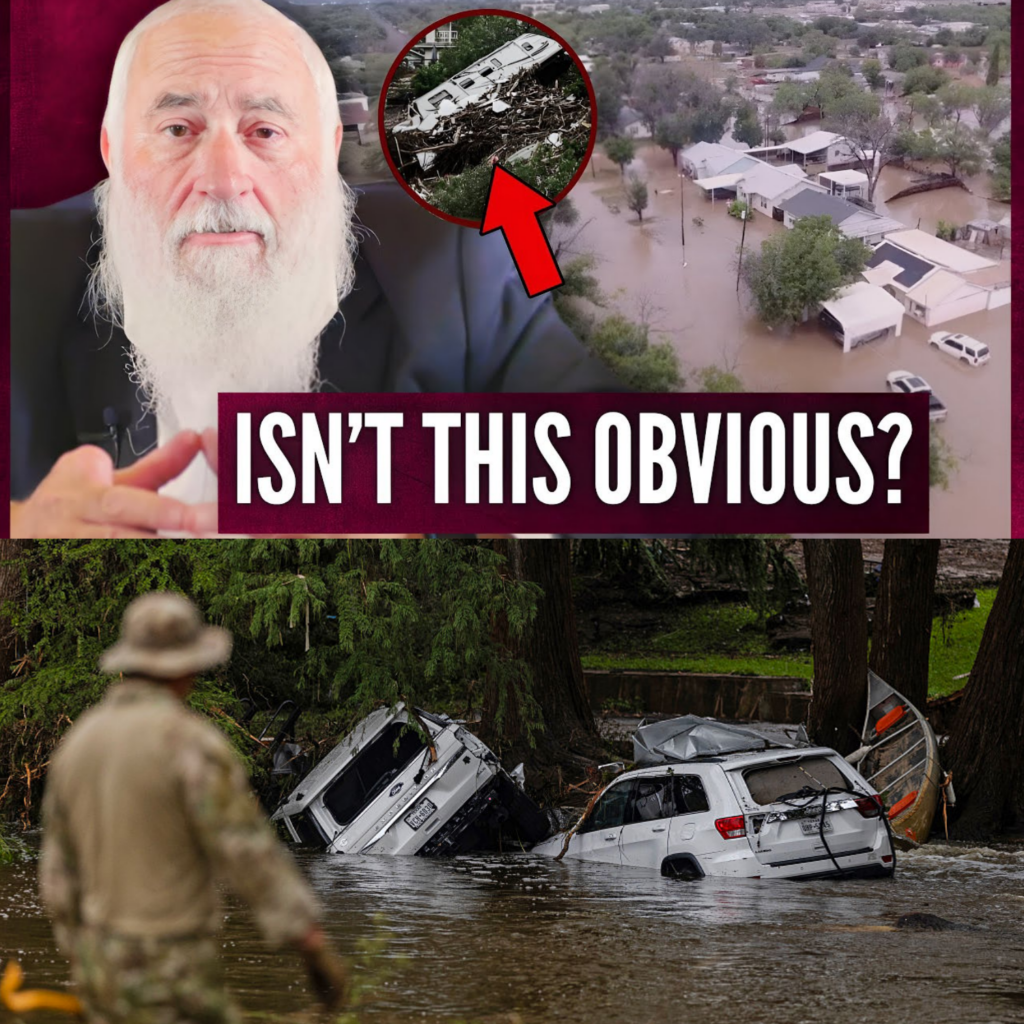
On a sudden, devastating afternoon in central Texas, a historic deluge shattered a century of environmental calm. Within a terrifying forty-five-minute window, local rivers surged an astonishing twenty-six feet, transforming a multi-generational summer camp into a scene of absolute heartbreak. More than fifty souls were lost in the flash flood—most poignantly, children whose parents had sent them off with hugs and packed bags, expecting a lifetime of memories, only to be met with an unimaginable tragedy.
When the dust settles and the waters recede, humanity is always left with the exact same raw, bleeding question: How do we wrap our minds around a catastrophe that strikes with such sudden, indiscriminate fury? We casually blame “Mother Nature” as a shield for our powerlessness, but beneath that label lies a profound spiritual dichotomy between the things we can control and the forces that leave us entirely at the mercy of the infinite. It is a boundary line where human grief meets cosmic order, and it forces us to ask whether we are truly helpless, or if our response to chaos is the ultimate measure of our design.
We are built to crave order, yet we live in a world capable of breaking its banks in minutes. When tragedy strikes, the true test of human existence isn’t demanding an answer from the storm—it is finding the strength to build a boundary where the destruction ends.
.
.
.
Part II: The Myth of Mother Nature vs. The Genesis Matrix
When a natural disaster strikes, modern secular vocabulary quickly defaults to the phrase “Mother Nature.” It is a convenient, personified shorthand that allows humanity to group volcanic eruptions, tectonic shifts, and catastrophic weather patterns into a single, un-addressable category of “uncontrollables.”
However, ancient theological frameworks—specifically the account recorded in the Book of Genesis—offer a drastically different understanding of environmental mechanics.
+-----------------------------------------------------------------------+
|                    THE COSMIC BOUNDARY LANDSCAPE                      |
+-----------------------------------------------------------------------+
| SECULAR LABEL:         "Mother Nature" — an arbitrary, untamed,       |
|                        and occasionally malicious personification     |
|                        of planetary forces.                           |
|                                                                       |
| THEOLOGICAL REALITY:   A highly structured, speech-formed ecosystem   |
|                        intentionally bound by precise, divine limits  |
|                        to permit human survival.                      |
+-----------------------------------------------------------------------+
According to the creation narrative, the universe was not spun out of chaotic, unmanaged matter, nor is it governed by an independent matriarchal force. It was spoken into structural reality through ten distinct utterances—divine speech acting as the ultimate medium of formation.
When the upper waters were separated from the lower waters, and the dry land was commanded to appear, a boundary system was established. The natural forces of the earth—the crushing weight of the oceans, the volatile speed of the winds, the atmospheric pressure of the clouds—were intentionally restricted. They were given a playground, but they were also given a wall. The tragedy in Texas represents a horrific moment where, for reasons hidden within the infinite complexity of the cosmos, those spoken limits temporarily broke.
Part III: The Shaddai Imperative at the Doorpost
To understand how ancient tradition conceptualizes the control of these boundaries, one must examine the specific linguistic titles assigned to the Divine. Among the numerous names utilized in Hebrew tradition, the name inscribed upon the exterior of the mezuzah—the sacred scroll affixed to the doorpost of every traditional home—is Shaddai.
=====================================================================
                    THE MECHANICS OF THE DIVINE HALT
=====================================================================
  THE EXPANDING CHAOS  ---> The raw, unbridled expansion of physical
                            forces (oceans rushing outward, winds
                            accelerating beyond human tolerance).
                                 |
                                 V
  THE SHADDAI COMMAND  ---> "Dai!" (Stop / Enough). The cosmic brake
                            that binds natural elements to their
                            assigned operational zones.
=====================================================================
The literal root of Shaddai points directly to the phrase She’amar L’olamo Dai—”The One who said to His world, ‘Enough!'”
During the formative stages of creation, physical elements expanded exponentially. The oceans threatened to drown the continents before they could form; the winds threatened to scour the topography clean. The cosmos required a sovereign limit. By uttering “Stop,” the Creator forced the oceans to halt at the edge of the sand, establishing a stable equilibrium that allowed human civilization to take root.
But the placement of this specific name on the household doorpost introduces a radical concept: the synchronization of cosmic control with human free will. The doorpost serves as a daily psychological threshold. As a person transitions from the chaotic, unfiltered stresses of the outside marketplace into their domestic sanctuary, the name Shaddai acts as a blueprint for the human psyche. It is a reminder that while we cannot command the physical clouds to stop raining, we possess the absolute, free-will capacity to look at our internal storms—our anxieties, our frustrations, our professional resentments—and command them to halt at the threshold of our homes.
Part IV: The Valid Anger of the “Why”
When twenty-four inches of water falls within a single day, washing away multi-generational summer camps, the human spirit naturally rebels against the silence of the sky. The question of “Why?” is not an act of theological betrayal; it is a vital, historically validated component of the human condition.
Even Moses, the supreme lawgiver of biblical history, stood before the Almighty and demanded an accounting for systemic suffering, asking why a sovereign force would permit trauma to override protection.
+-----------------------------------------------------------------------+
|                   THE PARALYSIS VS. ACTIVATION MATRIX                 |
+-----------------------------------------------------------------------+
| THE PARALYTIC RESPONSE:   Becoming permanently ensnared within the    |
|                           existential loop of "Why?", leading to a    |
|                           collapse of agency and despair.             |
|                                                                       |
| THE ACTIVE RESPONSE:      Acknowledging the raw grief and anger, but  |
|                           immediately pivoting to localized rescue,   |
|                           reconstruction, and community solidarity.   |
+-----------------------------------------------------------------------+
The lesson carved into human history is that while anger and mourning are entirely legitimate, getting stuck in the paralyzing loop of cosmic victimization is fatal. The universe is infinite, and the human mind is structurally incapable of reverse-engineering the exact macro-level calculations of an omnipotent design. We are not privy to the ultimate blueprint.
But our inability to understand the cause does not strip us of our ability to determine the consequence. In the immediate aftermath of the Texas deluge, the immediate human reaction was not a collective surrender to despair; it was an instantaneous activation of rescue boats, community kitchens, and mutual aid networks. When the cosmic boundaries fail, the human boundary of empathy must step into the breach.
Part V: The Historical Continuum of Resilience
The refusal to allow tragedy to paralyze human progress is perhaps most vividly demonstrated through the historical trajectory of the Jewish people. The historical record reveals a community that has been systematically displaced, hunted, and subjected to deliberate campaigns of total annihilation.
=====================================================================
               THE CHRONOLOGICAL CONTINUUM OF RECOVERY
=====================================================================
  THE MODERN HORROR    ---> The systematic destruction of European
                            Jewry during the Holocaust—the absolute
                            nadir of industrialized human malice.
                                 |
                                 V
  THE POTENT RECOVERY  ---> Refusing to die in the ashes; building a
                            sovereign state, reclaiming language, and
                            becoming a global center of innovation.
                                 |
                                 V
  THE LATEST RECKONING ---> The brutal massacres of October 7, 2023.
                            An open wound that was met not with collapse,
                            but with an ironclad national resolve to rebuild.
=====================================================================
Less than a century ago, a third of the global Jewish population was entirely erased via gas chambers, mass shootings, and systematic starvation. More recently, the horrific massacres of October 7th inflicted the deepest collective wound on the community since the mid-20th century.
Yet, the defining characteristic of this historical journey is an absolute refusal to let tragedy define the identity of the survivors. The response to destruction is never permanent mourning; it is always an aggressive, purposeful return to life, construction, and renewal. They do not allow the darkness of the past to dictate the parameters of the future.
Part VI: The Paradox of the 21st Century
We live in an era characterized by a profound, almost jarring dichotomy. It took thousands of years of human history to transition from the basic logistics of the horse and buggy to the development of stealth fighter jets and the unveiling of advanced Artificial Intelligence.
God has essentially unlocked a vault of unprecedented technological gifts for the 21st century, expanding human communication, medicine, and intellectual capacity beyond the wildest dreams of our ancestors.
+-----------------------------------------------------------------------+
|                     THE 21ST-CENTURY HYBRID REALITY                   |
+-----------------------------------------------------------------------+
| EXPONENTIAL ADVANCEMENT:       - Unlocking AI to map human thought.   |
|                                - Eradicating historic diseases.       |
|                                - Global instant communication networks|
|                                                                       |
| ELEMENTAL FRAGILITY:           - A 45-minute rainstorm can still      |
|                                  overwhelm modern infrastructure.     |
|                                - The absolute vulnerability of life   |
|                                  to basic physical forces.            |
+-----------------------------------------------------------------------+
This is the great paradox of modern life: we possess the computational power to simulate the universe, yet we remain entirely vulnerable to an hour of severe weather.
This tension serves as a vital humility checkpoint for our species. Our technological advancements do not make us gods; they simply give us more sophisticated tools to steward the world we have been given. The presence of immense blessing alongside immense vulnerability reminds us that life is a fragile, high-stakes gift that can never be taken for granted.
Part VII: The Blueprint for Human Refinement
If we accept the premise that we cannot physically build a dam high enough to stop every single once-in-a-hundred-years event, how do we honor the memory of those who perished in central Texas? The answer lies in a conscious, micro-level refinement of how we manage our own spoken environments.
If the universe was built through the precise, intentional power of words, then our words carry a weight that mimics the divine. Every single day, we utilize our speech to either construct or destroy the social ecosystems around us.
“We need to realize God created the world with words. We need to be careful with our words… Is it going to be beneficial? Is it going to be helpful? Is it going to be a building? Or is it going to be destructive, painful, and hurting?” — Broadcast Commentary
Before we open our mouths, we must run our thoughts through a rigorous filter of utility:
Is it constructive? Does this phrase add value, clarity, or comfort to the person receiving it?
Is it anchored? Am I speaking out of raw, unchecked emotional volatility, or am I intentionally choosing words that establish peace?
Does it respect limits? Am I using my speech to tear down someone else’s emotional boundaries, or am I bringing order to a chaotic conversation?
By practicing a disciplined guarding of our speech, we bring a small piece of the Shaddai principle into our daily interactions, pushing back against the social chaos that threatens to flood our communities.
Conclusion: The Sovereign Dialogue
The devastating flash floods of Texas are a stark reminder that our stay on this planet is bounded by forces far larger than our collective ego. We cannot control the path of the storm, the eruption of the volcano, or the sudden shifting of the earth. But we are never entirely powerless.
Human prayer, intentional reflection, and active spiritual connection are not passive, desperate acts of wishful thinking; they are an active dialogue with the source of the cosmic boundaries. History is filled with accounts of spiritual giants whose targeted, authentic pleadings moved the needle of natural events, bringing rain to droughts and calm to tempests. Your opinion, your intention, and your prayers carry weight in the cosmic ledger.
As central Texas begins the long, painful process of healing and rebuilding, let it serve as a universal call to abandon complacency. Do not take the calm mornings for granted. Develop a disciplined, active relationship with the Almighty, protect the sanctity of your speech, and ensure that when you cross the threshold of your home, you leave the filth of the world outside—maintaining a sanctuary of peace, love, and resilient unity that no earthly storm can ever wash away.