The Patterson-Gimlin Film Was Reanalyzed By New AI — The Result Shocked Experts
The Patterson-Gimlin Film Was Reanalyzed By New AI — The Result Shocked Experts
For fifty-nine seconds, the figure walked through the trees and refused to die.
That is the strange power of the Patterson-Gimlin film. It is short, shaky, grainy, and old enough to belong to another America. Yet after more than half a century, people are still staring at it frame by frame, slowing it down, enlarging it, stabilizing it, sharpening it, arguing over its hips, shoulders, stride, muscles, fur, shadow, and the famous moment when the creature turns its head toward the camera. Most footage fades into history. This one became a wound that never closed.
Now artificial intelligence has entered the argument.
And instead of ending the mystery, it may have made it more uncomfortable.
The film was shot on October 20, 1967, near Bluff Creek in Northern California. Roger Patterson and Bob Gimlin claimed they were riding on horseback when they encountered a large, hair-covered, bipedal figure moving across a creek bed. Patterson grabbed his 16mm camera and filmed what would become the most famous alleged Bigfoot footage in history. The figure, later nicknamed “Patty,” walks away with a heavy, swinging gait, briefly looks back, and disappears into the forest.
That was all it took.
Less than one minute of film created decades of obsession.
For believers, the Patterson-Gimlin film is the crown jewel of Bigfoot evidence. They point to the figure’s broad shoulders, long arms, unusual gait, apparent muscle movement, and proportions they claim would have been difficult to fake in 1967. They argue that no cheap costume from that era could explain what the footage appears to show. They say the body moves with an animal weight that no actor in a suit could reproduce.
For skeptics, the answer is simpler.
It was a man in a costume.
They point to Patterson’s interest in making a Bigfoot documentary, the film’s convenient timing, the lack of a body, the lack of conclusive biological evidence, and decades of failed attempts to confirm Bigfoot as a real species. They argue that the very fact the Patterson-Gimlin film remains the best evidence after all these years is itself suspicious. If Bigfoot truly exists, why has clearer footage not appeared in the age of smartphones, trail cameras, drones, and thermal imaging?
That question has haunted believers.
But it has never destroyed the film.
The footage survived because it lives in a frustrating middle ground. It is not clear enough to prove the creature is real, but not weak enough to be dismissed by everyone. It is just good enough to keep doubt alive. It shows something. That something walks. That something turns. That something has weight, shape, and presence. The human brain hates unfinished answers, and the Patterson-Gimlin film is one of the greatest unfinished answers in American folklore.
Then came AI.
At first, the promise sounded irresistible. Modern image stabilization, frame interpolation, motion analysis, upscaling, and machine-learning tools could finally do what human eyes had failed to do. AI could strip away the camera shake. It could smooth movement. It could identify body landmarks. It could compare the figure’s gait to human walking patterns. It could separate artifact from anatomy, blur from body, noise from evidence.
At least, that was the dream.
But the moment AI touched the film, the debate split open again.
Some viewers saw the stabilized footage and felt the mystery collapse. Without the violent shake of Patterson’s camera, the figure seemed less monstrous, less strange, more like a person walking in a suit across an open patch of ground. The famous turn toward the camera, once terrifying, looked almost theatrical. The movement, once described as impossible, appeared to some as heavy but human. The AI did not reveal an unknown ape. It revealed what skeptics believed had been there all along: a costume, a performer, and a legend built on blur.
Others saw the opposite.
They argued that AI stabilization does not create truth; it creates interpretation. If the original film is low-quality, grainy, compressed, copied, and unstable, any enhancement risks inventing details as much as revealing them. AI can smooth motion that was never smooth. It can sharpen edges that were never clear. It can fill missing visual information based on patterns learned from unrelated images. In other words, the machine may not be uncovering Patty. It may be rebuilding Patty.
That is the first shocking lesson of the AI reanalysis.
Artificial intelligence does not automatically settle old mysteries.
Sometimes it gives them new disguises.
The Patterson-Gimlin film is especially vulnerable to this problem because every detail matters. A dark patch can become a muscle. A shadow can become a seam. A blur can become fur. A compression artifact can become a buckle. A slight movement can become evidence of either anatomy or costume failure. When the image is this fragile, interpretation becomes dangerous.
That danger is not new. Long before modern AI, computer enhancement had already been used in attempts to analyze the film. In the 1990s, some researchers claimed enlarged frames revealed what looked like a fastener or buckle on the figure’s body. Believers rejected the claim, arguing that extreme enlargement produced meaningless blobs and artifacts. The argument then was the same as the argument now: are we seeing evidence, or are we seeing the limits of the technology?
AI has not removed that question.
It has made it louder.
Because modern viewers are tempted to treat AI as an authority. If a machine analyzes a gait, maps the body, stabilizes the footage, and labels features, people assume the answer is more objective than human opinion. But AI systems are trained, tuned, and interpreted by humans. They inherit assumptions. They make guesses. They can be impressive and still wrong. They can reveal patterns no person noticed and still hallucinate certainty from noise.
That means the result shocked experts not because it produced one clean answer, but because it exposed the fragile boundary between evidence and belief.
The same enhanced clip can convince one viewer the film is a hoax and another that the creature is real.
That is not a technical failure.
That is the Patterson-Gimlin curse.
The film does not behave like ordinary footage. It behaves like a psychological test. Show it to a skeptic, and they see a suit. Show it to a believer, and they see an animal. Show it to a scientist, and they ask for better data. Show it to a filmmaker, and they study staging. Show it to a costume designer, and they examine seams and movement. Show it to a hunter, and they watch posture and terrain. Show it to AI, and the machine returns probabilities that humans immediately turn into arguments.
The film reflects the viewer.
That may be why it has lasted so long.
One of the most discussed features in the footage is the gait. Patty’s walk has been described as strange, fluid, heavy, and difficult to imitate. The arms swing low. The shoulders seem wide. The knees bend. The feet appear to land in a deliberate, rolling motion. Supporters claim the figure has a non-human locomotion pattern and body proportions inconsistent with a man in a suit. Skeptics argue that a person wearing a bulky costume, moving across uneven terrain, could create exactly that strange impression.
AI motion analysis was supposed to help.
But the problem is that the source footage does not provide perfect measurements. Camera speed has been debated. Distance estimates vary. Lens distortion, uneven ground, copy quality, and frame timing all affect interpretation. If any of those inputs are uncertain, the output becomes uncertain too. A machine can calculate angles and motion paths, but if the original visual data is ambiguous, the calculation carries that ambiguity forward.
The AI can measure what it thinks it sees.
It cannot guarantee that what it sees is real.
This is where the story becomes more unsettling than a simple Bigfoot debate. The Patterson-Gimlin film is no longer only about whether a creature crossed Bluff Creek in 1967. It is about whether modern technology can recover truth from damaged images. In an age of deepfakes, AI upscaling, synthetic video, and algorithmic interpretation, the old Bigfoot film has become strangely modern. It asks a question we are all going to face more often:
When an image is unclear, who gets to decide what it shows?
For decades, people believed photographs and film had a special authority. A camera seemed like a witness that could not lie. But the Patterson-Gimlin film has always complicated that faith. It is visual evidence, yet contested. It shows something, yet proves nothing beyond dispute. It is real film, but the event it records remains uncertain. Now AI adds another layer. Enhanced images may look clearer, but clarity is not the same as truth.
A sharper mystery is still a mystery.
That did not stop the new analysis from sending shockwaves through the Bigfoot world. Some longtime believers watched stabilized versions and felt their confidence crack. Others accused the new footage, new analysis, or new claims of being manipulated, biased, or even AI-generated. In an earlier era, people argued over whether Bigfoot was real. Now they argue over whether evidence against Bigfoot is itself fake.
That is the perfect modern twist.
AI was brought in to resolve doubt.
Instead, it created new doubt about the tools used to resolve doubt.
The controversy became even more explosive after new documentary claims emerged, alleging that previously unseen footage may show a man in a Bigfoot-like suit before the famous 1967 film. If true, such evidence would be devastating to the Patterson-Gimlin film’s authenticity. A rehearsal clip would turn the most iconic cryptid footage in history into something closer to a staged scene. It would not disprove every Bigfoot report ever made, but it would remove the strongest visual pillar believers have leaned on for generations.
That is why the reaction was so emotional.
For outsiders, the Patterson-Gimlin film is a curiosity. For believers, it is almost sacred. It is the moment the invisible became visible. It is the one clip that survived ridicule, documentaries, debates, experts, skeptics, and time. If that film falls, the entire Bigfoot belief system does not necessarily collapse, but its emotional foundation shakes.
People do not mourn ordinary hoaxes.
They mourn stories they trusted.
And Bigfoot has always been more than a creature. It is a symbol of wilderness, mystery, freedom, and the hope that the modern world has not mapped everything. Bigfoot lives in the spaces where roads end, where forests still feel old, where human certainty weakens. To believe in Bigfoot is often to believe that something large and unknown can still exist beyond the reach of civilization.
The Patterson-Gimlin film gave that belief a body.
AI may be taking that body apart.
But even if the footage is eventually accepted by most people as a hoax, the story will not disappear. In some ways, it may become even more important. A fake that lasts for nearly sixty years is not just a fake. It is a cultural event. It reveals what people wanted to believe, what they feared losing, and how a few seconds of imagery can become folklore.
That is the second shocking lesson.
The question is not only “Was Patty real?”
The question is “Why did we need her to be real?”
Part of the answer lies in the setting. Bluff Creek was not a city street or a movie studio. It was remote, wooded, rugged, and already tied to reports of giant footprints. The location gave the footage atmosphere. A creature crossing a forest clearing feels more believable than one crossing a parking lot. The wilderness itself becomes a character in the story. It suggests concealment, depth, and possibility.
Another part lies in the figure’s behavior. Patty does not attack. She does not perform. She does not linger. She simply walks away. That restraint makes the film feel more convincing to many viewers. A hoaxer might be expected to exaggerate, roar, wave, or create a dramatic encounter. Patty does none of that. She leaves. Her indifference becomes evidence for believers.
But skeptics see the same thing differently.
Walking away is exactly what a performer in a suit could do safely. It limits exposure. It avoids close inspection. It creates just enough footage to intrigue without giving too much away. The famous look back at the camera becomes, to skeptics, not animal curiosity but cinematic timing.
Again, the same details feed both sides.
That is why AI cannot simply break the tie. It can highlight motion, stabilize frames, compare proportions, and reduce blur, but it cannot read intention. It cannot tell us whether the turn was instinctive or staged. It cannot interview the dead. It cannot recover a lost original negative if the chain of copies has damaged what we see. It cannot make a fifty-nine-second clip carry more certainty than it contains.
At best, AI can help narrow possibilities.
At worst, it can create false confidence.
The most responsible experts understand that. They do not treat AI as a magic judge. They treat it as one tool among many. They ask about source quality, methodology, assumptions, training data, error rates, and reproducibility. They know that a dramatic YouTube enhancement is not the same as a peer-reviewed forensic study. They know that “looks real” and “looks fake” are not scientific conclusions.
But the public rarely waits for caution.
The internet wants verdicts.
Real or fake.
Creature or costume.
Proof or hoax.
Truth or lie.
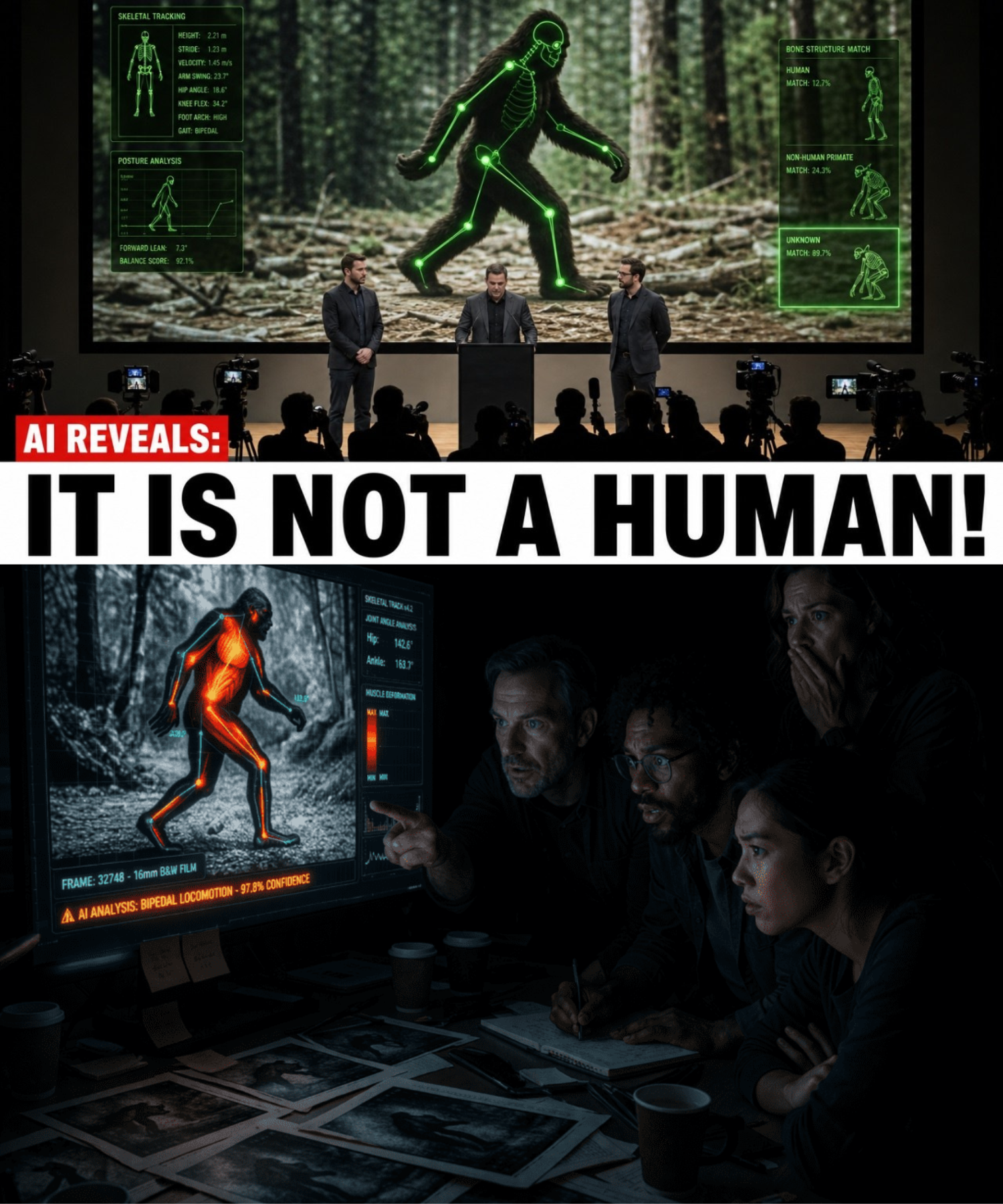
The Patterson-Gimlin film refuses to cooperate with that hunger. Every time the world thinks it is finished, it returns. A new enhancement. A new witness. A new documentary. A new allegation. A new AI model. A new generation of viewers seeing Patty’s walk for the first time and feeling the old chill.
Maybe that is the final reason the footage survives.
It is not merely evidence.
It is a ritual.
People gather around it, replay it, argue over it, and project meaning into its shadows. The film has become a campfire story made of celluloid. The forest is the darkness beyond the firelight. Patty is the shape moving at the edge. The viewer leans closer, trying to decide whether the shape is animal, man, myth, or something else entirely.
AI has now become another person at the campfire, holding up a brighter lamp.
But brighter light can create sharper shadows.
So what did the new AI reanalysis really reveal?
It revealed that the film may be more human-looking than believers want to admit.
It revealed that enhancements can make skeptics feel more confident.
It revealed that low-quality footage remains dangerous territory for machine interpretation.
It revealed that Bigfoot belief is not built on evidence alone, but on identity, hope, memory, and distrust.
It revealed that in the age of AI, even debunking can be dismissed as fake.
Most of all, it revealed that the Patterson-Gimlin film is no longer just a question from 1967. It is a question for the future of visual truth.
If we cannot agree on what a short strip of 16mm film shows after nearly sixty years of analysis, what will happen when the world is flooded with images that are easier to fake, easier to enhance, easier to distort, and harder to trust?
That may be the part that truly shocked experts.
Bigfoot is not the only thing hiding in the Patterson-Gimlin film.
So is the future of doubt.
The figure at Bluff Creek keeps walking because we keep needing it to walk. It walks through cryptozoology, through American folklore, through skeptical inquiry, through documentary culture, through AI enhancement, through online arguments, and through the deep human desire to believe there is still something out there beyond the reach of ordinary explanation.
Maybe Patty was a real creature.
Maybe she was a man in a suit.
Maybe the final answer is already obvious to one side and impossible for the other to accept.
But the film’s power does not come only from what happened in front of Roger Patterson’s camera. It comes from what happened afterward. Millions of people looked at the same frames and could not agree on reality. That is not just a Bigfoot story. That is a human story.
The AI may have sharpened the image.
It did not sharpen us.
And so the figure continues across the creek bed, step after step, half animal, half artifact, half memory, half myth. She turns once toward the camera, as if she knows we will still be watching long after the forest has changed, long after Patterson is gone, long after the first believers grow old, long after machines begin telling humans what they think they see.
Then she walks away.
Still unresolved.
Still disturbing.
Still carrying one of the strangest questions ever captured on film:
What if the thing we are trying to identify is not only in the woods, but inside the way we choose to believe?