Why Do These American Petroglyphs Look Egyptian?
Why Do These American Petroglyphs Look Egyptian?
The carvings were not supposed to be there—not in America, not on desert stone, and not shaped like symbols that seemed to belong on the walls of ancient Egypt.
At first glance, the mystery feels impossible to ignore. A long-beaked figure cut into rock. A human form with a strange headdress. A sun disk beside an animal. Lines that look almost like writing. A jackal-shaped creature that reminds viewers of Anubis, the Egyptian god associated with embalming and the dead. Across the American Southwest, the Great Plains, and remote canyon walls, ancient petroglyphs sometimes appear so unusual that modern observers ask a dangerous question: did someone from Egypt reach America long before Columbus?
It is the kind of question that can set the internet on fire.
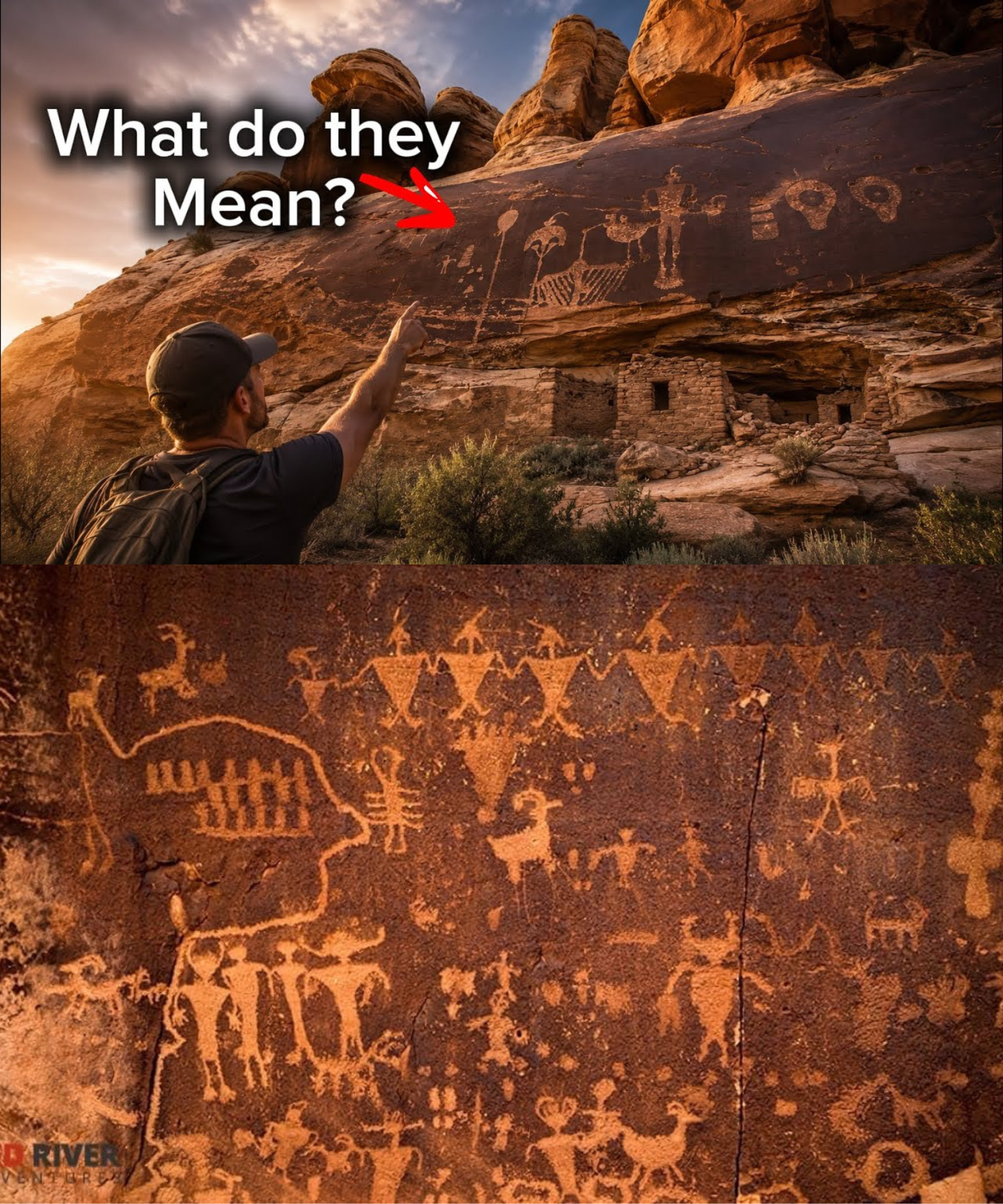
One image is all it takes. A weathered rock panel appears online, its grooves brightened by low sunlight. Someone circles a shape in red and writes, “This is clearly Egyptian.” Then thousands of viewers zoom in, comparing it to hieroglyphs, temple reliefs, gods, boats, scarabs, solar disks, jackal heads, and ancient scripts. Suddenly, a Native American rock-art site becomes a supposed lost chapter of world history. The conclusion spreads faster than the evidence: Egyptians crossed the Atlantic. The truth was hidden. Archaeologists are afraid to admit it.
But the real story is more fascinating than a simple yes or no.
Some American petroglyphs do look Egyptian—at least to modern eyes. The question is why.
The first reason is human pattern recognition. The human brain is built to find meaning in shapes. It sees faces in clouds, animals in stars, messages in cracks, and familiar symbols in unfamiliar art. This ability helped our ancestors survive. Recognizing patterns quickly could mean spotting a predator, reading tracks, or remembering sacred places. But the same ability can mislead us. When we look at ancient rock carvings without context, our minds search for the nearest familiar category. If a figure has an animal-like head, we may think “Egyptian god.” If a symbol looks like a bird, we may think “hieroglyph.” If a circle has rays, we may think “sun disk of Ra.”
That does not mean the similarity is meaningless.
It means similarity is only the beginning of the investigation, not the end.
The second reason is that many ancient cultures used similar visual building blocks. Spirals, circles, hands, animals, horned figures, boats, birds, snakes, humans with raised arms, and sun-like signs appear across the world because human beings everywhere watched the same sky, hunted animals, feared death, marked territory, told stories, and tried to communicate with powers they could not control. A circle with rays does not automatically mean Egypt. It can mean sun, power, time, life, prayer, direction, or something we no longer understand. A human with an animal head does not automatically mean Anubis. It may represent a masked dancer, a spirit being, a shamanic transformation, a clan symbol, or a figure from a local story.
This is where many sensational theories go wrong.
They compare shapes without comparing worlds.
An Egyptian symbol belongs to a specific writing system, religious structure, language, material culture, and historical setting. A Native American petroglyph belongs to its own landscape, people, route, ritual life, ecology, and time period. To prove contact, researchers would need much more than resemblance. They would need secure dating, artifacts in context, inscriptions readable by trained specialists, materials traceable across oceans, settlement evidence, genetic or botanical indicators, and a chain of evidence strong enough to survive professional scrutiny.
A figure that “looks Egyptian” is not enough.
That may sound disappointing, but it should not be. Because the American rock art itself is already extraordinary without importing Egypt into it.
Across North America, Indigenous peoples carved and painted messages into stone for thousands of years. These markings were not random doodles. They appeared along travel corridors, near water sources, in canyons, on cliffs, beside hunting grounds, at ceremonial locations, and in places where light and shadow changed dramatically during certain seasons. Some may have marked memory. Some may have connected to stories. Some may have warned travelers. Some may have recorded animals, events, prayers, visions, migrations, or sacred knowledge. Many meanings are still known only through descendant communities, and some meanings may have been lost forever.
This matters deeply.
When modern viewers call these images “Egyptian,” they may unintentionally erase the people who actually made them.
That is the real danger.
A petroglyph that looks mysterious to outsiders may be part of an Indigenous tradition with its own history and dignity. To rip it out of context and assign it to Egyptians, Phoenicians, Celts, or lost Atlantis without evidence is not harmless curiosity. It can become a way of denying Native American creativity, intelligence, and spiritual complexity. The old colonial assumption was that Indigenous peoples could not have built, mapped, measured, traveled, carved, or encoded meaning without help from the Old World. Modern pseudoarchaeology often repeats that mistake in exciting new packaging.
But the stones tell a different story.
They say America was never empty.
It was full of observers, artists, travelers, hunters, priests, storytellers, astronomers, healers, and communities who understood their landscapes with a sophistication outsiders often failed to recognize.
Still, the Egyptian-looking cases deserve attention because they show how powerful visual echoes can be. Take the so-called Anubis Caves in the Oklahoma Panhandle, one of the most famous examples in alternative archaeology. The site contains carvings that some researchers and enthusiasts interpret as evidence of Egyptian, Celtic, or other Old World influence. One figure has been compared to Anubis because of its canine-like form. Some markings have been claimed to resemble ancient scripts. Some observers argue that sunlight reaches certain symbols at important times of the year, suggesting astronomical design.
To believers, this sounds like a smoking gun.
To skeptics and mainstream archaeologists, it is a cautionary tale.
The central issue is context. Are the markings truly ancient? Are they all from the same period? Were they made by Indigenous peoples, later visitors, ranchers, vandals, or multiple groups across centuries? Do the supposed “letters” form a real readable inscription, or are they random scratches interpreted through wishful thinking? Does the canine figure truly represent Anubis, or does it simply resemble a canine because many cultures carve canine-like animals? Are the solar alignments intentional, or coincidental effects of light moving through irregular rock?
These questions matter more than excitement.
A responsible investigation cannot begin with the conclusion and then force every line into place. It has to ask what the stone, landscape, dating, tool marks, weathering, cultural context, and regional archaeology actually support. When those pieces are missing or uncertain, the theory remains speculation.
That does not make the site boring.
It makes it complicated.
And complicated is often more honest than sensational.
The same pattern appears in the Grand Canyon Egyptian myth. In 1909, a newspaper story claimed that an expedition had discovered Egyptian-like artifacts and hieroglyphs in a hidden Grand Canyon cave. The tale included mummies, tablets, and a supposed Smithsonian connection. It was thrilling. It had everything: secret chambers, ancient Egypt, America, institutional cover-up, and a lost civilization. But no credible evidence has ever confirmed the expedition, the people named in the article, or the alleged artifacts. The story became one of the most persistent archaeological myths in America.
Why did it survive?
Because it gives people the feeling of forbidden knowledge.
It suggests that official history is incomplete, that institutions are hiding the truth, and that one old article can overturn everything. But the myth’s endurance tells us more about modern distrust than ancient history. People want the American landscape to contain secret Egypt because secret Egypt feels more dramatic than the already powerful truth of Native American antiquity.
That is the twist.
The false mystery distracts from the real one.
The real mystery is not why Egyptians would carve American rocks. The real mystery is how many different Indigenous cultures created rock art across such vast landscapes, with meanings so layered that modern viewers are still learning how to approach them respectfully. The real mystery is why certain symbols appear in certain places, why some panels align with sunlight, why some figures seem human and animal at once, why spirals recur, why hands appear, why animals dominate some sites and abstract forms dominate others.
Those are not small questions.
They are enormous.
A spiral carved into desert stone may look simple, but it may connect to motion, migration, emergence, water, wind, ceremony, or the sun. A horned figure may not be a “demon” or “Egyptian god,” but a sacred being within a local cosmology. A line of animals may not be a hunting sketch, but a story, a prayer, a clan memory, or a map of spiritual relationship to the land. A strange anthropomorphic form may not represent an alien or foreign visitor, but a visionary experience.
Ancient images often look foreign because we are the foreigners.
We are outsiders looking at a conversation not meant for us.
This is especially important in the American Southwest, where rock-art panels can include symbols accumulated over long periods. A single wall may contain images from different centuries, cultures, and purposes. Later people may carve near earlier images. Some symbols may be renewed, altered, damaged, copied, or misunderstood by later visitors. Time itself becomes layered on the rock. What modern viewers see as one mysterious “message” may actually be a conversation across generations.
Egyptian temple walls are different. They often belong to state-supported religious and royal systems with standardized writing, trained scribes, formal iconography, and carved inscriptions connected to kings, gods, rituals, and historical claims. American petroglyphs, by contrast, often arise from many decentralized communities with diverse languages, traditions, and landscapes. They are not inferior because they are different. They belong to another kind of knowledge system.
So why do some look Egyptian?
Because both ancient Egypt and Indigenous America used symbolic visual language rooted in the body, animals, the sky, death, power, and sacred place.
Because human beings often give spiritual ideas animal features.
Because sun symbols appear wherever people depend on the sun.
Because profile figures are easy to carve.
Because straight lines, hooks, crosses, circles, and repeated marks emerge naturally in many mark-making traditions.
Because modern viewers come with Egyptian images already in their heads.
And because mystery grows in the gap between resemblance and proof.
There is also another reason: Egypt has become the world’s default symbol for the ancient and mysterious. When people see an unfamiliar old symbol, they reach for Egypt first because Egyptian imagery is globally famous. The pyramids, sphinx, mummies, hieroglyphs, Anubis, Horus, and Ra dominate popular imagination. Egypt feels like the source code of mystery. So anything ancient and strange is pulled toward it in the modern mind.
But resemblance can be a trap.
A bird carved in America is not automatically Horus.
A dog-like figure is not automatically Anubis.
A triangle is not automatically a pyramid.
A line of marks is not automatically hieroglyphic writing.
Ancient people around the world used the natural forms available to human imagination. Birds fly. Snakes move between earth and hidden spaces. Dogs guard, hunt, and scavenge. The sun rises and gives life. Human bodies can be stretched, masked, transformed, or stylized. These are universal experiences, not Egyptian patents.
The stronger question is not “Does this look Egyptian?”
The stronger question is “What does this mean here?”
Here—in this canyon.
Here—near this water source.
Here—on this travel route.
Here—beside these other symbols.
Here—in relation to this community’s traditions.
Here—in this landscape, under this light, at this season.
Context turns mystery into knowledge.
Without context, every symbol becomes a mirror for our own imagination.
That is why archaeologists are cautious. Caution is not fear of truth. It is respect for evidence. A dramatic theory may be exciting, but if it depends on isolated images, uncertain dating, and comparisons made by eye alone, it remains weak. Real history needs weight. It needs layers of support. The more extraordinary the claim, the stronger the evidence must be.
Did people cross oceans before Columbus? Yes, in some cases we know they did. The Norse reached North America around a thousand years ago. Polynesians crossed vast Pacific distances. Human beings were far more capable of navigation than old textbooks once admitted. So the idea of ancient contact across water is not automatically impossible.
But possibility is not proof.
Egyptian contact with ancient America would require direct evidence. Not vibes. Not resemblance. Not one ambiguous carving. Not an internet overlay. Evidence.
Until that evidence appears, the responsible answer is that American petroglyphs that look Egyptian are best understood as Indigenous rock art being misread through a modern Egyptian lens—or, in some cases, as later carvings, hoaxes, or contested marks with uncertain origins.
That answer may seem less thrilling than secret Egyptian explorers.
But it is actually more meaningful.
It restores the carvings to the land where they belong.
It allows American petroglyphs to be American—not because modern national borders matter, but because the images belong to the Indigenous histories of this continent. They belong to people who watched these skies, walked these canyons, knew these animals, buried their dead in these soils, and told stories shaped by these horizons.
That is enough wonder.
More than enough.
Imagine standing before a petroglyph panel at sunset. The rock glows red. Shadows deepen inside the carved lines. A spiral catches the last light. A bighorn sheep seems to step across the stone. A human-like figure raises both arms. Nearby are marks no one can confidently translate. For a moment, the wall feels alive. It is easy to understand why someone might think of Egypt, because Egypt also made stone speak.
But this wall is not asking to be turned into Egypt.
It is asking to be seen on its own terms.
The true mystery is not that ancient America secretly looked Egyptian. The true mystery is that different civilizations, separated by oceans, still reached for stone when they wanted memory to survive. They carved animals because animals mattered. They marked the sun because the sun ruled life. They shaped human figures because the body was the first symbol. They placed signs in sacred landscapes because meaning was not separate from place.
This is not evidence of a single lost global empire.
It is evidence that human beings everywhere are symbol-making creatures.
That may be the deepest connection of all.
Not Egyptians sailing into every canyon.
Not hidden priests carving Anubis in Oklahoma.
Not secret Smithsonian chambers full of suppressed proof.
But the shared human need to mark the world, speak to the unseen, remember the dead, measure the heavens, and leave something behind that says: we were here, and this place mattered.
So why do these American petroglyphs look Egyptian?
Because the ancient world speaks in visual echoes.
Because our eyes bring Egypt with us.
Because sacred symbols often rhyme across cultures.
Because mystery attracts familiar names.
And because the past is easier to sensationalize than to patiently understand.
The carvings may not prove Egyptian visitors.
But they prove something just as powerful: ancient America had its own sacred landscapes, its own symbolic systems, its own memory carved into stone.
That is not a weaker story.
It is the one the rocks have been telling all along.