A Hidden Detail in Nefertiti Bust Has Been Revealed — And It’s Shocking!
A Hidden Detail in Nefertiti Bust Has Been Revealed — And It’s Shocking!
For more than a century, the world believed it was looking at the perfect face of Queen Nefertiti. Then modern scanners looked beneath the painted surface—and found another face hiding inside.
The bust of Nefertiti is one of the most famous images ever created by ancient Egypt. Her long neck, elegant blue crown, high cheekbones, calm mouth, and mysterious gaze have made her a global symbol of beauty, power, and royal perfection. Millions have seen her in books, documentaries, museum galleries, posters, and online images. Even people who know little about ancient Egypt often recognize her instantly.
But the face the world knows is not the whole face.
That is the shocking detail.
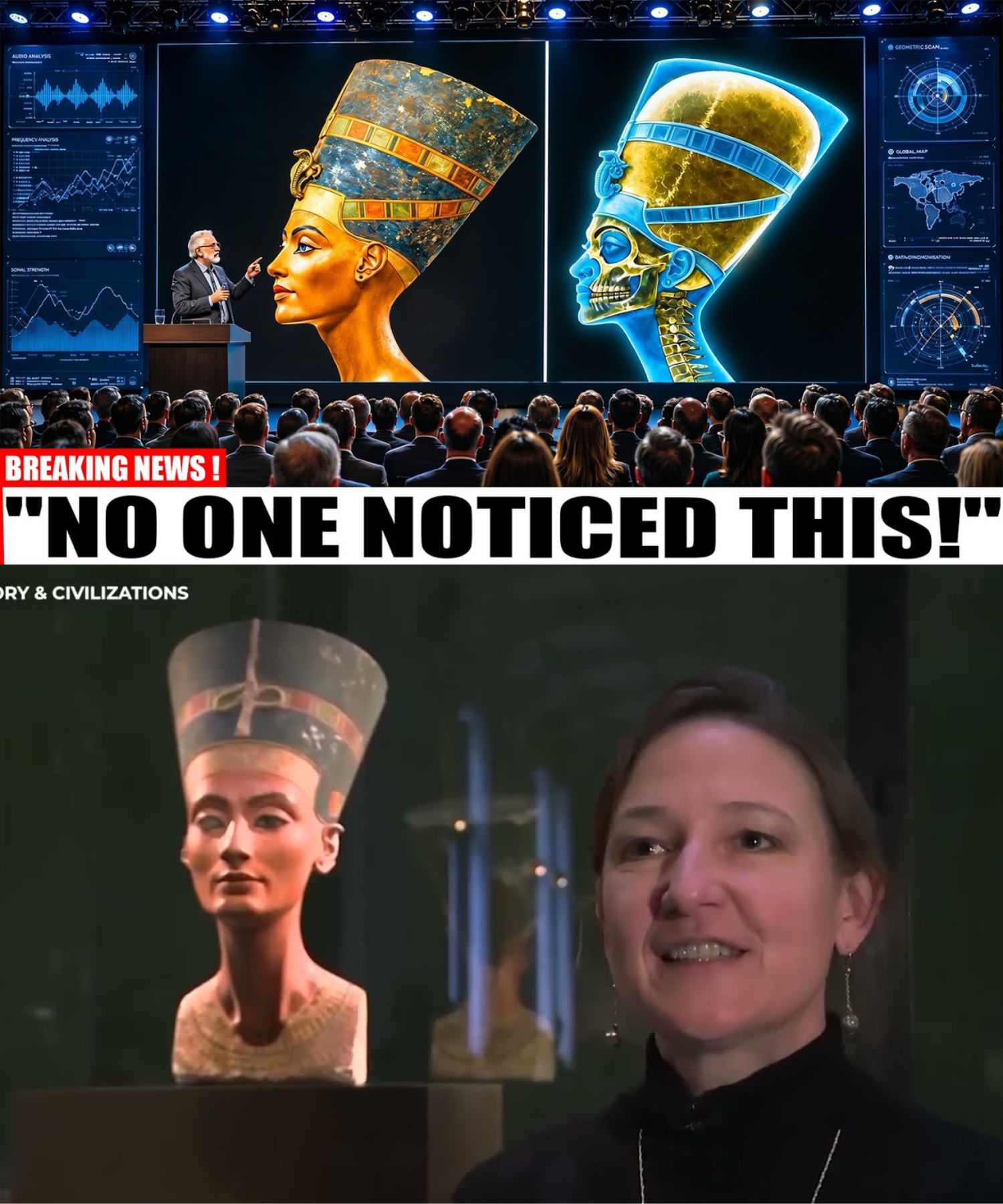
Beneath the smooth painted stucco, hidden inside the limestone core, researchers found an earlier version of Nefertiti’s face. It was not as polished. Not as perfectly softened. Not as timelessly idealized. It showed subtler features, slightly different contours, and hints of a more human queen beneath the famous surface. In other words, the bust was not simply carved once and painted. It was built, corrected, refined, and transformed.
The world-famous Nefertiti may be wearing an ancient artistic filter.
The discovery does not make the bust less valuable. It makes it more extraordinary. For generations, visitors have stood before the queen in Berlin and admired what seemed like effortless perfection. But the scans revealed that perfection was not effortless at all. It was engineered. The sculptor, likely working in the royal workshop of Thutmose at Amarna, first shaped a limestone face and then used layers of stucco to adjust, smooth, and idealize the final appearance.
The hidden face beneath the surface may bring us closer to the woman behind the icon.
That possibility is what makes the revelation so powerful.
Nefertiti lived during one of the most dramatic periods in Egyptian history. She was the Great Royal Wife of Pharaoh Akhenaten, the king who attempted a radical religious transformation centered on the Aten, the sun disk. Egypt’s traditional gods and priestly structures were challenged. A new capital was built at Amarna. Royal art changed. The king, queen, and their daughters were shown in unusually intimate scenes beneath the rays of the Aten. Bodies became elongated. Faces became expressive. Family, divinity, and political power were fused into a new visual language.
Nefertiti was not merely decoration in this world.
She was central to it.
Images show her worshiping the Aten, standing beside Akhenaten, riding in chariots, wearing crowns of authority, and in some scenes striking enemies in a pose usually associated with kings. Whether she ruled independently, co-ruled, or held extraordinary religious power remains debated, but one thing is clear: Nefertiti was not a passive queen hidden behind a throne. She was a visible force in one of Egypt’s boldest experiments.
That is why her bust matters so deeply.
It is not just a portrait of beauty.
It is a political image.
The famous surface of the bust gives us Nefertiti as she was meant to be seen: composed, balanced, serene, almost beyond human aging. Her right eye, with its dark inlay, gives the face a living intensity. Her missing left eye has generated endless speculation. Was it never completed? Was the bust a workshop model? Was the absence intentional, accidental, or unfinished? The question has never stopped haunting the object.
But the hidden inner face adds an even deeper mystery.
Why carve a more realistic face and then cover it?
One answer is simple: artistic process. Ancient sculptors often worked in stages. The limestone core gave structure. The stucco allowed refinement. If a cheek needed smoothing, stucco could correct it. If the nose needed adjustment, stucco could reshape it. If lines around the mouth or eyes seemed too natural for a royal ideal, the final surface could soften them. The bust may have functioned as a master model used in the workshop, showing how the queen should be represented across other works.
But another answer is more emotionally striking.
The sculptor may have begun with Nefertiti as a woman and ended with Nefertiti as an icon.
That transformation is not a small detail. It reveals the ancient machinery of royal image-making. Power does not simply show itself. It edits itself. It decides what the public may see. It turns a living person into a symbol. In Nefertiti’s case, the final image became so successful that it survived more than three thousand years and still defines beauty in the modern imagination.
Yet beneath it, the scanner found traces of something less perfect and more intimate.
The hidden face reportedly shows subtle differences in the nose, mouth, cheeks, and expression. These are not grotesque changes. They are not evidence that the famous bust is fake. They are evidence of refinement. The queen beneath the surface seems closer to life. The queen on the surface seems closer to eternity.
That tension is breathtaking.
Which one is the real Nefertiti?
The answer may be both.
The inner face may preserve an earlier, more natural version of the queen’s features. The outer face shows the official image: Nefertiti as royal beauty, divine partner, political symbol, and eternal presence. The bust is not a lie. It is a layered truth. It shows how ancient Egypt understood the difference between ordinary appearance and sacred representation.
Modern people often think of portraits as attempts to capture exact likeness. But ancient Egyptian royal art had a different purpose. It was not only about what someone looked like on a certain day. It was about what that person meant in the cosmic and political order. A queen’s image did not need to show every wrinkle, swelling, asymmetry, or tired line. It needed to express authority, youth, harmony, divine favor, and permanence.
The hidden face reveals the cost of that permanence.
A living woman had to become a perfect image.
That idea feels surprisingly modern. Today, public figures are photographed, filtered, edited, corrected, styled, and transformed before the world sees them. Faces are smoothed. Angles are controlled. Imperfections are erased. A celebrity’s public image may be as carefully constructed as any ancient royal portrait. The tools have changed, but the impulse is ancient.
Nefertiti’s bust may be one of history’s earliest masterpieces of image management.
The scanner did what time had failed to do.
It saw through the surface.
That is why the discovery feels almost personal. For decades, people have looked at Nefertiti and admired perfection. Now, we know that perfection sits over an earlier face. Suddenly the bust becomes less distant. It is no longer only a silent masterpiece behind glass. It becomes a record of decisions: add more stucco here, soften this line, refine that cheek, smooth this sign of age, create the queen the court wants to remember.
Every correction says something.
Not only about the artist.
About power.
About beauty.
About the pressure placed on royal women to embody ideals larger than themselves.
Nefertiti’s name is often translated as “the beautiful one has come.” That name alone has shaped how people see her. But the hidden detail beneath the bust suggests that beauty was not merely natural; it was constructed and enforced by art. The queen’s beauty became part of the Amarna project, part of a religious and royal revolution that needed visual perfection to communicate legitimacy.
The Amarna period was brief, strange, and unstable. After Akhenaten’s death, the religious revolution collapsed. The old gods returned. Amarna was abandoned. Royal names were attacked. Images were damaged. Nefertiti herself disappears from the record in ways that have fueled endless theories. Did she die? Did she become co-regent? Did she rule under another name? Was she erased? Her life remains full of missing pieces.
Yet her bust survived.
Ironically, the object that made her immortal was found not in a royal tomb, but in an artist’s workshop. That setting matters. It suggests the bust may have been part of the process of production, perhaps a model used by sculptors rather than a finished temple statue meant for public worship. If so, the hidden inner face becomes even more valuable. It gives us a rare glimpse into the workshop itself—the place where royal identity was crafted by hand.
Imagine the sculptor standing before the limestone core.
He knows the queen’s face. He knows the court’s expectations. He knows the visual language of Amarna. He begins with stone, then builds with stucco. Layer by layer, the face changes. The human becomes ideal. The private becomes official. The queen becomes a standard others will copy.
That is a stunning thought.
The bust is not only an artwork.
It is an instruction.
This may also help explain why the object feels so perfect. It was not necessarily meant to show a spontaneous moment. It may have been designed as a reference point, a visual formula, a controlled image of royal femininity and authority. The missing eye might even support the idea that it was a workshop model rather than a completed public cult object. But the exact reason remains debated, and that uncertainty adds to the fascination.
The hidden detail also deepens the ongoing debate over where the bust belongs. Since its discovery by a German archaeological team in 1912, the Nefertiti bust has been housed in Berlin. Egypt has repeatedly called for its return, seeing it as one of the greatest icons of Egyptian heritage. Germany has maintained that the bust was legally acquired and has emphasized its fragility and importance to Berlin’s museum collections. The debate is not only legal. It is emotional, historical, and symbolic.
The hidden face makes the object feel even more intimate.
This is not just a beautiful sculpture removed from Egypt.
It is a layered record of ancient Egyptian royal artistry, workshop practice, political theology, and human identity. It contains not only the image seen by millions, but a concealed stage of creation beneath the surface. That makes the question of ownership even more charged. Whoever controls Nefertiti does not merely control an artifact. They control one of the world’s most powerful images of ancient womanhood.
Still, beyond politics, the bust continues to speak because it holds contradiction so beautifully.
It is fragile but powerful.
Ancient but modern.
Idealized but human.
Silent but endlessly discussed.
Complete but missing an eye.
Perfect but hiding corrections.
That final contradiction may be the most important. The bust’s perfection is not pure. It is layered over adjustment. It carries the marks of artistic struggle. Beneath the queen the world worships is the queen the artist first carved. Beneath the icon is the person. Beneath the surface is the process.
That is what makes the hidden detail so shocking.
It does not destroy Nefertiti’s beauty.
It reveals how beauty was made.
The scans also remind us that technology has changed archaeology forever. In the past, discovering what lay beneath the surface might have required damaging an object. Today, CT scanning and other non-invasive methods allow researchers to look inside priceless artifacts without cutting them open. They can see cores, cracks, repairs, layers, hidden structures, earlier versions, and conservation risks. Ancient objects that seemed silent can now reveal internal histories.
The Nefertiti bust is a perfect example. For more than a century, its outer face dominated the conversation. Now the inside has joined the story. The sculpture is no longer only something to look at. It is something to look into.
That may be the future of museum science.
Not just displaying beauty, but uncovering the hidden lives of objects.
Every ancient artifact has a biography. It was made, used, damaged, moved, buried, discovered, cleaned, interpreted, displayed, photographed, politicized, and studied. The Nefertiti bust’s biography is especially dramatic because it has become a global symbol. But the hidden face reminds us that its first biography began in a workshop, under the hands of an artist making choices in real time.
Those choices still matter.
They tell us that ancient Egyptian artists were not mechanical copyists. They were skilled observers and image-makers who understood structure, proportion, material, and ideology. They knew how to use limestone and stucco together. They knew how to turn a core into a finished royal image. They knew how to create an object so compelling that, thousands of years later, people would still argue over it.
And yet, they also left behind traces of the face they covered.
That is the haunting part.
The hidden face was never meant for us.
It was buried under beauty.
But modern science found it anyway.
Now, when we look at Nefertiti, we cannot see only the surface. We must imagine the inner carving beneath the paint, the subtle lines hidden under stucco, the earlier mouth, the altered nose, the softened cheeks. We must imagine the sculptor deciding what the world would see and what it would not.
And perhaps we must ask the same question about every image of power.
What has been smoothed away?
What has been covered?
What human truth lies beneath the official face?
Nefertiti’s bust has survived because it is beautiful. It endures because it is mysterious. The hidden detail revealed by scanning does not solve that mystery. It makes it richer. It turns the bust from a frozen icon into a layered drama of art, politics, beauty, age, and identity.
For more than three thousand years, the queen kept two faces.
One for the world.
One beneath the world’s gaze.
Now the second face has begun to speak.
And what it says is stunning: perfection is not the absence of history. Sometimes perfection is the final layer placed over everything history tried to hide.