Joe Rogan Is Starting to Understand The Bible
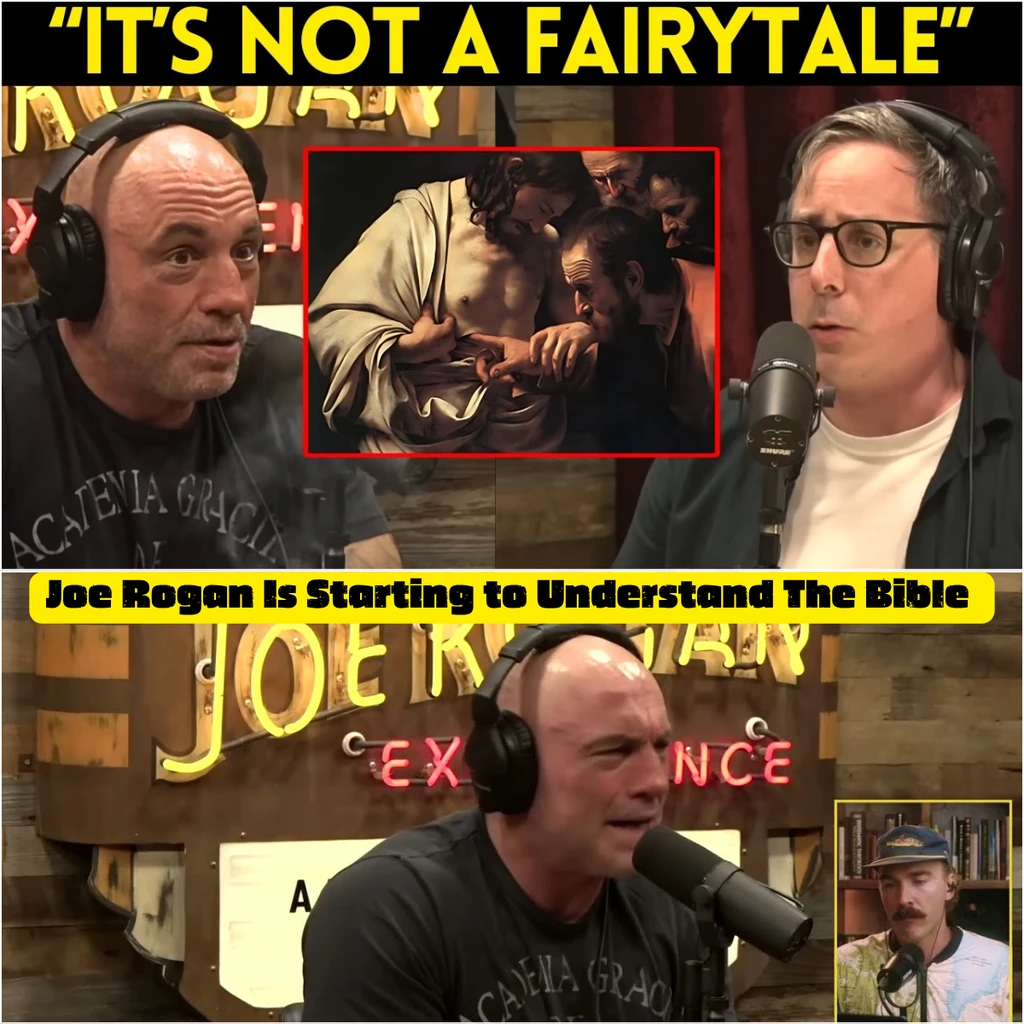
Joe Rogan Is Starting to Understand The Bible
The cultural skyline of America is shifting. For decades, the intellectual elite in cities like Chicago and San Francisco maintained a rigid boundary between “fact” and “faith.” To be a person of science or reason meant viewing religious narratives as pleasant, if primitive, fairy tales—folklore designed to keep the dark at bay before we had the luxury of electricity and the double-blind study. But as the mid-2020s progress, that dismissive posture is beginning to feel increasingly hollow.
A new conversation is emerging, one that isn’t happening in traditional cathedrals, but in the most modern of American forums: the long-form podcast. In recording studios from Austin to Los Angeles, voices that once championed the “New Atheism” are pausing. They are looking at the wreckage of a purely secular certainty and realizing that the “fairy tale” dismissal doesn’t actually fit the data. As one prominent cultural commentator recently noted, “I used to love all that new atheist stuff. But those guys fell apart. They don’t seem like they’re at peace.”
What is replacing that old skepticism is a fascination with the intersection of history and mystery. Americans are rediscovering that the Bible isn’t just a book of moral fables; it is a sprawling, gritty, and often confusing record of historical claims. From the flood myths that mirror geological discoveries of the Younger Dryas impact to the archaeological digs in the Levant that confirm the existence of the House of David, the “Book of Nature” and the “Book of Scripture” are starting to look like two sides of the same American coin.
The Problem of Certainty
In the American political and social landscape, ideology is often treated as a shield. It provides a comforting, ironclad certainty in an era of rapid change. But as many Americans are finding, that certainty is a double-edged sword. While it offers a sense of direction, it also creates a vacuum of peace. The “New Atheists”—figures like Dawkins or Hitchens—offered a certainty that was intellectually sharp but spiritually “persnickety.” It was a world of high-definition clarity that left the inhabitants feeling cold.
In contrast, there is a growing attraction to the “locked-in” dedication of the devout. Whether it’s a neighbor in a suburban Ohio neighborhood praying with consistent discipline or a colleague in a New York firm finding calm in ancient liturgy, there is a visible stability in faith that the secular “choose-your-own-adventure” morality lacks. This isn’t just about picking an ideology for the sake of utility; it’s about a genuine curiosity. Americans are asking: What if these people aren’t just dedicated to an idea, but to a reality?
This shift marks a move past the “utilitarian religion” phase—where we claim religion is “good for society” but not necessarily true—and into a deeper investigation. If the story of Jesus is just a myth, why does it feel so grounded in the dirt and blood of history?
The True Myth: Galileo’s Two Books
The American intellectual tradition is often defined by the tension between science and theology. However, the Renaissance scientist Galileo Galilei offered a perspective that is seeing a massive revival in 2025: the idea that God has given us two books. The first is the “Book of Nature” (the physical world explored by science), and the second is the “Book of Scripture” (the revelation explored by theology).
Galileo’s premise was simple: if both books come from the same Author, they cannot ultimately contradict one another. Any perceived conflict is not a conflict of reality, but a conflict of interpretation. In the United States, where the “evolution vs. creation” wars once defined the culture, a new synthesis is forming.
Modern American explorers are looking at the physical evidence of catastrophic global floods—massive, instantaneous releases of water from melting ice caps—and seeing the echo of the biblical flood narrative. They are seeing that the oral traditions of ancient peoples weren’t just imaginative flights of fancy; they were “eyewitness reports” of a world in chaos, written down on animal skins and hidden in clay jars. When those jars were found—like the Dead Sea Scrolls discovery that remains a cornerstone of American biblical scholarship—they didn’t reveal a changing, evolving legend. They revealed a text that had remained startlingly intact for thousands of years.
This realization is driving a “historical turn” in American faith. It’s no longer about whether the story is “inspiring”; it’s about whether the events actually happened.
The Archetype of the Ideal Man
At the center of this American re-evaluation is the person of Jesus. Even for those who aren’t ready to call themselves “believers,” there is a growing consensus that Jesus of Nazareth represents the highest ethical peak of human history. In a culture obsessed with “influence,” Jesus stands as the ultimate influencer—one who didn’t seek power, who died nonviolently, and who offered a plan for human interaction that has outlasted every empire.
This is where the American mind begins to grapple with what C.S. Lewis famously called the “True Myth.” We are a culture that loves hero stories—the damsel in distress, the hero’s journey, the sacrificial savior. We see these archetypes in our cinema, from Star Wars to the Marvel Universe. But the historical person of Jesus presents a terrifying and beautiful possibility: What if the story we’ve been telling ourselves since we sat around campfires is actually true?
What if we manifest these stories because they are actually our story? In the “Garden of the Gethsemane” or on the “dusty streets of Jerusalem,” history and archetype merge. For the American skeptic, this is where it gets “weird.” The depiction of Jesus is remarkably consistent across historical sources. He isn’t a shifting legendary figure; he is a documented human being whose existence is more certain than many of the Roman emperors we take for granted in our history books.
In recent years, scholars and seekers across the United States have begun to view the Bible not just as a theological work, but as a living archaeological map. In major museums in New York or research facilities in Washington D.C., interest in ancient artifacts is reaching an all-time high. A prime example is the Dead Sea Scrolls—a discovery that remains the cornerstone of American textual scholarship.
These scrolls, found in clay jars in the Qumran caves, are not merely religious tales. They are copies dating back thousands of years, demonstrating the startling accuracy of the text over time. A key example is the Great Isaiah Scroll. Written long before the birth of Jesus, it describes the “suffering servant” in detail—an image that believers identify as Jesus. For the modern American, who values authenticity and evidence, the fact that an ancient text remained intact for millennia is a powerful historical proof. It shatters the bias that these were just “oral legends” that became distorted over time.
This connection extends beyond parchment. When American travelers visit Jerusalem, they aren’t just visiting a religious site; they are visiting a historical crime scene. Walking in the Garden of Gethsemane, where Jesus was arrested, provides a sense of reality that no philosophical theory can replace. Modern archaeology has even confirmed the existence of the House of King David—a figure once considered a myth until the 1990s. The deeper we dig into the earth, the more it becomes clear that these stories are tied to real locations and events in the human timeline.
Ethics and the Cost of Emptiness
As American society moved away from religious foundations, a new problem emerged: the crisis of moral standards. In debates at prestigious universities from Harvard to Stanford, people began to realize that without a “transcendent anchor,” the concepts of right and wrong become flimsy and dependent on personal whim.
Cultural observers have pointed out that without religion, humans easily fall into a state where they cannot answer basic questions about human value and the right to life. A society based solely on “individual will” leads to division and disorientation. Conversely, religion provides a framework where people are encouraged to become the best versions of themselves. Voluntary self-sacrifice, kindness, and placing the community above the self are values that Jesus modeled perfectly.
In cities like Chicago or Philadelphia, where loneliness and mental health issues are at an all-time high, faith communities are becoming “anchors” for displaced young people. Statistics in the U.S. show that those who practice a genuine faith often report higher levels of happiness and charity. This isn’t just a psychological effect; it is the result of living for an ideal higher than self-worship or the vanity of social media.
The Solution to the Problem of Evil
The final part of the spiritual journey in America often leads to the most difficult question: Why does evil exist? New Atheist movements often used the existence of suffering to deny God, but they offered no practical solution to deal with it.
Christianity offers a different answer. If God were to eradicate evil entirely and immediately, none of us would likely be left, because every individual is, to some degree, part of the problem. Instead of destruction, the story of Jesus is a story of redemption. The image of Jesus dying on the cross with arms wide open is the ultimate symbol of forgiveness and sacrifice. He chose to bear the consequences of evil himself, opening a path for humanity to be healed and reconnected to the ultimate reality.
The resurgence of faith in the U.S. in 2025 is not a retreat into an ignorant past. It is a brave step forward by a generation that has tested everything—consumerism, digital fame, and extreme individualism—and found it all wanting. They are returning to the great questions of philosophy: Where are we from? What are we for? And where are we going?
The synthesis of historical evidence and spiritual experience is creating a new face for America. It is a nation finding its soul again through ancient books, honest debate, and a persistent hope that, behind the chaos of the modern world, there is a deep meaning and a pair of arms always open and waiting.