The Dark Trinity (Anu, Enki & Enlil)
PART 1: The Uncovering of Ancient Knowledge
The Sumerian civilization, the cradle of humanity’s first known writing and culture, had long captivated scholars. Known for its early advancements in mathematics, astronomy, and the creation of the first urban centers, Sumer held a deep, mysterious allure for those who sought to understand the origins of civilization. But within its rich history lay something even more intriguing: a religious tradition that, in its very foundations, hinted at something much older, something universal.
Dr. Lydia Grant, an esteemed historian and professor of ancient religions, had spent much of her academic career researching the lost civilizations of the ancient Near East. But it was her fascination with Sumer that led her to her most groundbreaking discovery. For years, she had been sifting through ancient tablets, cuneiform inscriptions, and forgotten texts, looking for patterns and connections between the various myths and religious practices of the ancient world. And one day, during a routine examination of a newly unearthed collection of Sumerian tablets, she stumbled upon something that would change everything.
The tablets were old—older than most in the museum’s archives—and their inscriptions were faded with time. But Lydia’s eyes immediately locked onto a strange passage. It was a myth—an ancient Sumerian creation story—that spoke of three gods in a union, an inseparable trio of deities, each representing different aspects of existence. This wasn’t merely a pantheon of gods—it was a trinity. The concept of the divine manifested in three forms.
For Lydia, it was as though the floor had dropped beneath her feet. This trinity—this divine trifecta—was not unique to Christianity. In fact, it seemed to predate Christianity by millennia. The Sumerians had conceptualized a God who existed simultaneously in three distinct forms—one that created the heavens, one that embodied the earth, and one that governed the underworld. The three gods were inseparable, working in perfect harmony to sustain the universe. This was a deeply spiritual concept that mirrored the Christian Holy Trinity, but it was at least 4,000 years older.
The question that burned in Lydia’s mind was immediate: Why had this ancient triad of gods been erased from history? And what did it mean for our understanding of the Creator and the development of religious thought?
PART 2: The Three Sumerian Gods
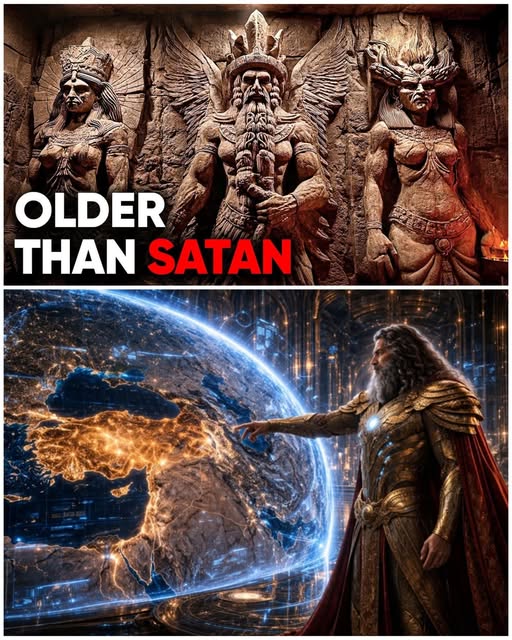
The three gods described in the ancient Sumerian creation myth were Anu, Enlil, and Enki. Each deity had a specific domain in the Sumerian pantheon. Anu, the supreme god, was the god of the heavens, a distant force that represented the sky and the cosmos. Enlil, his son, was the god of air, wind, and storms, holding dominion over the earth and the forces of nature. Finally, Enki, the god of water, wisdom, and creation, governed the underworld and played a critical role in shaping the world of the living.
Together, these gods formed a divine trinity—a trio that represented the fundamental aspects of existence: the heavens, the earth, and the underworld. They were not separate in purpose but united in their divine action, each governing a different sphere of influence that complemented the others. In this myth, the gods were not in conflict, nor were they rivals. They were collaborators, working together in perfect balance to create and maintain the world.
The triad of gods, in their union, reflected a profound understanding of the interconnectedness of life and the divine. Anu, Enlil, and Enki were not simply separate entities performing isolated functions; they were aspects of the same divine power, manifesting in different forms. This concept of a divine trio, where three distinct entities coexist as one, was deeply ingrained in the Sumerian worldview and can be traced to the very heart of their religious practices.
As Lydia sat in the archives, she reflected on the implications of this discovery. Could it be that the concept of the Trinity in Christianity—Father, Son, and Holy Spirit—had roots in this ancient belief system? And if so, how had this powerful, pre-Christian idea of the divine been lost or obscured over time?
PART 3: The Hidden Secrets of Sumerian Religion
Lydia’s research took her deeper into the Sumerian religious texts, and the more she read, the more fascinated she became. The Sumerians had a rich tradition of myths, legends, and religious practices, many of which centered around their gods. These gods were not just worshiped; they were intimately involved in the daily lives of the Sumerian people. Temples dedicated to Anu, Enlil, and Enki were scattered across the land, and the priests who served in these temples were seen as intermediaries between the gods and the people.
The rituals surrounding the worship of these gods were complex and multifaceted. Each god had their own set of offerings and prayers, and their power was invoked to ensure the prosperity of the land, the fertility of the crops, and the safety of the people. The Sumerians believed that the gods shaped the world through their divine will, but also that they were deeply connected to the fate of humanity.
One of the most striking aspects of the Sumerian pantheon was the emphasis on balance. Anu, Enlil, and Enki were not seen as competing forces but as complementary elements of the universe. Together, they upheld the cosmic order, ensuring that the heavens, the earth, and the underworld were in harmony. This balance was essential to the survival of the world, and it was maintained through the sacred rituals of the Sumerians.
Lydia marveled at the idea that this belief system had existed for thousands of years, and yet, it had been largely forgotten in the modern world. It was as though the very foundations of ancient religious thought had been buried, lost beneath layers of history, conquest, and cultural change. The trinity of Sumer, the divine triad that had been worshiped and revered, was now little more than an ancient relic, a forgotten truth.
PART 4: The Christian Trinity and Sumerian Influence
As Lydia continued her studies, she couldn’t help but notice the striking similarities between the Sumerian divine trinity and the Christian Holy Trinity. The parallels were uncanny: in Christianity, God the Father, God the Son, and God the Holy Spirit were united as one, distinct in person but equal in power and purpose. In the Sumerian belief, Anu, Enlil, and Enki were also distinct, each ruling a different domain, but united in their shared divine purpose.
Lydia began to wonder if the concept of the Trinity in Christianity was influenced by the ancient Sumerian trinity. It was widely known that early Christianity had emerged in the region of the ancient Near East, a region where the Sumerians once thrived. Could it be that the early Christian writers, many of whom were familiar with the cultural and religious practices of the surrounding civilizations, had incorporated this concept of the divine triad into their own faith?
As she researched more, Lydia uncovered fascinating evidence. The early Church Fathers, particularly those from regions that had once been part of the ancient Sumerian Empire, often spoke of the unity of God in their theological writings. Some scholars had even suggested that the Christian Trinity was rooted in ancient Near Eastern religious ideas, including those found in Sumerian beliefs.
But the mystery deepened. If the Christian Trinity was influenced by ancient Sumerian religion, why had it been omitted or suppressed in later Christian teachings? Had the early Church intentionally obscured these connections, either to distance themselves from pagan influences or to solidify their own unique identity?
Lydia’s mind raced as she sifted through the ancient texts. The more she learned, the more she believed that the key to understanding the true nature of the Christian Trinity might lie in these ancient Sumerian beliefs. And if she could uncover that truth, she would have solved a riddle that had baffled scholars for centuries.
PART 5: A Divine Connection
One night, while poring over cuneiform texts in the quiet archives, Lydia stumbled upon something remarkable—an ancient prayer that appeared to be a direct reflection of the Sumerian belief in the triad of gods. It was an invocation, a prayer to Anu, Enlil, and Enki, asking for mercy, protection, and blessings. The language used in the prayer was both elegant and powerful, and as Lydia read it, she felt a deep connection to the ancient world, as though she were tapping into something eternal.
The prayer spoke of a divine unity that was inseparable. It acknowledged the distinct roles of each of the gods—Anu as the god of the heavens, Enlil as the god of the earth, and Enki as the god of water and wisdom—but it also affirmed that all three were one in purpose, working together to maintain the cosmic order.
The idea of divine unity, expressed through the trinity of gods, was not unique to Christianity—it had been part of human consciousness for millennia. But the more Lydia examined the prayer, the more she realized that the concept of God in Christianity—Father, Son, and Holy Spirit—was not just a theological innovation. It was a continuation of a much older tradition, a way of understanding the divine that transcended cultural and religious boundaries.
Lydia couldn’t help but feel that she was standing at the crossroads of history—at the intersection of ancient Sumerian beliefs and modern Christian theology. The revelation that the Christian Trinity might have had its roots in the ancient world was both profound and unsettling. How many other aspects of Christianity had been influenced by these ancient religions? And what other hidden truths could be uncovered if the connections between them were explored further?
PART 6: The Hidden Truths of Creation
As Lydia’s research deepened, she began to see how the Sumerian triad of gods related not just to the idea of divine unity but to the broader understanding of creation itself. Anu, Enlil, and Enki didn’t just rule over distinct parts of the world; they were intimately involved in the creation of the universe. According to Sumerian mythology, it was through the cooperation of these three gods that the heavens, the earth, and the waters were brought into being. Each god contributed to the creation of the world, and each played a vital role in sustaining it.
In this sense, the Sumerian trinity wasn’t just a theological concept—it was a cosmic explanation for the origins of everything. The triad of gods worked together in harmony, each fulfilling a unique purpose while remaining united in their divine will.
This understanding of creation—the divine collaboration between Anu, Enlil, and Enki—struck Lydia as remarkably similar to the Christian doctrine of creation. In the Christian story of creation, the Father, Son, and Holy Spirit worked together to bring the world into existence. The Father created, the Son redeemed, and the Spirit sustained. The unity of the Trinity was not just a spiritual concept—it was a model for the creation and the ongoing existence of the world.
As Lydia pieced together these parallels, she began to see that the Sumerian gods were not just primitive representations of nature—they were symbolic of a deeper understanding of the universe and the divine. The triad of gods was a representation of the cosmic order, a divine partnership that reflected the harmony and balance of the natural world.
PART 7: The Veil Lifted
The more Lydia studied the connections between the Sumerian gods and the Christian Trinity, the more she felt that the veil between ancient and modern religious thought was beginning to lift. The understanding of the divine in both traditions, though expressed in different ways, shared common threads. Both sought to explain the unity of God and His relationship to creation. Both emphasized the importance of divine cooperation, of love and mercy, in the unfolding of history.
It was then that Lydia realized the full depth of the truth. The story of the Trinity was not just a Christian concept—it was a universal one, found in the earliest traditions of humanity. From the ancient Sumerians to modern-day Christians, the desire to understand the divine as a unified force, working in harmony to sustain the world, had been present for millennia.
And with this realization came a new understanding of the Creator. The divine trinity, whether in its ancient or modern form, was not just about theology or doctrine—it was about the relationship between God and the world. It was about the love that held the universe together, the mercy that flowed from God’s heart to the world, and the hope that, through divine unity, humanity could be redeemed.
PART 8: The Legacy of the Sumerian Trinity
As Lydia’s research culminated in her final paper, she felt a deep sense of fulfillment. She had uncovered the hidden truths of the Sumerian trinity and traced its legacy into modern Christianity. The discovery had not only deepened her understanding of religion but had given her a renewed sense of connection to the divine.
Lydia’s work was published in several renowned academic journals, and it sparked a renewed interest in the connections between ancient and modern religious thought. Scholars from around the world began to explore the ways in which the Sumerian trinity had influenced not just Christianity, but other major religions and philosophies.
For Lydia, however, the journey was not just academic—it was spiritual. She had spent her career unraveling the mysteries of ancient faiths, but in doing so, she had found a deeper connection to God. The study of the ancient world had led her to a greater understanding of the divine—a revelation that transcended time, culture, and belief.
In the end, Lydia’s discovery revealed a profound truth: the divine trinity is not just a Christian concept—it is a universal symbol of the harmony that governs the universe. Whether in ancient Sumer, in the Bible, or in the hearts of those who seek the divine, the trinity represents the perfect unity of God’s love, mercy, and creation. It is the eternal story of divine cooperation, and it is a story that will continue to unfold for generations to come.