The Sumerian Tablet the Bible Couldn’t Hide – It Describes What Noah’s Ark Really Was
The Sumerian Tablet the Bible Couldn’t Hide — It Describes What Noah’s Ark Really Was
Part 1
The tablet arrived in New York City inside a flood-damaged cedar box that smelled of river mud, old smoke, and something faintly sweet, like grain left too long in a sealed room. It was delivered to the American Museum of Sacred History at 3:17 in the morning by a courier who did not appear on any security camera after he stepped through the front doors. The guard on duty swore the man wore a gray raincoat and carried the box with both hands, as if it were heavier than its size allowed. When asked where the package came from, the courier said only, “From under the water,” placed it on the desk, and walked out into the storm. By the time the guard opened the door to call him back, the sidewalk was empty.
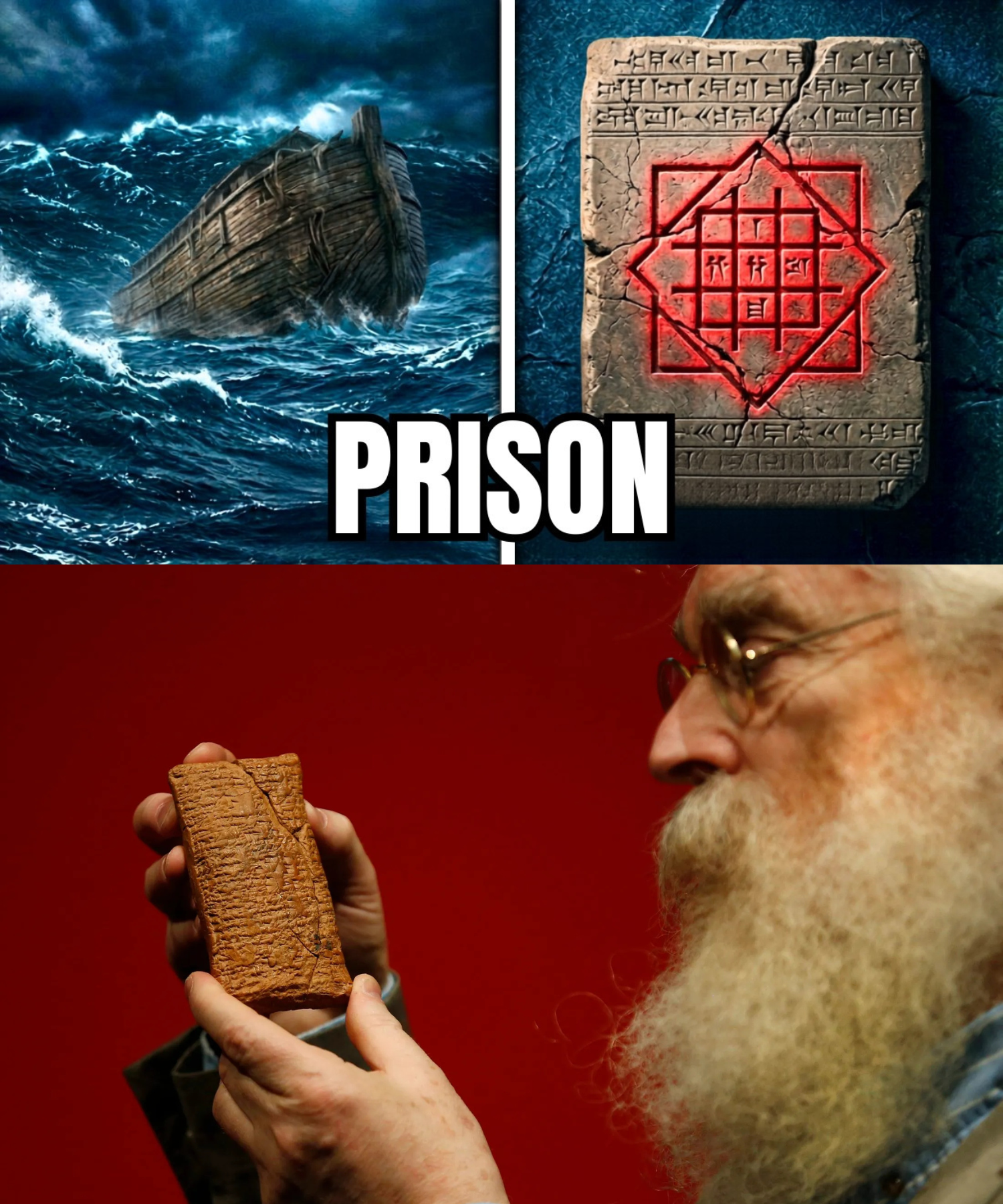
Dr. Miriam Cole was called before sunrise. She was a biblical historian from Columbia University, known for ruining bad documentaries by explaining ancient texts carefully. She hated phrases like “the Bible couldn’t hide this,” because they usually meant someone wanted to sell confusion as revelation. Still, when she opened the cedar box and saw the clay tablet inside, her skepticism changed shape. The object was real enough to frighten her. Its surface was cracked but not destroyed, covered in cuneiform wedges arranged around a central image: not a boat, not exactly, but a long, ribbed structure resting between two mountains while water rose around it. Above the structure were animals, seed jars, tools, and human figures carrying lamps.
At the top of the tablet was a title Miriam translated twice, then a third time with her hand over her mouth.
The House That Floated Before the World Remembered Mercy.
The phrase was not Noah’s Ark in any simple sense, but the imagery was close enough to ignite a war if handled carelessly. Ancient flood stories had long existed outside the Bible. Scholars knew that. The Epic of Gilgamesh, Atrahasis, Sumerian flood traditions—none of this was new. But this tablet contained a strange marginal line written in a later hand, one that did not belong to the ancient scribe. It was in English, carved crudely across the back of the clay after the artifact had already been old for thousands of years.
New York has the name. Ohio has the wood. Los Angeles has the lie.
Miriam closed the lab door.
By 8:00 a.m., she had called three people. Dr. Caleb Ward, an archaeologist and environmental historian at Ohio State University. Naomi Reyes, a Los Angeles documentary filmmaker who specialized in religious media manipulation. And Father Gabriel Moreno, a priest in Queens whose church had recently survived a basement flood that had washed up relics, ledgers, and questions nobody knew how to answer. They met by secure video, and Miriam placed the tablet under the camera.
Caleb spoke first from Columbus, still holding a mug of coffee. “Please tell me this is not another ‘Noah’s Ark finally found’ circus.”
“It is not Noah’s Ark,” Miriam said.
Naomi leaned toward her screen in Los Angeles. “But someone wants people to think it is.”
Father Gabriel looked at the image of the structure between mountains. “What does the text say?”
Miriam read the first lines slowly.
The wise one did not build a ship first. He built a memory of creation inside wood. He gathered breath, seed, craft, law, song, and beasts according to their kinds. He did not flee the waters. He carried a covenant through them.
No one spoke.
The line was beautiful. It was also dangerous. In the wrong hands, it would become another viral claim: the Bible lied, the Ark was not a boat, Christianity hid the truth, ancient Sumer knew the real story. Miriam could already see the thumbnails. Burning Bible. Clay tablet. Red arrows. A giant wooden machine under floodwater. The words WHAT NOAH REALLY BUILT in all caps.
Then the museum alarm sounded.
Not a burglary alarm. A flood alarm.
Water was rising in the basement archive, though no pipe had burst.
When Miriam and the security team ran downstairs, they found the floor covered in a thin sheet of water. Floating on its surface was a single strip of cedar wood, dark with age, marked with the same symbol as the tablet: a house, a wave, and a lamp.
On the wood, someone had carved one sentence.
The Ark was never only about surviving the flood.
Part 2
Ohio had the wood because Ohio had the forgotten river. Caleb Ward knew it before Miriam finished describing the cedar strip. Thirty miles southeast of Cleveland, near a town called Mercy Ridge, there was an old floodplain locals called Noah’s Bottom—not because anyone believed the biblical Ark had landed there, but because a nineteenth-century preacher named Elias Bell had built a strange wooden chapel there after the Great Flood of 1913 devastated parts of Ohio. Bell believed America misunderstood the Ark. He preached that it was not merely a rescue vessel, but a pattern of obedience: prepare before judgment, preserve life, carry memory, emerge with responsibility. His chapel vanished under mud after another flood in 1937.
Caleb had studied Bell’s papers years earlier and dismissed them as passionate frontier theology mixed with bad archaeology. Now Miriam’s tablet had arrived in New York with the phrase Ohio has the wood, and the museum basement had produced a cedar strip with Bell’s symbol. He did not like coincidence when it began quoting dead preachers.
Two days later, Miriam, Father Gabriel, and Naomi arrived in Ohio. Snow covered the fields in dirty white patches. Mercy Ridge looked like many post-industrial American towns: a closed factory, a tired church, a diner with good coffee, a river that had carried both life and ruin, and people who knew outsiders usually arrived when they wanted a story, land, grant money, or footage of decay. Caleb met them at the local archive, where the town historian, Ruth Bell, waited with her arms folded. She was Elias Bell’s great-granddaughter, seventy-four years old, sharp-eyed, and openly unimpressed by New York urgency.
“You found one of his flood sticks,” she said after seeing the cedar strip.
“One of his what?” Naomi asked.
“Flood sticks. He carved warnings into cedar after the 1913 flood. Buried them in places he thought America would one day need to remember.”
Miriam showed her the Sumerian tablet image.
Ruth’s face changed.
“That symbol,” she whispered. “He copied it from somewhere.”
“Where?”
Ruth opened a metal cabinet and removed a leather notebook wrapped in cloth. Elias Bell’s handwriting filled the pages in slanted black ink. Near the middle was a sketch nearly identical to the tablet’s central image: a long ribbed structure between mountains, water below, lamps above, animals and seed jars inside.
Under it, Bell had written:
The Ark was not a coffin for the world behind it. It was a womb for the world after it.
Father Gabriel sat down.
The notebook explained that Bell had once seen a “Mesopotamian flood tablet” in New York, in the private collection of a wealthy industrialist named Arthur Vale. Vale had dismissed it as a curiosity, but Bell became obsessed with its spiritual meaning. He believed the ancient flood stories and Genesis were not enemies fighting for ownership of Noah, but witnesses to humanity’s oldest terror: the day water revealed what civilizations had built on violence. Bell did not think the Sumerian tablet disproved the Bible. He thought it rebuked modern readers who reduced the Ark to measurements and missed its moral architecture.
Caleb led the team to the old floodplain at dusk. The ground was frozen hard. Sycamore trees leaned along the river, their pale branches twisting against the gray sky. Near the place where Bell’s chapel once stood, ground-penetrating radar revealed a rectangular anomaly under six feet of silt.
They dug for three hours.
At midnight, they struck wood.
Not a boat.
A buried chamber.
Inside were cedar beams, sealed jars of seeds, rusted tools, animal bones from local farms, handwritten names of flood victims, and a painted sentence on the wall:
Build before the rain, not because you fear death, but because you love what God made.
Ohio did not contain Noah’s Ark.
It contained an American sermon built out of wood, mud, and memory.
Part 3
The leak happened before dawn because every discovery now has a shadow discovery made by someone with a phone. A volunteer at the Mercy Ridge excavation sent a blurry photo of the cedar chamber to his cousin in Chicago, who posted it under the caption: NOAH’S ARK FOUND IN OHIO?? Within six hours, the internet had turned a buried flood chapel into proof of everything people already wanted to believe. Some claimed the Ark had been in America all along. Others claimed the Sumerian tablet proved the Bible copied older myths. A third group insisted the government had hidden ancient flood technology beneath Ohio. By lunchtime, Naomi had counted twelve videos using the phrase “Bible couldn’t hide it.”
Father Gabriel watched one clip in Ruth’s kitchen, then closed the laptop. “The Bible did not hide this. People are hiding from what it means.”
Ruth pointed at him with a spoon. “That’s the first useful thing anyone has said today.”
Miriam and Caleb worked to document the chamber properly. The seed jars contained early twentieth-century American crop seeds—corn, wheat, beans, squash, apple seeds, clover—stored after the 1913 flood as a memorial to survival. The tools were ordinary: hammers, saw blades, a rusted plow piece, needles, a child’s slate, a hymnbook sealed in wax. Bell’s chapel had not been an archaeological fraud. It had been a symbolic ark built for Mercy Ridge after disaster. A place to remember that survival without justice only delays collapse.
Naomi filmed carefully. No dramatic torchlight. No fake ancient music. No red arrows. She filmed Ruth holding her great-grandfather’s notebook. She filmed Caleb brushing silt from a seed jar. She filmed Miriam translating the Sumerian tablet’s second column. She filmed Father Gabriel reading Bell’s painted words with tears in his eyes.
The second column of the tablet was harder to translate. It described the builder of the flood-house not as a shipwright alone, but as a keeper of “kinds.” Animals, yes, but also songs, measurements, tools, laws, seeds, healing knowledge, stories of guilt, and “the names of those the kings forgot.” The Ark, in this telling, was not only a vessel of escape. It was a memory system. A portable creation. A covenant archive carried through judgment.
Miriam read the passage aloud in the Mercy Ridge church hall.
He brought into the wood not only beasts that breathed, but justice that had been broken, seed that had been buried, speech that had been corrupted, and names erased by kings. For if only flesh survives the flood and truth drowns, then the waters have not cleansed the earth.
The room went silent.
A local man named Peter Shaw, whose family had lost land in multiple floods, raised his hand. “So what are you saying? Noah’s Ark was a library?”
Miriam thought carefully. “I’m saying this tablet imagines the Ark as more than a boat. A boat saves bodies from water. An ark saves creation from forgetting.”
Ruth nodded. “That sounds like Bell.”
Caleb added, “And it sounds like America should pay attention.”
Because outside the church hall, Mercy Ridge still had abandoned houses in flood zones, polluted soil near the old factory, families without insurance, and emergency plans written in offices far from the people who would drown first.
The old flood story was no longer about ancient water.
It had become local.
Part 4
Los Angeles had the lie because Los Angeles understood better than any city in America how to make truth look less profitable than distortion. Naomi returned west with the footage and found three production companies already developing specials based on the leak. One was titled Ark Beneath America. Another, The Sumerian Secret That Destroys Genesis. The worst was from Vale Media, run by Adrian Vale, a descendant of the same collector who had shown Elias Bell the tablet a century earlier. Its trailer opened with thunder, flooded cities, burning Bible pages, and a narrator declaring, “What if Noah’s Ark was not what the Bible told you?”
Naomi paused the trailer at the ten-second mark and whispered, “Here we go.”
She confronted Adrian in his Burbank office, where posters of religious documentaries lined the walls like trophies. He smiled when she entered. “Naomi, you have to admit, this one is big.”
“It is big,” she said. “That’s why you shouldn’t lie about it.”
“We’re not lying. We’re asking questions.”
“You’re implying the Bible hid something.”
“Didn’t it?”
“No. You’re taking a Sumerian flood meditation, a New York artifact, and an Ohio memorial chapel, then turning them into a conspiracy because conspiracy sells better than responsibility.”
Adrian leaned back. “Responsibility doesn’t hold viewers.”
“Then maybe viewers need to be disappointed until they grow up.”
He laughed. “You should put that on a poster.”
Naomi left before she said something unhelpful.
Her own film took shape slowly. She titled it The Ark Was Memory. It began in New York, with the tablet arriving in rain. Then Ohio, with the cedar chamber and flood victims’ names. Then Los Angeles, with trailers showing how sacred stories are stripped of their moral force and resold as secret knowledge. She wanted viewers to understand that the scandal was not that the Bible had hidden the truth. The scandal was that Americans preferred a hidden-truth fantasy over the truth already given: build righteousness before the flood, preserve life, remember the forgotten, emerge with responsibility.
Jonah Price, her editor, suggested a sharper title: The Ark Was Not Escape.
Naomi liked it but kept The Ark Was Memory.
“It feels less angry,” she said.
“Is that good?”
“Maybe not. But this story already has enough shouting.”
The Los Angeles chapter focused on modern arks. Data centers preserving knowledge while communities around them suffered drought. Luxury bunkers built by billionaires preparing to survive disasters they helped create. Churches with beautiful sanctuaries but no emergency shelter plan. Museums preserving ancient artifacts while ignoring living flood victims. Climate labs warning of rising water while politicians postponed action. America, Naomi’s narration said, had become obsessed with survival without repentance.
That was not Noah.
That was Pharaoh building higher walls.
When she screened the rough cut for a small group in East L.A., a teenager named Marisol said, “So the Ark wasn’t about running away?”
Father Miguel, who hosted the screening, answered, “No. It was about carrying life through judgment so life could begin again differently.”
Marisol frowned. “Did people begin differently?”
No one answered.
That silence stayed in the film.
Part 5
The third column of the Sumerian tablet changed everything again. Miriam had avoided translating it publicly because the clay was damaged and several lines were uncertain. But after weeks of imaging, she reconstructed enough to understand why the tablet had been sent now. The final section described what happened after the flood. Not the landing. Not the rainbow. Not the animals leaving. Those were present in symbolic form, but the emphasis was elsewhere. The tablet’s final warning concerned the survivors.
When the waters fell, the builder opened the house. The beasts returned to the earth. The seeds entered the soil. The tools entered hands. The songs entered mouths. But the sons of men desired again the measurements of kings. They asked, “How high shall we build so water cannot judge us again?” The wise one answered, “Build lower, near the poor, near the soil, near the memory of drowning.” But they built upward and called it safety.
Caleb read the translation in Ohio and muttered, “That sounds less like Noah and more like New York.”
Miriam looked up sharply. “It sounds like Babel.”
“Same human disease.”
The tablet did not describe Noah’s Ark as a secret machine, alien vessel, DNA vault, or hidden technology. It described it as a divine act of preservation against corrupt civilization, followed by humanity’s temptation to rebuild the same arrogance after surviving judgment. That was the part America did not want. People wanted to know what the Ark really was because they imagined the answer would make them feel clever. The tablet suggested the real question was whether surviving catastrophe changes the survivor.
In New York, Miriam presented the translation at the museum. She began with a warning. “This tablet does not replace Genesis. It does not expose a hidden Bible. It does not tell us that Noah’s Ark was secretly something else in a way that destroys faith. It gives us another ancient witness to the flood imagination, and it helps us hear one question with fresh force: what is worth preserving when judgment comes, and what must not be rebuilt afterward?”
A reporter asked, “So what was the Ark really?”
Miriam answered, “Obedience made visible.”
That line traveled far.
In Ohio, Ruth held a public reading in the Mercy Ridge church hall. Before the tablet passage, she read names of local flood victims from 1913 and 1937. Then she read names of families still living in flood-vulnerable housing. “An ark that only remembers ancient animals and forgets current neighbors is a toy,” she said. “We don’t need toys. We need plans.”
The town began building its own modern ark—not a boat, but a network. Emergency shelters on high ground. Seed banks for local farms. Backup medical supplies. Flood maps written in plain language. A ledger of elderly residents needing evacuation help. A church basement converted into a disaster kitchen. Local schools teaching children how to respond to floods. Volunteers trained before storms, not during them. They called it the Bell Ark Project because Ruth threatened anyone who called it Noah’s Ark Ohio.
Naomi filmed the first volunteer training. No thunder. No ancient music. Just people labeling water jugs, checking radios, mapping houses, and arguing about generator fuel.
It was not cinematic in the usual way.
It was holy in the useful way.
Part 6
The backlash came from people who preferred the mystery when it required nothing. Conspiracy channels accused Miriam of suppressing the “real translation.” Some insisted the tablet described a technological Ark and that scholars were hiding evidence of ancient advanced civilization. Others said the tablet disproved the Bible and that believers were refusing to admit defeat. Religious influencers used the story to attack one another. Skeptics mocked Christians. Christians mocked scholars. The flood returned as noise.
Adrian Vale released his special anyway: The Bible Couldn’t Hide the Ark. It was slick, fast, and dishonest in polished ways. It showed the Sumerian tablet, then cut to dramatic flood simulations, then suggested Genesis had reduced a complex ancient memory system into a simple boat story. It ignored Miriam’s cautions, flattened Bell’s theology, and used Mercy Ridge footage without showing the town’s disaster work. Naomi watched it once and felt the old disgust.
Ruth watched it too, in the church basement, surrounded by volunteers packing emergency kits.
When it ended, she said, “He took our flood and sold it back without sandbags.”
That became the best review of the special.
Naomi released The Ark Was Memory three days later for free. It opened with the same question Adrian used—what was Noah’s Ark really?—but answered by slowing down instead of speeding up. The film showed the tablet as an ancient witness, not a weapon. It showed Genesis being read beside Sumerian flood traditions, not as enemies, but as texts asking what kind of people survive judgment. It showed New York hunger for revelation, Ohio memory of water, Los Angeles addiction to distortion. It showed the Bell Ark Project building emergency systems in a poor town while national media argued about secrets.
The film’s central line came from Father Gabriel:
“The Ark was not built so Noah could brag that he knew a flood was coming. It was built so life could continue after human violence had brought the world to ruin. If your knowledge of judgment makes you proud instead of obedient, you are not Noah. You are the generation outside the door.”
The film did not explode online.
It moved slowly.
Churches used it in Bible studies. Emergency planners used it in community workshops. Seminaries used it in classes on ancient Near Eastern literature. Climate groups used it to talk about moral preparation. Farmers in Ohio used it to discuss seed preservation. A shelter network in New York used it to plan flood response for homeless communities. A Los Angeles film school used it to teach context theft.
Adrian’s special got more views.
Naomi’s film built more arks.
Years later, she would say that was the first time she truly understood success.
Part 7
The flood came the following spring. Not a world flood. Not a biblical deluge. Not even the worst flood in American history. But for Mercy Ridge, it was enough. Three days of rain turned the river brown and violent. Water pushed against banks, filled drainage ditches, swallowed low roads, and began rising toward the old neighborhoods where people had been told for years that major flooding was unlikely. The warning sirens sounded at 4:40 a.m.
This time, Mercy Ridge was ready.
The Bell Ark Project activated before sunrise. Volunteers called elderly residents from the evacuation ledger. School buses moved families to the high-ground church. The disaster kitchen opened. Teenagers carried seed boxes and medical kits. Ruth stood in the command room with a raincoat over her nightgown, giving orders like a prophet with a clipboard. Caleb coordinated mapping data. Father Gabriel, who had returned from New York after seeing the forecast, helped carry cots. Miriam documented nothing at first. She carried water.
Naomi filmed only after Ruth said, “Film the system, not the suffering.”
The river reached the first row of houses by noon. Several basements flooded. A bridge closed. One mobile home was swept off its foundation, but the family had already been evacuated. No one died. That was not luck. That was preparation. That was the Ark as obedience before rain.
At 3:00 p.m., the cedar chamber under the old floodplain filled with water again. Sensors placed by Caleb showed the river entering the buried space. For a moment, the team feared the chamber would collapse. Instead, a sealed compartment in the wall floated free, rising through the water like a memory refusing burial. When the flood receded two days later, volunteers found the compartment lodged against a sycamore tree.
Inside was another cedar strip from Elias Bell.
It read:
If you built before the rain, you have understood the tablet.
Ruth cried when she saw it.
So did Caleb, though he denied it.
The Mercy Ridge flood became national news, but not because it destroyed everything. Because it did not. The town’s preparation saved lives. The headlines changed. Ohio Town Inspired by Ancient Ark Text Avoids Flood Disaster. The Ark as Emergency Planning. From Ancient Tablet to Modern Resilience. Some headlines were still dramatic, but for once the drama pointed toward usefulness.
Miriam returned to New York and gave a lecture with mud still on her boots. “The question was never whether Noah’s Ark was merely a boat,” she said. “The question is whether we build what mercy requires before the water rises.”
In Los Angeles, Naomi added the flood footage to the final version of her film. The ending changed. It no longer closed with scholarly reflection. It closed with volunteers serving soup to evacuated families while rain hammered the church roof.
No one needed to say what the Ark really was.
The town had built one.
Part 8
Years later, the headline still appeared online: The Sumerian Tablet the Bible Couldn’t Hide — It Describes What Noah’s Ark Really Was. It was not a good headline, but it would not die. It promised scandal, and scandal travels faster than wisdom. Yet under that headline, sometimes, people now shared Miriam’s lecture, Naomi’s film, Caleb’s flood maps, Ruth’s emergency checklist, Father Gabriel’s sermon, and photos of Mercy Ridge volunteers standing ankle-deep in mud, smiling because no funerals had to be planned.
The tablet remained in New York, preserved behind glass with a long explanation that disappointed people who wanted a secret and nourished people who wanted understanding. Its label did not say it proved or disproved the Bible. It said: Ancient Mesopotamian flood text, later connected to American flood memory through nineteenth- and twentieth-century religious interpretation. Its imagery presents the flood vessel as a container of life, memory, justice, and covenant.
Caleb said the label was too long.
Miriam said truth often is.
In Ohio, the Bell Ark Project expanded beyond Mercy Ridge. Other towns built their own versions: disaster ledgers, seed libraries, high-ground shelters, church kitchens, medical networks, plain-language flood education, neighbor-to-neighbor evacuation plans. Some were religious. Some were secular. Ruth did not care as long as people moved before water did. “Call it whatever you want,” she said. “Just build before the rain.”
In Los Angeles, Naomi’s film became required viewing in a media ethics class because it showed how easily ancient texts could be stolen by spectacle and returned by service. Adrian Vale eventually issued a quiet apology after his special aged badly. He donated part of its profit to flood resilience work, though Ruth said she would believe his repentance when he showed up with sandbags. To everyone’s surprise, one year he did. He was terrible at filling them. Ruth corrected his technique for twenty minutes. Naomi filmed none of it. Some repentances are safer off camera.
Father Gabriel preached the anniversary sermon in Queens each year during storm season. He always said the same thing: “The Ark was not panic. It was obedience. The Ark was not escape. It was responsibility. The Ark was not proof that Noah was clever. It was proof that God preserves life through those who listen before the sky changes.”
On the tenth anniversary of the tablet’s arrival, Miriam, Caleb, Naomi, Father Gabriel, Ruth, and the Mercy Ridge volunteers gathered by the Ohio river. Children planted apple seeds from the Bell Ark seed bank on higher ground. Someone read from Genesis. Miriam read from the Sumerian tablet. Ruth read the names of flood victims. Then she read the names of the living volunteers who had answered phones, driven buses, cooked soup, carried medicine, and checked on neighbors before the water came.
The river moved quietly that day.
No miracle split the clouds.
No ancient boat surfaced.
No voice thundered from heaven.
But a town that once would have drowned had learned to remember, prepare, and carry life through danger.
Maybe that was not as clickable as a hidden Ark.
Maybe it was better.
Because the Sumerian tablet had not revealed that the Bible was hiding the truth.
It had revealed that the truth was larger than curiosity.
Noah’s Ark was wood, yes.
A vessel, yes.
A story, yes.
A warning, yes.
But more than anything, it was obedience shaped before disaster, mercy made practical, memory sealed against the flood, and life carried through judgment so the world after the water would not simply rebuild the violence that drowned the world before.
And America, for once, had not only asked what the Ark was.
It had built one.