The Scariest Creatures Caught by Police Officers!
The Scariest Creatures Caught by Police Officers!
When the sun sets and municipal landscapes quiet down, the individuals tasked with maintaining public order find themselves patrolling a boundary far more volatile than any precinct sector. Across the United States and the wider global landscape, modern law enforcement officers, private security details, and emergency dispatchers are increasingly encountering anomalies that refuse to comply with the laws of physics or standard police protocol. Captured on high-definition body cameras, dashboard arrays, and thermal imaging systems, these incidents—ranging from physical blockades by legendary local folklore to phantom entities occupying the rear seats of patrol cruisers—are forcing a paradigm shift in how we document the unknown. This is no longer a matter of campfire ghost stories; it is an emerging catalog of institutional encounters where the thin blue line directly intersects with the deeply unsettling and the completely unexplainable.
The Phantom Passages of the Nuʻuanu Pali
For centuries, the Nuʻuanu Pali Lookout on the island of Oahu, Hawaii, has stood as a site of profound historical weight and deep spiritual resonance. It was here, in 1795, that King Kamehameha I drove hundreds of opposing warriors over the sheer cliffs to secure the unification of the Hawaiian islands. Today, the windswept vista is a premier tourist destination by day, but by night, it transforms into a localized focal point for Hawaiian supernatural lore.
Local authorities have long maintained a quiet familiarity with the area’s unsettling atmosphere, but a recent incident involving a rookie Honolulu Police Department officer moved the phenomenon from cultural hushed tones into the realm of modern law enforcement record.
Tasked with the late-night assignment of securing the lookout’s security gates after visiting hours, the officer was navigating the winding, unlit mountain access road. Through the mist, her headlights illuminated a solitary woman dressed in white walking along the shoulder. Remembering the generational warnings shared among veteran island cops regarding a ghostly female apparition that frequents the pass, the officer slowed her vehicle to offer assistance or order the pedestrian out of the restricted zone.
What occurred next defies conventional explanation. As the officer leaned toward her window to call out, her gaze flicked to the rearview mirror. The woman was no longer on the asphalt. Instead, she was sitting perfectly upright in the cruiser’s enclosed plastic back seat—the secure partition intended for detained suspects.
“Oh, what are you doing out here, Auntie?” the rookie managed to ask, deploying a traditional local term of respect in a desperate bid to maintain psychological composure.
The entity remained absolute in its silence, maintaining a cold, unblinking presence in the rearview mirror for several agonizing seconds before evaporating into the ambient shadows of the cabin. The encounter highlights a recurring reality for first responders in the Pacific: the operational reality of the job frequently requires stepping directly into spaces where historic trauma and modern infrastructure collide.
The Void in the Driver’s Seat: Traffic Anomalies and the Fracture of Object Permanence
The psychological foundation of law enforcement relies heavily on the concept of object permanence and situational awareness. When an officer conducts a routine traffic stop, every movement is calculated based on visible human behavior and physical boundaries. However, dashcam archives from rural state highways are beginning to reveal instances where these fundamental rules are completely shattered.
On an isolated stretch of highway, a state trooper initiated a standard vehicle stop for a minor speeding violation. The interaction began normally; the officer approached the driver’s side window, engaged with a woman who identified herself as Sarah, and collected her paperwork before retreating to the cruiser to run a standard database check. Upon scanning the information, the system flagged the vehicle’s registration as entirely expired, prompting the officer to return to the suspect vehicle to investigate further.
As the officer stepped back to the driver’s side door and began to speak, the audio log captured an abrupt transition from routine authority to absolute, paralyzed confusion:
The Operational Directive: “Sit tight, Sarah, I’ll be right back with you… Okay, your registration is—”
The Break in Reality: The sentence cuts off as the officer’s flashlight illuminates an entirely empty cabin.
The Immediate Search: The officer’s body camera documents a frantic, multi-directional sweep of the immediate shoulder, the adjacent drainage ditches, and the interior floorboards.
There were no open doors, no auditory signatures of a suspect fleeing into the brush, and no physical timeline that would allow a human being to exit a vehicle unobserved within a three-second window. The driver had simply ceased to exist within the physical space, leaving behind a cold steering wheel and a string of unanswerable questions for the department’s morning briefing.
This fracture of physical reality is closely mirrored in incidents involving abandoned vehicles. A midnight patrol officer spotted a sedan parked hazardously on the shoulder of a dark county road. Suspecting a disabled motorist or an intoxicated driver, the officer approached with a spotlight. Through the heavily tinted glass, the officer later swore under oath that he observed the distinct silhouette of a human being sitting motionless in the front passenger seat.
Yet, when the door handle was breached, the vehicle was entirely vacant. Shrugging off the visual as a trick of high-contrast lighting, the officer tagged the vehicle for impoundment and returned to his shift. It was only during a routine review of the high-definition body camera footage the following afternoon that the true nature of the encounter was exposed.
As the officer walked away from the vehicle, the infrared lens of the camera captured a pale, multi-fingered hand pressed flat against the interior of the windshield from the inside of the locked, empty car—leaving a stark, translucent impression that faded from the glass only after the cruiser’s headlights left the scene.
Echoes of the 1863 Line: Gettysburg’s Residual Warfare
There is perhaps no geography in North America more saturated with collective historical trauma than the battlefields of Gettysburg, Pennsylvania. The three-day Civil War conflict in July 1863 resulted in upwards of 51,000 human casualties and the slaughter of more than 5,000 horses, leaving a deep, indelible scar on the American landscape.
While the site is heavily managed by federal park rangers and preservationists, the surrounding roads remain open to local traffic—and to the occasional, terrifying intrusion of historical echoes into modern technology.
While driving through a historic sector of the battlefield late at night, a motorist named Greg Elling and his family captured a sequence of events on a dashboard camera that has since become a central piece of study for regional paranormal researchers. As the vehicle navigated a low-lying fog bank near the historic tree lines, a series of pale, semi-transparent human forms materialized directly in the path of the vehicle.
The entities did not exhibit the erratic, chaotic movements of modern pedestrians; instead, they moved in a rigid, military skirmish formation, running in a uniform direction across the asphalt as if locked in a perpetual, looping replay of a charge that occurred over a century ago.
The footage demonstrates what researchers classify as a “residual haunting”—a non-intelligent, purely energetic imprint left upon the environment by extreme emotional or physical violence. For the motorists passing through, however, the experience offers a jarring reminder that the roads we construct over historical battlegrounds are often shared with the transparent remnants of the men who died creating them.
Institutional Silences: Night Shifts and the Abigail Manifestation
The corporate and institutional world has its own unique cross-sections with the unexplained, typically witnessed by the isolated night-watchmen who manage corporate campuses, historical theaters, and transit hubs during the dead hours between 2:00 AM and 5:00 AM. These individuals operate in environments where silence is the expected baseline, making any deviation profoundly jarring.
In a modern commercial complex, a security guard was observed via a central control room CCTV system engaging in an intense, animated conversation in the main lobby. He was gesturing politely, nodding his head, and consulting his clipboard while facing an entirely empty corridor. Intrigued and concerned by his partner’s erratic behavior, a second guard radioed the floor to inquire about the situation.
The resulting audio log, preserved by the facility’s security management system, outlines an institutional mystery that remains unresolved:
Guard 2: “Hey, who are you talking to down there? There’s nobody on the monitor.”
Guard 1: “I’m talking to a lady. Her name is Miss Abigail, and she says she’s looking for Mr. Griffin.”
The second guard went entirely silent over the radio. According to internal corporate HR records and local obituaries, a longtime administrative assistant named Abigail had passed away from natural causes exactly two years prior to that night. Furthermore, the “Mr. Griffin” she was searching for was a founding executive of the firm who had retired decades before.
The security guard on the floor was entirely unaware of the company’s historical roster, eliminating the possibility of a staged hoax or psychological projection. The incident serves as a classic example of an institutional entity continuing its professional routine long after the biological machinery has ceased to function.
Automated Machinery and the Poltergeist Vector
As human spaces become more automated, the anomalies that occupy them appear to be adapting to our technological infrastructure. This is particularly evident in the growing number of reports involving automated fitness centers, transit portals, and public parks where heavy machinery begins to operate without external input or power connectivity.
Consider the perplexing security footage obtained from a municipal park’s outdoor recreation zone. Under the glare of security lights, a heavy-duty, hydraulic shoulder press machine began executing a series of rapid, high-resistance repetitions. The metal framework slammed up and down with immense kinetic force, bending the internal stabilizing rods as if occupied by a high-performance athlete.
Local maintenance crews who inspected the apparatus the following morning confirmed that the internal resistance seals were fully intact and required a minimum of 180 pounds of downward pressure to actuate—completely ruling out wind currents or localized seismic vibrations.
A similar technological intrusion occurred at a high-end cycling studio. A client arriving early for an advanced spinning class entered an entirely dark, locked studio room well ahead of the instructor. In the center of the front row, a single stationary bike was operating at an extreme velocity. The flywheels were spinning at a high RPM, the pedals turning into a blur of motion, and the digital console flickering with real-time biometric telemetry data—tracking a heart rate and caloric burn despite the seat being entirely vacant.
These occurrences suggest that paranormal phenomena are not confined to old, wooden Victorian homes; rather, they are capable of manipulating modern, mechanical, and electronic systems, turning everyday wellness spaces into theatres of kinetic unease.
Folklore Bound by the Horizon: The Chasing Entities of the High Desert
When first responders operate in international jurisdictions or isolated border regions, the anomalies they encounter often shed the traditional characteristics of American ghost lore, taking on the more predatory, aggressive traits of regional mythology. This was vividly demonstrated in a harrowing dashboard video captured by an emergency response unit operating along a desolate, unlit highway in the high desert plains.
As the patrol vehicle rounded a sharp bend, the headlights framed a figure standing dead center on the two-lane road. The entity appeared to be a woman clad in a traditional, flowing white garment, but her physical posture immediately triggered a defensive reaction from the officers. Her head was bent forward at a severe, unnatural angle, her spine appeared violently contorted, and her limbs moved with a disjointed, arachnid-like asymmetry.
Rather than fleeing from the oncoming vehicle, the figure initiated a high-speed pursuit of the police cruiser. As the driver threw the transmission into reverse to create a defensive buffer, the entity matched the vehicle’s speed, sprinting forward with an impossible cadence while letting out a series of high-pitched, metallic shrieks that overdriven the cruiser’s external audio microphones.
The responding officers, trained for conventional human threats, were forced to play a terrifying game of cat-and-mouse with an entity that seemed to view their multi-ton vehicle as nothing more than a toy.
The footage, which quickly circulated through closed law enforcement networks, aligns precisely with regional accounts of La Llorona or localized Djinn manifestations—entities defined by their hostility toward human intruders and their ability to warp the physical space around them to project raw, unadulterated terror.
Bipedal Anomalies and the Failure of Tactical Containment
The most critical threat to public safety occurs when an anomaly breaches the perimeter of a residential property, forcing tactical units to engage with entities that do not respond to conventional compliance commands or non-lethal deterrents.
During a frantic 911 call late at night, a homeowner reported a massive, hulking bipedal entity positioned just outside his low-profile kitchen window. The caller described a creature standing over seven feet tall, covered in dense, dark matted hair, with a facial structure that blended hominid characteristics with an apex predator.
By the time responding units arrived with tactical K9 teams, the perimeter was quiet, but the physical evidence left behind was undeniable. Deep, heavy structural depressions were pressed into the soft garden soil beneath the window sill, and the exterior aluminum siding was scored with deep, multi-inch gouges that bypassed the paint and sliced directly into the metal framing.
The police K9 units, typically aggressive and unyielding when tracking human suspects, refused to leave the transport cages, whimpering and displaying signs of acute neurological distress when exposed to the scent lingering near the point of impact.
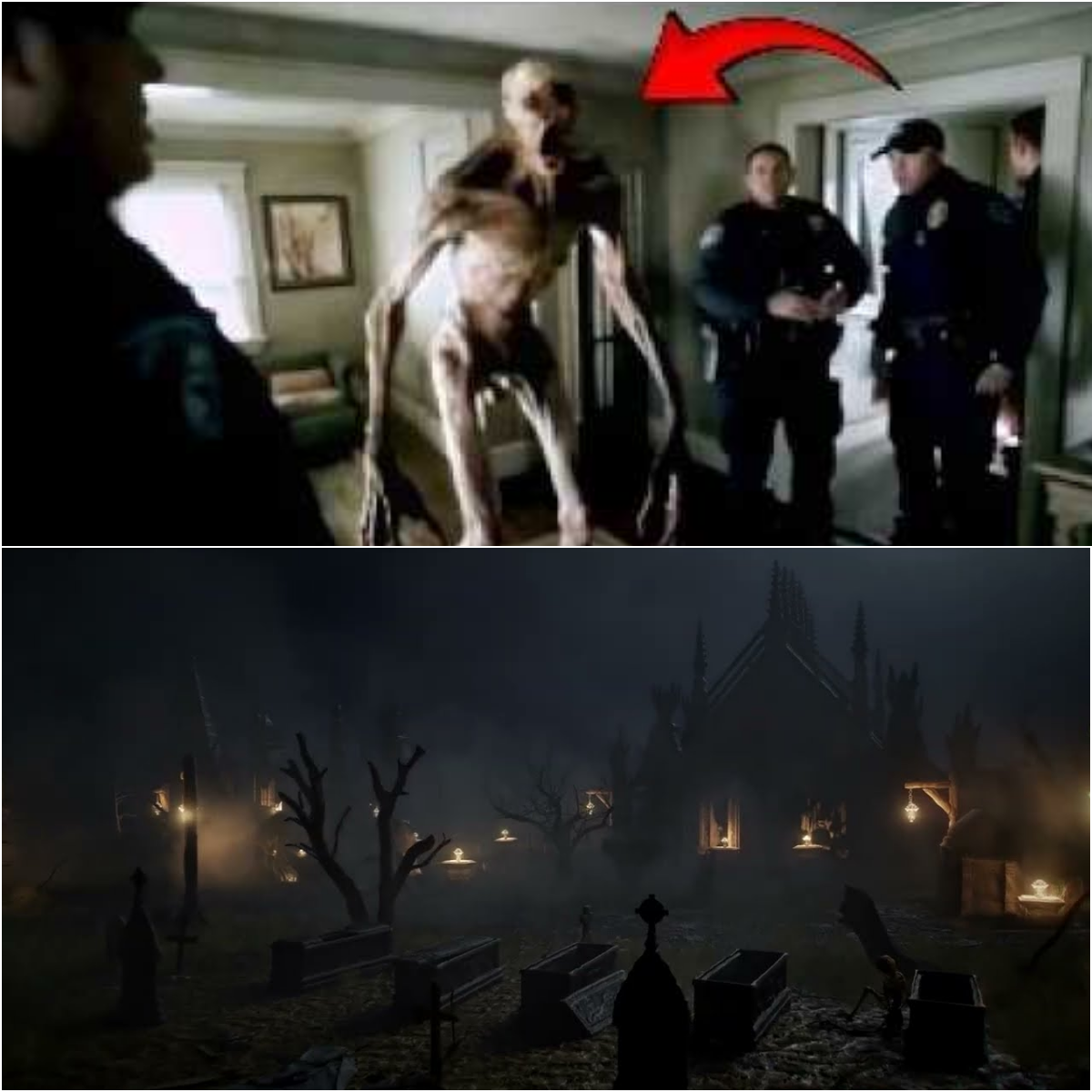
This failure of tactical containment is further illustrated by a chilling Ring camera sequence recorded in a quiet suburban cul-de-sac. A homeowner was alerted by a smartphone notification indicating movement on his front porch at 3:15 AM. Checking the live video feed from his secure master bedroom, he witnessed a pale, hairless humanoid creature crawling across his concrete steps on all fours.
The entity’s limbs were abnormally elongated, its joints bending with a sickening, inverted flexibility that recalled the urban legends of the “Rake” or a regional “Skinwalker.”
The creature paused directly in front of the illuminated doorbell camera, lifting its head to stare straight into the lens with oversized, highly reflective ocular cavities that completely lacked distinct pupils or irises. It reached out a long, skeletal hand and began methodically testing the deadbolt mechanism of the front door, moving with a chilling, calculated intelligence before retreating into the upper canopy of a nearby oak tree upon hearing the distant approach of a police siren.
The Metrics of the Unexplained: A Journalistic Conclusion
As we look across the expanding library of law enforcement encounters with the anomalous, a common thread becomes apparent: the traditional tools used by society to categorize reality are beginning to fail. We can no longer relegate these events to the realm of psychological delusion or optical trickery when the witnesses are trained professionals whose daily survival depends on their ability to accurately read a scene.
The badges we rely on to protect our communities are finding themselves on the front lines of an entirely different kind of frontier—one where the suspects don’t have fingerprints, the crime scenes defy the laws of gravity, and the evidence is recorded not in a property locker, but in the shivering, indelible memories of the men and women who work the night shift. As technology continues to sharpen our focus on the dark corners of our world, we may soon have to accept that the most terrifying things caught on camera are the ones we are completely powerless to arrest.