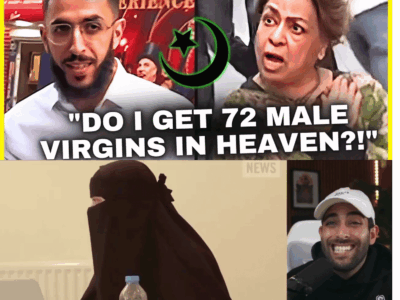
A Western Woman’s New Life After Embracing Islam Draws Mixed Reactions Across America

Quran Verses on Women Spark Online Debate Over Interpretation, Gender, and Religious Understanding in the U.S.
A growing online discussion has emerged across social media platforms after a viral video featured commentary on Quranic verses relating to women, marriage, and family law. The clip, which has been widely shared in the United States, has sparked heated debate about religious interpretation, gender roles, and cultural context within Islam.
While some viewers praised the discussion as an opportunity to better understand Islamic scripture, others criticized the framing of the verses and the conclusions drawn from them. The controversy highlights the challenges of interpreting religious texts in short-form digital media, where complex theological concepts are often reduced to brief, emotionally charged segments.
Quranic Verses and Their Context
At the center of the debate is Surah An-Nisa (Chapter 4 of the Quran), a chapter that addresses a wide range of topics including family law, inheritance, marriage, and social justice. Several verses referenced in the viral video focus specifically on the treatment of women in marriage and divorce.
The speaker in the video highlighted passages encouraging fairness in marriage, prohibiting the mistreatment of women, and discouraging the recovery of dowries or marital gifts after divorce under certain conditions.
In Islamic legal terminology, the concept of “mahr” refers to a mandatory gift given by the husband to the wife at the time of marriage. This is distinct from dowry systems in some other cultures, where wealth is often transferred from the bride’s family to the groom’s family.
Scholars note that in classical Islamic jurisprudence, the mahr is considered the woman’s personal property and cannot be taken back without legal justification. However, interpretations of how these rules are applied vary across cultures and legal systems.
Diverging Interpretations Online
The viral video presented a personal reading of the text, emphasizing themes of fairness and protection for women in marriage. The speaker suggested that certain verses reflect a framework designed to safeguard women’s financial rights and dignity within marriage contracts.
However, critics of the video argued that religious texts must be understood within broader historical, linguistic, and scholarly contexts, rather than through isolated readings.
Religious scholars interviewed in similar debates often stress that Quranic interpretation (tafsir) is a complex discipline involving language, history, and legal tradition. They caution against drawing sweeping conclusions from single verses without examining the wider structure of Islamic jurisprudence.
Marriage, Law, and Cultural Practice
The video also referenced a real-world case discussed online, involving a canceled marriage reportedly linked to financial disputes over marriage gifts. While such cases circulate widely on social media, legal experts note that marriage practices vary significantly across Muslim-majority societies.
In some communities, cultural customs can differ from religious prescriptions, leading to misunderstandings about what is religiously required versus what is socially practiced.
For example, while Islamic law outlines specific guidelines for mahr, the amount, timing, and enforcement often depend on local tradition and legal systems.
Sociologists studying Muslim societies emphasize that financial arrangements in marriage are not unique to Islam and exist in many cultural and religious traditions worldwide.
Gender Roles and Religious Debate
A major portion of the online discussion focused on gender roles in religion. The viral commentary questioned whether Islamic tradition allows for gender equality in leadership roles, marriage structure, and religious interpretation.
These claims were met with strong responses from Muslim scholars and activists who pointed out that Islamic history includes a wide range of female scholars, business owners, and religious authorities, even if contemporary practices differ across regions.
They also emphasized that modern debates about gender in religion often reflect broader cultural and political disagreements rather than purely theological ones.
In the United States, where religious pluralism is a foundational principle, such debates frequently intersect with discussions about feminism, identity, and free expression.
Controversy Over Language and Interpretation
Another focal point of the viral video was the discussion of gendered language in reference to God. The speaker questioned whether divine references should be interpreted as masculine, feminine, or gender-neutral in English translation.
Linguists and theologians note that Arabic grammar includes gendered forms, but traditional Islamic theology generally emphasizes that God (Allah) is beyond human categories of gender.
The debate over whether English pronouns such as “he,” “she,” or “they” accurately reflect theological concepts highlights broader challenges in translating religious ideas across languages and cultures.
Social Media Amplification
As with many religious and political topics, the discussion gained traction largely due to social media amplification. Short video clips, commentary edits, and reaction videos contributed to a rapidly expanding and often polarized debate.
Media researchers note that complex theological discussions are particularly vulnerable to oversimplification online. When removed from scholarly context, religious texts can be interpreted in dramatically different ways depending on the viewer’s perspective.
This dynamic often leads to conflicting narratives, with some viewers seeing the content as empowering and educational, while others view it as controversial or misleading.
The Importance of Context in Religious Study
Experts in comparative religion emphasize that sacred texts must be understood within their historical and cultural frameworks. Islamic jurisprudence, like many religious legal systems, developed over centuries and includes multiple schools of thought.
Scholars caution that selective quotation can lead to misunderstandings about both the text and the tradition it represents.
They also stress the importance of distinguishing between religious doctrine, cultural practice, and individual interpretation.
Conclusion
The viral video discussing Quranic verses on women has become a focal point for broader conversations about religion, gender, and interpretation in the digital age.
While some viewers found personal meaning and inspiration in the discussion, others raised concerns about accuracy and context.
Ultimately, the debate reflects a larger reality of modern media: religious texts, when shared online, often become part of fast-moving cultural conversations that extend far beyond their original theological frameworks.
As discussions about faith continue across social media platforms in the United States and beyond, experts emphasize the need for careful interpretation, respectful dialogue, and awareness of context when engaging with complex religious material.