The Dead Sea Scrolls Were Re-analyzed by AI — What It Revealed Changes Everything
The Dead Sea Scrolls Were Re-analyzed by AI — What It Revealed Changes Everything
Part 1
The first warning appeared in New York City at 2:17 in the morning, inside a sealed research room beneath the American Museum of Sacred History, where the lights were never fully turned off and the air was kept cold enough to preserve fragments of parchment older than empires. Dr. Miriam Cole had been awake for sixteen hours, staring at a wall of monitors that displayed scraps of ancient Hebrew, Aramaic, Greek, ink cracks, fiber shadows, wormholes, stains, and gaps where time had eaten words before anyone alive could read them. The museum did not own the Dead Sea Scrolls, not in the way headlines would later claim. It held high-resolution copies, multispectral imaging data, old American research photographs, comparative fragments, and private archive scans connected to decades of scholarly study. That distinction mattered to Miriam. It would not matter to the internet.
The project was supposed to be careful. Boring, even. A new artificial intelligence system called Enoch was being trained to compare damaged textual fragments, detect scribal patterns, reconstruct missing letter forms, identify ink density differences, and suggest possible joins between fragments that human eyes had missed. Miriam hated the name Enoch. It sounded like the kind of name a donor would choose after reading one dramatic article about ancient mysteries. She had argued for something dull, like Fragment Alignment Model Three. The donors refused. They wanted Enoch. They wanted mystery before the machine had earned trust.
At 2:17, Enoch stopped processing.
The main screen went black.
Then one line appeared in white letters:
The missing text is not missing. It was moved.
Miriam stood so quickly her chair struck the cabinet behind her.
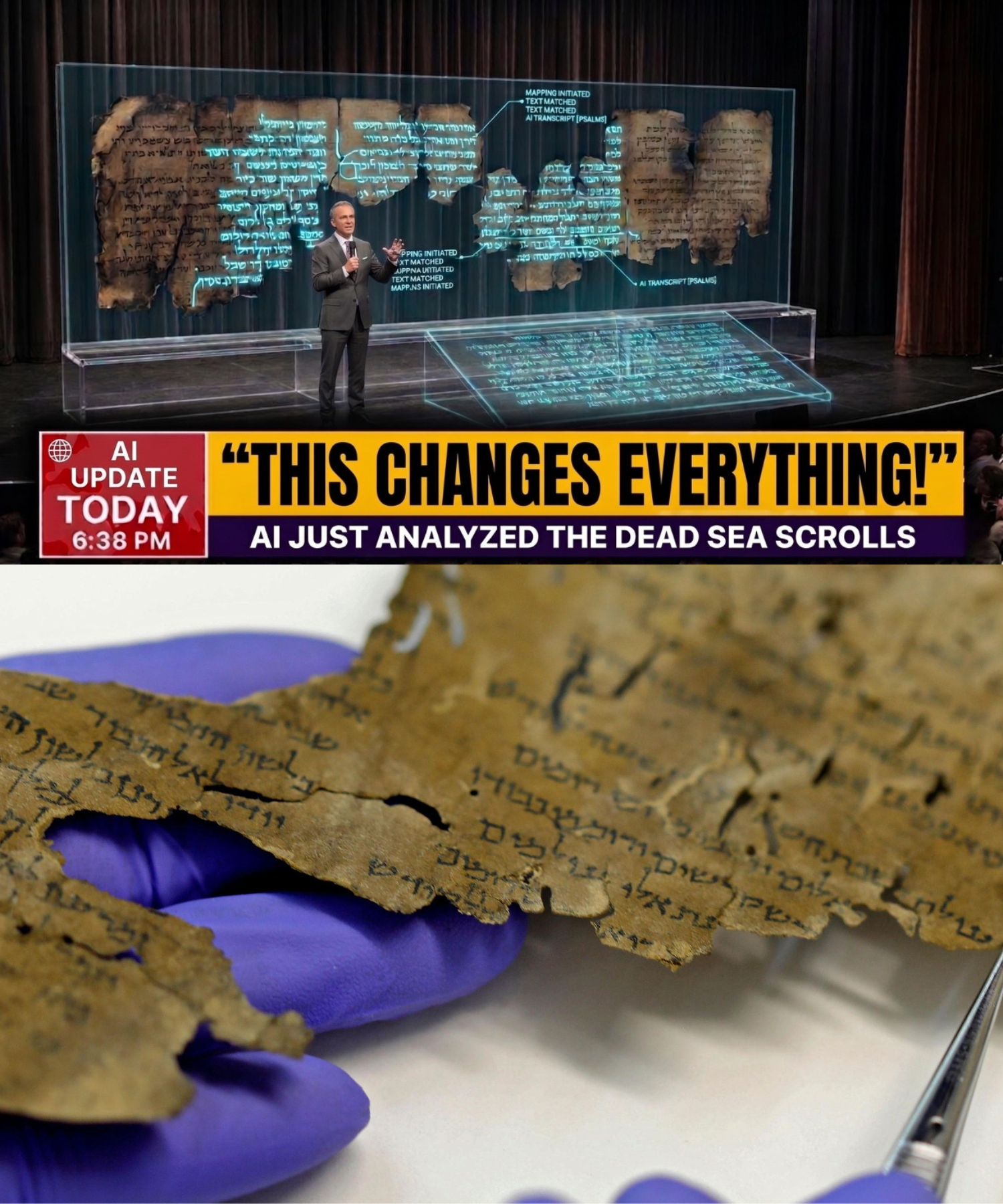
The AI had been processing a group of fragments from a sectarian commentary long thought too damaged to reconstruct coherently. The text dealt with judgment, light and darkness, covenant, community discipline, and the coming age—familiar themes in the world of the scrolls. But the machine had found an anomaly. Several fragments that scholars had categorized separately for decades appeared, under deep pattern comparison, to belong to one larger composition. Not a new Bible. Not a secret Gospel. Not a hidden prophecy about America. But a text whose lines had been scattered across collections, archives, and mislabeled folders.
The reconstructed heading was partial, but terrifyingly elegant:
The Instruction for the Generation That Reads After the Ruin.
Miriam whispered, “No.”
The screen shifted, showing a reconstructed column. Most lines were uncertain. Some were heavily damaged. But enough remained to stop her breath.
They will count the words but not hear the voice. They will preserve the skins and neglect the covenant. They will seek the Teacher among fragments while the poor wait outside their gates. They will ask what was hidden from them, but not what was required of them.
Miriam turned off the system.
It turned itself back on.
A second message appeared:
New York has the fragments. Ohio has the hand. Los Angeles has the lie.
By dawn, she had called Caleb Ward in Ohio. Caleb was a forensic manuscript analyst at Ohio State University, trained to study ink, parchment, scribal hand, and the places where technology becomes dangerous because humans want certainty more than truth. He answered on the third ring, voice rough with sleep.
“If this is about AI discovering Jesus in the Dead Sea Scrolls, I’m resigning from civilization.”
“It is not that,” Miriam said.
“Good.”
“But the AI found a reconstruction.”
“That happens.”
“It also found a warning written like it knew we would misuse the reconstruction.”
Silence.
Then Caleb said, “Do not say that to a reporter.”
In Los Angeles, Naomi Reyes saw the leaked screenshot before Miriam could stop it. Someone inside the museum had photographed the AI screen and posted it anonymously. Within an hour, the headline was everywhere:
AI Re-analyzes the Dead Sea Scrolls — Hidden Message Reveals the Generation After the Ruin.
Naomi closed her laptop and whispered, “They are already turning it into prophecy.”
She booked the first flight to New York.
Part 2
The museum tried to contain the leak with a responsible statement, which was like trying to stop a wildfire with a glass of water and a footnote. It explained that an AI-assisted textual analysis had generated preliminary hypotheses about fragment relationships. It stressed that no new Scripture had been discovered, no secret doctrine had been confirmed, and all machine outputs required human verification. The words “preliminary,” “uncertain,” and “scholarly review” appeared nine times. The public ignored all nine.
By noon, videos appeared claiming the Dead Sea Scrolls had predicted artificial intelligence. By evening, influencers said the “Generation After the Ruin” meant modern America. Some called it proof of the end times. Others called it evidence that religious institutions had hidden a warning from the public. A few insisted the AI had become spiritually aware because it had used the phrase “the poor wait outside their gates.” Skeptics mocked everyone and somehow became just as certain as the believers they were mocking.
Naomi arrived in New York in the middle of the noise. Miriam met her in the museum archive, where the reconstructed text glowed on a secure monitor under three layers of access control that had already failed socially, if not technically. Naomi read the lines slowly.
“They will ask what was hidden from them,” she said, “but not what was required of them.”
Miriam nodded. “That is the line they will ignore.”
“Of course. It accuses the audience instead of flattering them.”
The AI’s reconstruction depended on something Caleb had to verify in Ohio. Enoch had identified a shared scribal hand across fragments stored in different American research archives, including a set of old photographic plates from a mid-twentieth-century study copied and stored in Columbus. If the hand matched, the reconstruction became more plausible. If it did not, the whole thing might collapse into machine hallucination.
Caleb flew to New York with a hard drive full of Ohio data and the attitude of a man preparing to disappoint both heaven and cable news. He sat beside Miriam for nine hours, comparing stroke angles, ink pooling, letter spacing, parchment grain, and damage patterns. The AI had not invented the similarity. It had noticed something real. But real did not mean finished. It meant the work became harder.
“This is one scribe,” Caleb said finally.
Miriam closed her eyes.
“Certain?”
“No. Strong probability.”
“That is scientist language for ‘yes, but don’t quote me.’”
“It is scientist language for ‘I value my soul.’”
The Ohio plates revealed something else. In the margin of one old research photograph, a scholar in 1958 had written: possible displaced column — ethical warning? The note had never entered the published record, perhaps because the scholar could not prove the connection, perhaps because the archive system separated the fragments, perhaps because no one cared enough at the time. The AI had not discovered the warning from nothing. It had found a question someone had already glimpsed and lost.
That evening, Naomi filmed Miriam and Caleb in the archive. No dramatic music. No glowing ancient map. Just exhausted scholars surrounded by fragments and the uncomfortable realization that technology had done what technology often does: not replace human wisdom, but expose what human systems had failed to remember.
“Is this going to change everything?” Naomi asked.
Caleb leaned back.
“No,” he said. “But people who want it to change nothing should be nervous.”
Miriam looked at the reconstructed line again.
“The scrolls are not changing,” she said. “The reader is being judged.”
Part 3
Ohio had the hand, and the hand told a story no viral video wanted. The fragments connected by the AI had not come from one neat excavation folder. They had passed through scholars, photographers, private collectors, university copies, storage rooms, misfiled boxes, and the strange American habit of preserving sacred material with great care while forgetting why care matters. Caleb brought Naomi to the Ohio archive where the old photographic plates were held in cold storage. The room smelled of dust, metal shelving, and the faint chemical ghost of film.
On one table, Caleb laid out printed images of the scribal hand. “Look here,” he said, pointing to a letter. “Same pressure pattern. Same hesitation on the downstroke. Same spacing before divine titles. The AI noticed the rhythm.”
Naomi leaned closer. “A machine recognized a human hand.”
“That is a poetic way to make it sound less unsettling.”
“Is it wrong?”
“No.”
The Ohio plates included fragments from what scholars had once called a community instruction. Enoch’s reconstruction suggested those fragments belonged to a warning addressed to future readers who would inherit ruins, texts, and choices. The word “ruin” did not necessarily mean the modern world. It might have referred to the destruction of a community, the collapse of Jerusalem, judgment imagery, or sectarian expectation. But the language was flexible enough that modern readers would inevitably see themselves.
Ruth Bell entered the Ohio archive uninvited, as usual. Ruth was not a scrolls scholar. She was a seventy-six-year-old community organizer from Mercy Ridge, Ohio, who ran a food pantry, distrusted spectacle, and had an alarming gift for translating academic anxiety into sentences ordinary people could survive.
Caleb handed her a draft translation.
She put on her glasses and read in silence.
Then she looked up. “So it says people will protect old holy words but ignore poor folks at the door?”
“More or less.”
She handed it back. “Then yes, it’s about America.”
Caleb sighed. “That is not how historical context works.”
“No,” Ruth said. “That is how mirrors work.”
Naomi smiled. She knew that line would stay.
The Ohio chapter of her documentary began with Ruth walking through the Mercy Ridge food pantry while Caleb’s voice explained scribal hands. The contrast was deliberate. Ancient ink, modern soup cans. Parchment fragments, donated diapers. AI reconstruction, handwritten lists of families needing rent assistance. The scroll warning had spoken of preserving skins while neglecting covenant. Ruth’s pantry made that line unbearable.
Father Caleb Ward, the parish priest in Mercy Ridge, agreed to host a public reading of the provisional translation, but only if no one called it prophecy. The parish hall filled with people who had no patience for scholarly vanity: recovering addicts, factory workers, mothers, retired nurses, teenagers, widowers, men who had been ignored by systems with better vocabulary than mercy.
Miriam read slowly:
They will count the words but not hear the voice.
A retired teacher whispered, “That’s church.”
Miriam continued:
They will preserve the skins and neglect the covenant.
Ruth said, “That’s museums.”
They will seek the Teacher among fragments while the poor wait outside their gates.
A man in the back said, “That’s everybody.”
No one corrected him.
After the reading, a teenager named Marcus asked the simplest question. “So what are we supposed to do? Stop studying old texts?”
Miriam shook her head. “No. Study them more honestly. The text is not against scholarship. It is against scholarship without obedience.”
Ruth pointed toward the pantry shelves. “Meaning after you read, carry boxes.”
Marcus carried boxes.
That became the first act of the film.
Part 4
Los Angeles had the lie before Naomi returned. Vale Media released a special trailer titled AI Finds the Dead Sea Scrolls’ Final Prophecy. It showed glowing Hebrew letters, a digital face made of light, flames over Washington, New York skyscrapers cracking, and a narrator saying, “For two thousand years, a warning was hidden. Now artificial intelligence has uncovered the message they never wanted you to read.” Naomi watched the trailer in her Burbank editing suite and paused on the phrase “they never wanted.”
“They who?” Jonah asked.
Naomi answered, “Whoever the audience already hates.”
That was how these videos worked. They did not simply misinform. They gave viewers emotional permission to distrust before understanding. The actual reconstruction accused readers of disobedience. The trailer accused institutions of hiding secrets. The actual text said the poor waited outside the gates. The trailer showed shadowy men locking scroll boxes. The actual discovery required humility. The trailer offered superiority.
Naomi called Adrian Vale.
“You turned an ethical warning into a conspiracy.”
“We made it accessible.”
“You made it false.”
“The public needs urgency.”
“The poor at the gate are urgent. You cut them.”
He did not answer immediately.
Then he said, “People don’t click on poverty.”
“They click on judgment.”
“Exactly.”
Naomi hung up and changed her film’s title to The Warning at the Gate.
The Los Angeles chapter exposed how the lie was made. Naomi showed Vale Media’s trailer frame by frame, then placed the actual provisional translation beside each distorted claim. “Final prophecy” became “sectarian instruction.” “Hidden for two thousand years” became “misfiled and uncertain fragments.” “They never wanted you to read” became “scholars had seen possible connections but lacked data.” Most importantly, “America is doomed” became “the reader is responsible for the poor at the gate.”
She interviewed digital media experts in Los Angeles who explained why AI made religious content more volatile. A machine output carried the aura of neutrality. People trusted it or feared it as if it were a new oracle. But AI did not understand covenant, poverty, humility, or God. It detected patterns. Humans supplied meaning. If humans were dishonest, the machine became a faster way to lie.
Miriam said it best during a video call. “AI can help us see letters. It cannot repent for us after we read them.”
Naomi made that the trailer line for her film.
The real scandal came when a second AI system, trained by an independent influencer group, produced a wildly different reconstruction claiming the text referred to “the last American generation.” It was nonsense, built from poor data and theological expectation. But it spread faster than the careful academic version because it sounded clearer. Caleb reviewed it and said, “This is not reconstruction. This is autocomplete wearing a robe.”
Ruth loved that line.
The controversy forced the museum, Ohio State, and several independent scholars to release a public methodology report. It was long, detailed, and difficult. Most people did not read it. But some did. Teachers used it. Seminary classes discussed it. Skeptics appreciated its caution. Believers who cared about truth shared it as an act of resistance.
In Los Angeles, Naomi filmed a group of young Christians watching both versions. One said, “The fake one made me feel excited. The real one made me feel responsible.”
Naomi leaned forward. “Which one do you think is more likely to be from God?”
The room went quiet.
That silence became Part Four’s ending.
Part 5
New York brought the scrolls back to the city of gates. Miriam insisted that the first public exhibit of the reconstructed text not be held in a glamorous museum hall, but in partnership with shelters, churches, synagogues, libraries, and food programs across the city. The museum board resisted. Miriam showed them the line about the poor waiting outside the gates. The board stopped resisting out loud.
The exhibit was called Fragments and Gates. Visitors began at the museum, where they learned what the Dead Sea Scrolls were, how fragmentary ancient texts are studied, what AI can and cannot do, and why the reconstruction remained provisional. Then, instead of ending at the gift shop, the exhibit route directed visitors to partner sites across New York: a food pantry in Queens, a refugee legal clinic in Brooklyn, a hospital chapel in Manhattan, a prison reentry center in the Bronx, and a church basement where volunteers packed meals at dawn.
Some visitors hated this.
“I came to see ancient texts,” one man complained.
A museum guide answered, “The text anticipated that.”
Naomi filmed the guide after getting permission.
The New York chapter centered on Denise Carter, a nurse who volunteered at a clinic near the museum. She said she had spent years watching religious people argue about sacred history while uninsured patients rationed insulin across town. “I love the scrolls,” she told Naomi. “I really do. But if the scrolls make you more excited about ink than mercy, maybe you’re reading them under the wrong light.”
Miriam used Denise’s line in a lecture. She explained that the Dead Sea Scrolls mattered because they gave modern readers a precious window into ancient Jewish religious life, scriptural transmission, community identity, expectation, law, and prayer. But no ancient text should become an escape from living obligation. “The scrolls survived the desert,” she said. “The question is whether our conscience can survive the archive.”
In Ohio, Ruth watched the New York exhibit coverage and approved only half of it. “Too many lanyards,” she said. “But the clinic part is good.”
Mercy Ridge created its own version: after every Bible study, participants had to do one practical act connected to the text. If they studied manna, they worked the pantry. If they studied healing, they visited the sick. If they studied justice, they attended a court hearing for someone alone. When they studied the AI reconstruction, Ruth wrote on the board: Who is outside our gate? The answers were not abstract. Mrs. Alvarez without heat. Peter from rehab. The trailer park after flooding. The high school boy sleeping in his car. The young mother whose benefits had been delayed.
The scroll warning had become local.
That was when it became dangerous to the right people.
A donor in New York withdrew funding after complaining that the exhibit had become “political.” Miriam answered in writing: “The poor at the gate are not political because they inconvenience donors. They are part of the text.”
The donor did not return.
A smaller donor replaced the funding anonymously.
Ruth said, “Good. Less plaque, more bread.”
Part 6
The sixth part of the story belonged to the machine itself. Enoch, the AI system, had become famous in the worst way. Some people treated it like a digital prophet. Others called it a threat to biblical scholarship. A tech magazine asked whether AI might “finish reconstructing Scripture.” Miriam nearly threw the magazine into the East River. Caleb wrote a public essay titled The Machine Is Not a Scribe. It began: “A scribe knows he is copying for a community. A machine predicts patterns without conscience. Use the tool. Do not enthrone it.”
Naomi built Part Six around that essay.
She visited the lab where Enoch ran, filming servers, screens, cables, cooling systems, and the hands of the engineers who maintained it. The machine looked nothing like an oracle. It looked like expensive equipment humming under fluorescent light. Yet people outside the lab had given it spiritual weight because Americans were always tempted to believe that newer tools could bypass older disciplines.
Miriam explained on camera, “AI can reveal possible joins we missed. It can compare hands, ink traces, damage patterns, language probabilities. That is genuinely useful. But interpretation requires languages, history, community, theology, humility, and moral imagination. The danger is not that AI will read the scrolls. The danger is that people will stop reading themselves after the AI speaks.”
Caleb tested Enoch by feeding it a deliberately incomplete fragment. It produced three possible reconstructions, each with probability ranges. Then he showed how changing the training corpus altered the result. Viewers could see, visually, that AI output was not revelation. It was shaped by data, assumptions, models, and human choices. Naomi made the scene almost suspenseful, not by exaggerating, but by letting uncertainty become visible.
The strongest moment came when Enoch generated a new line from a damaged section:
The sons of light will be known not by lamps held high, but by bread carried low.
The probability was moderate, not certain. A human scholar might translate differently. Caleb warned against treating it as final.
Ruth heard the provisional line and said, “I don’t care if it’s sixty percent. It’s true enough to make sandwiches.”
Miriam laughed harder than anyone expected.
The line entered the film with a caution label.
That caution became important. A rival AI model soon produced a more dramatic version: The sons of light will rule when the false lamps fall. It spread online because it sounded apocalyptic and triumphant. Caleb demonstrated why it was likely wrong. The rival model had weighted later apocalyptic language too heavily and ignored the immediate context of humility, poverty, and covenant. But many people preferred the wrong line because it made them feel powerful.
Naomi cut between the two translations.
Bread carried low.
False lamps fall.
Then she asked viewers which one sounded more like the warning they had been avoiding.
Part Six ended in the Mercy Ridge pantry. Marcus carried a box of bread through the back door while the AI-generated line appeared onscreen with a small note: provisional reconstruction. He set the box down and said, “Even the footnote has homework.”
Ruth nodded.
“Now you’re learning.”
Part 7
The documentary premiered in three cities on the same night. New York hosted the museum screening. Ohio hosted the food pantry screening. Los Angeles hosted the media ethics screening. Naomi refused a red carpet. She also refused a streaming platform’s proposed title: AI Reveals the Dead Sea Scrolls’ Hidden Prophecy. Her title remained The Warning at the Gate.
The film opened with the leaked screenshot, then immediately cut to Miriam turning off the AI and the machine turning itself back on. It moved from New York fragments to Ohio plates, from Los Angeles distortion to Mercy Ridge obedience, from technical reconstruction to poor people outside actual gates. It did not deny the wonder of the discovery. The AI had genuinely helped scholars see a possible connection across scattered fragments. That mattered. But the film insisted the revelation was not a secret code about the end of the world. It was a test of whether readers would obey the moral force of what they claimed to uncover.
In New York, the audience was silent during Denise’s clinic scene. In Ohio, people laughed every time Ruth corrected Caleb and cried when Peter, a recovering addict, said the line about preserving skins while neglecting covenant sounded like his own life: he had kept every recovery chip but stopped calling the men who were still using. In Los Angeles, the room went cold when Naomi showed how easily the fake AI reconstruction had been built from bad assumptions.
After the screenings, the Q&A in each city connected by livestream. A student in New York asked Miriam whether the reconstructed text should be treated as sacred. Miriam answered, “No. It should be treated as historically significant if verified, spiritually serious in theme, and morally challenging in reception. Sacred Scripture is not being expanded here. But truth can still wound us from outside our canon.”
A pastor in Ohio asked what to preach from it.
Ruth answered before Miriam could. “Preach the Bible. Then let this thing ask whether you’re doing it.”
Everyone laughed, but Miriam nodded.
A filmmaker in Los Angeles asked Naomi whether AI would destroy religious documentary work.
Naomi said, “No. Human laziness will. AI will only make it faster.”
The film spread slowly at first, then deeply. Seminaries used it to teach textual humility. Churches used it to connect Bible study with service. Universities used it to discuss AI ethics. Skeptics used it to show that responsible religious scholarship was possible. Believers used it to resist both fear-based prophecy content and empty academic detachment.
The most unexpected response came from a synagogue in Brooklyn. A rabbi wrote to Miriam: “Your film reminded Christians that the scrolls belong first to Jewish history, not Christian anxiety. For that, thank you. It also reminded all of us that texts preserved through catastrophe ask something of communities after catastrophe.”
Miriam read the letter aloud at the museum.
Then she placed it beside the exhibit.
The scrolls had survived caves, collectors, scholars, cameras, algorithms, and headlines.
Now they were trying to survive the readers.
Part 8
Years later, the headline still appeared in corners of the internet that loved revelation more than responsibility: The Dead Sea Scrolls Were Re-analyzed by AI — What It Revealed Changes Everything. It remained true enough to be dangerous and false enough to need correction. AI had not discovered a new Bible. It had not proved a secret prophecy about America. It had not replaced scholars. It had not become a digital prophet. But it had revealed something that changed the people willing to be changed: scattered fragments, once misfiled and overlooked, formed a warning that sounded painfully alive.
New York kept the archive and the exhibit. The museum no longer ended scroll displays with only text panels and artifact cases. It ended them with a question projected above the exit: Who waits outside your gate? Some visitors found that manipulative. Others found it necessary. A few complained that they came for history, not guilt. Miriam answered once in an interview, “History without moral memory is tourism.”
Ohio kept the practice. Mercy Ridge became known for Bible study that always became work. Ruth lived long enough to see the pantry expand, not into a branded charity campus, but into a network of homes, rides, meals, legal help, addiction support, and youth mentoring. She never let anyone name a building after her. “Put names on casseroles if you must,” she said. “Buildings already think too highly of themselves.”
Los Angeles kept the warning about media. Naomi’s film became required viewing in documentary programs, religious media workshops, and AI ethics courses. She taught students that every edit asks a moral question. What did you cut? What did you make louder? Who became a villain because the story needed speed? Who became invisible because the truth was inconvenient? When AI enters the process, she said, those questions do not disappear. They become more urgent.
Caleb continued refining the reconstruction. Some lines became stronger. Others weakened. One fragment once thought connected was later removed. Another was added. The final scholarly edition was more modest than the viral version and more powerful because of it. Its title was not The Instruction for the Generation That Reads After the Ruin. That remained a reconstructed heading with uncertainty. The published title was longer, uglier, and safer. Ruth refused to use it.
“I’m calling it the Gate Scroll,” she said.
Scholars objected.
The name stuck informally anyway.
On the tenth anniversary of Enoch’s first anomaly, Miriam, Caleb, Naomi, Marcus, Denise, Father Caleb, and a group of students gathered in the original New York research room. The AI system had been upgraded many times. Enoch was no longer the same model, though people still used the name. On the wall was the line that had started everything:
They will ask what was hidden from them, but not what was required of them.
Miriam read it aloud.
Then she turned to the group and said, “So what was required?”
They answered not with theories, but with names. Families fed. Patients accompanied. Prisoners visited. Students taught. Addicts called before relapse. Donors corrected. Lies exposed. Articles rewritten. Videos deleted. Apologies made. Gates opened.
Not enough.
Never enough.
But real.
At the end of the gathering, the newest version of Enoch processed a damaged line from a fragment still unresolved after all those years. The screen flickered. A probability map appeared. Caleb leaned forward, frowning.
The system suggested a possible reading:
The word preserved is not yet the word obeyed.
No one spoke.
Miriam smiled sadly.
“Of course,” she said. “It would say that.”
Outside, New York moved in rain. Ohio packed food boxes. Los Angeles edited another story and, somewhere, chose not to lie. The fragments remained broken. The reconstruction remained provisional. The work remained unfinished.
The Dead Sea Scrolls had been re-analyzed by AI.
What it revealed did change everything.
Not because the machine uncovered a secret no one had ever imagined.
But because it reminded a generation drowning in information that the oldest danger was still the same:
to read the warning, preserve the fragment, debate the method, share the headline, and walk past the gate where obedience was waiting.