Mysterious Beings Not From Earth Caught On Camera
Mysterious Beings Not From Earth Caught On Camera
In an era when nearly every human interaction, traffic intersection, and pristine stretch of wilderness is monitored by a digital lens, the unexplained has found a new medium. The grainy, sepia-toned photographs of mid-century flying saucers and elusive forest apes have been replaced by a relentless stream of high-definition security feeds, trail cams, and smartphone videos uploaded straight to the cloud. This democratization of surveillance has not dispelled our ancient dread of the unknown; instead, it has digitized it, transforming folklore into viral content and shifting the boundary of paranormal evidence from dusty archives to the palm of our hands.
The New Wilderness of the Security Feed
For decades, the search for things that bump in the night required an active excursion into the dark—a deliberate journey into deep woods or abandoned structures with flashlights and audio recorders. Today, the phenomena come to us, captured while we sleep by automated consumer electronics. The modern lens does not sleep, does not blink, and possesses no human bias, which makes its anomalies all the more jarring to a public accustomed to absolute digital fidelity.
Consider the recent footage originating from the high desert of the American Southwest, specifically the notorious geographic anomaly known as Skinwalker Ranch. Located southeast of Ballard, Utah, the property has long been the subject of both serious scientific curiosity and intense local legend. In the early 1990s, the ranch gained national attention when its residents reported a series of deeply unsettling events: cattle systematically subjected to clean, seemingly surgical mutilations; the unexplained disappearance of guard dogs; and silent, glowing orbs traversing the pastures under the cover of darkness.
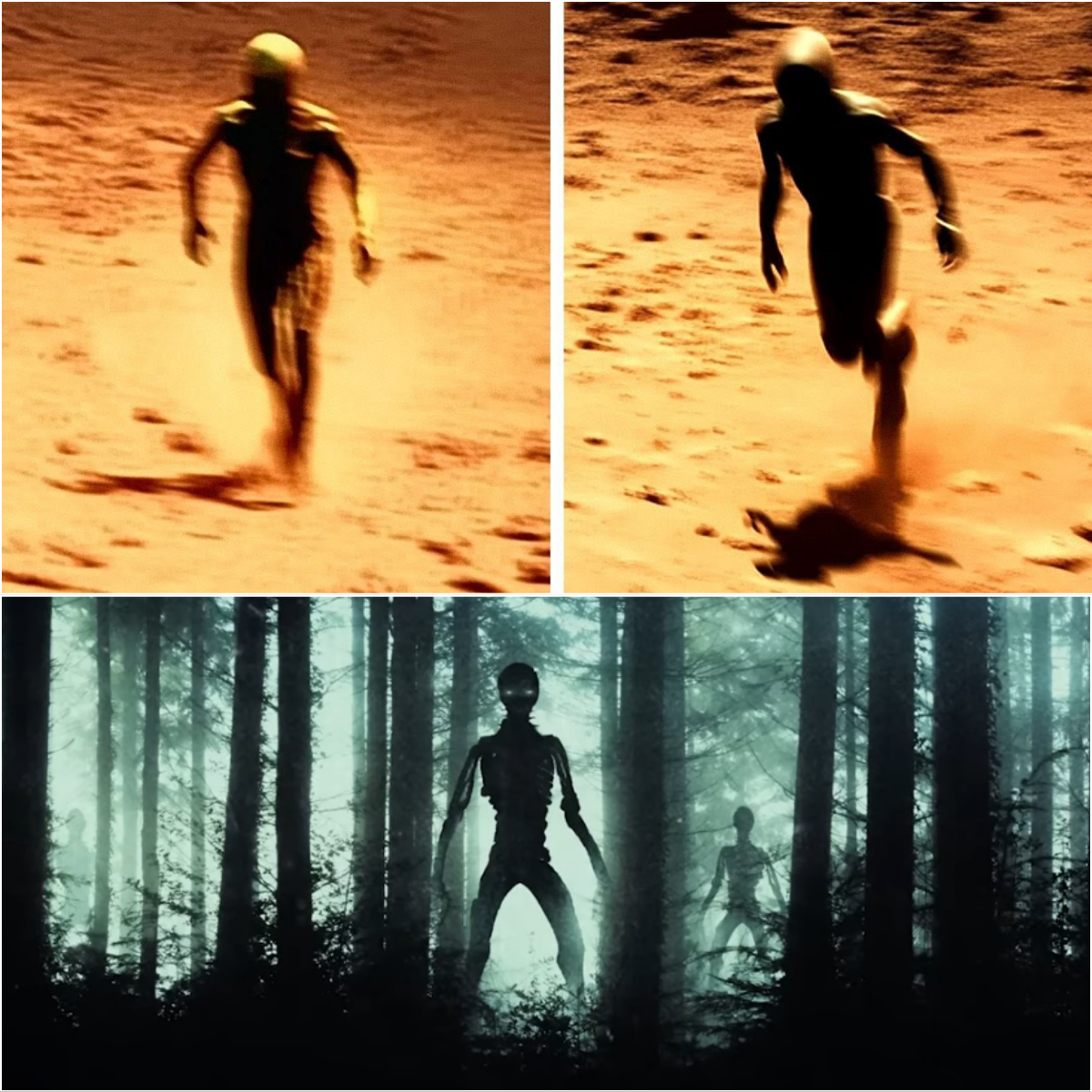
The phenomenon mutated into something entirely modern when a security camera on the property captured a fleeting, surreal sequence. Across the empty, infrared-lit frame, a minute humanoid figure—possessing two distinct, spindly legs and a rudimentary torso and head, but entirely lacking arms—trudges methodically through the dirt. To seasoned internet analysts, the creature bears a striking resemblance to the “Fresno Nightcrawler,” a legendary piece of California digital lore involving white, stilt-like entities walking across suburban lawns.
When billionaire aerospace enthusiast Robert Bigalow purchased Skinwalker Ranch in 1996 to deploy an array of physicists and tech-driven researchers, he effectively laid the groundwork for a new kind of ghost hunt. The mystery was no longer about what a terrified witness thought they saw in the brush; it became an exercise in data collection. When an anomalous shape walks across a sensor, it creates an indelible digital footprint. It challenges the viewer not to trust a human story, but to decipher an unedited file of ones and zeros.
The Anatomy of a Modern Myth: From Varginha to Peru
The modern internet operates as a global accelerator for local panics, turning regional anomalies into international focal points within hours. Two distinct international incidents illustrate how traditional entity encounters have adapted to survive in the hyper-connected landscape of the twenty-first century.
In the mid-1990s, the city of Varginha, Brazil, became the epicenter of one of the most celebrated creature-recovery narratives in South American history. On a humid afternoon in January 1996, three young women walking through a vacant lot encountered a creature crouching near a mud-slicked brick wall. Their description was visceral: a bipedal humanoid with deep brown, oily skin webbed with prominent veins, an oversized skull topped by three distinct cranial ridges, and large, glowing red eyes that seemed to project a sense of profound distress and physical weakness.
The military quickly cordoned off the sector, and rumors of a crashed extraterrestrial craft and subsequent hospital lockdowns spread through the municipality. Decades later, a piece of video surfaced on the dark underbelly of the internet, purposed to show the raw archival footage of that very entity being examined on a military gurney. Though the official state inquiry concluded that the girls had merely encountered a local, non-verbal man with severe mental and physical disabilities who was seeking shelter from a torrential downpour, the digital artifact refuses to die. The footage is dissected frame by frame by amateur sleuths trying to distinguish between a historical medical tragedy, a cinematic hoax, and a genuine cosmic event.
Plaintext
The Varginha Event Matrix:
[ Witness Testimony: Oily skin, cranial bumps, crimson eyes ]
                             |
                             v
[ Official Military Report: Disoriented local resident in heavy rain ]
                             |
                             v
[ Internet Archive Lifecycle: Raw tape leak -> Spectral analysis -> Mythos preservation ]
A much more aggressive, terrifying iteration of this phenomenon occurred more recently in the dense, isolated riverscapes of northeastern Peru. In the summer of 2023, members of the indigenous Ikitu tribe, residing in a rural outpost near Iquitos, began reporting night attacks by seven-foot-tall, armored entities they termed Los Pelacaras—the Face Peelers. Armed with oversized heads, luminous yellowish eyes, and a complete immunity to local hunting shotguns, these entities were said to hover nearly a meter off the rainforest floor, executing swift, predatory strikes against vulnerable villagers. One teenage girl was hospitalized with deep lacerations to her neck following an alleged struggle in the dark.
The panic grew so severe that the Peruvian military and federal prosecutors launched an expedition into the jungle. The official determination was startlingly pragmatic: the “aliens” were likely illegal, heavily armed gold-mining syndicates utilizing commercial jetpacks to terrorize the indigenous population, effectively clearing the resource-rich land of witnesses.
Yet, even when viewed through a secular lens, the reality of jetpack-bound cartel miners hovering through a pristine Amazonian canopy to mimic ancient demons is arguably as terrifying and surreal as an alien invasion. It shows how easily the modern tools of technology can blend into the ancient landscape of human fear.
The High-Definition Horizon: The Aegean Anomalies
While many paranormal clips suffer from low resolution and poor lighting, some historical recordings retain their power because of their clarity and the circumstances of their capture. The Kumburgaz, Turkey UFO videos, recorded between 2007 and 2009, remain a central pillar of modern anomalous research.
Yalcin Yalman, a night security guard working at a resort complex overlooking the Sea of Marmara, began noticing strange lights hovering over the water during his late-night shifts. Armed with a video camera equipped with a high-magnification telephoto lens, Yalman spent two years systematically filming these midnight arrivals. The resulting footage is uniquely unsettling: rather than distant, blurry points of light, Yalman captured highly detailed, metallic, crescent-shaped crafts floating silently against the dark sky.
Plaintext
The Kumburgaz Analysis Protocol:
[ Objective Data: 2007-2009 Video Archive ] -> [ Magnification: Telephoto Lens ]
                                              |
                                              v
[ Visual Elements: Dual humanoid silhouettes within an open-air observation deck ]
When international UFO research organizations subjected the raw tape to laboratory analysis, they ruled out standard misidentifications such as aircraft, weather balloons, drones, or optical reflections from the coastline. What set the Kumburgaz footage apart, however, was what appeared when the camera zoomed in to its maximum threshold. Within the central rim of the dark craft, two distinct, elongated silhouettes with oversized craniums could be seen moving slightly, as if peering out from an open cockpit or observation deck. Yalman himself never claimed to know the origin of the vessels, maintaining only that he recorded what was physically present before him—leaving the world with a haunting, high-definition look into a window that shouldn’t exist.
The Wilderness Lens: Monsters in the Scope
The urge to document the anomalous is not confined to urban security guards; it is shared by those who venture into the deep, unmonitored spaces of the American and European wilderness. In these accounts, the camera becomes an extension of a hunter’s survival instinct, a tool used to verify an encounter that defies the natural order.
A chilling video clip emerged on the online platform Reddit, uploaded by a user whose wife’s coworker had traveled deep into an isolated mountain range for a multi-day hunting excursion. During the trip, two of the group’s experienced hunting hounds bolted into the dense timber after an unknown scent. Hours later, following the distant sound of panicked baying, the hunters discovered the dogs torn apart in a clearing, suffering from injuries that did not align with a typical bear or cougar attack.
As the hunters scanned the distant ridges through the high-powered optics of a rifle scope, they spotted a bizarre, lanky figure moving along the tree line. The recorded footage shows a towering, pale biped with disproportionately long, thin arms that seemed draped in dark, matted hair or fiber. The entity moved with a strange, deliberate gait, completely unbothered by the rough terrain.
Plaintext
Wilderness Trauma Comparison:
[ Standard Apex Predator (Bear/Cougar): Territorial claw markings, predatory consumption ]
                                    ||
                                    \/
[ Mountain Ridge Anomaly: High-impact dismemberment, non-consumption, avoidance of human contact ]
A similar encounter was documented by an outdoor enthusiast who posted an account under the pseudonym “Perplexed Seal.” While sitting around a campfire with friends near a dense forest at twilight, the group noticed a tall, chalk-white figure standing motionless in an adjacent field. The entity gave off an immediate, visceral sense of malice, causing several members of the party to feel physically ill.
When a nearby car engine was ignited, the figure suddenly stood completely upright—revealing a height estimated between six and seven feet—before ducking behind a low bush. The friends who remained at the campsite later reported that the entity spent the night running in blindingly fast, silent circles around the perimeter of the field, its white limbs cutting through the darkness before it vanished back into the old-growth timber.
The Glitch in the Eye: The Corporate Shape-Shifters
Not all modern entity encounters take place in lonely forests or distant villages. One of the most widespread internet conspiracies claims that these beings live among us in plain sight, occupying the highest tiers of global media, entertainment, and political power. This theory relies on microscopic digital analysis, focusing on video clips where a public figure’s human disguise appears to briefly malfunction under the scrutiny of television studio cameras.
This subculture spends countless hours reviewing interview footage of pop icons and politicians, looking for fractional frame errors. In one widely circulated clip of pop star Justin Bieber, analysts point to a moment where his eyes appear to blink unnaturally, revealing a semi-translucent, nictitating membrane—the third eyelid common in reptiles—that slides horizontally across the cornea.
In another piece of media, during a high-profile television interview with hip-hop artist Nicki Minaj, the camera captures a split-second shift where her pupils appear to compress from round human circles into vertical, predatory slits before reverting to normal in the subsequent frame.
Plaintext
The Mechanics of the Digital Artifact:
[ Studio Lighting Source ] -> [ High-FPS Sensor Compression ] -> [ Interlacing Artifact ]
                                                                |
                                                                v
                                              [ Illusion of Vertical Pupil Slit ]
To digital video engineers and media experts, these terrifying transformations are easily explained by the mechanics of modern broadcasting. They are the natural result of macro-blocking, rolling shutter artifacts, and data compression algorithms struggling with intense studio lighting and rapid facial movements. When a video stream drops a packet of data, it can create a brief visual glitch that looks remarkably organic and reptilian.
Yet, for a population increasingly distrustful of institutional power and corporate media, these digital glitches are interpreted as literal truths. They view the camera glitch not as a failure of technology, but as its greatest triumph: a moment where the cold, unbiased sensor accidentally pulls back the curtain on a hidden reality.
The Technologist’s Dilemma: Trusting the Unseen
The rise of the digital camera as the primary witness to the bizarre has left modern society in a strange dilemma. We find ourselves caught between two opposing forces: a powerful technological capability that can capture the world in unprecedented detail, and an equally powerful capability to fabricate reality from scratch.
We live in an era where generative artificial intelligence, sophisticated computer graphics, and deepfake algorithms can create highly convincing video clips out of thin air. A talented visual effects artist sitting in a home studio can easily create a convincing rendering of a pale humanoid walking through the woods, or a glowing orb dancing across a suburban street. This ease of fabrication means that video evidence, which was once considered the gold standard of proof, is now viewed with deep skepticism by the scientific community.
Plaintext
The Digital Evidence Paradox:
High-Definition Capture (Ubiquitous Sensors) <---> Total Digital Fabricability (CGI/Deepfakes)
This paradox has changed how we think about wonder and belief. For the true believer, the sheer volume of these videos across different platforms, countries, and contexts suggests a core truth that cannot be ignored. They argue that even if ninety-nine percent of these clips are the result of digital hoaxes, camera glitches, or optical illusions, the remaining one percent represents a profound mystery that challenges our understanding of the universe.
For the skeptic, these videos are an interesting study in human psychology and digital media—a modern continuation of our ancient desire to look into the dark and see something looking back. As our tools for monitoring the world grow sharper, the line between what is real and what is imagined becomes increasingly blurred, leaving us to wonder whether the monsters on our screens are lurking in the world outside, or are simply reflections of the technology we use to watch it.