The Terrifying Reason Göbekli Tepe Was Buried 😳
Göbekli Tepe: The 12,000-Year-Old Mystery That Shouldn’t Exist
A hill in southeastern Turkey spent thousands of years hiding one of humanity’s greatest secrets.
From a distance, it looked ordinary. Nothing more than a rounded rise in the landscape, overlooked by travelers and shepherds for generations. But beneath that hill lay a discovery so astonishing that it forced archaeologists to reconsider the story of civilization itself. Massive stone circles. Monumental carved pillars. Sophisticated symbolism. And a mystery that becomes stranger the deeper scientists dig.
Because according to everything we thought we knew about human history, Göbekli Tepe should not exist.
The Hill That Changed Human History
Near the modern border between Turkey and Syria stands a site known as Göbekli Tepe, which translates roughly to “Potbelly Hill.” For thousands of years, nobody suspected that anything extraordinary lay beneath it.
Then archaeologists began excavating.
What they uncovered stunned the world.
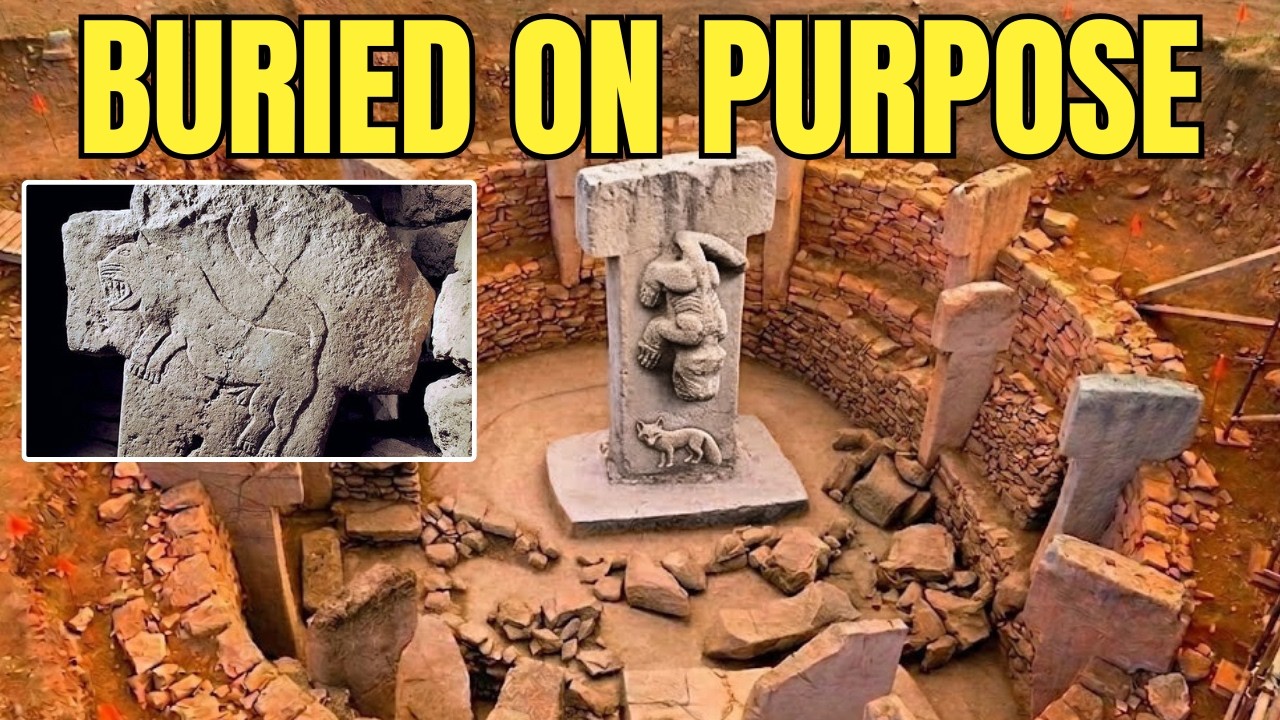
Hidden beneath layers of earth were enormous circular enclosures built from towering T-shaped limestone pillars. Some stood nearly 20 feet tall. Others weighed up to 10 tons. Their surfaces were covered with detailed carvings of animals—foxes, vultures, snakes, scorpions, wild boars, and other creatures that once roamed the ancient landscape.
The structures were not random. They were carefully planned, deliberately arranged, and built with remarkable precision.
Even more shocking was their age.
Göbekli Tepe dates back roughly 11,500 to 12,000 years, making it thousands of years older than the Egyptian pyramids and approximately 6,000 years older than Stonehenge.
When these stones were erected, many historians believed humans were still living as simple hunter-gatherers.
Yet the evidence beneath the hill suggested something entirely different.
A Timeline That Breaks the Rules
For more than a century, archaeologists worked with a relatively straightforward model of civilization.
First came agriculture.
Once people learned to farm, they produced food surpluses. Food surpluses allowed populations to grow. Larger populations created specialists—craftsmen, priests, leaders, and builders. Eventually those specialists constructed temples, monuments, and cities.
The sequence seemed logical.
Farming came first.
Monumental architecture came later.
Göbekli Tepe appears to reverse that order.
The builders of the site lived before pottery. Before metalworking. Before writing. Before wheels. Before cities.
And yet they somehow quarried, carved, transported, and erected multi-ton stone pillars on a scale previously thought impossible for societies at that stage of development.
The contradiction is difficult to ignore.
How could people without agriculture organize enough labor to build something so complex?
How could nomadic hunter-gatherers coordinate projects that may have taken decades or even generations?
Who planned the construction?
Who fed the workers?
Who taught the builders the skills required to create such sophisticated carvings?
The site raises questions faster than it answers them.
The Discovery That Rewrote Archaeology
The modern story of Göbekli Tepe begins largely with German archaeologist Klaus Schmidt.
When Schmidt arrived at the site during the 1990s, he immediately recognized that the stone fragments scattered across the hill were unlike anything previously discovered.
Excavations soon revealed pillar after pillar emerging from the soil.
What initially seemed like a modest archaeological project rapidly transformed into one of the most important discoveries in modern archaeology.
As more structures appeared, Schmidt developed a theory.
Göbekli Tepe, he proposed, was not a settlement.
It was a ritual center.
A temple complex.
A place where scattered groups of hunter-gatherers gathered periodically for ceremonies, festivals, and communal activities before returning to their normal lives.
At first, the evidence seemed to support the idea.
Researchers found little indication of permanent housing. There appeared to be few domestic structures. The enormous circular enclosures seemed more ceremonial than residential.
The theory was revolutionary.
Perhaps religion did not emerge after civilization.
Perhaps civilization emerged because of religion.
Maybe the desire to gather for rituals encouraged cooperation. Maybe those gatherings created a need for reliable food supplies. Maybe that need eventually inspired agriculture itself.
For decades, this became one of the most influential interpretations of Göbekli Tepe.
But new discoveries have complicated the picture.
The Questions That Refused to Go Away
Even if Göbekli Tepe served as a ritual center, significant mysteries remained.
The pillars did not carve themselves.
The site contains hundreds of tons of worked stone.
The labor required to extract, transport, and position those blocks would have been immense.
Archaeologists also struggled to explain how construction crews could remain fed during large building projects without established agriculture.
Then there was another puzzle.
A truly bizarre one.
At some point around 8000 BCE, long after the monuments had been constructed, the entire complex was intentionally buried.
Not abandoned.
Buried.
The builders filled the enclosures with enormous quantities of soil, rubble, tools, animal bones, and debris.
The process appears deliberate and systematic.
Someone wanted these structures hidden.
But why?
New Evidence Changes the Story
Recent excavations have revealed evidence suggesting that life at Göbekli Tepe may have been more complex than previously believed.
Researchers have uncovered indications of repeated occupation and long-term activity around the site.
Among the discoveries are hearths and fire pits showing signs of frequent use over extended periods.
These were not isolated ceremonial fires.
They appear to have been used repeatedly by people returning to the same locations again and again.
Storage features have also been identified.
Such facilities imply planning, resource management, and perhaps longer-term habitation than originally assumed.
Archaeologists have also recovered large numbers of stone tools, grinding stones, animal remains, and plant materials.
Grinding stones are particularly significant.
These heavy objects are not the kind of tools typically carried from place to place by highly mobile groups. They are more often associated with settled or semi-settled lifestyles.
The evidence suggests that Göbekli Tepe may not have been merely a gathering place visited occasionally.
It may have supported a more permanent human presence.
If true, that possibility further blurs the line between hunter-gatherer societies and the earliest forms of civilization.
Messages Hidden in Stone
The carvings at Göbekli Tepe are among its most fascinating features.
At first glance, they appear decorative.
A closer look suggests otherwise.
Different enclosures emphasize different animals.
Some feature snakes prominently. Others focus on foxes. Still others showcase vultures, boars, or other creatures.
The patterns appear intentional.
Researchers increasingly believe that the imagery carried symbolic meaning understood by the people who built the site.
These were not random artistic choices.
They may have represented clans, beliefs, stories, rituals, territories, or concepts now lost to time.
One pillar in particular has attracted enormous attention.
Known as the Vulture Stone, or Pillar 43, it contains a complex arrangement of symbols that some researchers believe may have astronomical significance.
This interpretation remains controversial, but it has generated intense debate.
Could the carvings preserve observations of the sky?
Could they record historical events?
Or are modern observers simply projecting meaning onto ancient symbols?
The answers remain uncertain.
But few scholars doubt that the carvings were intended to communicate something important.
The Giant Stone Figures
One of the most intriguing aspects of Göbekli Tepe is the shape of its pillars.
The massive T-shaped stones are unlike most ancient monuments.
For years, researchers viewed them simply as architectural elements.
Today, many archaeologists believe they may represent stylized human figures.
Several pillars display carved arms running along their sides.
Some feature belts and loincloth-like details.
These features suggest that the pillars themselves were intended to depict human beings.
If that interpretation is correct, the enclosures become even more extraordinary.
Instead of standing among stone supports, visitors would have found themselves surrounded by enormous human-like figures arranged in circles.
Silent guardians carved from limestone.
Watching.
Observing.
Participating in rituals whose meaning has long since disappeared.
The realization transforms the site from architecture into sculpture on a monumental scale.
Why Was It Buried?
No mystery surrounding Göbekli Tepe is more puzzling than its burial.
The site was not destroyed by invaders.
It was not covered by natural disaster.
The evidence strongly suggests intentional concealment.
Someone filled these monumental enclosures by choice.
The effort required would have been enormous.
Why invest so much labor in burying something your ancestors worked so hard to create?
Several possibilities exist.
Perhaps changing religious beliefs made the old monuments obsolete.
Perhaps social transformations rendered the site unnecessary.
Perhaps new settlements emerged elsewhere.
Or perhaps the burial was intended as preservation.
A way of protecting sacred knowledge for future generations.
No one knows.
And that uncertainty fuels some of the more dramatic theories surrounding the site.
The Comet Hypothesis
Among the most controversial ideas connected to Göbekli Tepe is the suggestion that some carvings record a catastrophic celestial event.
Certain researchers argue that symbols on the Vulture Stone correspond to constellations and astronomical alignments.
They propose that the imagery may reference a comet impact or cosmic disaster occurring around 10,950 BCE.
This timeframe coincides with the beginning of the Younger Dryas, a period of dramatic climatic cooling that lasted more than a thousand years.
The Younger Dryas remains one of the most studied climate events in Earth’s recent history.
Some scientists support the idea that a cosmic impact contributed to the environmental changes.
Others strongly disagree.
The debate continues.
If the comet theory were correct, it would imply that the builders of Göbekli Tepe preserved memories of a world-changing catastrophe and encoded those memories into stone.
That possibility is fascinating.
But it remains speculative.
At present, no consensus exists.
A Pattern Across the World
Göbekli Tepe may be unique in age, but it is not unique in purpose.
Throughout history, humans have repeatedly invested enormous effort into building monuments that serve no obvious practical function.
Stonehenge in England.
The megalithic temples of Malta.
Ancient ceremonial complexes across the Americas.
Monumental structures in Africa, Asia, and Oceania.
Again and again, cultures separated by geography, language, and time constructed places dedicated not to survival, but to meaning.
They raised stones.
Marked sacred spaces.
Aligned structures with celestial events.
Created symbols meant to endure long after their creators were gone.
Göbekli Tepe appears to represent one of the earliest known examples of this impulse.
An impulse that would eventually shape civilizations around the globe.
The Real Significance of Göbekli Tepe
The greatest lesson of Göbekli Tepe may not be about lost civilizations or cosmic disasters.
It may be about human capability.
For generations, people assumed that the earliest hunter-gatherers lived simple lives focused almost entirely on survival.
Göbekli Tepe challenges that assumption.
Its builders possessed organization.
Planning.
Engineering skill.
Artistic talent.
Symbolic thought.
Religious or spiritual beliefs.
And perhaps most importantly, the ability to cooperate on an extraordinary scale.
These were not primitive people stumbling accidentally toward civilization.
They were intelligent humans creating meaning in a rapidly changing world.
The more archaeologists uncover, the more complex those people appear.
The Mystery Is Just Beginning
Remarkably, only a small fraction of Göbekli Tepe has been excavated.
Geophysical surveys indicate that many more structures remain hidden beneath the ground.
Future generations of archaeologists may spend decades—or even centuries—uncovering what still lies below the hill.
Each excavation season reveals new clues.
Each discovery raises new questions.
And every answer seems to deepen the mystery.
Twelve thousand years ago, someone carved symbols into stone, erected monumental circles, and then buried them beneath a hill.
Today, we are still trying to understand why.
Perhaps that is what makes Göbekli Tepe so captivating.
It is not merely an archaeological site.
It is a message from the dawn of human history.
A message we have only just begun to read.