The Marian Apparition You Haven’t Heard About!
The Marian Apparition You Haven’t Heard About!
The winter of 1933 did not arrive in Banneux with a gentle dusting of frost; it dropped from the Ardennes like iron. It was a bleak, godless winter, the kind that froze the water in the porcelain basins before dawn and made the pine trees along the high ridge groan like old men. A few hundred miles to the east, Adolf Hitler was consolidating a dark, terrifying grip on Germany, but in this forgotten, swampy hamlet of Belgium—a place so small it was omitted from the regional road maps—the only war that mattered was the one against starvation.
Inside the cramped, smoke-stained kitchen of the Beco cottage, eleven-year-old Mariette stood near the coal stove, her breath forming tiny plumes of white mist. Born on March 25, 1921—the Feast of the Annunciation—she carried a name that felt far too sacred for her surroundings.
Her father, Louis, was a hard, disillusioned laborer who had not stepped inside a church since the Great War. He viewed the parish priest with the same hostility he reserved for the tax collector, and he didn’t care a whit whether his seven children knew their catechism or died in their sins. The cottage was a place of survival, not spirituality.
Yet, hidden beneath the frayed straw mattress of her iron bed, Mariette kept a secret. It was a cheap, glass-beaded rosary she had found in the dirt outside a neighboring village months ago. She didn’t entirely understand the prayers, but on the nights when the hunger in her belly kept her awake, she would pull it out, holding the cold beads against her chest until she drifted off to sleep.
The Vision through the Pane
It was the evening of January 15, just after seven o’clock. The temperature had plummeted into the single digits, and a heavy, relentless snow was blanketing the yard. Mariette leaned her forehead against the freezing glass of the kitchen window, her eyes straining into the dark. She was waiting for her older brother, Julian, who was late returning from his shift at the timber mill.
The kitchen was lit by a single, sputtering oil lamp that cast long, grotesque shadows across the wooden floorboards. As Mariette rubbed a circle of frost off the glass, her breath hitched.
Out in the yard, standing perfectly still in the knee-deep snow, was a woman.
The woman was surrounded by an oval aura of blinding, brilliant light that seemed to absorb the falling snowflakes before they could touch her. She was extraordinarily beautiful, with features so pure they defied the rough geometry of the world. She wore a luminous, snow-white gown that cascaded down to her feet, tied at the waist by a vibrant blue sash that caught the light like deep water.
Mariette leaned closer, her nose touching the cold glass. She noticed that the woman was barefoot, her toes hovering just an inch or two above the frozen crust of the snow. Embedded precisely between the toes of her right foot was a single, perfect golden rose that gleamed with a warmth that seemed impossible in the dead of winter.
The lady raised her right hand, her fingers slender and graceful, and made a slow, deliberate motion. She was signaling Mariette to come outside.
“What are you staring at, girl?” her mother, Louise, barked from the hearth, where she was mending a torn burlap sack.
“Mama,” Mariette whispered, her voice trembling. “There is a beautiful lady in the yard. She is shining. She wants me to go out to her.”
Louise dropped her needle and let out a harsh, mocking laugh. “A lady? In this storm? It’s probably the neighbor’s old sow got loose again.”
“No, Mama! Look!” Mariette insisted, her eyes never leaving the window. A sudden wave of logic hit the young girl; she reasoned that the vision might be a trick of the light, a reflection of the oil lamp against the double-paned glass. She reached out, picked up the heavy lamp, and carried it into the dark hallway.
When she returned to the window, the yard should have been pitch black. Instead, the brilliant oval of light remained, and the woman was still there, waiting with the same patient, sorrowful smile.
“Mama, please! Come look!” Mariette pleaded, her voice rising in panic.
Louise grumbled, throwing her mending aside. She marched over to the window, squinted into the darkness for a brief second, and then violently pulled the heavy wool curtain shut. “Rubbish! There’s nothing out there but dark and frost. You’re letting your imagination run wild, just like your father. Next thing you’ll tell me it’s the Blessed Virgin herself!”
“But it is, Mama! She has a rosary hanging from her sash, and she’s holding the beads!” Mariette cried, pulling the curtain back open. “Look at her! She’s so beautiful. She wants me to go out!”
“You will stay right inside this house,” Louise snapped, grabbing Mariette by the shoulder and dragging her away from the glass. “Lock the door. I won’t have you running around the swamp in your nightshirt chasing after ghosts.”
When Mariette managed to slip back to the window a few minutes later, the light had vanished. The yard was nothing but an expanse of white and gray shadows. Her heart pounding against her ribs, she ran up the stairs to her freezing bedroom, dug her hidden rosary out from beneath the straw mattress, and fell to her knees. When Julian finally walked through the front door a half-hour later, stamping the snow from his boots, Mariette ran down to tell him. He merely laughed in her face, calling her a superstitious fool.
The Transformation of Louis Beco
For three days, the cottage was filled with a tense, suffocating silence. Mariette’s father watched his daughter with a mixture of suspicion and growing unease. He noticed that she no longer complained about her chores, and her eyes had a strange, distant clarity that hadn’t been there before.
On the evening of January 18, the air was completely still. The clock on the mantelpiece struck 7:00 PM.
Suddenly, as if pulled by an invisible wire, Mariette dropped the dish towel she was holding, bolted across the kitchen, and flung the back door wide open. She sprinted out into the snow-covered yard, her bare feet sinking into the drift.
“Mariette! Get back inside!” Louis roared, grabbing his heavy wool coat and charging out after her. He was terrified that his daughter was losing her mind, or worse, that the bitter cold would freeze her blood.
He caught up to her near the old hedge at the edge of their property. But before he could grab her arm, Mariette dropped to her knees with a force that should have shattered her kneecaps against the frozen ground. She didn’t cry out. Her hands flew together in a posture of prayer, and her head tilted upward, her eyes locking onto a point in the air just three feet away.
Louis stopped dead in his tracks. He didn’t see the woman. He saw only the dark pines and the white snow. But as he watched his daughter, an overwhelming, suffocating weight settled over the yard. The air around Mariette seemed to vibrate with a palpable, electric heat that defied the winter. The sheer intensity of the scene—the absolute stillness of the girl, her face illuminated by a glow he couldn’t trace—paralyzed him behind the trunk of a large oak tree. He was completely mesmerized, his breath catching in his throat.
In Mariette’s eyes, the beautiful lady had descended even closer. She signaled for the girl to rise and follow her.
Mariette stood up, her movements mechanical and smooth, and began to walk backward along a narrow path that led toward the ditch at the side of the main road. Louis followed a few paces behind, his heart hammering against his ribs in a way he hadn’t felt since the trenches of 1914.
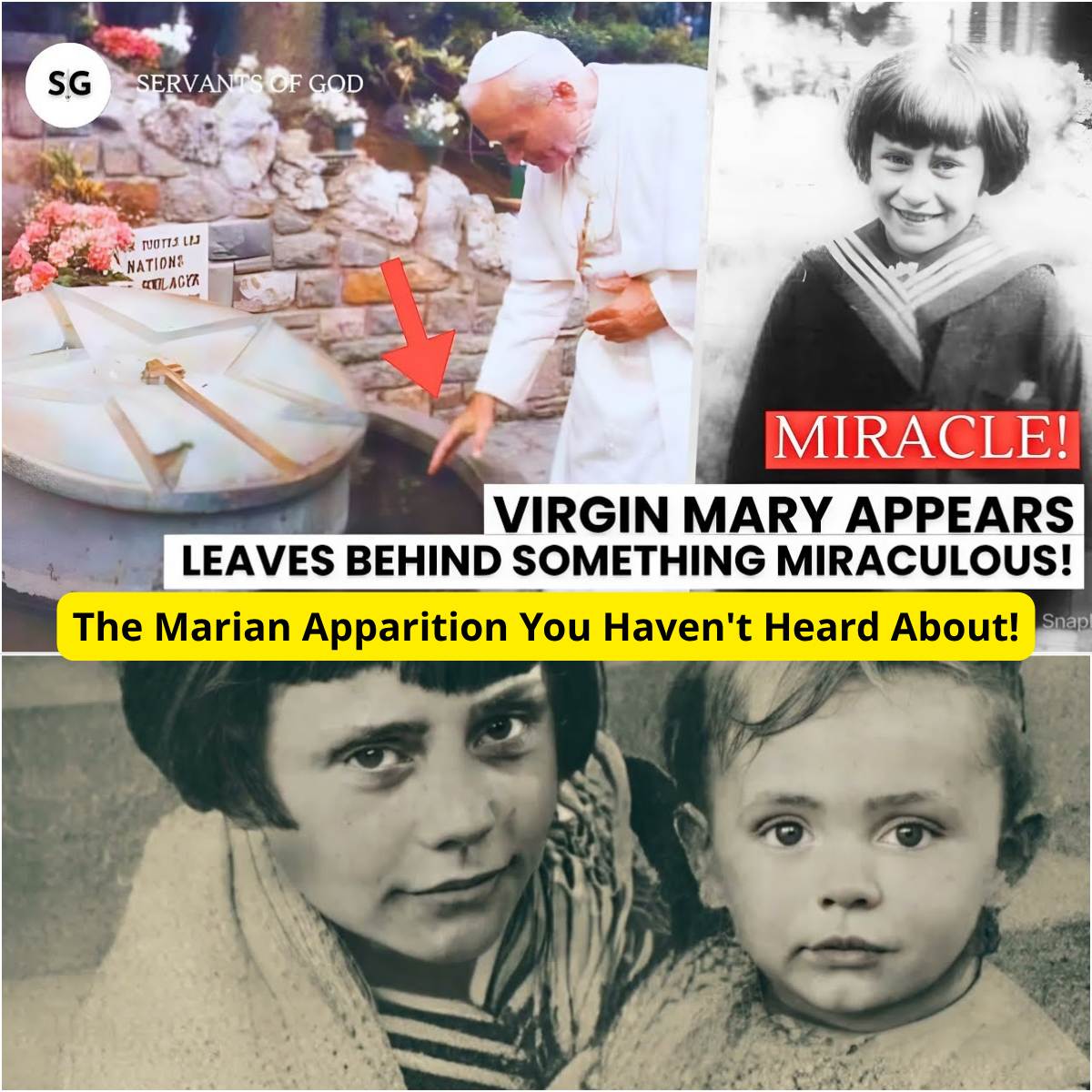
Suddenly, Mariette dropped to her knees a second time, right at the edge of a small, forgotten spring that trickled out from beneath a mossy stone bank. The water was usually choked with dead leaves and frozen solid by January, but tonight, it was bubbling with a clear, liquid energy.
The lady stood directly above the water. She looked down at the young girl and spoke, her voice like the sound of a silver bell echoing across a quiet lake.
“Put your hands into the water,” the lady said.
Mariette did not hesitate. She plunged both of her hands into the icy spring. Strangely, the water didn’t feel cold; it felt like a warm, reviving current that rushed up her arms and settled into her chest.
“This fountain is reserved for me,” the lady said with an expression of profound tenderness. She looked at Mariette for a long, beautiful moment, then whispered, “Good night.”
As the lady faded back into the dark sky, the intense heat vanished from the yard, leaving only the standard, bitter chill of the Belgian night. Mariette pulled her wet hands from the spring and looked up at her father, who was standing over her, his face pale and tears streaming down his weathered cheeks.
Louis Beco did not say a word on the walk back to the cottage. He didn’t scold her, and he didn’t mock her. The very next morning, before the sun had even cleared the high pines, the man who had abandoned God for twenty years marched down to the parish rectory, knocked on the door, and demanded to go to confession so that he could return to Mass and receive Holy Communion.
The Virgin of the Poor
The beautiful visitor returned to the tiny yard in Banneux a total of eight times between January and March of 1933. Each apparition followed a similar pattern, drawing small crowds of curious onlookers, local doctors, and skeptical church officials who watched Mariette enter a state of complete ecstasy that left her entirely insensitive to pinpricks or the blinding glare of flashlights.
During the third apparition, Mariette gathered the courage to ask a question that had been burning in her heart. “Who are you, beautiful lady?”
The woman smiled, a look of infinite mercy crossing her face. “I am the Virgin of the Poor,” she replied.
During a subsequent visit at the spring, she expanded on the purpose of her long journey to this forgotten corner of the world.
“This fountain is reserved for all nations… to bring comfort to the sick,” she declared. She told Mariette that she desired a small chapel to be built on the site, a place where the broken, the impoverished, and the forgotten could come to find a grace that the material world had denied them.
The final apparition occurred on March 2, 1933, under a dark, rain-slicked sky. The Virgin of the Poor looked down at the little peasant girl who had become her messenger one last time. “I am the Mother of the Savior, the Mother of God,” she said solemnly. She placed her glowing hand over Mariette’s head in a silent blessing and whispered her final words: “Pray much. Adieu.”
When the light vanished for the last time, Mariette fell forward into the mud, weeping bitterly. She knew the beautiful lady would not return.
The Postman’s Retinement
The world did not make it easy for Mariette Beco. In the years that followed, she was subjected to relentless interrogations by ecclesiastical commissions, psychiatric evaluations, and the intense, often suffocating scrutiny of thousands of pilgrims who began to descend upon the small hamlet of Banneux. Skeptics claimed she was an attention-seeking child who had been influenced by the nearby apparitions at Beauraing, while others suggested she was suffering from a psychological delusion brought on by the trauma of poverty.
But through it all, Mariette’s testimony remained as unyielding as the Ardennes stone. She never altered a single detail of her story. She never sought money, fame, or special treatment.
In 1942, right in the dark heart of World War II, the Bishop of Liège officially approved the veneration of Mary under the title of Our Lady of the Poor. Five years later, formal approval for the supernatural character of the apparitions arrived from the Holy See in Rome. Finally, in 1949, under the pontificate of Pope Pius XII, the events of Banneux were declared definitive and authentic.
A beautiful, simple stone chapel was constructed over the exact spot where the Virgin had requested it, and the small spring was enclosed in stone, becoming a destination where millions of sick and impoverished individuals from every corner of the globe traveled to immerse their hands in the water, looking for the comfort that had been promised to an eleven-year-old girl in the winter of 1933.
As for Mariette herself, she did exactly what she had always intended to do: she vanished into the background. She refused to enter a convent, she did not give paid interviews, and she chose to live a completely private, ordinary life, eventually marrying and raising a family far away from the spotlight of international fame.
In 2008, the world celebrated the 75th anniversary of the apparitions. A large international contingent of journalists traveled to Belgium, trying to secure a statement from the elderly woman who had once stood barefoot in the snow with the Queen of Heaven. Mariette, then eighty-seven years old, repeatedly declined the requests for cameras and microphones.
When a close friend finally pressed her for a brief message to be read to the pilgrims gathered at the shrine, the old woman let out a soft, tired smile that carried the exact same practical simplicity of the young girl who had moved the oil lamp seventy-five years prior.
“I was no more than a postman who delivers the mail,” Mariette explained gently, her wrinkled hands resting in her lap. “Once the task has been done, the postman is of no importance anymore. The mail is what matters.”
Mariette Beco passed away quietly on December 2, 2011, at a retirement home not far from the spring. She left behind no grand theological treatises, no personal monuments, and no wealth. But today, if you travel to that small pocket of Belgium that was once omitted from the maps, you will find a stone fountain where the water still runs clear and warm beneath the winter ice, and a small chapel where the poor of the earth still gather to hear the echo of a voice that promised that no one is ever truly forgotten by heaven.