Anti-Israel Teen Screams at Jewish Student During Explosive U.S. Campus Clash — Then One Question Changes Everything
Anti-Israel Teen Erupts During Explosive U.S. Debate — Then Gets Stunned by Basic Questions About Israel and Hamas
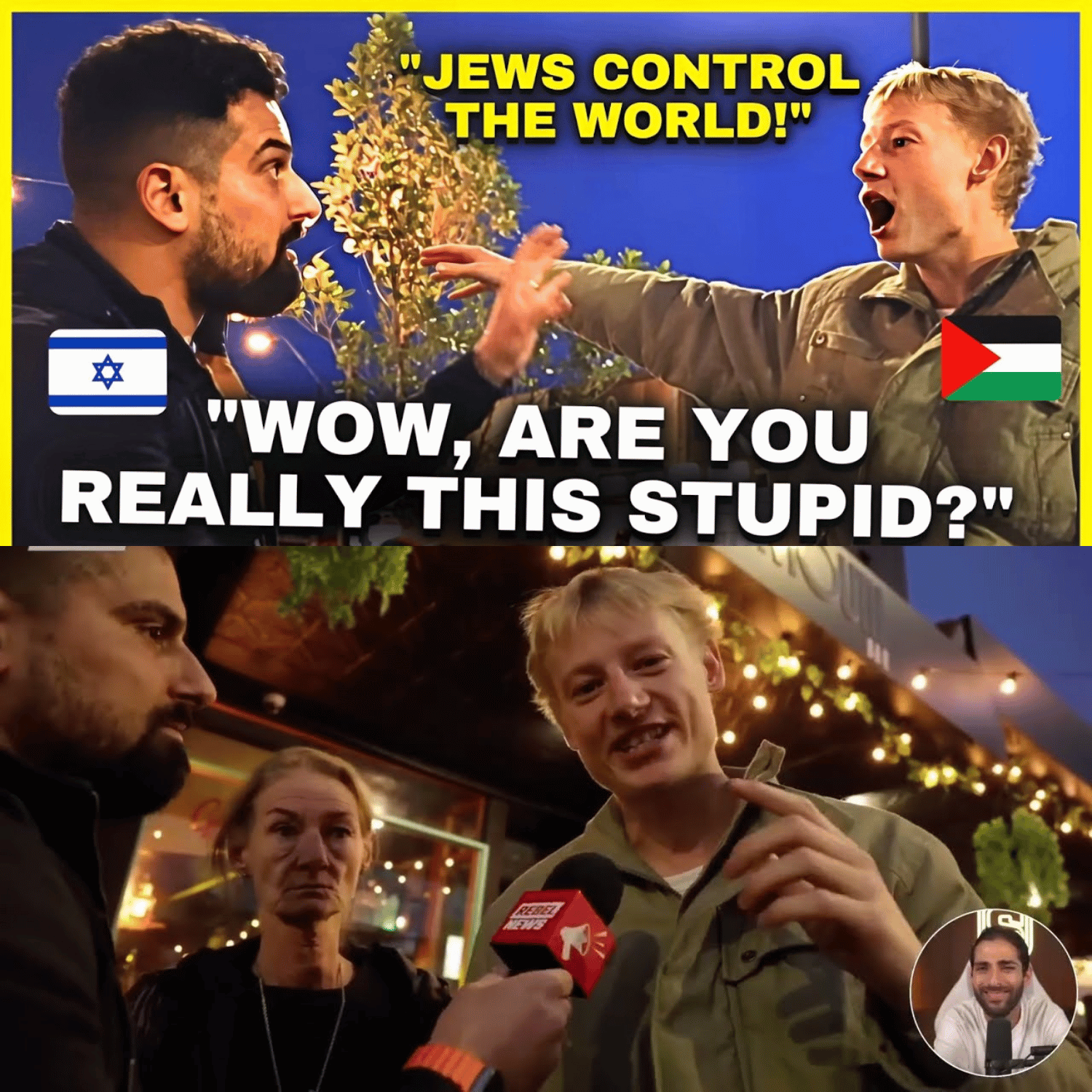
WASHINGTON, D.C. — A heated street interview in the United States took an unexpected turn when a young anti-Israel activist confidently demanded “regime change” in Israel, only to struggle when pressed on the facts behind his claims.
The dramatic exchange unfolded during a public political discussion, where the teenager accused Israel of controlling Western society, influencing world affairs, and causing conflicts throughout the Middle East. But as the conversation continued, simple questions about history, democracy, and the Israel-Hamas war appeared to expose major gaps in his understanding of the issues he was passionately arguing about.
The encounter quickly drew attention online, with viewers describing the debate as a striking example of how emotionally charged political opinions can sometimes outrun factual knowledge.
A Shocking Opening
The conversation began with a startling statement.
When asked why he supported drastic action against Israel, the young activist responded that the country needed “regime change” and claimed that Jewish influence extended throughout Western institutions.
He argued that Israel exercised excessive power and blamed the country for conflicts involving both Palestinians and Iran.
Yet moments later, when challenged to explain who he believed the “real Jews” were, the teenager appeared uncertain.
Rather than offering a clear answer, he admitted that he was not particularly educated on Judaism and struggled to explain his own claim.
The interviewer immediately seized on the contradiction.
“How can you accuse an entire group of controlling society,” he asked, “if you cannot even explain who they are?”
The teenager acknowledged several times that he was not fully informed on the subject, but continued expressing strong opinions about Israel and Jewish influence.
Democracy Versus “Regime Change”
The conversation intensified when the activist called for regime change in Israel.
The interviewer responded with a simple observation.
Israel is a democracy.
Unlike authoritarian governments, leadership changes through elections. Israeli voters regularly choose their government through the ballot box.
The interviewer pointed out that if someone wants political change in a democracy, elections—not bombs—are generally the mechanism.
The teenager initially denied advocating violence.
Moments later, however, he appeared to contradict himself, admitting that he might support forceful action despite acknowledging he was not fully educated on the issue.
That admission became one of the most discussed moments of the exchange.
Viewers noted the contrast between the activist’s confidence in demanding major geopolitical changes and his repeated acknowledgment that he lacked detailed knowledge about the conflict.
The October 7 Question
The debate soon shifted to the war between Israel and Hamas.
The teenager argued that Israel had started wars in both Gaza and Iran.
The interviewer immediately pushed back.
He referenced the October 7 Hamas attack, during which Hamas militants crossed into Israel, killing civilians, taking hostages, and triggering the current war.
“How did Israel start that war,” the interviewer asked, “if Hamas invaded Israel first?”
The activist attempted to broaden the discussion by referencing decades of historical tensions.
However, when asked specific questions about major conflicts involving Israel since 1948, he struggled to provide details.
At one point, he admitted he did not know when modern Israel was established.
The interviewer argued that understanding the basic timeline of the conflict was essential before making sweeping claims about responsibility for wars.
The exchange highlighted a growing issue seen across many political debates: strong convictions often paired with limited historical knowledge.
The Hamas Dilemma
Perhaps the most difficult moment came when the conversation turned toward Hamas itself.
The activist agreed that Hamas should be removed from power.
But the interviewer followed up with a question that many observers viewed as central to the entire debate:
“How do you remove Hamas?”
The teenager acknowledged that the group would likely have to surrender or be militarily defeated.
The interviewer noted that this was effectively the goal Israel claims to be pursuing.
While the activist criticized the scale of Israel’s military campaign, he struggled to provide an alternative strategy for eliminating Hamas while simultaneously opposing the methods currently being used.
The exchange exposed a dilemma frequently discussed by military analysts and policymakers.
Many critics of Israel’s war effort condemn civilian casualties while also insisting Hamas must be removed. Yet practical alternatives for achieving that objective are often difficult to define.
A Debate About Information
As the conversation continued, attention shifted away from geopolitics and toward media consumption.
The interviewer asked where the activist received his information.
The teenager cited political commentator Candace Owens as one of his influences.
That revelation prompted another line of questioning.
The interviewer argued that many online commentators make strong claims without presenting complete context, encouraging audiences to accept conclusions without independently verifying facts.
He accused social media personalities of repeatedly using emotionally charged terms such as “genocide,” “ethnic cleansing,” and “Jewish control” without sufficiently examining evidence.
According to the interviewer, repetition can sometimes create the illusion of truth, particularly among audiences already predisposed to believe certain narratives.
The activist defended his right to form his own opinions but admitted he could not immediately provide statistics or historical details to support several of his claims.
Broader Questions About Public Discourse
The confrontation reflects a larger trend visible across American campuses, social media platforms, and political gatherings.
The Israel-Hamas conflict has become one of the most polarizing issues in public life.
Supporters of both sides frequently accuse opponents of spreading misinformation, ignoring history, or selectively presenting facts.
The debate also highlighted concerns about conspiracy theories involving Jewish influence.
Historians have long noted that claims about Jews secretly controlling governments, media, or financial institutions have circulated for centuries and have often fueled discrimination and antisemitism.
Critics argue that such theories oversimplify complex political realities and assign collective blame to entire groups of people.
Supporters of Israel point to these concerns when responding to accusations of hidden Jewish control.
Meanwhile, critics of Israeli government policies insist that opposition to Israeli actions should not automatically be equated with prejudice against Jewish people.
A Viral Moment
By the end of the interview, the teenager had repeatedly acknowledged that he lacked detailed knowledge about several key topics he was discussing.
For many viewers, that became the defining takeaway.
The issue was not whether people should support or oppose Israeli government policies.
Rather, it was the contrast between certainty and understanding.
The exchange served as a reminder that in an era dominated by viral clips, social media influencers, and political outrage, passionate opinions can spread faster than verified facts.
And sometimes, the simplest questions can become the hardest ones to answer.