Scientists Finally Identified What Swallowed a Great White Shark Whole — And It’s Terrifying
Scientists Finally Identified What Swallowed a Great White Shark Whole — And It’s Terrifying
The tag washed ashore before the shark did.
That was the first sign that something was wrong. Somewhere off the coast of Australia, a nine-foot female great white shark had vanished into deep water, leaving behind no body, no blood trail, no floating remains, and no witness. Only a small tracking device survived, carried back from the ocean like a black box from a crash site. When scientists opened the data, the story it told was almost impossible to believe.
The shark had not simply died.
Something had taken it.
For most people, a great white shark represents the top of the ocean’s food chain. It is the shadow beneath the boat, the fin in the distance, the nightmare shape moving through blue water with ancient confidence. Its body is built like a torpedo. Its jaws can tear through seals. Its senses can detect life from astonishing distances. It is the animal humans fear when they imagine the ocean looking back.
But the data from the tag suggested that this predator had become prey.
The shark, later nicknamed “Shark Alpha,” had been tagged as part of a research project designed to study great white movement patterns. For months, nothing seemed extraordinary. She moved through her world like an apex predator, diving, hunting, traveling, and disappearing into the cold depths where humans could only follow through instruments.
Then the tag recorded the event.
A sudden, violent dive.
A plunge to nearly 1,900 feet.
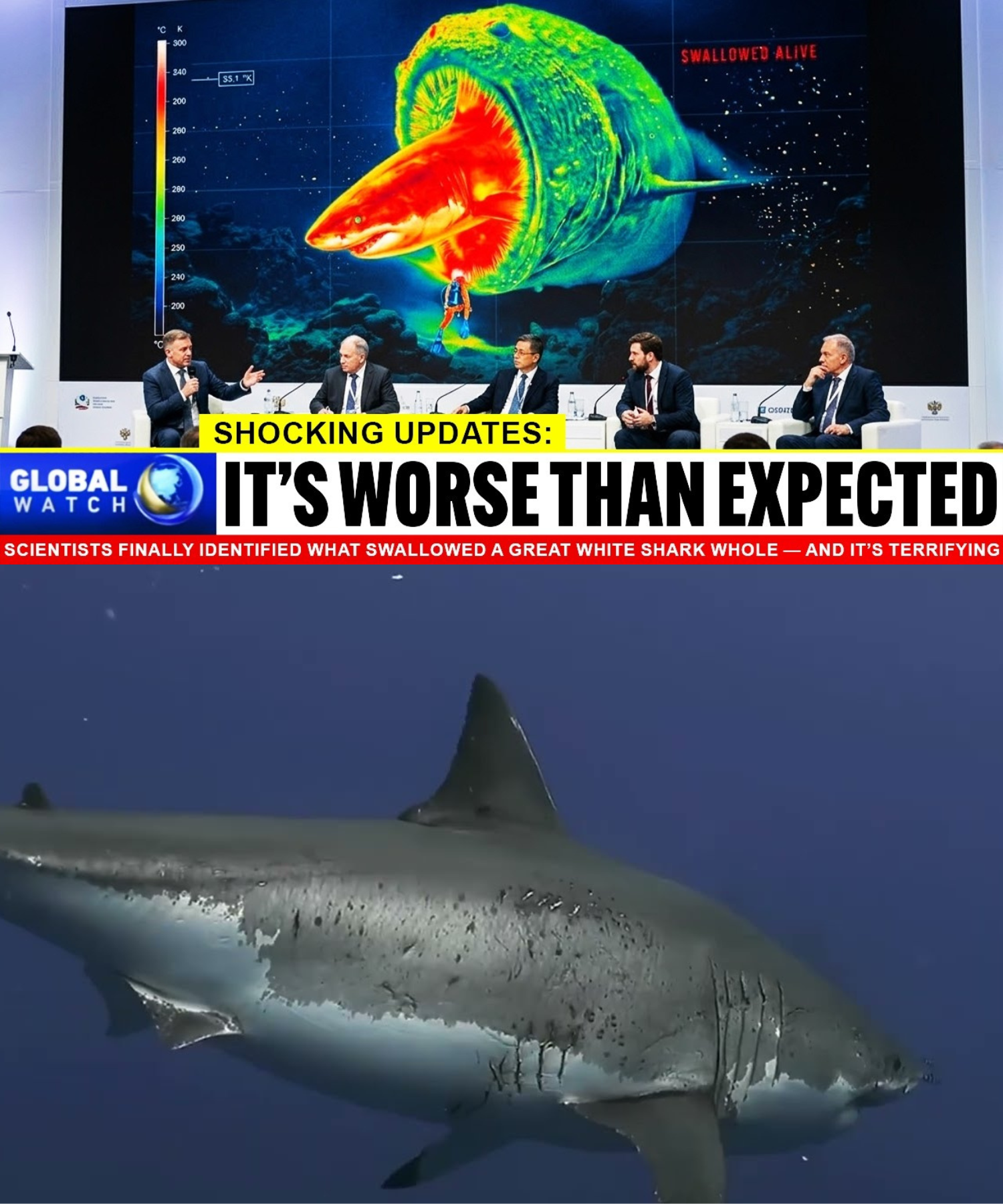
A temperature spike so dramatic that researchers immediately understood the tag was no longer outside the shark’s body in cold seawater. It appeared to be inside something warm. Something alive. Something large enough to bite, swallow, or tear away the part of the shark carrying the tag and carry it into the depths.
For a moment, the ocean’s hierarchy collapsed.
What eats a great white shark?
That question should sound absurd. It feels like asking what hunts a lion on the open plains or what frightens a wolf in the forest. But the ocean does not respect human rankings. We call something an apex predator because it sits near the top of its known food web, not because it is untouchable. In the sea, size, surprise, temperature, depth, and opportunity can rewrite the rules in seconds.
The first theories were wild.
A megalodon.
A giant unknown shark.
A prehistoric monster somehow still alive in the deep.
A creature large enough to swallow a great white whole and vanish without leaving a trace.
The internet loved that version because it gave the story a monster. And the ocean is the perfect place for monsters. It is vast, dark, underexplored, and indifferent. It hides whale carcasses, trenches, giant squid, strange lights, ancient fish, and animals that look as if evolution designed them in nightmares. If any place on Earth could still hold something enormous and unseen, people thought, it would be there.
But scientists did not start with monsters.
They started with data.
The tag gave them depth. It gave them temperature. It gave them timing. It gave them movement after the attack. That mattered because a corpse does not behave like a living predator. A tag floating loose does not move through the water column in the same way a swimming animal does. A tag sitting outside a body does not remain warm in cold deep water. The device had become a witness, and its testimony was colder than any legend.
It suggested ingestion.
Not necessarily that the entire shark had been swallowed whole in one impossible gulp. That is where the story often gets exaggerated. The tag may have been swallowed after a larger animal bit off the part of the shark where it was attached. But either way, the conclusion was unsettling: a large predator had attacked the great white, and the tag had entered that predator’s digestive system.
That was terrifying enough.
The first serious suspect was another great white.
Sharks are not sentimental animals. Cannibalism is known in the shark world. Some species begin killing siblings before they are even born. Great whites have been seen with bite scars from other sharks, and they are opportunistic predators. A larger great white could attack a smaller one, especially if territory, food, weakness, or surprise created the right moment. A nine-foot great white sounds huge to humans, but in its own species, it is not the largest possible animal. Adult females can grow far bigger.
The idea of a cannibal great white is disturbing because it replaces the fantasy monster with something real.
No prehistoric survivor.
No unknown leviathan.
Just a larger shark, moving through the same waters, powerful enough to turn one of the ocean’s most feared hunters into food.
That version of the answer is almost worse. It means the great white’s world is not ruled by clean categories. There is always something larger, older, more dominant, more desperate, or luckier. A predator can spend years surviving by perfect instinct, then disappear because another predator made one better decision.
But not every scientist was satisfied with the great white explanation.
The temperature spike raised questions. Great white sharks can warm parts of their bodies above the surrounding water, which helps them hunt in cold seas. But the tag’s recorded temperature seemed high enough to make some experts look toward another suspect: the killer whale.
The orca is the ocean predator that makes the great white seem less invincible.
Killer whales are not whales in the casual sense most people imagine. They are dolphins, intelligent, social, fast, strategic, and capable of coordinated hunting that looks almost military. They kill seals, dolphins, whales, rays, and sharks. In some regions, they have learned to target shark livers, rich organs full of oils and nutrients. They do not simply bite at random. They can learn, teach, specialize, and pass hunting behavior through groups.
That makes them uniquely frightening.
A great white is terrifying because of instinct and physical power.
An orca is terrifying because of intelligence.
When orcas hunt sharks, they do not need to overpower them in a chaotic struggle. They can use technique. They can strike with precision. They can flip sharks, exploit tonic immobility, tear open the body, and take the liver while leaving much of the rest behind. In South Africa, researchers have documented orcas killing great whites and affecting shark behavior along the coast. In some areas, great whites appear to leave when certain orcas arrive.
Think about that.
The shark that humans fear may flee from something else.
That realization changes the entire emotional map of the ocean.
If Shark Alpha was taken by an orca, then the event was not just predation. It was strategy. A warm-blooded, air-breathing hunter may have attacked a great white, swallowed enough tissue and the tag to carry the evidence inside its body, and moved on as if nothing extraordinary had happened. To humans, it became a mystery. To the predator, it may have been lunch.
The deeper scientists looked, the more the story became less about one shark and more about the hidden violence of marine ecosystems. Large predators do not live in peaceful isolation. They cross paths. They compete. They steal. They kill. They scavenge. They follow migrations, carcasses, breeding grounds, and temperature lines. In the open ocean, power is not a crown. It is a temporary advantage.
That is the part people misunderstand about apex predators.
They are not kings.
They are survivors.
The great white shark has survived for millions of years because it is built for a brutal world. Its senses are extraordinary. Its body is efficient. Its teeth are replaceable blades. Its skin is armored with tiny tooth-like scales. Its liver stores energy for long travel. Its muscles allow bursts of speed. Its ability to retain warmth lets it hunt across different temperatures. It is one of the most perfectly designed predators alive.
And still, something got it.
The image is hard to shake: a great white moving through dark water, unaware that another predator has found its angle. Perhaps the attack came from below. Perhaps from the side. Perhaps it began as a violent collision, a bite, a roll, a burst of panic. The shark dove hard, or the tag moved downward with the attacking animal. In either case, the data captured a plunge into cold depth followed by impossible warmth.
The ocean gave no scream.
Only numbers.
That is what makes the story feel modern and ancient at the same time. Ancient, because it is a tale of predator and prey in the black water. Modern, because we know it through technology. Without the tag, Shark Alpha would have simply disappeared. No one would have known whether she migrated, died, was caught, or vanished into some unexplained deep. The tag turned her disappearance into evidence.
It became the ocean’s confession.
But even with that confession, the final answer remains complicated. Was it definitely a larger great white? Was it an orca? Was the entire shark consumed, or only the tag-bearing section? Did the predator attack a healthy shark, or did it scavenge after injury? Did Shark Alpha encounter a known killer, or did the tag record a rare interaction scientists still do not fully understand?
The honest answer is that the strongest explanations point to known predators, not sea monsters.
That may disappoint anyone hoping for megalodon.
But it should not comfort anyone.
Known predators are enough.
A living orca is more frightening than a mythical shark because it is real, intelligent, and documented. A larger great white is more frightening than a prehistoric fantasy because it means the monster was not hiding in legend. It was swimming in the same ocean all along, part of the same food web, obeying the same brutal logic.
Nature does not need fiction to be terrifying.
The case also exposed how little humans really know about what happens when large predators meet away from cameras. Most of the ocean is not observed. Even today, with satellites, tags, drones, sonar, submarines, and research vessels, the majority of predator interactions happen unseen. A shark can die in seconds, and the only witness may be a sensor smaller than a hand. A whale can be stripped in deep water, and no one knows until bones appear. A predator can change the behavior of an entire coastline, and humans notice only when the familiar animals stop showing up.
The ocean is not empty.
It is under-watched.
Shark Alpha’s case became famous because the evidence survived long enough to reach shore. The tag washed up like a clue from another world. It did not show video. It did not provide a clear image of jaws closing. It did not identify the killer by name. It gave scientists a puzzle made from pressure, temperature, and movement. That kind of evidence is powerful, but it is also frustrating. It narrows the answer without always closing the case.
That uncertainty is where public imagination rushes in.
People want a simple headline: scientists identified the beast. They want one predator standing over the mystery. They want a final answer with teeth. But the reality is stranger. The likely culprit is not a single mythical creature. It is the ocean’s food web itself — larger sharks, killer whales, warm-bodied predators, cannibalism, ambush, competition, and the terrifying truth that the line between hunter and hunted is thinner than people think.
A great white is an apex predator until something larger or smarter arrives.
That is the entire ocean in one sentence.
Recent orca attacks on great whites have made that truth impossible to ignore. In South African waters, researchers have documented killer whales targeting sharks with shocking speed and precision. The famous orcas nicknamed Port and Starboard have become symbols of this reversal. Their hunting behavior has been linked to great whites leaving areas where they once gathered, creating ripple effects across local ecosystems.
That is not just a cool animal fact.
It is a warning.
When one predator changes another predator’s behavior, the whole system can shift. Seals, smaller sharks, fish, tourism, scavengers, and competing predators can all be affected. The removal or displacement of great whites from a region may change which animals thrive and which decline. The ocean is not a chain. It is a web, and when something pulls hard enough on one strand, the vibration travels.
Shark Alpha’s death may have been one event.
But it pointed toward a larger truth.
The sea is full of hidden hierarchies humans are only beginning to map.
For decades, popular culture trained people to see the great white as the ultimate villain. The shark was the monster under the surface. The fin was the warning sign. The human was the victim. But science keeps complicating that story. Great whites are vulnerable animals. They are threatened by fishing, bycatch, pollution, habitat pressure, and slow reproduction. They are powerful, but not numerous enough to be careless. They are dangerous in rare encounters, but they are also essential predators in marine ecosystems.
And sometimes, they are prey.
That is the piece that changes everything emotionally. The great white becomes less like a monster and more like a participant in a violent world. It hunts. It is hunted. It dominates one moment and disappears the next. Its power is real, but not absolute. In that sense, Shark Alpha’s story makes the shark more frightening and more fragile at the same time.
It also makes the ocean feel bigger.
Not physically bigger — we already know the ocean covers most of the planet — but psychologically bigger. Bigger in the sense that its stories are not built around us. Humans are not the center of the drama. Sharks kill seals whether humans watch or not. Orcas kill sharks whether cameras are there or not. Giant animals die, sink, feed entire communities, and become bone without ever entering a headline.
The ocean is always happening.
We only catch fragments.
A tag washing ashore is one of those fragments. A carcass missing its liver is another. A shark suddenly leaving a hunting ground is another. A bite scar on a whale. A dive pattern that changes overnight. A temperature spike in a device that should have been in cold water. Each fragment is a sentence from a book we barely know how to read.
Shark Alpha’s tag gave scientists one of the most chilling sentences of all.
The hunter was eaten.
That is why this story has lasted. Not because it proves a prehistoric monster survived. It does not. Not because it proves a great white was swallowed whole in the cartoonish way the internet sometimes imagines. The evidence is more cautious than that. The story lasts because it reveals something true and frightening: no creature is completely safe in the ocean.
Not the seal.
Not the tuna.
Not the dolphin.
Not the shark.
Not even the great white.
Somewhere in that cold Australian water, a predator met a predator. One lived. One vanished. The surviving evidence rode inside a warm body, moved through depth and darkness, then eventually returned to the surface and washed ashore. Humans found it later and tried to reconstruct a death they were never meant to see.
That is the nature of ocean science.
It is detective work after the crime scene has been swallowed.
The most terrifying answer, then, is not “megalodon.” It is not even “orca” or “larger great white,” although both possibilities carry their own kind of fear. The most terrifying answer is that the ocean’s rules are not the rules we imagine. There is always another level. Another shadow. Another predator outside the frame.
The great white shark is not the end of the food chain.
It is one powerful sentence inside a much larger story.
And Shark Alpha’s tag was the comma that proved the sentence was not over.
By the time the device reached shore, the predator was gone. The shark was gone. The moment of attack was gone. The water had closed over everything, smoothing the surface as if nothing had happened. People walked the beach. Waves moved in. The tag lay there, small and ordinary, carrying a story too violent for its size.
Scientists read the numbers.
The ocean kept the body.
And somewhere beyond the reach of the camera, something large enough, smart enough, or bold enough to take a great white shark continued swimming.