Fallen Angel Found In The Euphrates River! A New Video Just Resurfaced!
Fallen Angel Found In The Euphrates River! A New Video Just Resurfaced!
The video begins with mud, silence, and a shape no one wants to explain.
At first, it looks like another shaky clip from a drying riverbank: brown water, cracked earth, scattered stones, men shouting somewhere off camera, and the trembling zoom of a phone held by someone who clearly did not expect the day to end in fear. Then the lens moves closer. Something pale emerges from the mud near the edge of the Euphrates, half-buried, half-exposed, shaped almost like a body. A shoulder. A bent spine. Something like wings folded against the ground.
That was all the internet needed.
Within hours, the clip was everywhere. Some called it a hoax. Some said it was a statue. Some insisted it was a fossil, an ancient carving, or a piece of weathered stone shaped by water and imagination. But others used a darker phrase, one that pulled the video out of ordinary curiosity and pushed it into the territory of prophecy.
A fallen angel.
The claim was almost too dramatic to believe, and that may be exactly why it spread so quickly. The Euphrates is not just any river. It is one of the most ancient waterways in human memory, a river tied to Mesopotamia, empires, war, scripture, agriculture, kings, myths, and the birth of cities. It has flowed through lands where humanity first learned to write, count, build, worship, conquer, and remember. To say something strange was found in the Euphrates is already enough to make people look. To say a fallen angel was found there is to touch one of the oldest fears in the religious imagination.
Because for many believers, the Euphrates is not only geography.
It is a boundary.
In the Bible, it appears as a great river with symbolic weight. It is tied to ancient lands, promises, judgment, and the terrifying language of Revelation. One verse in particular has haunted generations: the command to release the four angels bound at the great river Euphrates. For people raised with prophecy, that line does not feel like poetry. It feels like a warning sealed inside time.
So when a new video resurfaces claiming that something winged, humanlike, and buried has emerged near the river, people do not watch it like ordinary footage.
They watch it like a sign.
But the first thing that must be said is simple: there is no confirmed evidence that a fallen angel has been found in the Euphrates River. No verified archaeological team has announced such a discovery. No respected scientific institution has presented biological evidence of a supernatural being. No serious report has confirmed the viral claim. What exists is a video, a story, and a river already heavy with meaning.
Yet that does not make the reaction meaningless.
Sometimes the most important part of a viral mystery is not whether the object is real. It is why so many people were ready to believe it.
The video appears to show several men standing near a muddy bank, pointing toward a strange form partly uncovered by receding water. The camera shakes badly. The sound is unclear. The image quality is poor enough to invite every possible interpretation. The object’s surface looks rough and stone-like. One section resembles ribs or folded material. Another looks like a long, curved extension, which viewers quickly interpreted as a wing.
To a skeptical eye, it could be anything.
A damaged statue.
A piece of carved debris.
A root system.
A rock formation.
A sculpture staged for attention.
A digital fake.
Or simply one more example of the human brain finding bodies in random shapes, the same instinct that makes us see faces in clouds and animals in shadows.
But to a fearful eye, it looks like something that should have remained buried.
That is the power of the Euphrates. It gives even an unclear video the atmosphere of revelation. Had the same object appeared in a random construction site, it might have been dismissed in minutes. But place matters. A strange shape in mud becomes more disturbing when the mud belongs to a river named in ancient prophecy. The location turns ambiguity into dread.
The Euphrates has always been more than water.
It fed civilizations. It carried trade, armies, grain, stories, and bodies. Along with the Tigris, it helped create the fertile world of Mesopotamia, where Sumerians, Akkadians, Babylonians, and Assyrians rose and fell. Its banks saw temples, palaces, war, exile, kingship, and collapse. This was not a peaceful river in human history. It was a river of beginnings and endings.
That is why the drying of the Euphrates has become such a powerful image in modern prophecy culture. As water levels decline in parts of the region because of drought, climate pressure, damming, and mismanagement, people see more than an environmental crisis. They see scripture waking up. They see old words moving toward the present. They see the river giving back what it once swallowed.
And the internet turns every exposed stone into a possible warning.
The resurfaced video plays directly into that fear. It does not need to show much. In fact, its weakness makes it stronger. A clear video might be debunked quickly. A blurry one leaves room for imagination. Every missing detail becomes a doorway. Every shadow becomes evidence. Every shout in the background becomes panic. Every second of silence becomes a hidden message.
That is how modern mythology is born.
Not around campfires anymore, but through screens.
The phrase “fallen angel” carries a deep and complicated history. In popular imagination, fallen angels are beings cast down from heaven, rebels against divine order, spirits tied to judgment, corruption, temptation, and punishment. In biblical and extra-biblical traditions, angelic rebellion has often been connected to the corruption of the world before judgment. Whether one reads these stories literally, symbolically, or theologically, they strike a nerve because they suggest that evil is older than human society.
A fallen angel is not just a monster.
It is a broken holy thing.
That is what makes the image so disturbing. A demon can be hated. A monster can be hunted. But a fallen angel suggests tragedy as well as terror — beauty ruined, power corrupted, glory turned into darkness. The idea that such a being could be found buried in mud beside one of history’s oldest rivers feels almost designed to awaken dread.
But the real world demands caution.
Ancient artifacts are often misidentified online. Natural formations are often mistaken for bodies. Sculptures can be staged. AI-generated images and edited videos have made deception easier than ever. Religious fear can spread faster than verification. A video can be emotionally powerful and still false.
That is the dangerous balance.
The footage may not prove anything supernatural, but the reaction proves something human. We are living in an age where people are desperate for signs. Wars, droughts, collapsing trust, political chaos, strange weather, artificial intelligence, economic fear, and moral exhaustion have made many feel as if the world is trembling. When people already believe history is approaching a breaking point, a blurry shape in an ancient river can become more than a viral clip.
It becomes confirmation.
That word is important.
People do not always look at mysteries to discover the truth. Sometimes they look to confirm a fear already living inside them. The Euphrates video works because it lands in a world already anxious. If the river were full and forgotten, the clip might not matter. But the river has been shrinking in the public imagination for years, tied to headlines about drought and prophecy, climate and judgment, science and scripture.
So when the video resurfaces, it feels timed.
That feeling may be more powerful than fact.
The men in the clip do not explain much. Their voices overlap. The camera moves in and out. There are no clear measurements, no location markers, no official seals, no excavation records. The object is never properly documented from all sides. The scene feels raw, but raw footage is not the same as reliable evidence. In a serious archaeological discovery, the site would be secured, mapped, photographed, sampled, and studied. Experts would identify material, context, age, and origin.
Here, there is only panic and possibility.
Still, the image has an undeniable emotional force. The body-like shape appears trapped between water and earth, as if something ancient has been exposed by a river losing its strength. That symbolism is hard to ignore. Rivers bury secrets. Drought reveals them. Mud becomes memory. What was hidden becomes visible.
That is why the story spreads even among people who do not fully believe it.
They are not only asking, “Is this real?”
They are asking, “What if?”
What if something has been buried beneath the Euphrates for centuries?
What if old prophecies are not metaphor?
What if the drying river is uncovering more than ancient ruins?
What if humanity has misunderstood the boundary between history and the supernatural?
Those questions are thrilling. They are also dangerous when they outrun evidence.
The better question may be this: why does the Euphrates still have the power to frighten us?
Part of the answer is that the river belongs to humanity’s deep memory. Long before modern borders, it flowed through the cradle of civilization. It watched people build cities and invent writing. It watched empires rise in pride and fall into dust. It watched armies cross and refugees flee. It watched kings claim eternity and vanish. It watched temples filled with gods become ruins visited by tourists and soldiers.
A river that old feels like a witness.
And witnesses make people nervous.
The Euphrates has seen too much.
In that sense, the viral “fallen angel” video may be less about an actual being in the mud and more about the terror of exposure. People fear that something hidden is coming to the surface — not only in Iraq or Syria, not only in scripture, but in the world itself. Hidden corruption. Hidden judgment. Hidden history. Hidden spiritual decay. The river becomes a symbol of everything humanity has buried and hoped would stay buried.
That is what makes the story so compelling as a modern myth.
The object in the video may be fake, but the fear is authentic.
We live at a time when the word “revelation” no longer belongs only to religion. Every day, something hidden is revealed: leaked documents, buried crimes, secret files, lost cities, ancient DNA, satellite images, deep-sea footage, artificial intelligence analysis, forgotten manuscripts, and viral videos from places most viewers will never visit. The world feels as if it is constantly uncovering itself.
But not every revelation brings peace.
Some make the world feel less stable.
The Euphrates video fits perfectly into that mood. It gives viewers the feeling that the ancient and modern worlds have collided. A biblical river. A smartphone camera. A shape like a fallen body. A prophecy quoted in comment sections. A drying landscape. A public already trained to distrust official explanations. The result is explosive.
And perhaps that is the true warning.
Not that a fallen angel has been physically found.
But that humanity is now so spiritually unsettled that a blurry video can shake millions of people.
If the object is a statue, who made it and why was it placed there?
If it is a hoax, why did it work so well?
If it is a natural formation, why did so many immediately see a being punished by God?
If it is something unknown, why has no proper investigation confirmed it?
Each answer leads somewhere uncomfortable.
A hoax reveals our gullibility.
A statue reveals our hunger for symbols.
A natural formation reveals the power of fear.
An unexplained object reveals how little control we have over the stories we create.
The internet often treats mysteries like entertainment, but the Euphrates story feels heavier because it touches sacred fear. People are not only curious. Some are genuinely afraid. They read Revelation, look at the river, watch the clip, and feel that history has entered its final chapter. Whether one agrees with that interpretation or not, it should be understood with seriousness. Prophecy is not entertainment to the people who believe they are living inside it.
That is why careless exaggeration can be harmful.
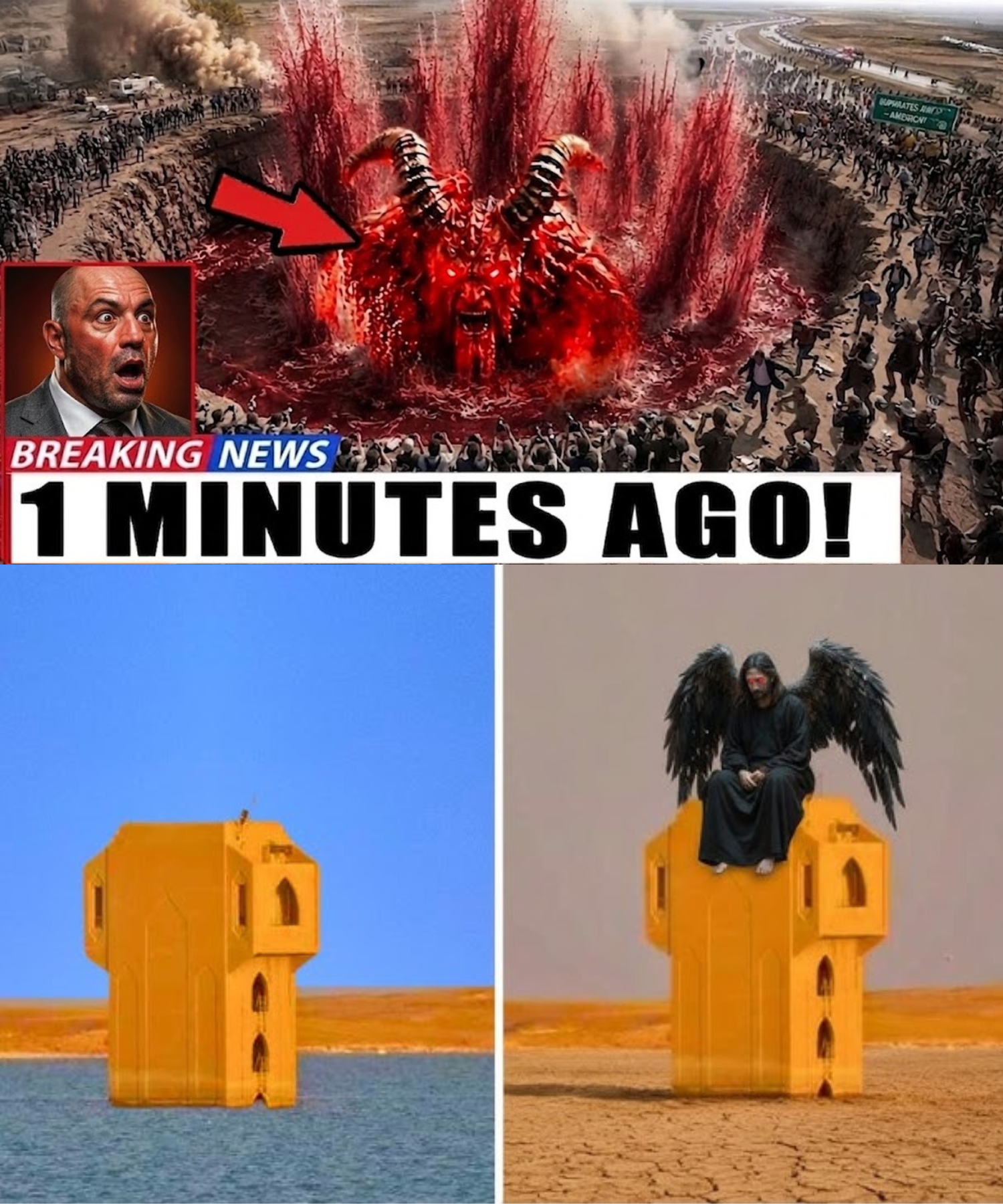
A dramatic video can become spiritual panic. A false claim can become a burden. Fear can spread faster than truth, especially when it borrows the language of scripture. If the river truly matters, then honesty matters too.
The Euphrates does not need fake angels to be terrifying.
Its real story is already immense. It is a river under pressure, flowing through lands shaped by war, drought, politics, displacement, agriculture, and ancient memory. Its decline affects real people: farmers, families, villages, economies, ecosystems, and communities that depend on water not for prophecy debates, but for survival. The drying of a great river is not merely a symbol. It is a human crisis.
That reality may be more frightening than the video.
Because if people only look for angels in the mud, they may miss the living suffering on the banks.
Still, the resurfaced footage will not disappear quickly. It has all the elements of a story people cannot resist: a forbidden river, a strange body, a prophecy, a possible cover-up, and the feeling that something ancient is returning. The more skeptics dismiss it, the more some believers will hold it tightly. The more believers promote it, the more skeptics will mock it. And in the middle, the video will keep circulating, gathering edits, music, captions, and fear.
That is how digital legends survive.
They do not need proof.
They need atmosphere.
And the Euphrates has atmosphere older than most civilizations.
The final seconds of the clip are the most haunting. The camera pulls back. The shape remains half-buried. The men keep speaking over one another. The river moves slowly nearby, not dramatic, not cinematic, just water passing through mud and history. Nothing rises. Nothing screams. No wings unfold. No angel opens its eyes. The video ends without answering anything.
That may be why it works.
A complete answer would kill the story.
An unanswered image lets it live.
So what was found in the Euphrates? The honest answer is that we do not know from the viral video alone. It may be a staged object, a damaged statue, a natural formation, or something deliberately misrepresented. It is not confirmed evidence of a fallen angel. But it has become a symbol powerful enough to make millions stop scrolling and stare.
And sometimes symbols reveal more than objects.
The fear surrounding this video reveals a world anxious about judgment. It reveals people searching ancient texts for explanations to modern collapse. It reveals distrust in institutions, hunger for mystery, fascination with prophecy, and a deep sense that something unseen is moving beneath history.
The Euphrates keeps flowing, though not as it once did.
Its banks still hold secrets, but not every secret is supernatural. Some are archaeological. Some are political. Some are environmental. Some are spiritual. Some belong to the human imagination, which can turn mud into prophecy when fear is strong enough.
The fallen angel may not be real.
But the question behind the video is.
What happens when an ancient river begins to reveal what it has been hiding?
For now, the object remains uncertain. The footage remains disputed. The prophecy remains interpreted in a thousand voices. But the feeling it created is impossible to ignore.
The Euphrates has always been a river of beginnings.
Now people are watching it as if it might also become a river of endings.