What Doctors Found Inside Saint Bernadette’s Body Suprised Everyone
In the quiet center of France, far from the coastal crowds and the industrial sprawl of the major cities, lies the town of Nethers.
It is a place of stone streets and silent history anchored by the convent of St Gildard.
For over a century, this convent has been the destination for a ceaseless stream of travelers.
They do not come for the architecture, though it is beautiful.
Nor do they come for the history of the religious order itself.
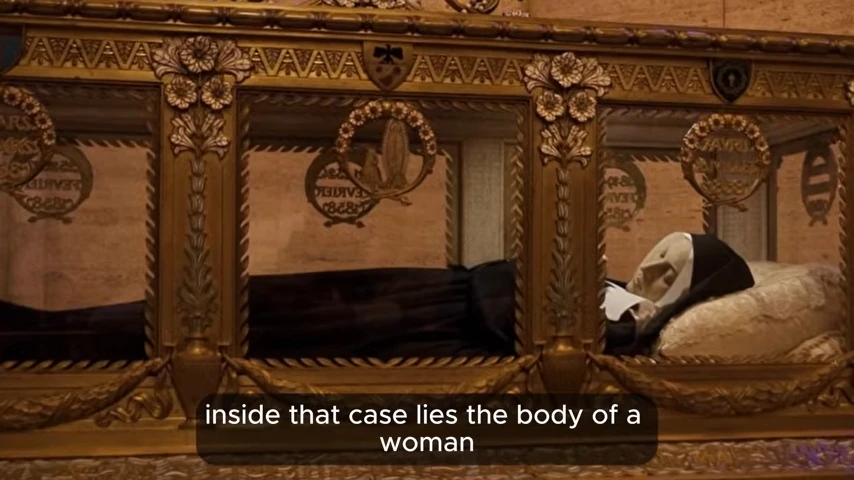
They come to stand before a glass case in the convent chapel.
Inside that case lies the body of a woman who died in 1879.

To the naked eye, she appears to be sleeping.
Her skin is smooth, her hands are clasped around a rosary, and her head tilts gently to the side.
But the story behind this repose is one of the most complex intersections of faith, biology, and history in the modern era.
To understand the mystery of these physical remains, we must first understand the end of the life that inhabited them.
It is often assumed that those regarded as holy figures in the Catholic tradition are treated with grandeur in death, buried in marble tombs, or prepared with elaborate rituals.
But for Bernardet Saurus, the opposite was true.
Bernardet arrived in Nevers in 1866, leaving behind the grotto of Lurs where she had famously reported seeing apparitions of the Virgin Mary.
She was 22 years old.
She had not come to the convent to be celebrated.
She had come seeking anonymity.
In her own words, she desired to be forgotten.
She famously compared herself to a broom used to sweep a room.
She said that once the work is done, the broom is placed behind the door and ignored.
She wanted to be that broom.
Her life within the convent walls was defined not by mystical ecstasy but by physical suffering.
Throughout her time at St Gilded, she was plagued by chronic asthma that often left her gasping for air.
Later she developed a painful tuberculosis of the bone that slowly ravaged her right knee.
By 1878 her condition had deteriorated significantly.
Her breathing was labored and her mobility was almost entirely gone.
She spent her final months in what she called her chair of torture.
Unable to lie down comfortably due to the asthma and unable to walk due to the tumor on her knee.
On April 16th, 1879, at the age of 35, Bernardet Saras died.
Witnesses at her bedside recalled that her passing was painful but peaceful.
Upon her death, the sisters of the convent prepared her body according to the strict customs of the time.
It is crucial to note for our investigation that there was no imbalming.
In late 19th century France, arterial imbalming was not a standard practice for nuns in a humble convent.
The procedure was expensive and reserved for the wealthy or the nobility.
Bernardet was neither.
Her body was simply washed and dressed in the habit she had worn in life.
She was placed in a coffin that was remarkably robust for a none of her station.
Documents from the convent archives confirm it was a double coffin.
The inner shell was made of zinc, a common metal used in France for transport or long-term storage, and the outer shell was made of oak.
This detail is vital for the pathologists and historians who would later analyze the preservation of her remains.
Zinc, when soldered shut, can create a hermetic environment.
This means it cuts off the oxygen supply that bacteria and insects require to decompose soft tissue rapidly.
However, a zinc lining alone does not guarantee preservation as the internal bacteria within a body usually begin the process of decay from the inside out almost immediately after death.
On April 19th, 1879, 3 days after her death, Bernardet was buried.
She was not placed in the main crypt with the other sisters which would have been the standard honor.
Instead, she was buried in the earth of a small chapel in the convent garden dedicated to St Joseph.
The location is significant because of the soil conditions.
The ground in this region of Navas is known to be damp.
It retains moisture, a factor that usually accelerates the decomposition of organic matter.
Water allows bacteria to thrive and compromises the structural integrity of wood and fabric.
Under normal circumstances, a body placed in such ground would undergo rapid skeletonization.
For 30 years, the grave remained undisturbed.
The seasons turned over the garden at St Gilded.
The damp earth froze in the winters and softened in the springs.
According to natural biological laws, the body inside the oak and zinc coffin should have been undergoing the inevitable process of decay.
The soft tissues should have liquefied and disappeared.
The cartilage should have dissolved.
After three decades, one would expect to find skeletal remains, perhaps some disintegrated fabric and the remnants of the wooden coffin.
By 1909, the process to beatify Bernardet was underway.
This is the first major legal step toward declaring a person a saint in the Catholic Church.
It is a rigorous procedure that functions much like a trial.
It requires a detailed investigation into the candidates’s life, virtues, and traditionally an examination of their mortal remains.
This examination is known as the canonical recognition of the body.
It is important to clarify that this process is not intended to prove a miracle.
The church does not require a body to be incorrupt to make someone a saint.
The purpose is legal and practical.
It is done to identify the remains, ensuring that the person beatified is indeed the person buried and to secure relics for future veneration.
On the morning of September 22nd, 1909, a small group gathered in the garden of St Gilded.
The atmosphere was official and somber.
This was not a public ceremony.
It was a private legal operation.
The group included Bishop Gorthy of Neas and several members of the Diosen tribunal.
Crucially, two medical doctors were present to serve as scientific witnesses.
Their names were Dr.
Jordan and Dr.
David.
Their role was to document the physical state of the remains objectively, regardless of what they might find.
The gravediggers began their work.
They removed the earth and revealed the outer oak coffin.
It showed clear signs of the passage of time.
The wood was damp and had begun to rot in places, weakened by 30 years of exposure to the wet soil.
The distinct smell of damp earth and decaying wood filled the air.
However, as they cleared away the debris, they found that the inner zinc coffin remained intact.
The heavy coffin was lifted from the grave and carried into the sacry to ensure privacy.
The witnesses gathered around.
There was likely a sense of apprehension in the room.
The sisters of the convent who held the memory of Bernardet in high regard may have feared the sight of a skeleton.
They may have feared the stark reality of death that usually greets such exumations.
The smell of an opened grave after 30 years is usually overpowering and distinct.
The workman approached the zinc coffin with shears.
The metal had to be cut.
As the shears bit into the zinc, the silence in the room would have been absolute.
The lid was carefully peeled back and removed.
Dr.
Jordan and Dr.
David leaned in to examine the contents.
The nuns stood back, waiting for the verdict.
What the doctors saw that morning was recorded in precise clinical detail.
It was not a skeleton that lay before them.
There was no smell of putrifaction.
Instead, they saw the body of Bernardet Salurus appearing almost exactly as she had when she was placed in the ground three decades prior.
This was the beginning of the mystery.
The first gaze into the coffin did not reveal the work of worms or the ravages of time.
It revealed a figure that seemed to have defied the very laws of the damp earth she had been buried in.
The doctors reached for their notebooks.
The investigation had just begun.
The sacry of St Gilded became a makeshift operating theater on that September morning in 1909.
The air was heavy with a scent of damp wood and the charcoal used in the sensors, but it notably lacked the one odor everyone had stealed themselves against.
There was no smell of death.
As Dr.
Jordan and Dr.
David leaned over the open zinc casket.
They found themselves staring into a face that history had not seen for 30 years.
Bernardet Saurus lay there, her head tilting slightly to the left, her small hands crossed over her chest, still clutching the rosary that had been placed there on the day of her funeral.
The crucifix of the rosary had tarnished and rusted, a sign of the moisture that had penetrated the coffin.
The habit she wore was damp and heavy with water absorption.
Yet amidst this environment of wet fabric and rusted metal, the body itself remained distinct.
The doctors began their examination with the rigorous skepticism required by the church tribunal.
They were not looking for a miracle.
They were looking for facts.
Dr.
David, a surgeon from Bordeaux, took the lead in the physical inspection.
He noted that the face was fully recognizable.
The skin clung to the bone structure, but it was intact.
There was no sign of the putrifaction that typically liquefies the soft tissues of the face within weeks of burial.
He observed that the skin had taken on a grayish white hue similar to the color of parchment or old chammo leather.
This discoloration is not unusual for a body that has been buried for decades, but the preservation of the tissue structure was unexpected.
The nose was thin and slightly shrunken, likely due to dehydration, yet it retained its shape.
The lips were slightly parted, revealing teeth that were still firmly set in the jaw.
The eyes of the saint were particularly compelling to the witnesses.
The eyelids were closed, but they had sunken into the orbits.
This sinking is a natural result of the fluids in the eye drying out over time.
However, the eyelids themselves were not rotted.
They were intact, sealing the eyes shut, just as they had been when she died.
Dr.
Jordan turned his attention to her hands.
In life, Bernardet had been a small woman, and in death, her hands appeared delicate.
The fingers were withered, the skin dry and wrinkled like a dried fruit, but the fingernails were still present and attached.
The doctors noted that the hands were holding the rosary with a firmness that suggested the tendons and muscles underneath the skin had not disintegrated.
They then proceeded to examine the rest of the body.
To do this, the sisters of the convent were asked to remove the damp, heavy habit.
This was a delicate task.
The fabric was wet and fragile, but as they peeled it away, they found the body underneath was emaciated but whole.
The ribs were visible beneath the skin, highlighting the physical toll her illnesses had taken on her in life.
Perhaps the most significant medical observation made that day concerned the structural integrity of the corpse.
When a body decomposes, the connective tissues that hold the skeleton together usually break down.
If you attempt to lift a skeletonized or partially decomposed body, it will often come apart.
However, when the sisters and the doctors attempted to lift Bernardet to place her on a table for cleaning, they found her body was rigid.
It moved as a single unit.
The head did not roll loosely.
The arms did not fall away.
The muscles and ligaments had dried and hardened, effectively locking the skeleton in place.
Dr.
David tapped on the chest and noted a sound that resembled tapping on cardboard or wood.
This indicated that the internal cavity was likely dry and that the internal organs had not bloated or exploded, which is a common stage of decomposition known as the active decay phase.
The sisters of the convent were permitted to wash the body.
This was an act of reverence, but it also served the purpose of removing the mold and salts that had accumulated on the skin from the damp environment of the grave.
They used warm water and cloths.
As they washed her, they reported that the skin, though hard, did not disintegrate under their touch.
For the nuns watching, this was a moment of profound spiritual validation.
They saw the preservation as a sign of divine favor, a confirmation that the woman who had suffered so much in life was being protected in death.
For the doctors, it was a biological puzzle.
Dr.
David wrote in his report that while the preservation was remarkable, he could not outright declare it supernatural based solely on a visual inspection.
He hypothesized that perhaps the zinc coffin despite the dampness had created a unique microclimate.
He considered the possibility that the body had undergone a process of natural mummification where the tissues dry out faster than they can rot.
This phenomenon is rare in the damp soil of central France.
Natural mummification usually requires extreme dryness like the sands of Egypt or extreme cold like the glaciers of the Alps.
To find a dry mummified body in a wet airtight coffin buried in moist earth was a contradiction that the medical reports acknowledged but could not fully explain.
The examination lasted several hours.
The tribunal documented every detail.
They measured the body.
They photographed it and they recorded the condition of every limb.
The report signed by both doctors concluded that the body was organized and intact without any trace of corruption or bad odor.
But the process of beatification is slow.
The church does not rush these matters.
The investigation in 1909 was only the beginning.
The body could not remain in the sacry.
It had to be returned to the earth while the legal proceedings continued in Rome.
The sisters prepared a new coffin.
This time they took extra precautions.
They lined the new zinc container with white silk and placed a mattress inside to cushion the small frame.
They dressed Bernardet in a fresh habit identical to the one she had worn.
They placed the rosary back in her hands before sealing the coffin.
A final crucial step was taken.
A document detailing the exumation and the identity of the remains was placed inside a metal tube and laid beside the body.
This was to ensure that if the grave were ever opened again, there would be no doubt about the identity of the occupant.
The zinc lid was soldered shut once more.
The wooden outer shell was screwed down.
On the evening of that same day, September 22nd, 1909, Bernardet Saurus was returned to a vault.
However, she was not put back into the damp earth of the garden chapel.
Instead, the coffin was placed in a sealed vault in the main crypt of the convent, a drier and more secure location.
The witnesses dispersed.
The doctors returned to their practices, and the nuns returned to their prayers.
The report was sent to the Vatican.
10 years would pass before the silence of the crypt was broken again.
The world outside changed dramatically in that decade.
The First World War swept across Europe, bringing with it a level of death and destruction that made the quiet repose of a single nun seemed distant.
But in 1919, as the dust of the war settled, the file on Bernardet Salurus was opened once more.
The questions regarding her preservation had not been fully answered and the requirements of the canonization process demanded a second look.
The body had survived 30 years in the damp earth.
Now the question remained, how would it fair after another decade in the crypt? Would the exposure to the air during the 1909 examation trigger the decay that had been held at bay? Or would the doctors find that time continued to have no hold over the saint of nevers? The world that emerged from the smoke of the first world war was fundamentally different from the one Bernardet Salerus had known.
Empires had fallen and the map of Europe had been redrawn.
Yet in the silent crypt of St Gilded, time had moved at a different pace.
On April 3rd, 1919, the silence was broken once again.
The beatatification process had resumed with the end of the hostilities.
The church tribunal required a second identification of the body.
This was standard procedure to ensure that the remains were still present and accounted for before any final decree could be made.
This time the exumation took place within the convent itself as the body had been moved to the crypt in 1909.
Dr.
Talon and Dr.
Kant were the medical professionals tasked with the examination.
They approached the coffin with the records from 10 years prior in hand.
They knew what had been seen in 1909, but they also knew that the body had been exposed to the air during that first examation, however briefly.
Exposure to oxygen is the great enemy of preservation.
It activates dormant bacteria and fuels oxidation, which turns tissues dark and brittle.
When the zinc coffin was opened for the second time, the doctors found that the body was essentially unchanged in terms of structure.
It had not disintegrated.
The skeleton was still fully clothed in flesh and muscle.
However, the visual appearance had shifted.
The skin, previously described as parchment colored, had darkened significantly.
It now bore a more brownish hue and patches of mildew and salt crystals were visible on the fabric of the habit and parts of the skin.
This was likely due to the humidity within the coffin and the interaction between the body and the damp clothes she had been reeri.
Despite this cosmetic deterioration, the integrity of the body remained the primary finding.
There was still no smell of rot.
The joints were still rigid.
The doctors concluded that the body remained incorrupt, a term that was becoming increasingly central to the case for her saintthood.
The coffin was recealed and Bernardet was left in the darkness of the crypt for another 6 years.
The year 1925 marked the final and most significant turning point.
The date for the beatatification of Bernardet was set.
This meant that the body would no longer be hidden in a crypt.
It was to be placed in a glass reoquaryy for public veneration.
On April 18th, 1925, the third and final exumation took place.
This was not merely an identification.
It was a preparation.
The goal was to ready the body for display and to extract relics.
In the Catholic tradition, relics, pieces of bone, hair or clothing from a saint are considered sacred and are distributed to churches around the world.
Dr.
Kant, who had been present in 1919, led this final medical procedure.
His report from 1925 is the most detailed and in some ways the most graphic of all the records we have.
It strips away any romanticized notion of what an incorrupt body looks like and presents the stark biological reality.
When the coffin was opened, the doctors noted that the darkening of the skin had progressed further.
The face, which had been pale in 1909 and brownish in 1919, was now described as having a slate gray or blackish tint.
This is a natural chemical reaction known as carbonization caused by the long-term exposure to the air trapped in the coffin.
The eyes had sunken further into the sockets and the nose had thinned to the point of being almost skeletal.
While the body was intact, it was not beautiful in the conventional sense.
Dr.
Kant was then tasked with the surgical removal of relics.
This procedure provided a unique opportunity to see beneath the dried exterior of the skin.
What he found inside stunned him more than the external preservation.
In a typical mummified body, the internal organs shrivel up and become dust or hard leather-like masses.
However, Dr.
Kant recorded that when he opened the thoracic cavity, the liver was soft.
This specific detail regarding the liver remains one of the most cited medical anomalies in the case of St Bernardet.
The doctors and the church officials were then faced with a dilemma.
The body was structurally sound and medically remarkable, but it was visually shocking.
The purpose of the reoquaryy was to inspire prayer and reflection, not fear or revulsion.
The decision was made to cover the face and hands.
This was not an attempt to deceive but a common practice in the display of relics.
A firm in Paris known for creating medical models was contacted.
They were commissioned to create a light wax mask for the face and wax coverings for the hands.
The mask was designed based on photographs of Bernardet in life and the impressions taken from her face during the exumation.
It was intended to sit directly over her skin, softening the harsh reality of the mummification while retaining the true form of the saint beneath.
As the doctors finished their work, they wrapped the body in padding to support the limbs and dressed her in a pristine habit.
The body, now holding the appearance of a sleeping woman, thanks to the wax coverings, was prepared for its final transfer.
The third exumation concluded the era of investigation.
The doctors had done their job.
They had documented the anomaly of the liver.
They had confirmed that after 46 years, including three burials and significant handling, the body of Bernardet Salerus had refused to return to dust.
Now the focus shifted from the medical to the public.
The body was about to be moved into the light of the convent chapel where it would face its most enduring test, the gaze of millions of pilgrims.
But before we step into the chapel, we must pause to analyze the medical evidence more deeply.
Was this truly inexplicable? Or can modern science offer a solution to the riddle of the soft liver and the preserved skin? The sight of St Bernardet in her glass coffin is undeniably moving.
She appears peaceful, untouched by the violence of death.
However, as we have established, what the pilgrim sees today is a curated image, a body preserved by nature but failed by wax.
To truly understand what happened in the grave at Nevers, we must step back from the spiritual interpretation and apply the cold lens of forensic science.
We must ask is the preservation of Bernardet Sberus scientifically impossible or is it a rare but natural outlier? To answer this we have to look at how human decomposition works.
When a person dies, the heart stops and the blood settles.
Almost immediately, the body’s internal chemistry changes.
cells begin to break down, releasing enzymes that digest the tissue from the inside out.
This process is calledis.
Simultaneously, the bacteria in the gut, no longer held in check by the immune system, begin to multiply and consume the organs.
This is putrifaction.
In a typical burial, especially in damp soil like that of nevers, this process is accelerated.
Moisture acts as a highway for bacteria.
It softens the skin and invites insects.
A body in a wooden coffin in wet ground usually becomes a skeleton within 5 to 10 years.
So why didn’t this happen to Bernardet? The first factor to consider is the coffin.
The doctors in 1909 and 1919 placed great emphasis on the zinc lining.
Zinc is a heavy metal.
When the coffin was soldered shut in 1879, it likely created an anorobic environment, meaning one without oxygen.
Without a constant supply of fresh oxygen, many of the bacteria and fungi that drive rapid decomposition cannot survive.
The decay process stalls.
However, the anorobic theory has a flaw.
The doctors noted that the rosary was rusted and the habit was damp.
This proves that moisture did get inside the coffin.
If moisture could get in, the seal was not perfect.
Yet, the body did not rot.
This suggests that something else was at play.
This brings us to the theory of adiposa.
This is a phenomenon often seen in bodies buried in cold, damp, and anorobic conditions.
It is sometimes called grave wax.
In this process, the body’s fat turns into a soapy waxy substance that is resistant to bacteria.
It creates a shell that can preserve the shape of the body for decades or even centuries.
Did Bernardet undergo this transformation? The description of her skin in 1909 parchment colored and dry does not perfectly match the description of Adiposa, which is usually white, crumbly, and greasy.
Instead, her body seemed to have undergone a form of natural mummification.
Her tissues had dehydrated and hardened.
This leads us to the most perplexing piece of evidence, the liver.
Recall Dr.
Kant’s report from 1925.
He stated that the liver was soft and almost normal inconsistency.
This is the detail that keeps forensic pathologists up at night.
In mummification, organs dry out.
In decomposition, they liquefy.
For a liver to remain soft and intact after 46 years is medically extraordinary.
The liver is essentially a sponge filled with blood and enzymes.
It is usually one of the first organs to dissolve.
Some skeptics argue that perhaps the doctor was mistaken, or that what he felt was not fresh tissue, but a specific type of decomposition sludge that retained some form.
But Dr.
Kant was a surgeon.
He knew what a liver felt like.
His surprise was genuine, and his report was sworn.
We must also address the criticism that the body was imbalmed.
There are rumors that the nuns secretly treated the body, but historical records are clear.
No imbalming took place.
Furthermore, the chemicals used in 1879 arsenic and mercury would have left distinct traces that were not observed.
The preservation appears to be endogenous, meaning it came from the body itself or its immediate environment, not from artificial chemicals.
So where does science leave us? It leaves us with a rare convergence of factors.
We have a body with very low body fat.
Bernardet was small and emaciated from tuberculosis.
A low-fat body has less fuel for bacteria.
We have a zinc coffin that while not perfect likely limited insect activity and oxygen flow.
And we have the specific albeit damp soil chemistry of never which may have interacted with the zinc to create a unique preservative atmosphere.
But even with all these factors, the preservation is exceptionally high quality.
Most bodies in these conditions would be covered in mold or partially skeletonized.
Bernardet was not.
Science can explain parts of the puzzle.
It can explain the drying of the skin.
It can explain the lack of insects, but it struggles to fully explain the soft liver or the lack of odor after the initial opening.
In the world of forensic science, this is classified as an anomaly.
It is not impossible, but it is statistically highly improbable.
It is this gap, the space between the probable and the actual that allows for the spiritual interpretation.
The church does not claim the preservation is a miracle in the strict sense.
They do not say it violates the laws of physics.
They say it is a sign.
In the end, the scientific verdict is one of respect for the unknown.
We can list the variables zinc, temperature, body mass, bacteria, but we cannot fully replicate the result.
We cannot say with 100% certainty why Bernardet Sairus did not decay.
We can only observe that she didn’t.
The wax mask that covers her face today is a symbol of this boundary.
Beneath the wax lies the reality a dried darkened face that has survived the century.
Above the wax lies the image of the saint serene and sleeping.
Both are true.
The science and the faith exist in the same space, separated only by a thin layer of wax.
As we move to the final part of our documentary, we will leave the laboratory and enter the chapel.
We will look at what this body means to the millions who visited and how the legacy of the little saint of Lurs has outlived the medical debates.
Today, the journey of Bernardet Sberus concludes in the main chapel of the convent of St gilded inevers.
The damp earth of the garden and the darkness of the crypt have been left behind.
They have been replaced by light and gold.
To the right of the altar lies the body that has been the subject of our investigation.
She is encased in a reoquaryy of bronze and crystal.
She is dressed in the habit of the sisters of charity and her head rests on a pillow embroidered with violets.
To the observer standing a few feet away, the medical realities of the exumations are invisible.
The darkened skin is hidden beneath the thin layer of wax applied in 1925.
The wax mask does not hide the truth so much as it translates it.
It softens the reality of death into an image of peace that the human mind can comprehend.
It is here that the scientific and the spiritual finally diverge.
For the skeptic, the body behind the glass is a biological curiosity.
It is a rare instance of natural preservation aided by a sealed environment and body composition.
For the believer, the preservation is a sign.
The Catholic Church does not officially declare the preservation itself to be a miracle.
In the same way, it declares a sudden healing.
Instead, the church views the condition of St Bernardet as a witness.
It is seen as a reflection of her inner purity and a tangible connection between the physical world and the spiritual promise of the resurrection.
There is a profound irony in this display.
Bernardet was a woman who spent her entire life trying to disappear.
She famously said she wanted to be like a broom that is placed behind the door when this sweeping is done.
Yet history has refused to let her stay behind the door.
She is now one of the most visible women in history.
Her body is gazed upon by thousands of people every year.
Pilgrims come to Nevers not just to see a preserved corpse, but to be near the woman who spoke to the Virgin Mary.
The story of the incorrupt body of St Bernardet is not just a story about what happened to a corpse in a coffin.
It is a story about the human need for permanence.
We live in a world where everything decays.
To see something that has resisted this universal law strikes a deep chord in the human psyche.
As we leave the chapel, we are left with the final image of the little saint of Lurs.
She lies in her glass coffin suspended between the history of the 19th century and the reality of the 21st.
The doctors have closed their notebooks.
The faithful have lit their candles.
Bernardet Sberus remains silent.
It is a silence that speaks louder than the medical reports.
She remains a humble witness to a mystery that is larger than herself.