This 20,000-Year-Old Oregon Discovery Just Shattered Human History!
This 20,000-Year-Old Oregon Discovery Just Shattered Human History!
The discovery did not come from a palace, a pyramid, or a lost city. It came from Oregon’s high desert, where a few stone flakes, ancient animal teeth, and buried layers of ash are forcing scientists to rethink one of the biggest stories ever told about the first Americans.
For decades, the old version of human history in North America sounded clean and confident. People crossed from Asia into the Americas near the end of the Ice Age, moved south through an opening between massive ice sheets, and spread across the continent around 13,000 years ago. Their tools became known as Clovis points, and for a long time, “Clovis-first” was treated almost like a historical law.
Then Oregon began breaking that law.
In the dry, lonely landscape of eastern Oregon, far from Portland’s city lights and the green postcard forests most people associate with the state, archaeologists have uncovered evidence suggesting humans may have been living there more than 18,000 years ago. That date does not merely add a few centuries to the timeline. It pushes human presence in the American West thousands of years deeper into the Ice Age, into a world of extinct camels, ancient bison, volcanic ash, harsh winds, and landscapes that would look almost alien to modern eyes.
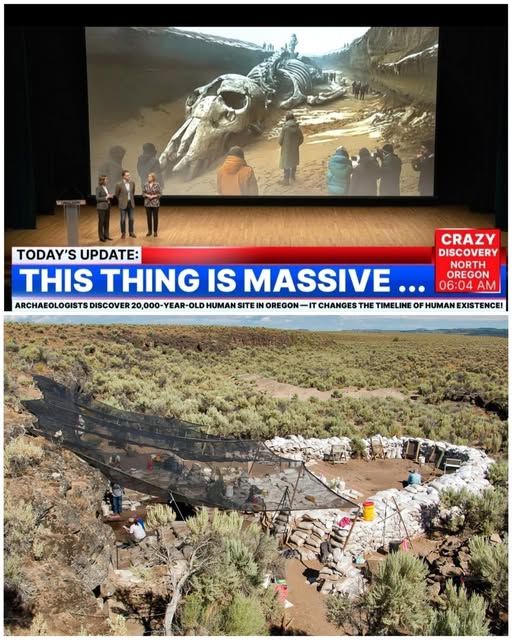
The site at the center of the controversy is Rimrock Draw Rockshelter, near Riley, Oregon. It is not spectacular at first glance. No towering ruins. No carved faces. No golden relics. Just a rock shelter in the high desert, the kind of place a person might walk past without realizing the ground beneath their feet could contain one of the oldest chapters of human life in North America.
But archaeology often changes history through small things.
A flake of stone.
A tooth fragment.
A layer of ash.
A tool buried where no tool should be.
At Rimrock Draw, researchers found stone artifacts and ancient animal remains in deeply buried layers. The key detail is context. Some of the evidence appears below volcanic ash linked to a Mount St. Helens eruption more than 15,000 years old. Other dating from associated animal tooth enamel has produced an age around 18,250 years. That does not prove every dramatic headline claiming “20,000 years” in the strongest possible sense, but it pushes the conversation dangerously close to that older window.
And that is enough to shake the old story.
If people were in Oregon more than 18,000 years ago, then the first Americans were not simply late arrivals rushing through an ice-free corridor after the glaciers opened. They were already moving, surviving, hunting, gathering, making tools, and adapting to the far western landscapes of North America while the continent was still shaped by ice, megafauna, and climate instability.
That changes everything.
It means Clovis was not the beginning.
It was one chapter in a much older book.
The Oregon evidence also connects to another famous site: Paisley Caves. There, researchers found coprolites—ancient dried feces—that produced human DNA evidence dated to around 14,300 years ago. It may sound strange that fossilized waste could become one of the most important archaeological discoveries in the Americas, but in science, glamour matters less than proof. Human biological evidence, preserved in the right context, can speak louder than a spear point.
Paisley Caves helped show that people were present in Oregon before Clovis. Rimrock Draw may push that presence even earlier.
Together, they suggest Oregon was not a forgotten edge of the Ice Age world.
It may have been one of its key corridors.
For years, the peopling of the Americas was often imagined as a single great movement through an inland ice-free corridor. But evidence from across the Americas has complicated that picture. Sites older than Clovis suggest that humans arrived earlier, moved in different ways, and adapted to more environments than the old model allowed. One increasingly important possibility is the Pacific coastal migration route.
Instead of waiting for an inland corridor to open, early people may have moved along the Pacific coast, using shorelines, boats, kelp forests, estuaries, and marine resources. The problem is that much of that ancient coastline is now underwater because sea levels rose after the Ice Age. If early communities lived along the coast, many of their camps may be submerged beneath the Pacific, hidden from ordinary archaeology.
That makes inland sites like Rimrock Draw even more important.
They may be surviving windows into a larger human movement whose coastal evidence has been drowned by time.
Imagine the Oregon high desert 18,000 years ago. The climate was different. The animals were different. Human groups would have been small, mobile, and deeply skilled. They knew how to read the land, follow water, track animals, find stone, make tools, process hides, and survive cold nights under a sky untouched by modern light. These were not primitive wanderers stumbling accidentally through the continent. They were experts in survival.
A stone flake from such a place is not just debris.
It is evidence of a decision.
Someone chose the stone. Someone struck it. Someone made an edge. Someone needed that edge for cutting, scraping, butchering, shaping, or survival. That single action, preserved under layers of sediment, crosses 18,000 years and places a human hand back into the landscape.
That is the quiet power of archaeology.
It turns forgotten gestures into evidence.
The animal remains deepen the story. Camel and bison fragments connect the site to the vanished Ice Age world. North America once had camels, horses, mammoths, giant ground sloths, saber-toothed cats, and other animals that disappeared near the end of the Pleistocene. If humans were present in Oregon during this period, they were not living in the world we know. They were sharing the land with creatures that would later become ghosts in the fossil record.
That raises one of archaeology’s most difficult questions: what role did humans play in the disappearance of Ice Age megafauna?
The answer is debated. Climate change was enormous. Ecosystems were shifting. Human hunting may have added pressure. Disease, habitat change, and cascading ecological effects may all have contributed. But earlier human dates matter because they change the timeline of interaction. If people were present thousands of years before Clovis, then humans and megafauna may have lived alongside one another for longer than once assumed.
That makes the extinction story more complicated.
And history becomes more honest when it becomes more complicated.
The Rimrock Draw evidence also matters because it challenges how confidently old academic models were once defended. For much of the 20th century, evidence older than Clovis was often treated with suspicion. Some skepticism was necessary; archaeology depends on careful dating, stratigraphy, and context. But the strength of the Clovis-first model sometimes made researchers slow to accept older sites. Evidence that did not fit the model could be dismissed too quickly.
Now the model has changed.
Not because one site destroyed it overnight, but because multiple sites kept pushing back.
Oregon is part of that larger shift.
Paisley Caves showed humans were there around 14,300 years ago. Rimrock Draw suggests even earlier occupation. Other pre-Clovis sites across North and South America have added pressure. The result is a new picture of the first Americans: older, more mobile, more diverse, and more adaptable than the textbook version once allowed.
This is why the phrase “shattered human history” feels dramatic but not meaningless.
The discovery does not rewrite all of human history in one strike. It does something more precise: it shatters a simplified timeline of the Americas. It breaks the idea that the first human story here began neatly at Clovis. It forces us to imagine generations of people living, moving, adapting, and dying in North America long before the old consensus permitted them to exist.
And every extra thousand years matters.
A thousand years is not a footnote. It is dozens of generations. It is grandparents telling stories to children who become grandparents themselves. It is migrations, births, deaths, marriages, memories, tools, camps, routes, songs, and knowledge passed across landscapes.
If people were in Oregon more than 18,000 years ago, then countless human lives existed before the chapter we once called the beginning.
That realization should humble everyone.
It also connects powerfully with Indigenous histories. Many Native traditions speak of deep presence on the land, of ancestors who witnessed floods, volcanic events, animals, and transformations in the world. Scientific dating and oral tradition are not the same kind of evidence, but they can speak to one another with respect. As archaeology pushes the timeline deeper, it increasingly challenges the outdated idea that Indigenous presence in the Americas was shallow or recent.
The land has memory.
So do its peoples.
Discoveries like Rimrock Draw remind modern readers that North America was not empty wilderness waiting for history to begin. It was already lived in, understood, named, traveled, and remembered by people whose descendants remain part of the continent’s living story.
The scientific work is still careful. Archaeologists must test every claim. They must rule out contamination, disturbed layers, misidentified stones, dating problems, and natural processes that can confuse interpretation. That caution is not weakness. It is what makes the discovery meaningful. A claim this old must survive scrutiny.
But the evidence keeps growing stronger.
The artifacts are not floating loose in meaningless dirt. They come from layers with geological context. The animal remains help anchor the age. The volcanic ash provides a chronological marker. The broader regional record supports the possibility of early occupation. And Paisley Caves already demonstrated that Oregon held pre-Clovis human presence thousands of years before the old model expected.
The result is not wild fantasy.
It is a serious challenge.
There is another reason the Oregon discovery fascinates people: it comes from a landscape that still feels ancient. The high desert does not soften itself for visitors. It is open, dry, rugged, and exposed. Wind moves across sagebrush. Light strikes rock in harsh angles. At night, the sky opens with a kind of silence modern cities have almost erased. It is easy to imagine ancient people there because the land still carries a sense of survival.
A rock shelter in such a place is not just a shelter. It is a decision point. A place to rest. A place to process food. A place to watch the land. A place to survive weather. A place where small human groups may have returned again and again because the site offered protection and access to resources.
That is what makes the evidence feel intimate.
Not a grand monument.
A camp.
A working edge of stone.
A trace of food.
A human presence under ash.
Sometimes the oldest history is not monumental. Sometimes it is quiet enough to fit in the palm of a hand.
The discovery also reveals how much remains unknown. If Oregon holds sites older than 18,000 years, how many more are still buried? How many were destroyed before anyone knew to look? How many lie under private land, desert sediment, collapsed caves, or lakebeds? How many coastal sites are now underwater? How many museum collections already contain overlooked artifacts waiting for new methods to reveal their age?
Archaeology is not finished.
It is barely keeping up with the questions.
Each new dating method, each new excavation, each new collaboration with Indigenous communities, each new technology brings the possibility that the timeline will shift again. What seems shocking today may become normal tomorrow. That is how knowledge grows. Not by protecting old models at all costs, but by allowing evidence to force better questions.
Rimrock Draw asks one of the biggest questions of all:
How early were people really here?
The answer may not stop at 18,000 years.
It may move closer to 20,000.
Maybe beyond.
But the goal is not to chase the oldest possible headline. The goal is to understand the real human story: when people arrived, how they moved, what routes they used, what environments they adapted to, how they interacted with animals, how they survived climate upheaval, and how their descendants carried memory forward.
That story is bigger than a date.
Still, dates matter because they open the door.
Fourteen thousand years ago was already revolutionary.
Eighteen thousand years ago is even more disruptive.
Twenty thousand years would force an even deeper rethinking.
The Oregon evidence sits in that charged space between what is already proven and what may soon become harder to deny. It tells us the old timeline was too small. It tells us the American West was part of a deep human story. It tells us that people were here in an Ice Age world that science is still reconstructing piece by piece.
And maybe that is why the discovery feels so powerful.
It does not merely tell us humans arrived earlier.
It tells us we underestimated them.
We underestimated their mobility.
Their resilience.
Their intelligence.
Their ability to survive landscapes that would terrify most modern people.
Their ability to make a life in a world of ice, ash, camels, bison, and uncertain seasons.
The people of ancient Oregon did not know they were making history. They did not know future scientists would debate their tools, dates, and traces. They did not know their presence would one day challenge an entire model of migration. They were simply living.
That may be the most moving truth of all.
Human history is not made only by kings, cities, wars, and monuments. It is also made by people who stopped under a rock shelter, struck stone, processed food, watched the weather, and survived another day.
Thousands of years later, their smallest traces are speaking loudly enough to shake the world.
The old story said humans arrived late.
Oregon says: look again.
The old story said Clovis was first.
Oregon says: there were others before.
The old story said the beginning was simple.
Oregon says: the beginning was deeper, older, and far more human than we imagined.
And beneath the dust of the high desert, more answers may still be waiting.