They Drained a Lake Near Stonehenge — and Found the Stones It Was Copied From
They Drained a Lake Near Stonehenge — and Found the Stones It Was Copied From
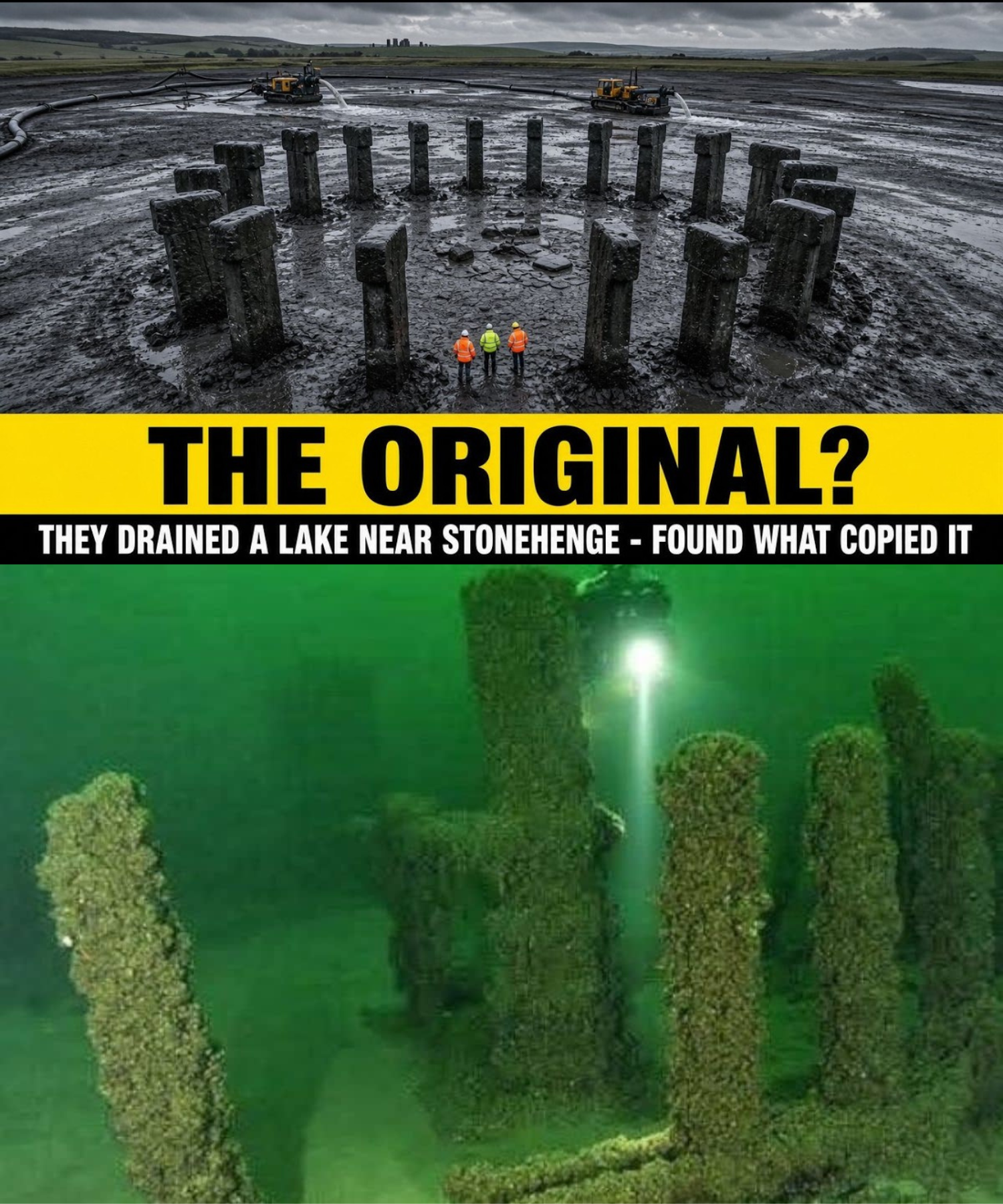
The story sounded impossible at first: water pulled back, mud split open, and beneath the surface lay the ghost of a monument older than Stonehenge itself.
For centuries, Stonehenge has stood on Salisbury Plain like a question made of stone. No matter how many times archaeologists measure it, scan it, dig around it, or explain part of its construction, the monument refuses to become ordinary. It remains one of the most famous prehistoric sites on Earth, a ring of stones that seems to hold the silence of an ancient people who left no written explanation behind.
But the newest twist in the Stonehenge story is not simply about how the stones were raised. It is about whether Stonehenge was truly original.
What if the monument the world knows was not the beginning?
What if it was a copy, a relocation, or a sacred memory rebuilt hundreds of miles away?
That is the idea that has shaken the archaeology of Stonehenge in recent years. The dramatic version says a lake was drained and the stones it was copied from were found. The real story is more complicated, but no less astonishing. Archaeologists did not uncover a perfect second Stonehenge sitting under a vanished lake beside Salisbury Plain. Instead, they found something arguably more powerful: evidence that the bluestones at Stonehenge may have come from an older sacred landscape in Wales, and that part of Stonehenge’s identity may have been carried from one place to another like a portable ancestral world.
To understand why this matters, we have to begin with the stones themselves.
Stonehenge is built from two main types of stone. The massive outer stones are sarsens, a type of sandstone likely sourced closer to the monument. But the smaller inner stones, the famous bluestones, are different. They came from far away—around 140 to 180 miles from Salisbury Plain, from the Preseli Hills of west Wales. That fact alone is extraordinary. In a world without wheels, engines, cranes, or metal machinery, Neolithic people somehow transported multi-ton stones across rivers, valleys, hills, and open country.
For a long time, that was mystery enough.
Why move stones so far?
Why not use only local stone?
Why choose these particular rocks?
The answer may lie not only in geology, but in memory.
In Wales, archaeologists identified ancient quarry sites linked to some of Stonehenge’s bluestones, including Craig Rhos-y-felin and Carn Goedog. These were not random outcrops. The evidence suggests people extracted stones from these locations in the Neolithic period. That means the bluestones were not simply glacial rocks picked up casually by builders in southern England. They were likely chosen, quarried, and carried by human beings with purpose.
That purpose becomes even more haunting when we look at Waun Mawn.
Waun Mawn is a site in the Preseli region of Wales where archaeologists found evidence of a large prehistoric stone circle. Only a few stones remain standing or lying today, but excavation revealed stone holes where other monoliths once stood. The circle may have been dismantled. Even more provocatively, one of the stone holes at Waun Mawn appears to match the shape of a bluestone at Stonehenge in a way researchers compared to a key fitting into a lock.
That image changed everything.
A stone removed from one circle.
A hole left behind.
A matching stone standing later at Stonehenge.
Suddenly, the old question became sharper: did the builders of Stonehenge move stones from an earlier Welsh monument and rebuild them on Salisbury Plain?
If so, Stonehenge was not merely constructed.
It was inherited.
This possibility transforms the monument from an engineering puzzle into a human story of migration, memory, and identity. Imagine a community leaving one sacred landscape and traveling east. They do not leave everything behind. They take stones. Not because stones are practical. They are not. They are heavy, stubborn, dangerous, and difficult to move. They take them because the stones mean something.
The stones may have represented ancestors.
They may have marked sacred ground.
They may have embodied clan identity.
They may have carried the authority of an old homeland into a new world.
That is a very different picture from the popular image of Stonehenge as a mysterious standalone temple built by anonymous people for unknown reasons. In this view, Stonehenge becomes a monument of movement. A monument of people carrying their past with them. A sacred relocation project that joined two distant regions through stone.
The “drained lake” version of the story may be an exaggeration, but the emotional truth behind it is powerful: something hidden beneath the landscape has been revealed, and it suggests Stonehenge may have been built from the memory of another place.
This is not the only recent discovery reshaping the Stonehenge landscape. Archaeologists have also studied the Durrington pit circle, a huge ring of deep pits near Durrington Walls, not far from Stonehenge. The scale is staggering: pits several meters deep, arranged in a vast circuit over a mile wide. For a time, some experts wondered whether the pits might be natural. More recent research strengthened the argument that they were human-made.
That discovery matters because it shows Stonehenge was not alone.
It was part of a huge ceremonial landscape.
There were timber circles. Burial mounds. Processional routes. Settlement areas. Earthworks. Pits. Waterways. Sacred alignments. The monument tourists visit today is only the most famous visible piece of a much larger Neolithic world.
When we say “Stonehenge,” we often imagine one ring of stones.
The ancient builders may have understood it as a whole landscape of the living, the dead, the ancestors, the sun, the seasons, and the journey between worlds.
That makes the possibility of a copied or relocated monument even more fascinating. If the bluestones came from an earlier circle in Wales, then Stonehenge may have been a fusion of landscapes: Welsh stones placed into an English ceremonial world. It may have united distant communities. It may have marked a political alliance. It may have helped migrants preserve ancestral identity. It may have been a sacred act of rebuilding.
And perhaps, to the people who moved the stones, it was not a copy at all.
It was a continuation.
Modern people tend to think of sacred sites as fixed. A church is built in one place. A temple belongs to one hill. A grave belongs to one cemetery. But ancient people often treated sacred objects, bones, relics, and stones as portable carriers of power. If a community moved, the sacred could move with them. The stone was not just material. It was presence.
That may explain why the builders would endure the impossible labor of transporting bluestones across such distance. They were not hauling rocks.
They were carrying a world.
This idea also adds a deeply human layer to Stonehenge. The monument is often discussed through technical questions: How were the stones moved? How were they raised? How were they aligned? What tools were used? How many workers did it take? These questions matter, but they can make the builders seem like an engineering problem rather than living people.
The Welsh connection restores emotion.
People moved those stones for reasons strong enough to exhaust bodies, organize labor, cross landscapes, and reshape memory. They may have sung while dragging them. They may have mourned people buried near them. They may have told children stories about where the stones came from. They may have believed the stones were alive with ancestral force.
If Stonehenge was copied from, inspired by, or partially relocated from an earlier monument, then it becomes a story about loss as much as construction.
Why was the old circle dismantled?
Why were some stones removed?
Did people leave willingly?
Were they migrating because of social pressure, climate, conflict, alliance, marriage, or spiritual calling?
Did they believe they were preserving the old sacred center, or replacing it with something greater?
These questions are difficult to answer, but they make the monument feel less like an alien object and more like a trace of real human drama.
The popular imagination loves the idea that Stonehenge was built by druids, giants, lost civilizations, or supernatural beings. Those theories survive because the monument feels too strange to belong to ordinary people. But the real discoveries are more moving. Stonehenge was built by human beings with patience, skill, belief, and social organization far greater than modern arrogance once allowed.
They understood stone.
They understood landscape.
They understood timing.
They understood the power of gathering people around a shared sacred project.
The fact that they left no written explanation does not mean they lacked intelligence. It means they spoke through monuments instead of manuscripts.
Stonehenge was their text.
The landscape was their page.
The stones were their sentences.
When archaeologists uncover evidence of earlier stone circles, quarry sites, or enormous pit structures, they are learning how to read that text more carefully. The meaning is still incomplete, but the grammar is becoming clearer. Stonehenge was not a random pile of giant rocks. It was constructed through choices layered across generations.
The bluestones may have arrived first.
The sarsens came later.
The monument changed form.
The landscape around it changed too.
This long development matters. Stonehenge was not built in a single afternoon of prehistoric genius. It evolved. It was modified, rearranged, repaired, and reimagined. That suggests its meaning may have changed over time. A place that begins as one kind of ritual center may become another. A circle of stones may become a burial place, then a solar monument, then a symbol of unity, then a memory of origins.
The possible Waun Mawn connection fits beautifully into this larger picture. It suggests Stonehenge may have begun with borrowed sacred power—a transplant from one ancestral landscape into another.
That does not make Stonehenge less original.
It makes it more alive.
Human culture works this way. We inherit, move, adapt, rebuild, reinterpret. Churches are built on older shrines. Cities are built on older settlements. National identities form from migrations and memories. Families carry objects across oceans because those objects hold the old home inside them. The Neolithic builders may have done something similar with stones.
A stone from Wales placed in Salisbury Plain could become a bridge between past and future.
This is why the story grips people even when the “drained lake” detail turns out to be more legend than verified archaeology. The underlying idea is true enough to shock: archaeologists have found evidence that Stonehenge’s stones came from a distant sacred landscape, and possibly from an earlier stone circle. The world’s most famous stone circle may preserve the bones of another.
That is an extraordinary thought.
It means Stonehenge is not only a monument.
It is a memory of a monument.
The discovery also challenges how we think about prehistoric Britain. These communities were not isolated tribes trapped in small local worlds. They had connections across long distances. They moved materials, ideas, symbols, and perhaps people across Britain. The transport of the bluestones reveals networks of cooperation or authority that must have been powerful. Whether the stones were dragged, carried, floated, or moved through combined methods, the project required planning on a scale that still commands respect.
This was not primitive chaos.
This was organized sacred labor.
And if the Altar Stone at Stonehenge came from even farther away, possibly from northeast Scotland as recent studies have suggested, then Stonehenge may represent connections across even more of Britain than previously imagined. The monument may have been a national-scale sacred project long before Britain was a nation.
That possibility is breathtaking.
Stonehenge may have gathered stones from distant regions to create a center of unity, ritual, ancestry, or power. Its builders may have been doing in stone what later societies did through crowns, flags, temples, and capitals: creating a shared symbol large enough to bind separate peoples together.
If that is true, then Stonehenge was not copied because its builders lacked imagination.
It was copied because memory mattered.
It was rebuilt because origins mattered.
It was assembled from elsewhere because elsewhere had to be brought into the center.
The mystery is no longer only how they moved the stones.
It is why the stones were worth moving.
That question may never have one final answer. Stonehenge has survived precisely because it keeps its secrets well. Each generation brings new tools and new theories. Some ideas will fall. Others will deepen. What once seemed impossible becomes plausible. What once seemed certain becomes uncertain. The monument remains, not because it gives easy answers, but because it forces better questions.
The story of a drained lake revealing the stones Stonehenge was copied from may be dramatic mythmaking. But the real archaeology is powerful enough without exaggeration. In Wales, an earlier stone circle may have stood before Stonehenge took shape. In the Preseli Hills, the bluestones were quarried. On Salisbury Plain, those stones were set into a new sacred landscape. Near Stonehenge, enormous pits and earthworks show that the entire region was alive with ritual activity.
Taken together, the evidence points to a world more connected, more ambitious, and more spiritually complex than many people once imagined.
Stonehenge was not built by people staring blankly at the sky with no plan.
It was built by people who understood that stone could hold memory.
And that may be the most haunting discovery of all.
When we look at Stonehenge today, we may not be looking at the first version of a sacred idea. We may be looking at the second life of an older monument, carried across Britain by people who refused to leave their ancestors behind.
The stones are silent.
But perhaps they are not mute.
They may still be saying where they came from.
They may still be carrying the shape of a lost circle in Wales.
And if the archaeologists are right, then Stonehenge is not only a wonder of ancient engineering. It is proof that long before written history, people were already doing something profoundly human: taking the sacred pieces of one home and building another.