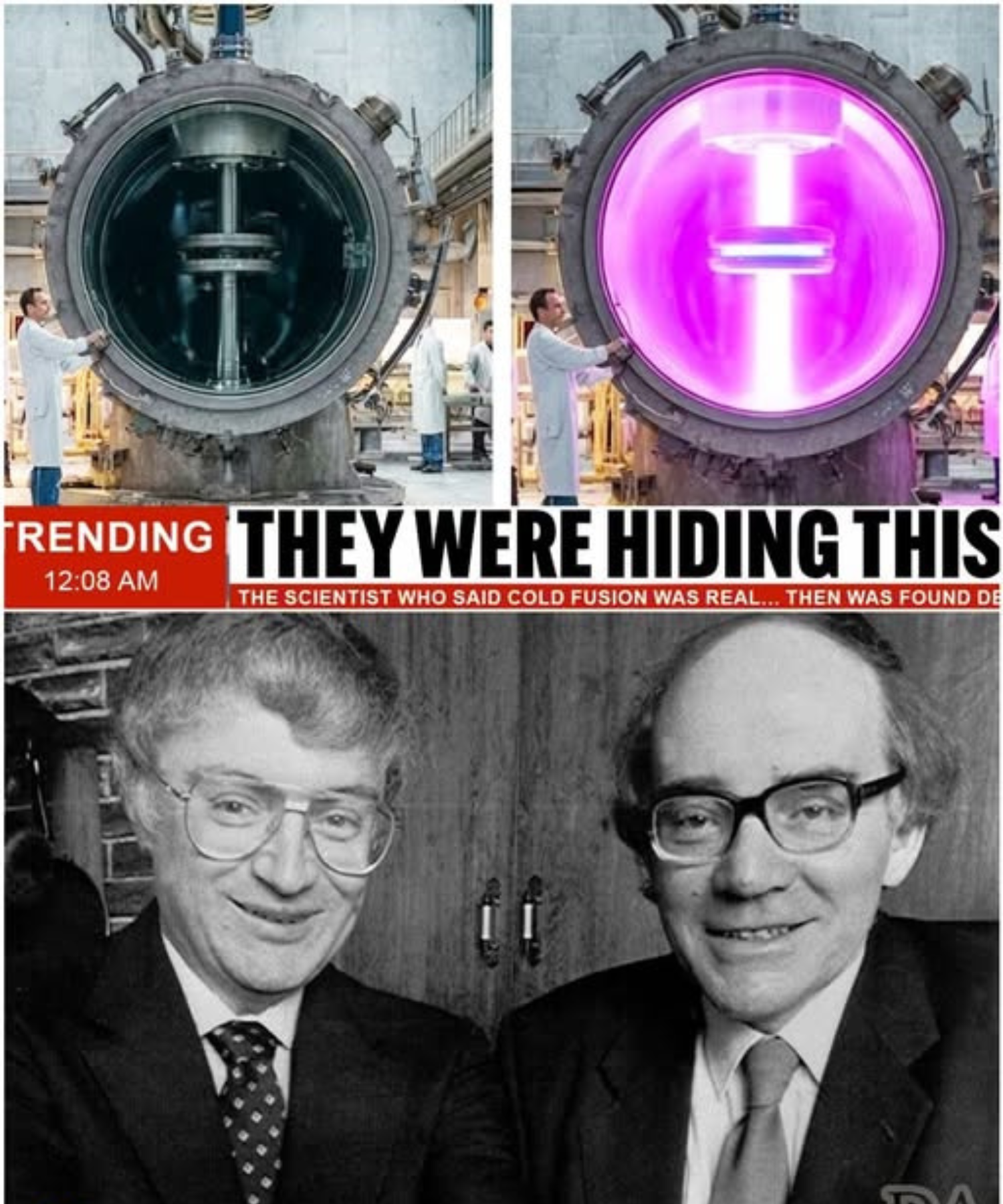
The Scientist Who Said Cold Fusion Was Real… Then Was Found Dead
EUGENE MALLOVE EXPOSED COVER UP THEN BRUTALLY KILLED IN MYSTERY
In the shadowed corridors of scientific power where careers are made and broken with a single peer-reviewed paper, one man dared to challenge the unbreakable consensus.
Eugene Franklin Mallove, a brilliant MIT-trained scientist and relentless truth-seeker, stood alone against the titans of mainstream physics.
He proclaimed to the world that cold fusion—the holy grail of unlimited clean energy—was not only possible but had already been achieved.
For years he fought, published, and exposed what he called a deliberate conspiracy of silence.
Then, on a quiet spring evening in 2004, he was found beaten and bloodied in the driveway of his childhood home, his life extinguished in a frenzy of violence that still fuels dark suspicions today.
The story of Eugene Mallove reads like a thriller ripped from the pages of forbidden knowledge.
Born in 1947 in Norwich, Connecticut, Mallove displayed an insatiable curiosity from childhood.
He earned degrees from MIT in aeronautical and astronautical engineering and a doctorate from Harvard in environmental health sciences.
His early career sparkled with promise: work at prestigious labs, groundbreaking papers on interstellar travel including solar sails to reach Alpha Centauri, and a role as chief science writer at MIT’s news office.
He seemed destined for the inner circle of elite academia.
Everything changed in March 1989 when two chemists, Stanley Pons and Martin Fleischmann, announced they had achieved nuclear fusion at room temperature in a simple tabletop experiment using palladium electrodes and heavy water.
The implications were staggering: clean, abundant energy that could end fossil fuel dependence, solve climate crises, and power humanity into a new golden age without the deadly radiation or massive infrastructure of hot fusion reactors.
The world held its breath.
Labs raced to replicate.
Headlines screamed of a scientific revolution.
Then, almost as quickly, the dream collapsed.
Mainstream physicists declared the results irreproducible.
Skeptics ridiculed the claims as junk science.
Funding dried up.
Careers were ruined.
Pons and Fleischmann became pariahs.
But Mallove, positioned at the heart of MIT, smelled something rotten.
As he dug deeper, he became convinced that the dismissal was not based on honest science but on institutional self-preservation.
Hot fusion programs, sucking billions in government grants for decades with little practical progress, faced an existential threat from this cheap, decentralized alternative.
In 1991, Mallove published his bombshell book Fire from Ice, meticulously documenting evidence that cold fusion experiments had indeed produced excess heat—sometimes far beyond chemical explanations.
He accused MIT researchers of manipulating data in their replication attempts to show negative results, protecting their own funding streaMs. The book sent shockwaves.
Mallove resigned from his MIT position in protest, burning bridges with the establishment he once served.
He founded Infinite Energy magazine and the New Energy Foundation, turning himself into the loudest, most articulate champion of low-energy nuclear reactions (LENR), the rebranded field of cold fusion research.
For the next thirteen years, Mallove lived on the front lines of a scientific war.
He traveled the globe attending obscure conferences, interviewing researchers who claimed successful replications, and publishing detailed technical articles that mainstream journals refused to touch.
He appeared on radio shows like Coast to Coast AM, warning audiences of a cover-up that suppressed technologies capable of transforming civilization.
His message was clear and uncompromising: vested interests in big energy, academia, and government were actively burying the truth to maintain the status quo.
Friends and colleagues described him as brilliant yet combative, a man whose passion sometimes bordered on obsession.
He had a loving family—wife Joanne, children Kimberlyn and Ethan—but his crusade consumed him.
By the early 2000s, cold fusion remained fringe, yet pockets of quiet research persisted in garages, small labs, and even some corporate backrooMs. Mallove believed the tide was turning.
New experiments with nickel-hydrogen systems and other variations hinted at breakthroughs.
He pushed harder than ever, perhaps unaware of how dangerous his visibility had become.
Then came the night of May 14, 2004.
Mallove drove to his parents’ former home at 119 Salem Turnpike in Norwich, Connecticut—the house where he had grown up.
Recent tenants had been evicted for non-payment, leaving the property in disarray.
He went to clean it out, a mundane family chore on an ordinary Friday evening.
What happened next was anything but ordinary.
A passerby later spotted a barefoot man covered in blood lying in the driveway.
Police arrived to a scene of horrific violence.
Mallove, 56 years old, had suffered dozens of stab wounds and lacerations to his face and body.
His trachea was crushed.
Shoe prints marked his clothing where assailants had stomped him repeatedly.
Blood splatter painted the area.
His wallet and shoes were missing, suggesting a robbery gone wrong—or staged to look like one.
He was rushed to the hospital but died from his injuries.
The brutality shocked even seasoned investigators.
This was no simple mugging.
The overkill spoke of rage, personal vendetta, or something meant to send a message.
Immediately, whispers began.
Was this connected to his work?
Had Mallove gotten too close to revealing a game-changing energy secret?
Conspiracy theories exploded online and within alternative science circles: oil companies, government agencies, or rival physicists silencing a threat to trillion-dollar industries.
Official investigators focused on a more earthly motive.
The evicted tenants’ family harbored resentment.
Chad Schaffer, whose parents had been forced out, allegedly confronted Mallove along with Mozzelle Brown.
A violent argument erupted.
The men overpowered the scientist, beating him mercilessly.
They later returned with Candace Foster to stage the scene and dispose of evidence.
Years of investigation, dismissed charges, DNA evidence, and trials followed.
Schaffer took a plea for manslaughter.
Brown was convicted of murder and sentenced to 58 years.
Foster received lesser time for hindering prosecution.
Case closed, according to authorities.
A tragic, senseless killing born from a housing dispute.
But doubts linger like radiation in an abandoned lab.
Why the extreme violence for a simple eviction grudge?
Why stage a robbery if it was spontaneous rage?
Mallove’s son Ethan and supporters have questioned whether the full story emerged.
The timing—right as cold fusion interest showed faint signs of revival—felt too convenient to some.
Mallove had enemies in high places, and his death conveniently removed the field’s most vocal advocate at a critical juncture.
The scientific community largely moved on.
Cold fusion remained stigmatized, though quietly, researchers continued experiments.
Today, LENR studies receive occasional funding and attention, with claims of anomalous heat persisting.
Some see vindication on the horizon as climate pressures mount and hot fusion projects like ITER face delays and ballooning costs.
Mallove’s writings are still referenced by believers as prophetic.
Yet his murder stands as a haunting footnote.
In the annals of suppressed science, from Tesla’s wireless energy dreams to modern inventors of water-powered cars who met untimely ends, Mallove’s story fits a chilling pattern.
Brilliant minds promising paradigm shifts suddenly silenced.
Coincidence or conspiracy?
The debate rages in forums, podcasts, and independent documentaries.
Skeptics dismiss it as paranoia.
Others point to the billions at stake in energy markets and the human tendency to protect power.
Imagine the world Mallove envisioned: decentralized reactors in every basement producing limitless heat from seawater-derived fuel, ending wars over oil, lifting nations from poverty, and cooling a warming planet.
No meltdowns, no waste storage nightmares, no geopolitical blackmail.
A post-scarcity energy future.
His critics called it fantasy.
He called it suppressed reality, backed by calorimetric data, peer-reviewed anomalies, and replicated excess heat.
His personal life added poignancy.
A devoted father who cherished his first grandson shortly before death.
A man who balanced rigorous engineering with openness to fringe ideas like aetherometry.
He lived boldly, wrote fearlessly, and died horribly—barefoot in his own driveway, fighting until his last breath against forces unseen.
Two decades later, the questions remain unanswered for many.
Did Eugene Mallove die because of a petty eviction fight, or did he pay the ultimate price for threatening an empire built on energy monopoly?
As new generations of scientists revisit cold fusion with advanced tools and less institutional baggage, his legacy endures.
The man who said cold fusion was real may have been proven right by history.
But the circumstances of his death serve as a grim reminder of the dangers awaiting those who challenge sacred cows.
The driveway where he fell is quiet now.
The house stands as a silent witness.
Yet in laboratories and online communities, the fire Mallove ignited still burns.
Unlimited energy awaits validation or eternal dismissal.
Meanwhile, the scientist who dared speak truth lies in his grave, his voice silenced but his warning echoing louder than ever: question everything, especially the science that protects the powerful.
The quest for cold fusion continues.
So does the mystery of who really wanted Eugene Mallove dead.