30,000-Year-Old Egyptian Man’s Face Recreated — A Glimpse into Ancient Human Evolution
30,000-Year-Old Egyptian Man’s Face Recreated — A Glimpse into Ancient Human Evolution

A groundbreaking scientific achievement has just brought the face of an ancient Egyptian man back to life after 30,000 years, offering fascinating insights into human evolution. Researchers have used advanced photogrammetry techniques to reconstruct the face of a young man who lived in the Nile Valley during the early days of humanity. This remarkable process has revealed startling details about the person who lived thousands of years ago and could provide vital clues about our ancestral history.
In 1980, archaeologists uncovered the man’s remains at the Nazlet Khater 2 site in Egypt’s Nile Valley. The skeletal analysis revealed that he was between 17 and 29 years old at the time of his death, stood about 160 cm tall, and had African ancestry. These remains are considered the oldest Homo sapiens fossils ever discovered in Egypt, offering a rare window into the lives of early humans in the region. However, the identity of this individual remained largely unknown, with the only items found in his grave being a stone axe.
Fast forward over 40 years, and a team of Brazilian researchers has used cutting-edge 3D imaging technology to reconstruct his face. Using detailed scans and digital images from the skeleton housed in the Egyptian Museum in Cairo, the team, led by archaeologist Moacir Elias Santos, has created two virtual models of the man’s face. The first model presents him with eyes closed in black and white, while the second model takes a more artistic approach, showcasing a young man with dark, messy hair and a neatly trimmed beard.
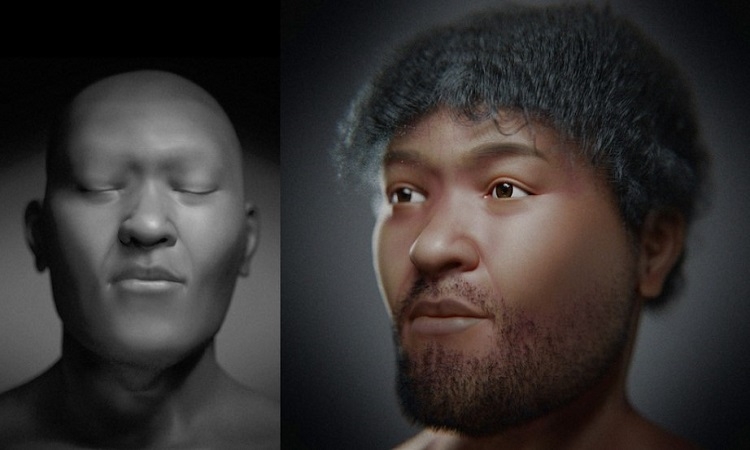
Despite missing key parts of his skeleton — such as ribs, hands, and parts of his legs and feet — the team was able to work with the preserved skull, which showed a modern structure with some ancient features. For example, his jawbone was far more robust than what we typically see in men today. Using sophisticated scanning techniques and comparison with existing datasets, the researchers were able to replicate and simulate the missing parts of the skull. This allowed them to create an incredibly lifelike reconstruction.
What makes this project particularly special is how it bridges the gap between the past and the present, transforming ancient bones into a relatable human figure. “What we do is estimate the face based on available statistical data, and the result is a very simple structure. But humanizing the face is always important — adding the hair, skin color, and other features helps make the subject come alive,” explained Cícero Moraes, the Brazilian graphics expert who contributed to the study.
The team’s goal is not just to create a realistic image but to help archaeologists better understand how humans have evolved over millennia. The reconstructed face provides a tangible connection to the past, reminding us that the ancient world is closer than we often realize — just a few layers of history and technology away. As these findings continue to develop, researchers hope to uncover even more about our ancestors’ lives and the journey that brought us to where we are today.