If These Miracles Were Not Filmed, No One Would Have Believed Them
If These Miracles Were Not Filmed, No One Would Have Believed Them
In an era defined by hyper-connectivity and structural skepticism, the human impulse to seek out the transcendent has found an unlikely sanctuary: the security camera. Across the globe, millions of viewers are bypasses traditional theological channels to find glimpses of the miraculous in the grainy, low-resolution streams of street surveillance, baby monitors, and smartphone videos. This digital democratization of the divine suggests that our appetite for wonders has not disappeared; it has simply migrated from ancient texts to the cold, unblinking lenses of modern automation.
The Geometry of Digital Devotion
To spend time navigating the contemporary landscape of viral “miracle” videos is to witness a profound shift in how the modern public conceptualizes the supernatural. For centuries, a miracle required historical vetting, ecclesiastical validation, and often generations of localized tradition before it earned widespread belief. Today, a clip uploaded to social media can bypass those institutional gatekeepers entirely, commanding millions of views and establishing a new narrative of divine intervention within hours.
Consider an incident recorded on a quiet street in China that has become a touchstone for online believers. Late at night, a heavy commercial truck and a cyclist converged toward an intersection on a trajectory that made a fatal collision mathematically certain. In a fraction of a second, a blur appeared on the low-frame-rate security feed—a human-shaped figure moving at a velocity that defied the constraints of human biology. Before the truck could impact the space, the cyclist was instantaneously relocated to the far sidewalk, entirely unharmed.
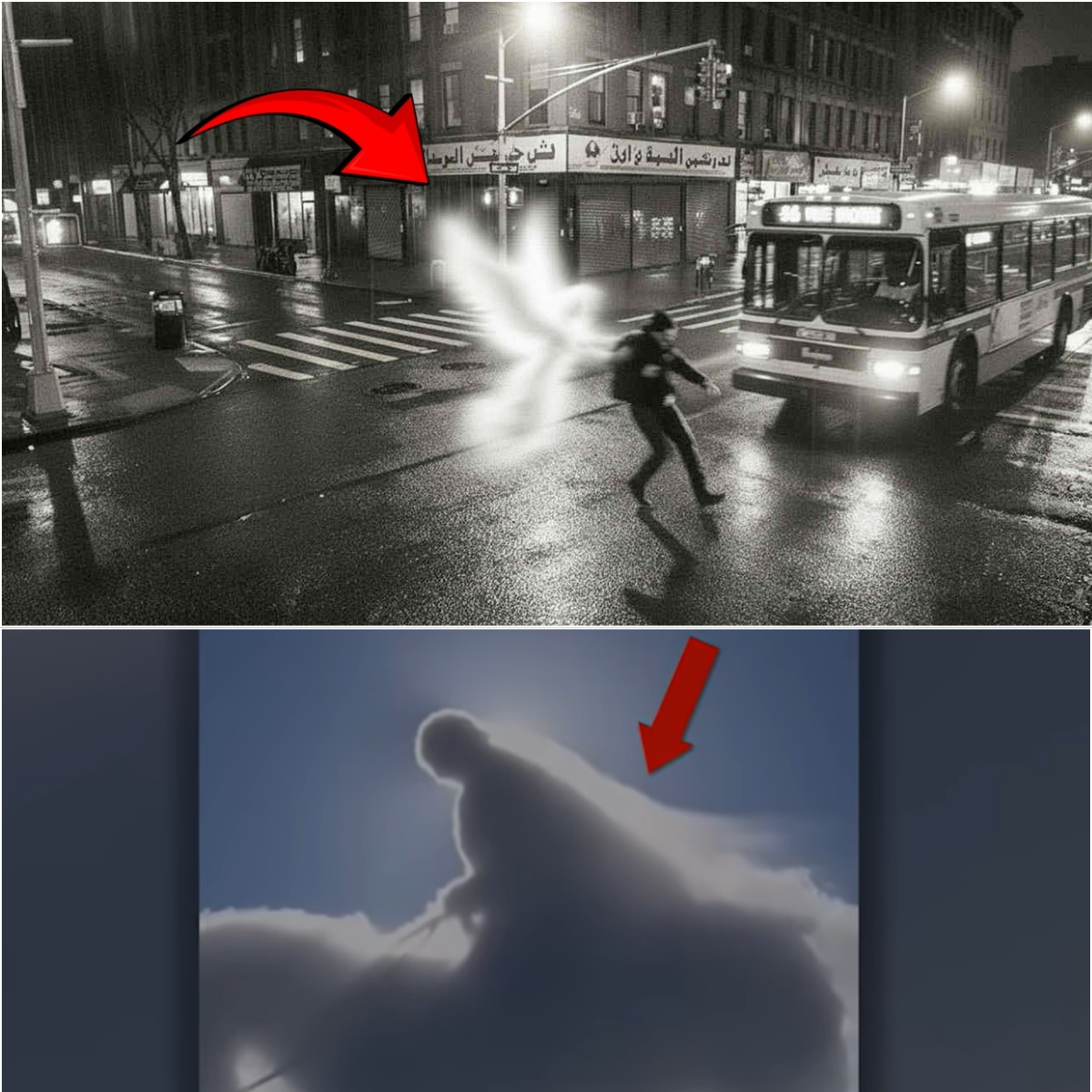
To the engineers and media analysts who dissect such clips, the explanation is straightforward: sophisticated video editing, digital compositing, or a clever promotional campaign utilizing traditional practical effects and post-production software. Yet, for the vast community of commentators who populate the digital forums beneath the video, the explanation is singular and absolute. It is a modern manifestation of a Guardian Angel, captured not by a saint in a state of ecstasy, but by a commercial security system designed to track traffic patterns.
The Security Feed as Sacred Space
The architecture of modern surveillance—originally implemented for risk management, crime prevention, and corporate liability—has inadvertently created a vast, global archive for those hunting the anomalous. Because these cameras run continuously, capturing millions of hours of mundane reality, they are viewed by the public as inherently objective witnesses. When something inexplicable occurs within their frame, it carries a weight of authenticity that a staged photograph or a personal testimony can no longer command in an age of profound media cynicism.
"What happens next is hard to explain. An unseen force suddenly twists the robber's arms behind his back..."
This dynamic was vividly illustrated in a widely shared video from an independent retail shop. A store owner, facing a brazen daylight robbery as a customer began clearing merchandise from the counter, called out to Jesus in a moment of acute distress. The security camera subsequently captured the assailant’s momentum abruptly halting, his arms contorting behind his back as though restrained by an invisible law enforcement officer, allowing the owner’s family to intervene until local authorities arrived.
For the shopkeeper and her community, the footage served as undeniable material proof of heavenly intervention. For a secular audience, it offered a fascinating study in psychological suggestion, acute muscle spasms brought on by panic, or a well-rehearsed staging. What remains significant is that the debate itself is mediated entirely through the frame of a digital video recorder (DVR). The security monitor has become a contemporary lens through which humanity projects its deepest desires for protection and justice in a world that often feels dangerously random.
Everyday Apparitions and the Search for Meaning
The categories of digital miracles extend far beyond dramatic physical rescues. They frequently touch on the deeply personal landscapes of grief, memory, and localized worship. In March 2024, a family grieving the unexpected passing of their patriarch captured a moment during his funeral service that quickly captured the internet’s attention. Amid dozens of identical floral arrangements lining the chapel, a single standalone decoration began to sway rhythmically back and forth, while the surrounding environment remained perfectly static.
"If it were the wind, everything should have been swaying, right? But no... it was moving clearly, almost intentionally."
In an earlier era, this would be a comforting family anecdote, shared quietly at gatherings to ease the pain of loss. In the digital age, it becomes an empirical artifact. Uploaded to the internet, the swaying flower transforms into a collective cultural experience, drawing thousands of messages from strangers who see in that isolated mechanical anomaly—likely caused by a localized draft or a faulty wire stand—a universal sign that the human consciousness survives bodily death.
Similarly, the home baby monitor has evolved into a frequent source of modern supernatural lore. In April 2021, a mother checking her child’s afternoon nap via a remote camera system observed a brilliant, self-luminous orb circling the crib, hovering just within reach of the child’s outstretched hand before dissipating entirely. While physicists and hardware manufacturers readily identify these phenomena as “backscatter”—the reflection of infrared light off airborne dust particles or small insects close to the camera lens—the emotional resonance for the parent often overrides the technical diagnosis. The orb is interpreted as a maternal ancestor or a celestial guardian, transforming a cheap piece of plastic consumer electronics into an instrument of profound spiritual reassurance.
The Institutional Response to the Virality of Faith
While the internet allows for the instant canonization of these digital anomalies, traditional religious institutions find themselves in a complex position. On one hand, these viral moments generate a renewed interest in spiritual matters among a younger, tech-literate demographic that has largely drifted away from formal religious participation. On the other hand, mainstream ecclesiastic bodies maintain a rigorous, deeply cautious approach to confirming anything as a genuine miracle.
This institutional caution was evident in the long-term investigation of a eucharistic occurrence at Christ the King Church in Kerala. In 2013, during a standard mass, a priest noted a distinctive discoloration forming on a consecrated host, which gradually assumed the contours of a human countenance resembling traditional Western iconographical depictions of Jesus. Unlike the fast-paced economy of the internet, where such an image is accepted or dismissed in a swipe, the local archdiocese initiated a decade-long process of scientific, medical, and theological evaluation before Archbishop Joseph Pamplain formally approved it as a significant sign intended to fortify local faith.
This tension highlights a growing divide in how the modern world processes the extraordinary. The institutional approach relies on historical precedent, rigorous testing to rule out natural chemical reactions or mold growths, and a slow distillation of theological meaning. The digital approach, by contrast, thrives on immediacy, emotional impact, and the democratic consensus of the comment section. To the online believer, a decade of bureaucratic vetting is unnecessary when the proof is readily viewable in high definition on a smartphone screen.
Pareidolia in the Anthropocene
Psychologists and cognitive scientists point out that the human brain is fundamentally an advanced pattern-recognition machine. For evolutionary survival, we are hardwired to find faces in the brush, intentionality in random noises, and signs of agency in natural phenomena—a psychological reality known as pareidolia.
When a community in Pena Miller, Mexico, looks up during a Good Friday procession and observes the clouds parting to form a stark, geometric cross illuminated by crepuscular sunbeams, the event is undeniably spectacular. However, meteorologists classify this as an entirely natural consequence of atmospheric wind shear and sunlight refraction. Similarly, when residents of Sao Paulo, Brazil, record a massive, roiling cloud formation that bears an uncanny resemblance to a horse and rider silhouetted against the sunset, they are participating in an ancient human tradition of reading the heavens like a cosmic storybook.
"It seemed like the Bible prophecy had come true..."
What has changed is not the nature of the weather, but the speed at which these interpretations are amplified. In the past, a strange cloud formation was a fleeting local event, remembered by a few dozen villagers. Today, documented by a dozen iPhones simultaneously, it becomes a global digital monument. The comment sections quickly fill with apocalyptic urgency, linking a natural atmospheric event to ancient biblical prophecies regarding the end times. The digital medium amplifies the psychological effect, turning a beautiful coincidence of weather into an existential warning for a global audience.
The Persistent Need for Wonder
Ultimately, the phenomenon of the digital miracle reveals a deeper truth about life in the twenty-first century. We live in a world that has been systematically mapped, quantified, and explained by modern science. We understand the physics of lightning strikes, the biology of stray dogs defending children from potential abductors, and the mechanics of optical illusions inside foggy mountain caves.
Yet, despite this vast architecture of knowledge, humanity harbors a profound resistance to the idea that the universe is merely a cold, mechanical equation devoid of higher purpose. The viral success of these clips—whether they depict a glowing dove sitting motionless on a dark highway or a white bird perching precisely on the head of an altar statue during a solemn mass—proves that our collective desire for the sacred remains entirely intact.
We turn to these videos because they offer a momentary reprieve from the weight of ordinary existence. They suggest that beneath the surface of our mundane, predictable routines, there is a hidden layer of magic, justice, and protection waiting to break through. By looking at the world through the lens of our security cameras, we are not merely monitoring our property; we are searching for confirmation that someone, or something, is still watching over us in the dark.