Mediterranean Underwater MONSTER—Kolumbo Volcano 7KM from Santorini as Dual System THREATENS 3M!
Just 7 kilometers from Santorini, a growing underwater magma chamber is forcing scientists to reassess volcanic risk in one of the world’s top tourist destinations.
Beneath the blue waters of the Aegean Sea, not far from the whitewashed cliffs of Santorini, a massive underwater volcano has been quietly rebuilding itself for nearly 400 years.
Its name is Kolumbo.
And in 2025, it sent a message that scientists — and governments — could not ignore.
30,000 Earthquakes and a State of Emergency

In early 2025, more than 30,000 earthquakes were recorded in just 30 days between Santorini and the nearby island of Amorgos. The largest tremors reached magnitude 5.2. Buildings shook. Schools closed. Thousands of residents left voluntarily.
The Greek government declared a state of emergency.
At first glance, this looked like a typical seismic swarm in a tectonically active region. But what researchers uncovered beneath the seafloor made the situation far more serious.
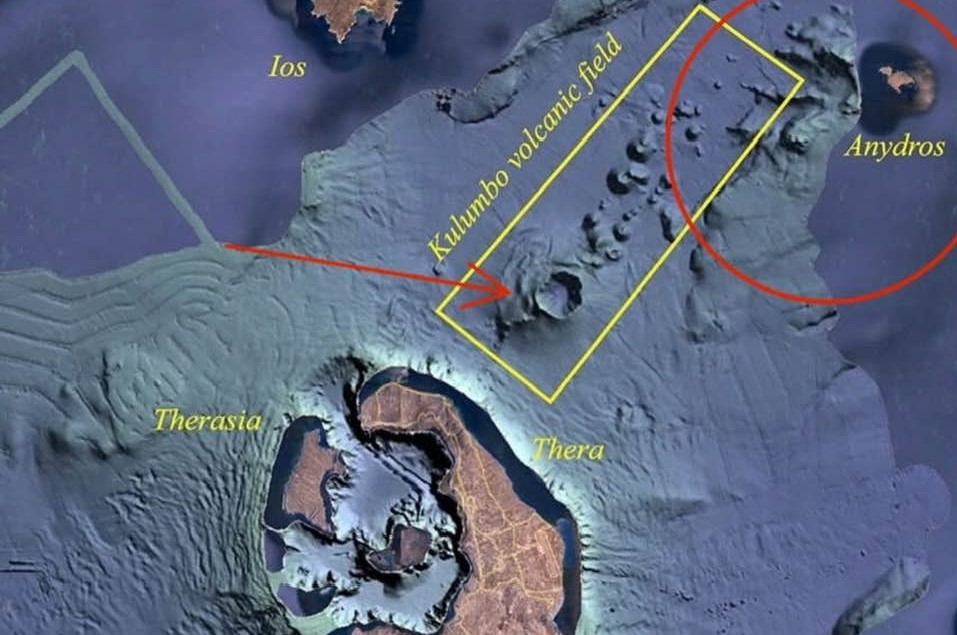
The earthquakes were occurring directly above Kolumbo — a submarine volcano that last erupted in 1650.
And it isn’t alone.
The Hellenic Volcanic Arc: A Geological Collision Zone
Kolumbo sits within the Hellenic Volcanic Arc, a highly active tectonic boundary where the African Plate subducts beneath the Aegean Plate.
This same volcanic arc produced one of the most catastrophic eruptions in ancient history — the eruption of Thera around 1600 BCE, widely linked to the collapse of the Minoan civilization.
The region contains at least 25 submarine volcanic cones, many historically under-monitored.
Kolumbo lies approximately:
7 km northeast of Santorini
500 meters below sea level at its crater rim
1,600 feet beneath the Mediterranean surface
From above, the sea appears calm. Beneath it, magma is accumulating.
The 1650 Eruption: A Warning from History
When Kolumbo erupted in 1650:
Pyroclastic flows raced across the sea surface
Toxic gases reached Santorini
70 people died
At the time, Santorini’s population was small.
Today, the island hosts roughly 20,000 permanent residents and welcomes 3 to 3.5 million tourists annually.
Four centuries of silence may sound reassuring. But in volcanology, silence can mean pressure is building.
The 2022 Discovery That Changed Everything
In 2022, researchers led by scientists from Imperial College London used advanced seismic imaging known as full waveform inversion to peer deep beneath Kolumbo.
What they discovered was startling.
A Previously Unknown Magma Chamber
Depth: 2–4 kilometers below the seafloor
Width: ~600 meters (2,000 feet)
Volume: 1.4 cubic kilometers of molten rock
That’s enough magma to fill over 500,000 Olympic-sized swimming pools.
More concerning: the chamber is growing.
400 Years of Continuous Magma Accumulation
Researchers estimate Kolumbo’s magma chamber has been expanding at roughly:
4 million cubic meters per year
At that rate, within 150 years, it could reach the estimated volume expelled during the 1650 eruption.
Kolumbo is not dormant.
It is recharging.
The study warned that a future eruption could resemble highly explosive submarine events such as the 2022 Hunga Tonga-Hunga Ha’apai eruption, which generated global shockwaves and tsunami waves up to 20 meters (66 feet).
Now imagine that scale of eruption just 7 km from Santorini.
2025: Scientists Discover a Shared Magma System
In late 2025, research published in Nature revealed something even more consequential:
Kolumbo and Santorini Caldera are not independent volcanoes.
They are connected.
Using AI-assisted seismic analysis of more than 25,000 earthquakes, researchers identified a shared magmatic reservoir feeding both systems.
What Happened in 2025:
Magma intruded laterally across ~20 km of crust
Seafloor above Kolumbo subsided by 32 cm
Santorini’s surface uplifted by 10 cm
Both volcanoes responded to the same deep magma pulse
They were, as scientists described it, “breathing together.”
This transforms the risk assessment. It’s no longer about one volcano. It’s about an interconnected volcanic system beneath one of Europe’s busiest tourism regions.
The Mediterranean Tsunami Risk
Unlike the Pacific Ocean, the Mediterranean lacks a robust, basin-wide tsunami warning system.
Distances are short.
If a major submarine eruption or flank collapse occurred near Santorini:
Waves could reach nearby islands in minutes
Evacuation windows would be extremely limited
Peak tourist season would magnify exposure
Millions visit the Greek islands each summer. Few consider submarine volcanic risk when booking their flights.
A Second Giant: Marsili Volcano Near Italy
While attention focuses on Santorini, another massive underwater volcano lies in the Tyrrhenian Sea south of Naples.
Its name: Marsili.
Few outside scientific circles know it exists.
Yet Marsili:
Is roughly 70 km long and 30 km wide
Rises nearly 3,000 meters from the seafloor
Has a shallow magma chamber
Contains structurally unstable volcanic flanks
Italy’s Istituto Nazionale di Geofisica e Vulcanologia has warned that a partial flank collapse could trigger tsunamis reaching southern Italy within 20 minutes.
In worst-case simulations, wave heights approach 20 meters.
The Mediterranean is not geologically quiet. It is simply less visible.
Monitoring Efforts Are Expanding — But Gaps Remain
In December 2025, the German research vessel RV Meteor deployed advanced submarine monitoring systems near Kolumbo.
The Santorini Volcano Observatory has installed seismographs inside Kolumbo’s crater.
Real-time data analysis has dramatically improved since 2022.
But monitoring is not the same as preparedness.
Building:
Tsunami detection systems
Evacuation infrastructure
Public communication protocols
Cross-border coordination
takes time — and political will.