Disturbing Things Found Deep Inside Abandoned Mines
Disturbing Things Found Deep Inside Abandoned Mines
The deep interior of an abandoned mine is the closest thing the modern world has to a physical twilight zone. Beneath the topsoil of the American landscape lies a silent, labyrinthine underworld of collapsed timber, rusted iron, and forgotten shafts—capsules of industrial history that have been completely swallowed by darkness. Decades after the final shifts ended and the headframes stopped turning, these subterranean spaces have evolved from mere economic relics into potent landscapes of mystery. In an era when every square inch of the Earth’s surface is mapped by satellites and tracked by GPS, the underground remains a stubborn blind spot. It is a realm where water runs impossibly clear, where the artifacts of our ancestors are preserved in status quo, and where the contemporary imagination routinely project its deepest anxieties, turning geological anomalies, lost history, and internet hoaxes into a new genre of subterranean folklore.
The Museum Beneath the Flood: Bonne Terre and the Subterranean Deep
Long before urban exploration became a viral phenomenon on social media, the transition of an abandoned mine from an active industrial hazard to an eerie historical sanctuary was perfectly realized in the American Midwest. Deep beneath the surface of Missouri lies the historic Bonne Terre lead mine, a sprawling subterranean complex that once stood as the world’s premier producer of galena—the dense, metallic lead sulfide crystal embedded in host dolomite rock that fueled the rapid industrial growth of the United States.
From the mid-19th century until 1962, generations of miners blasted through the limestone, leaving behind architectural wonders known as “room and pillar” formations—massive columns of undisturbed rock left standing to support the staggering weight of the earth above. When the pumps were finally disconnected in 1962, the lower tiers of the mine slowly, relentlessly filled with groundwater. Without the churning interference of surface weather or currents, the rising water formed a vast, subterranean reservoir holding more than one billion gallons of water, creating the largest underground lake on the planet.
Today, the flooded chambers of Bonne Terre function as an accidental museum of the industrial age. The water remains a constant, crisp 18°C, boasting a crystal-clear visibility that often exceeds 30 meters. Under the artificial floodlights of modern diving expeditions, the remnants of the mining era are preserved with haunting precision. Rusted ore carts still balance perfectly on their iron rails, looking as though they are waiting for a long-dead mule team or locomotive to pull them into the light. Picks, shovels, hand drills, and heavy pneumatic jackhammers rest exactly where workers dropped them when the final whistle blew.
Wooden scaffolding and staircases hang suspended over the clear depths, their timbers preserved by the mineral-rich environment. This silent, underwater landscape illustrates a core truth about abandoned mines: when humanity steps away, the vacuum left behind is filled by a eerie stillness that preserves our history while casting it in a deeply unfamiliar, almost alien light.
The Fallen Angel of Elga: Viral Media and Subterranean Mythology
As the tools of storytelling shifted from regional folklore to the instant velocity of digital media, the deep underground became a frequent setting for elaborate digital hoaxes. In early 2023, a startling video began circulating on international networks, purportedly filmed by a crew of hardhat-wearing miners operating within the remote Elga coal mining complex in the Sakha Republic of Siberia.
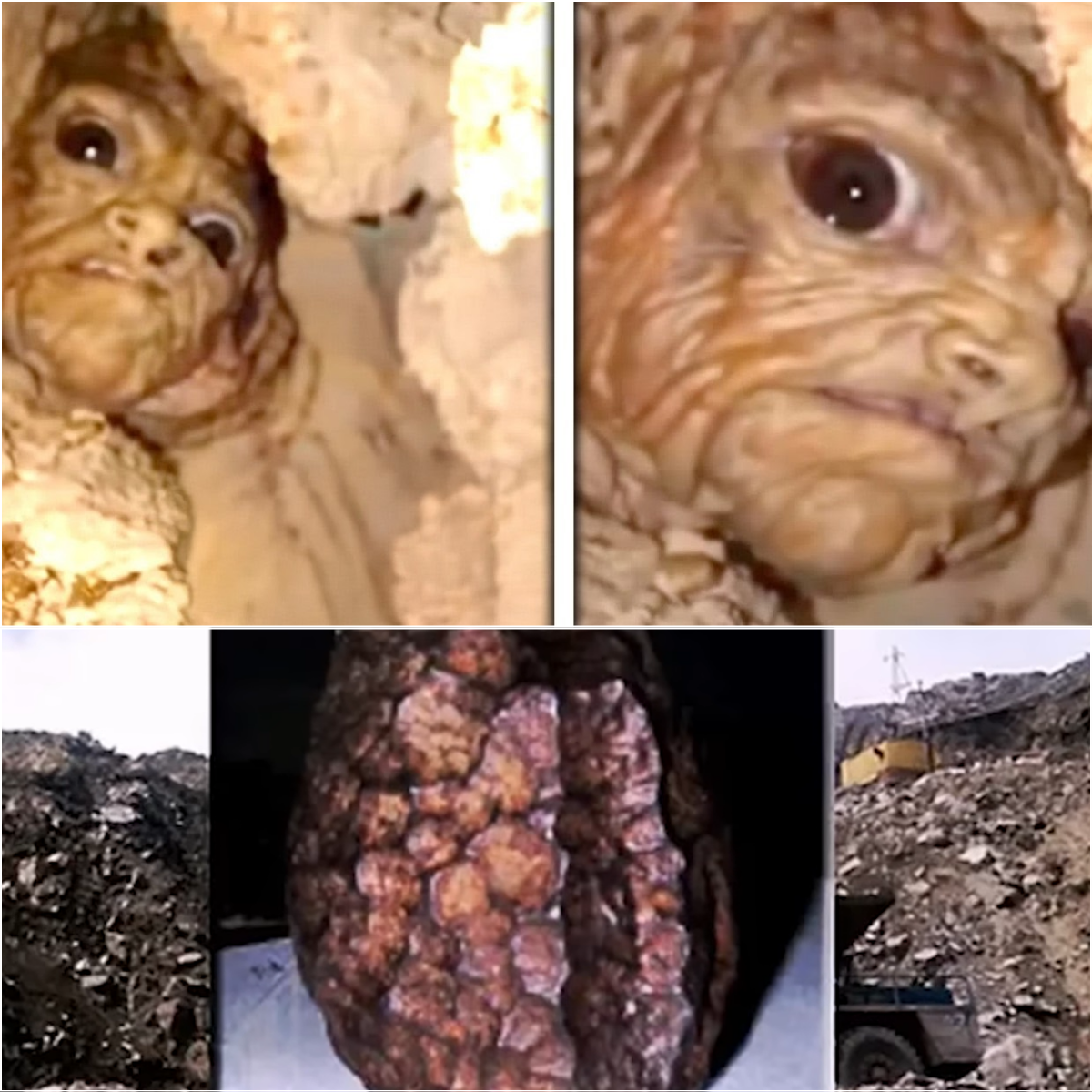
The shaky, smartphone-shot footage captured the dramatic moment a heavy excavator uncovered a massive, meticulously detailed stone statue buried deep within a coal seam. The artifact depicted a trágic, human-like figure with powerful, folded avian wings—an image the miners and subsequent internet commentators immediately labeled a literal, petrified “fallen angel.” The video was quickly packaged with dramatic audio commentary claiming that everyone in the immediate vicinity could feel an oppressive, “antinatural energy” radiating from the stone, evoking Abrahamic myths of celestial beings cast out of heaven for pride and rebellion.
To a viewer unversed in modern viral marketing and regional Russian art projects, the footage appeared to be a world-altering archaeological discovery. In reality, the “Fallen Angel of Elga” was a masterpiece of contemporary prop design and digital staging. The statue was not a product of the Carboniferous period; it was a highly detailed replica created for an art installation and subsequent creative video campaign.
The immediate adoption of the video by millions of viewers as potential proof of pre-human civilizations or supernatural intervention showcases how effectively the deep underground bypasses our skepticism. Because the subterranean world is inherently old, dark, and hostile, we are uniquely conditioned to believe that anything could be down there—even the petrified remnants of the divine.
Predators of the Shaft: The Rise of Subterranean Arachnids
The terror of the unknown underground is frequently rooted in biology rather than the supernatural. For centuries, miners have returned to the surface with accounts of encounters that challenge the nerves of even the most experienced laborers: the sudden discovery of massive, hyper-adapted predators thriving in the dark, humid microclimates of old workings.
While many of these stories are exaggerated by the claustrophobic pressure of deep-shaft mining, modern biology has confirmed that some of these nightmares are terrifyingly real. The most striking example is the Sierra Cacachilas wandering spider (Califorctenus cacachilensis), a massive arachnid discovered by researchers navigating the deep, humid chambers of abandoned mine shafts in the desert mountains of Baja California Sur, Mexico.
Anatomical Profile of the Sierra Cacachilas Wandering Spider:
- Leg Span: Up to 10 centimeters across (the size of a softball).
- Body Length: Approximately 2.5 centimeters.
- Coloration: Dull, mottled brown and grey for camouflage against mine timbers.
- Hunting Strategy: Active, nocturnal ambush predator; does not spin webs.
- Toxicity: Belongs to the family Ctenidae; bite is painful but not medically significant to humans.
Unlike typical household spiders, these cave-adapted hunters do not construct webs to snare their prey. Instead, they rely on speed and exceptional tactile sensitivity, running along the rock walls and rotting support timbers of abandoned shafts to hunt large cave crickets, rodents, and small reptiles. The environment of an abandoned mine provides the perfect nursery for these creatures: a constant temperature, high humidity, complete darkness, and an ecosystem supported by wood-rotting fungi and insect life.
When an urban explorer or a modern surveyor catches the glint of multiple compound eyes reflecting in the beam of a headlamp—revealing a spider the size of a softball crouched on a narrow tunnel wall—the primal human fear of venomous predators blends seamlessly with the claustrophobia of the deep earth.
Caskets of Salt: The Mummified Laborers of Chehrabad
While human tissue usually decays rapidly in normal environments, certain specific geological deposits can arrest the march of time, creating encounters with the past that are both scientifically invaluable and deeply unsettling. The most profound realization of this phenomenon occurred within the ancient salt mines of Chehrabad, located in the Zanjan Province of northwestern Iran.
Between 1993 and 2010, commercial salt miners executing routine excavations accidentally uncovered a series of human remains that would become known to science as the “Salt Men of Chehrabad.” These were not deliberate burials or ceremonial mummies; they were the exceptionally well-preserved remains of ancient miners who had been crushed and buried by catastrophic tunnel collapses centuries earlier. The intense concentration of rock salt combined with the extreme aridity of the mine environment acted as a natural desiccant, rapidly extracting moisture from the tissue before microbial decay could begin.
The result was a collection of natural mummies that retained an astonishing level of physical detail. The first specimen discovered, dating back roughly 1,700 years to the Sassanid Empire, featured a preserved head with a long, white beard, a shock of thick hair, and a single gold earring still pierced through the ear lobe. Subsequent discoveries yielded the body of a teenage boy dating back 2,200 years to the Achaemenid Empire, his leather boots, woolen trousers, and iron knife still intact.
Medical scans of the mummies even revealed the presence of ancient intestinal parasites, providing historians with an unprecedented look at the diet, health, and brutal working conditions of ancient industrial laborers. The Chehrabad mummies serve as a stark reminder that the history of mining has always been paid for in human lives, and that the earth can hold those bodies in its salt-crusted grip for millennia.
The Ultimate Stash: Merkers-Kaiseroda and the Wealth of the Third Reich
The darkness of a mine does not just hide geological secrets; it has also served as the ultimate vault for human greed and the spoils of war. As the Allied forces advanced into the heart of Germany during the closing weeks of World War II, the collapsing Nazi regime sought out the deepest, most secure locations on the continent to conceal the accumulated wealth of a conquered Europe.
In April 1945, the U.S. Third Army, under the command of General George S. Patton, captured the small village of Merkers in Thuringia. During routine interrogations of displaced civilians, military intelligence officers learned of a massive, clandestine logistics operation occurring at the nearby Merkers-Kaiseroda potassium and salt mine. Acting on these tips, American soldiers descended more than 640 meters beneath the earth into a vast network of subterranean salt galleries.
What they discovered remains the single largest hoard of plundered wealth ever recovered. In a massive bricked-in vault deep within the salt strata, soldiers discovered over 8,300 individual bars of gold bullion, weighing more than 100 tons. The room was packed with 55 crates of raw gold ingots, thousands of bags filled with gold coins, and massive reserves of platinum, silver, and international currency.
Beyond the bullion, the mine held priceless cultural treasures, including masterpieces from the Berlin State Museums, works by Rembrandt, Titian, and Manet, and the original records of the Reichsbank. The salt environment, with its stable humidity and temperature, had kept the stolen art perfectly preserved. The recovery of the Merkers treasure demonstrated that when civilization crumbles, its elite will always look to the ancient, subterranean dark to keep their secrets safe from the light of day.
The Salzburg Cube: Misplaced Artifacts and Geologic Anomalies
The human desire to discover a forgotten history often manifests in the promotion of “out-of-place artifacts”—objects found embedded within ancient geological strata that seem to challenge our understanding of human technological evolution. The most famous subterranean example of this phenomenon is the Wolfsegg Iron, often referred to as the Salzburg Cube.
In the autumn of 1885, a laborer working at the Braun iron foundry in Schöndorf, Austria, was breaking open a massive block of tertiary lignite—brown coal—that had been harvested from the Wolfsegg mine in Upper Austria. Inside the ancient coal, which geologists estimated to be between 20 and 60 million years old, the worker discovered a small, anomalous piece of iron. The object was roughly cubic in shape, featuring heavily pitted surfaces, two distinct rounded faces, and a deep, uniform horizontal groove carved around its center, giving it the distinct appearance of a machined or cast tool.
The Lifecycle of an Out-of-Place Artifact (OoPart):
1. Discovery: A worker extracts an unusual object from deep geological strata (e.g., coal or limestone).
2. Institutional Assessment: Early, primitive scientific analysis provides ambiguous or sensational conclusions.
3. Fringe Proliferation: The object is adopted by alternative historians as proof of ancient aliens or lost civilizations.
4. Modern Verification: Advanced chemical and metallurgical testing reveals a modern, industrial origin.
For decades, early paranormal researchers and alternative historians championed the Salzburg Cube as definitive proof of an advanced, pre-human civilization or ancient extraterrestrial visitors who had dropped a piece of machinery into a prehistoric swamp. However, modern metallurgical analysis conducted in the late 20th century by the Natural History Museum of Vienna thoroughly dismantled the myth.
Chemical testing revealed the object contained no nickel, completely ruling out a meteoric origin, and proved that the metal was a type of cast iron routinely used in 19th-century mining machinery. The “cube” was not a relic of the Miocene epoch; it was a piece of ballast or a mechanical tooth from a contemporary mining drill that had broken off and become wedged into a fissure in the coal face, where it was subsequently compressed by shifting earth. The story of the Salzburg Cube demonstrates how easily the intense, industrial environment of a mine can create its own modern myths.
The Tragedy of the San Rafael Swell: Eight Years in the Dark
While many tales of abandoned mines involve historical legends, the most terrifying encounters are those that are grounded in contemporary human tragedy. The vast public lands of the American West are dotted with thousands of unmapped, hazardous uranium and radium mines left behind by the mid-century atomic boom, creating deadly traps for the unwary.
In May 2011, a young couple from Colorado—Sara Bennett and Andrew Miller—embarked on a three-day photography and camping excursion into the remote, rugged wilderness of the San Rafael Swell in Utah. After purchasing a local topographic map at a gas station in Green River, the couple drove their vehicle into the backcountry and vanished without a trace. Despite exhaustive search efforts involving helicopters, canine tracking units, and teams of desert survival specialists, no sign of the couple or their gear was found for nearly a decade.
The mystery met a heartbreaking conclusion in August 2019, when a team of geology students from the University of Utah was conducting field research near the base of Temple Mountain. Exploring a remote canyon, the students discovered a partially hidden, collapsed entrance to a historic, abandoned uranium mine that had been officially sealed with steel bulkheads decades earlier. Clambering through a narrow gap created by shifting rock, the students traveled roughly 90 meters into the cool, dry interior of the shaft.
There, preserved by the arid desert air, they found Bennett and Miller. The couple was discovered sitting side-by-side in rusted folding camp chairs in the deep interior of the main drift. Near their feet lay a broken flashlight, an empty metal thermos, and a vintage Nikon DSLR camera containing unrevealed images of the desert landscape.
A forensic investigation suggested that the couple had entered the old workings to escape a sudden, severe desert dust storm or flash flood. Shortly after they entered, a localized ceiling collapse occurred near the portal, trapping them behind tons of unstable rock. In the complete, pitch-black silence of the mine, they had set up their chairs, turned off their failing flashlights to conserve battery, and waited for a rescue that would take eight years to arrive. The discovery stands as a grim warning of the absolute finality of the underground.
The Toy Collection of the Southwest: The Psychology of Subterranean Hauntings
The deep underground acts as a natural amplifier for psychological distress. When modern explorers navigate these spaces, the discovery of objects that are profoundly out of context can create an atmosphere of intense horror, often sparking viral internet legends regarding occult rituals or paranormal activity.
A prominent example of this psychological distortion occurred when an urban explorer documented his journey into an abandoned, turn-of-the-century silver and gold mine located in the high desert of Sandy Valley, Nevada. Navigating through a series of narrow, timber-reinforced drifts, the explorer discovered a collection of objects that seemed to suggest a bizarre, ritualistic haunting.
Scattered across the dry, dusty floor of an abandoned ore pocket was a group of vintage plastic dolls dressed in faded, ruffled clothing. One doll was carefully wrapped in a hand-knitted blanket, while another was arranged sitting upright beside a small plush toy. Nearby, the explorer found improvised altars constructed from mine debris, broken glass bottles topped with dried rabbit feet, and a handwritten note addressed to a mother, its faded ink expressing a cryptic, agonizing apology.
Subterranean Artifact Re-contextualization:
- Fringes/Internet: Proof of active occult cults, skinwalker rituals, or paranormal entities.
- Historical Reality: Remains of Cold War fallout shelters, children's play areas in historic mining camps, or temporary shelters for transient populations.
When the footage was uploaded online, commentators immediately claimed the mine was being utilized by an active occult group or a “skinwalker” attempting to mimic human family structures. However, local historical societies provided a far more rational context. During the height of the Cold War in the 1960s, Civil Defense officials routinely evaluated old, dry mine shafts in the Nevada desert as potential community fallout shelters, stocking them with emergency provisions, bedding, and rudimentary toys to keep children occupied during a prolonged subterranean stay.
Furthermore, during the Great Depression, many desperate, transient families utilized the entrance drifts of abandoned mines as rent-free, weather-resistant sod homes. The terrifying “ritual site” was merely the abandoned playroom of a impoverished family from a previous century, preserved in the dry desert air.
The Frostmourne of the Keystone State: The Intersection of Gaming and Exploration
The contemporary passion for urban exploration frequently intersects with the surreal subcultures of the internet, creating anomalies that look like a digital glitch manifest in physical reality. In the hills of Pennsylvania, the landscape is scarred by the remnants of the 19th-century limestone quarrying boom—an industry that left behind massive, vaulted caverns that stretch deep into the hillsides.
A team of explorers navigating an underground limestone quarry discovered an artifact that looked completely impossible within a historic industrial setting. Resting on a natural stone ledge deep within a dark, flooded chamber was a massive, intricately detailed broadsword. The weapon featured a distinctive, skull-shaped guard, an icy blue finish, and runic inscriptions carved along the length of its blade. It was a perfect, full-scale replica of Frostmourne, the iconic, cursed weapon utilized by the Lich King in the popular video game franchise World of Warcraft.
The presence of a legendary video game weapon in a 19th-century limestone mine seems completely absurd until one understands the mechanics of modern digital content creation. The sword had been transported into the mine by a group of high-end cosplay photographers who were utilizing the dramatic, subterranean waterfall and natural limestone arches as a atmospheric backdrop for a fantasy photo shoot.
The heavy, 1.5-meter replica had apparently been dropped into a deep crevice during the technical scramble of the shoot and abandoned due to the rising waters of the mine’s natural aquifer. When the next group of explorers encountered it weeks later, illuminated solely by their high-powered flashlights, the sword became a viral sensation—a piece of digital fantasy dropped into the real world.
Why We Look to the Dark
The enduring fascination with the secrets found within abandoned mines reveals a fundamental truth about the human mind: we are an engine designed for exploration and narrative creation. For thousands of years, our survival depended on our ability to map the unknown, to conquer the dark, and to understand the threats hiding just beyond the reach of our firelight.
Today, we live in a world where the wilderness has been thoroughly tamed, quantified, and illuminated. The surface of the earth holds few geographical mysteries. In this light-soaked world, the abandoned mine functions as a necessary psychological safety valve. It is a place where the rules of the surface world are suspended, where history stands still, and where the dark remains absolute. Whether we are looking at the historic machinery of Bonne Terre, the natural preservation of the Chehrabad salt mines, or the viral hoaxes of modern digital media, we are all looking into the subterranean depths for the same thing: a reminder that the world still holds secrets that have not yet been fully explained.