What AI Found in the Dead Sea Scrolls Is Raising Serious Biblical Questions
What AI Found in the Dead Sea Scrolls Is Raising Serious Biblical Questions
The Dead Sea Scrolls were already one of the greatest biblical discoveries in history. But when artificial intelligence began reading the handwriting, the ancient fragments started revealing something scholars had missed for generations.
For decades, the Dead Sea Scrolls have been treated like a time capsule from the edge of the biblical world. Found in caves near Qumran by the Dead Sea beginning in the late 1940s, these fragile manuscripts carried the words of Isaiah, Psalms, Deuteronomy, Habakkuk, Daniel, Enoch, community rules, apocalyptic visions, legal writings, hymns, and sectarian teachings. They were not ordinary old documents. They were among the oldest surviving witnesses to the Hebrew Bible and to the religious world that shaped Judaism and early Christianity.
To believers, they felt like a miracle of preservation.
To scholars, they were a revolution.
But even after years of study, photography, translation, restoration, and debate, the scrolls still held secrets. Not the kind found in fantasy thrillers—hidden treasure maps, forbidden gospels, or codes that destroy religion overnight—but quieter secrets. More dangerous secrets, in some ways. Secrets about who copied the Bible, how old certain texts may be, how manuscripts were transmitted, and whether the biblical world was more complex than the simple stories people often tell about it.
Then AI entered the room.
At first, that sounds almost absurd. What could a machine possibly add to the study of ancient scripture? The scrolls were copied by human hands more than two thousand years ago. Their letters were written in ink on parchment and papyrus. Their scribes lived in a world of oil lamps, ritual purity, Roman pressure, desert communities, apocalyptic hope, and sacred discipline. Artificial intelligence belongs to a world of silicon chips, machine learning, digitized images, and statistical models.
Yet that collision between ancient ink and modern computation is exactly what has made the new discoveries so unsettling.
AI does not get tired. It does not become emotionally attached to a theory. It can compare thousands of tiny letter shapes, pressure patterns, curves, spacing habits, stroke angles, and writing features that even trained experts might struggle to hold in memory all at once. Human scholars still interpret the results, but the machine can detect patterns hidden at a scale too small for ordinary reading.
And in the Great Isaiah Scroll, one of the most famous biblical manuscripts ever found, AI saw something startling.
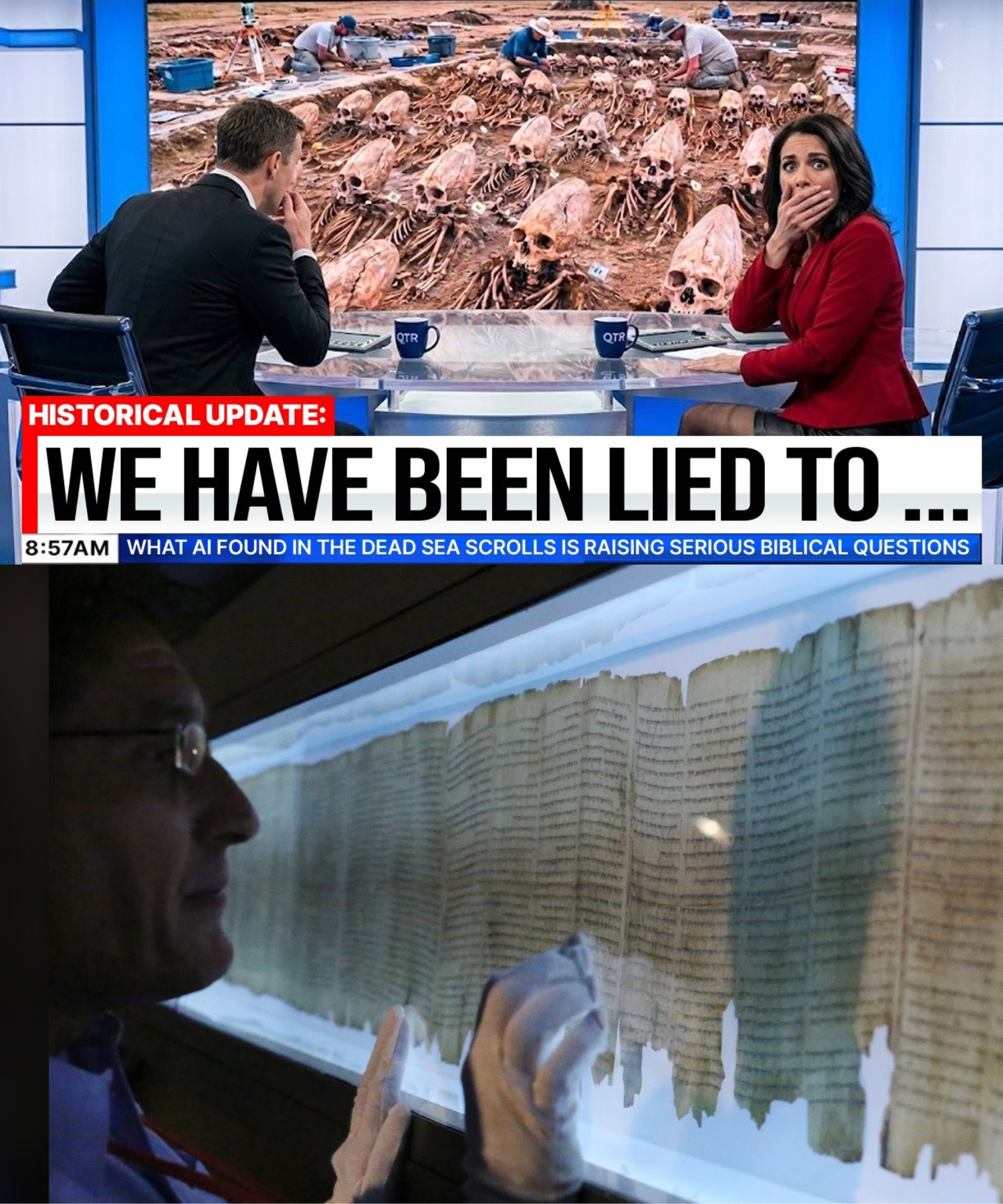
The handwriting looked remarkably uniform. For years, many assumed that one scribe copied the whole scroll. That was reasonable. The script seemed consistent. The manuscript felt like the work of a single trained hand. But when researchers used artificial intelligence to analyze the letters in detail, the results suggested something different: the Great Isaiah Scroll may have been copied by two scribes whose handwriting was so similar that generations of scholars had not clearly separated them.
That finding sounds technical, but its implications are enormous.
It means ancient biblical manuscripts could be produced by teams working so closely that their individual hands almost disappeared into a shared scribal style. It means the copying of sacred texts was not always the solitary labor of one anonymous writer bent over a scroll. It could be collaborative, disciplined, and standardized. Two scribes could mirror each other so carefully that only a modern machine could begin to detect the transition.
That raises the first serious biblical question: how did ancient scribes preserve sacred words?
Many people imagine biblical transmission as either perfectly mechanical or hopelessly chaotic. But the AI discovery suggests something more fascinating. The scribes were human, but they were not careless. They had training. They had conventions. They could imitate a house style. They could collaborate. They could maintain enough consistency that a manuscript remained visually unified even when more than one hand worked on it.
That is not a threat to the Bible.
It is a window into the people who protected it.
But it also makes the story more human. Sacred Scripture did not float down from heaven as a printed book. It passed through hands. Through eyes. Through memory. Through ink. Through communities that copied, checked, preserved, repaired, stored, and read these texts across generations. The AI did not expose the Bible as fake. It exposed the Bible’s ancient scribal culture as more complex than many people imagined.
Then came the second shock: dating.
A newer AI model, combined with radiocarbon dating and paleographic study, has suggested that some Dead Sea Scroll fragments may be older than previously believed. That may sound like a small adjustment, but in biblical studies, decades matter. A manuscript dated fifty or a hundred years earlier can shift debates about when certain texts were circulating, how stable they were, and how close a copy may stand to the period in which a book was composed, edited, or received as authoritative.
This is where the questions become sharper.
If some biblical scrolls are older than scholars once thought, then certain books or textual traditions may have been circulating earlier than expected. That could affect debates about Daniel, Enoch, and other writings tied to apocalyptic expectation, prophecy, and Second Temple Jewish thought. It could suggest that religious ideas were developing earlier, spreading faster, or being preserved more widely than older models allowed.
For believers, this can feel thrilling.
For scholars, it is also complicated.
AI dating does not magically settle every argument. The model depends on training data, radiocarbon samples, handwriting features, and expert review. Some scholars remain cautious because ancient handwriting is not a perfect clock. A scribe could use an older style. A community could preserve conservative scripts. A manuscript might be copied later in a traditional hand. Radiocarbon dating gives ranges, not exact birthday certificates. AI can sharpen probability, but it cannot replace judgment.
Still, the fact that AI and radiocarbon dating together are reopening questions is remarkable.
The Dead Sea Scrolls are no longer only being read.
They are being measured in new ways.
The third biblical question concerns authorship—not in the simple sense of “who wrote Isaiah?” or “who wrote Daniel?” but in the broader sense of how sacred texts were produced, copied, and received. The Great Isaiah Scroll shows that a biblical manuscript could be the work of more than one scribe. That invites scholars to look again at other scrolls. How many hands copied them? Were scribes working in schools? Did certain scribal communities specialize in particular texts? Could handwriting analysis reveal networks of manuscript production?
If AI can distinguish scribes within one scroll, it may eventually help identify whether fragments from different caves or collections were copied by the same hand or by scribes trained in the same tradition. That could reshape how scholars reconstruct the movement of texts across the ancient Jewish world.
Imagine the possibility.
Fragments long separated by damage, excavation history, and museum storage might be linked by handwriting. A scribe who copied one biblical text may have copied another. A community’s scribal habits might become visible across scattered pieces. The dead hands behind the scrolls may become, in a limited but powerful sense, recognizable again.
That is not just technical work.
It is almost intimate.
For two thousand years, these scribes were anonymous. AI may never give them names, but it can recover traces of their individuality: the angle of a letter, the pressure of a stroke, the curve repeated unconsciously across columns. The men who copied these texts were not machines. They had habits. Their hands tired. Their lines shifted. Their training shaped them, but their individuality remained hidden in the ink.
Now machines are helping us see the humans behind the sacred page.
The fourth question is about textual stability. The Dead Sea Scrolls famously showed that many biblical texts were transmitted with remarkable care, while also revealing textual diversity. Some scrolls align closely with the later Masoretic Text. Others preserve forms closer to the Septuagint or Samaritan traditions. Some show differences in wording, spelling, arrangement, or expansion. This does not mean the Bible was randomly rewritten. It means the textual world before later standardization was living, layered, and complex.
AI may deepen this picture.
By identifying scribes, dating manuscripts more precisely, and connecting fragments, researchers can better understand when certain textual forms existed. Did two versions of a biblical book circulate at the same time? Were some communities more conservative in copying? Were certain variants older than scholars assumed? Did scribes correct toward a known tradition, or preserve the text they received?
These are serious questions because they touch the way people think about Scripture.
Some believers may fear that textual diversity weakens faith. But many scholars and theologians see the opposite. The existence of ancient manuscript variants shows that Scripture lived in real communities before the invention of printing. It was read, copied, revered, interpreted, and transmitted by people who believed these words mattered deeply.
The Bible’s history is not less sacred because it is humanly transmitted.
It is more astonishing.
The fifth question concerns prophecy and timing. This is where popular headlines often become exaggerated. Some claim AI has “proved” biblical prophecy. Others claim it has “destroyed” prophecy by redating texts. Both are usually too simplistic. But dating does matter when discussing prophetic books, especially Daniel, which has long been debated because of its detailed apocalyptic visions and its historical setting.
If fragments related to Daniel or other apocalyptic texts date earlier than expected, that may affect scholarly conversations about when those writings were copied and circulated. It does not automatically settle theological debates. A copy is not necessarily the original composition date. But earlier manuscript evidence can narrow possibilities and force better questions.
This is why AI’s work on the scrolls feels explosive.
It does not scream one conclusion.
It quietly destabilizes lazy certainty.
The sixth question is about the community behind the scrolls. Were the manuscripts produced by the Essenes, a sect living near Qumran? Were they brought from Jerusalem and hidden during conflict? Were they part of a broader library? Scholars have debated this for decades. AI cannot solve the identity of the Qumran community by itself. But handwriting analysis, dating, fragment matching, and material study can provide new evidence for how diverse the collection was.
If many scribes copied the scrolls, that may suggest a large scribal network or a long period of manuscript accumulation. If certain hands repeat across multiple texts, that could suggest local copying. If dating shows some scrolls are older than expected, the community’s library may have deeper roots. If scripts vary widely, the collection may represent manuscripts brought from different places.
The AI does not answer every question.
It sharpens the questions.
The seventh question is perhaps the most modern one: should machines be allowed to interpret sacred history?
Some people feel uneasy about AI reading biblical manuscripts. There is something almost dystopian about algorithms analyzing Isaiah, Daniel, or ancient prayers. But the machine is not replacing reverence. It is not preaching. It is not deciding doctrine. It is doing pattern recognition. The danger is not that AI studies the scrolls. The danger is that people misuse AI results to make claims stronger than the evidence allows.
AI can detect patterns.
Humans must interpret meaning.
That distinction matters.
A machine may say two sections of handwriting differ statistically. A scholar must ask why. Was it a second scribe? A tired scribe? A change in pen? A different writing surface? A shift in posture? A later correction? A copying school? AI may predict a probable date range. Scholars must weigh it against radiocarbon data, archaeological context, paleographic tradition, and historical plausibility.
The best future for biblical studies is not AI replacing scholars.
It is AI forcing scholars to see what they missed.
That future is already arriving. Multispectral imaging can reveal ink invisible to the naked eye. Digital reconstruction can help match fragments. Machine learning can group handwriting styles. Statistical models can refine dating. Online databases allow scholars around the world to compare manuscripts instantly. The scrolls are no longer locked only in caves, museums, or specialist archives. They are entering a new technological age.
And yet, their power remains ancient.
A fragment of Isaiah still speaks of comfort, judgment, suffering, and hope. A piece of Psalms still carries prayer. A copy of Deuteronomy still bears covenant memory. A line from Habakkuk still wrestles with evil and divine justice. AI may reveal the scribal hand, but the words still reach the human heart.
That may be the most important point.
The serious biblical questions AI raises are not cheap questions. They are not “Is the Bible fake?” or “Did computers discover a hidden code?” Those headlines attract attention but miss the depth of the discovery. The real questions are better.
Who copied these texts?
How many scribes worked together?
How old are the manuscripts really?
How stable were biblical traditions before standardization?
How did ancient communities preserve sacred writings?
What can tiny letter shapes reveal about faith, labor, memory, and transmission?
And perhaps most importantly: what does it mean that the Bible has survived not as a myth floating above history, but as a text carried through history by real human hands?
The Dead Sea Scrolls have always raised questions. AI has simply made some of those questions harder to ignore.
For believers, this can be an invitation rather than a threat. Faith does not need to fear the history of Scripture. If the Bible came through human scribes, that is not scandalous. Christianity and Judaism have always confessed that God works through human beings—through prophets, priests, kings, fishermen, poets, mothers, exiles, and yes, scribes with ink-stained hands.
For skeptics, the scrolls are a reminder that the Bible cannot be dismissed as a late invention without dealing with ancient evidence. These manuscripts show biblical texts existing centuries before many later copies. They reveal a sacred library from a world much closer to the origins of Judaism and Christianity than medieval manuscripts ever could.
For scholars, AI is a new lamp lowered into an old cave.
It does not remove the mystery.
It reveals more of it.
The scrolls were hidden for centuries in desert caves. They survived war, decay, theft, fragmentation, and time. Now they are being examined by tools their scribes could never have imagined. Yet the most astonishing thing is not the technology. It is the continuity. A scribe copied Isaiah by hand more than two thousand years ago. A machine studies the pressure of his letters today. Between them stretches the entire drama of human history.
Empire rose.
Jerusalem fell.
Languages changed.
Religions spread.
Libraries burned.
Nations were born.
And still the ink remained.
What AI found in the Dead Sea Scrolls is not one simple secret. It found evidence of collaboration where many saw one hand. It found possible earlier dates where old assumptions had settled too comfortably. It found that the biblical manuscript tradition was both disciplined and human, stable and diverse, ancient and alive.
That is why the questions feel serious.
Not because the scrolls destroy the Bible.
Because they make its journey through history more visible.
And once you see the hands behind the text, the Bible becomes not smaller, but more astonishing: a sacred library carried across centuries by people who believed the words were worth preserving, even if no one would know their names.