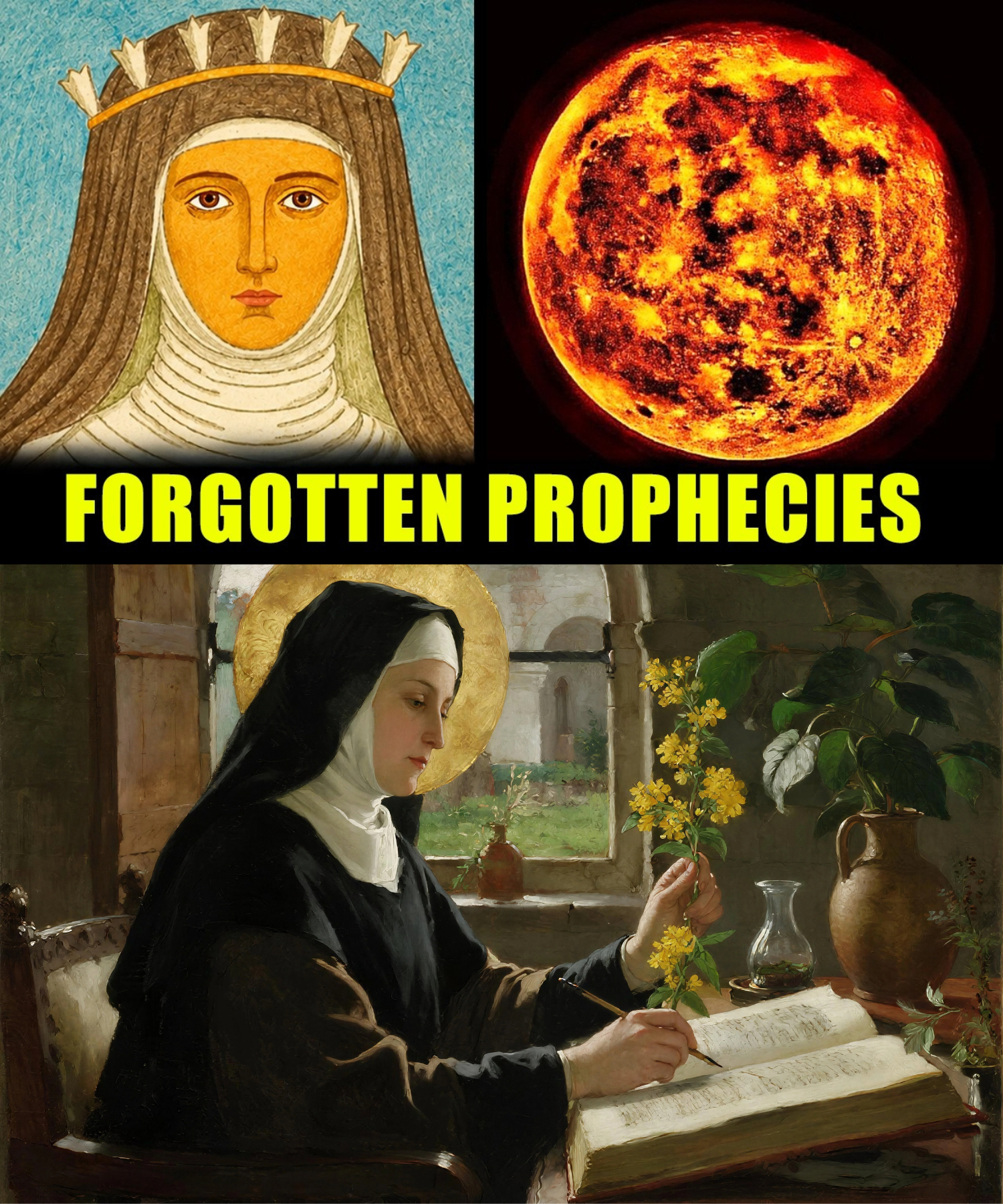
The FORGOTTEN Prophecies Of Hildegard Von Bingen
The Forgotten Prophecies of Hildegard von Bingen
Part 1
The manuscript was found in New York City at 2:31 in the morning, inside a climate-controlled vault beneath the American Museum of Sacred History, where old parchment, disputed relics, cracked icons, and forgotten letters slept under glass while the city above kept sinning in neon and rain. Dr. Miriam Cole had been called from her apartment near Columbia because a cataloging intern had opened the wrong box and found the right disaster. The box was labeled in dull ink: German devotional miscellany, nineteenth-century copy, no exhibition value. That was the kind of label museums used when they were too tired, too proud, or too underfunded to admit they did not know what they were holding. Inside lay a bundle of vellum leaves, stitched unevenly, with Latin marginal notes, German prayers, and one name that made Miriam stop breathing.
Hildegardis.
Hildegard von Bingen was not obscure. She had been a Benedictine abbess, visionary, composer, healer, theologian, and one of the most startling religious minds of the twelfth century. But America knew her mostly in pieces: mystical music in yoga playlists, herbal remedies in wellness blogs, feminist quotes on mugs, medieval art in museum shops, and the occasional Catholic lecture where people spoke of her visions without letting them become dangerous. Miriam had spent years studying how holy women were often made safe by being turned into aesthetics. Hildegard, in particular, had been flattened into incense, chant, and green light.
But the pages in the vault were not safe.
The first illustrated folio showed a woman standing beneath a burning wheel, her hands lifted toward a sky split by three colors: gold, black, and sickly green. Beneath her was a city of glass towers, not medieval, not exactly modern, but unmistakably prophetic in style. The Latin beside it was crude, possibly copied from an older source, perhaps misattributed, perhaps forged, perhaps a devotional meditation written centuries after Hildegard’s death. Miriam knew all the cautions. She repeated them to herself like a prayer against stupidity.
Then she translated the first line.
When the people across the western sea build towers of light and forget the root, the Living Fire will not vanish. It will withdraw into the poor until the proud become blind in their own brightness.
She sat down.
By sunrise, a photograph leaked. By noon, the internet had renamed the bundle: The Forgotten Prophecies of Hildegard von Bingen. By evening, Los Angeles had already made the lie more dramatic than the evidence. A trailer appeared online showing medieval nuns, burning skyscrapers, lightning over New York, riots in Los Angeles, a cracked American flag, and a narrator whispering, “A saint saw America’s fall nine hundred years before it happened.”
Miriam nearly threw her phone across the lab.
“This is why manuscripts should stay asleep until adults arrive,” she said.
Naomi Reyes flew from Los Angeles that night. She was a documentary filmmaker who had built a career rescuing sacred stories from people who wanted to turn them into prophecy bait. When she entered the New York vault, Miriam was standing over the manuscript with red eyes and a pencil behind her ear.
“Is it real?” Naomi asked.
Miriam did not look up. “That depends on what you mean by real.”
“Did Hildegard write it?”
“Almost certainly not in this form. It may be a later compilation inspired by her visions, a copied devotional text, a forgery, or a genuine lost tradition distorted by centuries of handling.”
“And what does it say?”
Miriam looked at the burning wheel again.
“It says America should be careful with holy women it turns into decoration.”
Part 2
Ohio received the manuscript because Dr. Caleb Ward’s lab had the best multispectral imaging equipment outside the federal archives, and because Caleb was the kind of scholar who could disappoint both mystics and skeptics without apologizing. The pages were transported from New York to Columbus under escort, sealed in a case that looked more important than most elected officials. Ruth Bell met them at the Ohio State lab with a thermos, a wool hat, and no invitation. Ruth was eighty, from Mercy Ridge, and had somehow become the moral auditor of every religious-historical crisis Naomi filmed.
Caleb saw her and sighed. “How did you get into a restricted lab?”
Ruth held up a visitor badge. “Young people trust old women with clipboards.”
“That is a security failure.”
“Most security failures are spiritual first.”
She leaned over the glass and looked at the image of Hildegard beneath the burning wheel. “So this nun predicted America?”
Miriam shook her head. “No responsible person is saying that.”
“Then America will.”
“Yes.”
Caleb’s scans complicated everything. The parchment was not medieval; it was likely early modern or nineteenth century. The ink was layered. Some Latin copied older phrasing associated with Hildegardian language: Living Light, greenness, corruption, burning vision, the body of the Church. Other passages sounded later, shaped by post-Reformation anxiety, industrial imagery, and perhaps nineteenth-century Catholic immigrants interpreting America through medieval prophetic imagination. The manuscript was not a simple lost prophecy. It was a transmission: Hildegard’s symbolic world carried across centuries, rewritten by frightened believers who saw in America both promise and danger.
Naomi asked, “So it is not fake exactly?”
Caleb answered, “It is materially real, textually layered, historically unstable, and spiritually inconvenient.”
Ruth nodded. “So, like most families.”
They translated the sections one by one. There were seven visions. The first was the Tower of Light Without Root. The second, the River of Iron. The third, the Choir That Forgot the Poor. The fourth, the Physicians Who Sold Sleep. The fifth, the Children Under the Glass Sun. The sixth, the Shepherds Counting Applause. The seventh, the Green Fire Returning Through Wounds.
Each vision sounded medieval and modern at once. The Tower warned of wealth without humility. The River of Iron described roads and rails carrying plenty past the hungry. The Choir warned of churches singing beautifully while ignoring the sick outside their doors. The Physicians vision spoke of healing turned into commerce. The Children vision described young souls raised under artificial light, fed images, noise, and fear until they no longer recognized creation. The Shepherds vision accused religious leaders who measured success by crowds, donors, and influence. The final vision was stranger: when the proud systems failed, divine viriditas—Hildegard’s green life-force of God—would return not through palaces, but through wounds, kitchens, gardens, sickrooms, prisons, and children.
Ruth became unusually quiet.
Naomi noticed. “What is it?”
Ruth pointed at the line about churches singing over the poor.
“That one does not need a carbon date.”
Part 3
Los Angeles wanted apocalypse. Naomi wanted the wound. That put her at war with almost everyone funding religious content that week. Vale Media released a special called Hildegard’s Lost Prophecy of America’s Collapse, complete with burning cities, Gregorian chants slowed into horror music, and a CGI Hildegard staring over Manhattan like a medieval surveillance satellite. The narrator claimed the saint had seen “New York, Los Angeles, and the fall of the American Church.” Miriam publicly called the special “an impressive arrangement of errors.”
Naomi’s own film took the opposite title: The Green Fire Beneath America.
She began in Los Angeles because the city understood spectacle better than any place on earth. She filmed churches with perfect lighting and parking teams, wellness shops selling Hildegard-inspired “divine feminine” herbal tonics, influencers using her name beside crystals, Catholic bookstores selling chant albums, and a downtown clinic where exhausted nurses treated people sleeping on sidewalks under billboards advertising luxury skincare. The contrast felt almost too obvious, but that was the point. Hildegard had written fiercely about the greenness of God, the living force pulsing through creation and the human body. America had turned greenness into branding while poisoning the poor.
Naomi interviewed Angela Brooks, a Catholic outreach worker under the 101 freeway. Angela listened to the fourth vision, the Physicians Who Sold Sleep, and looked toward the tents behind her.
“This country can keep people alive longer than any empire in history,” Angela said. “Then it asks whether they can afford to be treated like bodies God made.”
That line entered Part Three.
Then Naomi filmed a children’s tech detox retreat in the hills outside Los Angeles, where parents paid thousands to help their children stop staring at screens. The irony was too heavy to lift. Across town, public school teachers were begging for mental-health support, and children in shelters used donated phones as the only stable connection to family. The fifth vision, Children Under the Glass Sun, did not sound like medieval superstition anymore. It sounded like every exhausted child in America being raised beneath blue light, algorithmic fear, and adult denial.
At a Catholic high school in East L.A., a student named Lily read the vision aloud.
They will be given images before they are given silence, and they will know the faces of strangers before they know the cry of their own souls.
The classroom went still.
A boy whispered, “That sounds like us.”
Naomi did not need narration.
Los Angeles had given the forgotten prophecies their first American translation: not prediction, but diagnosis.
Part 4
New York hosted the public forum, and everyone arrived wanting the wrong answer. Was the manuscript authentic? Did Hildegard predict America? Was the United States under judgment? Did the visions name the modern Church? Would cities fall? Was this the end? Miriam stood before the auditorium at Columbia, looked at the crowd, and began with the sentence least likely to trend.
“The manuscript is not a clean medieval autograph, and anyone treating it as a simple lost prophecy is abusing both history and faith.”
Half the room deflated.
Then she continued.
“But that does not mean it is meaningless. It is a layered witness to how Hildegard’s visionary language traveled through communities who feared that wealth, technology, religious performance, medical power, and political pride could sever people from the Living God. Whether Hildegard wrote these words directly is less important than whether we recognize why they survived.”
A journalist asked, “So are they prophecies?”
Miriam answered, “They are prophetic in the biblical sense if they call us back to truth. They are not fortune-telling for people who want divine permission to feel superior.”
Ruth Bell, seated on the panel, leaned toward her microphone. “Translation: stop using dead nuns to yell at people you already dislike.”
The audience laughed, then listened.
The forum’s hardest moment came when Father Gabriel Moreno from Queens read the third vision, the Choir That Forgot the Poor. It described a sanctuary filled with music so beautiful it rose like gold smoke, while outside the church door, the cold wrapped itself around the hungry. The singers did not hear them because they had mistaken harmony for obedience.
Father Gabriel lowered the paper.
“I have celebrated liturgy beautifully,” he said, voice shaking. “And I have stepped over people afterward because I was tired.”
No one spoke.
A young Protestant pastor stood and said his church measured revival by attendance while the food pantry downstairs ran out of diapers every month. A Catholic musician admitted he cared more about chant purity than whether his parish was accessible to disabled worshippers. A seminary student asked if beauty itself was being condemned. Miriam shook her head.
“No. Hildegard loved beauty. But beauty in her world was never meant to float above suffering. True beauty heals the body of the world.”
That became Part Four’s center.
The forum ended with the seventh vision: Green Fire Returning Through Wounds.
When the towers dim and the choirs falter, the Living Fire will return through the cracked places: through women who were not believed, through children who still see, through the sick who bless the healthy, through the poor who remember bread, through the earth made brown by greed yet still pushing green from beneath the ash.
New York, for once, did not know how to clap.
Part 5
Ohio made the visions practical because Ruth would not allow a medieval manuscript to become another excuse for educated people to feel haunted and do nothing. In Mercy Ridge, she taped seven poster boards to the community center wall, one for each vision. Tower. River. Choir. Physicians. Children. Shepherds. Wounds. Then she handed people markers and said, “If this prophecy is about America, start with your street.”
The Tower board filled first: landlord neglect, donors controlling ministries, churches naming buildings after rich men, politicians promising renewal while cutting services. The River of Iron became truck routes carrying goods past neighborhoods without grocery stores, rail lines that divided poor districts, highways built through Black communities, delivery workers with no health insurance. The Choir board filled with religious performance: livestream metrics, worship wars, prayer breakfasts without repentance, beautiful services after which nobody knew who was hungry. The Physicians board filled with medical debt, insurance denials, exhausted nurses, addiction treatment waitlists. Children Under the Glass Sun became the longest board: anxiety, phones, violence, loneliness, school pressure, pornography, algorithms, no silence, no sleep.
Ruth stood before the boards and said, “Well, Hildegard did not waste a stamp.”
A teenager named Marcus asked, “What is Green Fire supposed to mean?”
Miriam, visiting from New York, explained Hildegard’s idea of viriditas—the greening power, the life of God in creation, healing, holiness, the freshness of grace.
Marcus frowned. “So not magic fire?”
“No.”
“Then what does it look like?”
Ruth pointed toward the pantry, where volunteers were packing food boxes while an old man fixed a broken walker and a nurse checked a child’s asthma inhaler.
“Mostly annoying work that keeps people alive.”
That answer shaped the Ohio chapter.
Mercy Ridge created a Green Fire Project. Each vision became a repair plan. Tower: donor transparency and tenant advocacy. River: food access and transport support. Choir: every worship event connected to service. Physicians: medical debt assistance and clinic rides. Children: screen-free community nights, counseling, and safe adult mentors. Shepherds: pastoral accountability. Wounds: grief circles, trauma care, and listening sessions for people who had been dismissed.
The project spread after Naomi posted a short clip of Ruth saying, “If your prophecy does not become a schedule, you are probably just enjoying fear.”
In Los Angeles, Angela Brooks painted that line on the wall of her outreach office.
In New York, Father Gabriel put it above the sacristy door.
The forgotten prophecies were no longer forgotten.
They were becoming inconvenient.
Part 6
The manuscript’s most controversial passage was the sixth vision: The Shepherds Counting Applause. It described religious leaders standing on high platforms while their flocks wandered thirsty below. They counted hands raised in praise, coins in the chest, names in the book, and voices calling them holy. But they did not count the wounded who left silently. Hildegard, or whoever preserved her voice in this manuscript, called them “shepherds who feed on echo.”
American churches hated that one.
Not all churches, of course. But enough. Some accused Naomi’s film of attacking pastors. Some Catholic commentators said the manuscript was being used to shame tradition. Some evangelical leaders said it was progressive propaganda. Some progressive churches said it was too medieval and judgmental. Miriam said the passage had achieved ecumenical usefulness by offending everyone with authority.
Naomi filmed leaders who took the vision seriously. A megachurch pastor in Dallas opened his books to the congregation after realizing donor culture had shaped sermons more than Scripture. A Catholic bishop in New York began listening sessions with people wounded by clergy neglect, not for publicity, but with phones off and no press. A small Black church in Cleveland admitted its pastor had covered for a beloved choir director who abused power. A Los Angeles house church realized its anti-institutional identity had become its own form of pride.
Then Naomi filmed leaders who performed repentance. One pastor staged a “Hildegard Sunday” with green lights, fog machines, and branded merchandise. Ruth saw the clip and said, “They turned the prophetess into a salad bar.” Naomi laughed so hard she had to cut the footage.
Part Six focused on the difference between being accused and being transformed. Prophetic language is easy to admire when it points outward. It becomes unbearable when it names your office. The Shepherds vision asked every religious leader in America one question: who stopped coming because you loved your platform more than their soul?
Father Daniel Mercer, a young priest in Ohio, answered honestly. He found a list of families who had left the parish over ten years and began calling them—not to demand return, not to correct them, but to ask what happened. Some did not answer. Some hung up. Some cried. One woman said, “Father, we left because after my son died, nobody came after the funeral.” Daniel wrote that sentence down and wept in the rectory.
He told Naomi, “I thought shepherding meant preaching truth. I forgot it also means noticing who is missing.”
That became Part Six’s ending.
The forgotten prophecies had left the museum.
They were now walking through church offices, board meetings, choir lofts, hospital corridors, school gyms, and kitchens where tired people were beginning to ask whether the Living Fire had withdrawn from their success and hidden itself among the ignored.
Part 7
The documentary premiered in New York under the title The Green Fire Beneath America. The museum auditorium was full of Catholics, Protestants, skeptics, historians, musicians, doctors, pastors, nuns, students, activists, and people who came because Hildegard’s name sounded mystical and safe. Naomi did not give them safe.
The film opened with the leaked manuscript image, then cut to Miriam saying, “America loves holy women after they can no longer interrupt meetings.” From there, it moved through New York’s vault, Ohio’s imaging lab, Los Angeles’s distortion, Mercy Ridge’s Green Fire Project, churches confronting the Shepherds vision, children reading the Glass Sun passage, and the final image of green shoots pushing through ash after a controlled burn in an Ohio field.
It did not claim Hildegard personally predicted America in modern detail. It did not pretend the manuscript was simple. It did not turn prophecy into a calendar. It argued that the visions mattered because they carried a prophetic grammar America needed: root versus tower, life versus performance, healing versus commerce, children versus noise, shepherding versus applause, wounds as the place where grace returns.
After the screening, a young woman asked Miriam, “If the manuscript is not certainly Hildegard’s, why should we listen?”
Miriam answered, “Because truth does not become harmless simply because attribution is complicated. We listen carefully, not credulously. And when a text tells us to feed the poor, heal the sick, protect children, humble leaders, and recover the life of God beneath our systems, the burden is not only on the parchment. It is on us.”
Ruth took the microphone next. “Also, if you need perfect provenance before loving your neighbor, your problem is not academic.”
The room laughed, but it hurt.
The film spread through seminaries, Catholic schools, Protestant churches, women’s religious communities, environmental groups, medical ethics programs, and youth ministries. Some used it badly, of course. People always do. But many used it well. Hildegard’s music was sung again, not as atmosphere, but as summons. Gardens were planted beside clinics. Churches audited budgets. Pastors called the missing. Schools created silence hours. Medical debt funds grew. Children were asked what kind of world adults were handing them.
In Mercy Ridge, Marcus stood before the Green Fire boards six months after the premiere and said, “I used to think prophecy meant telling the future. Now I think it means telling the present so clearly people can’t keep lying about it.”
Miriam wrote that down.
It was better than her lecture.
Part 8
Years later, the headline still appeared online: The Forgotten Prophecies of Hildegard von Bingen. It remained dramatic, but those who knew the manuscript understood the better truth. The pages found in New York did not give America a secret medieval map of its future. They gave America something more unsettling: an old language for sins it kept calling progress.
The manuscript was eventually cataloged not as an authenticated lost work of Hildegard, but as an early modern or later Hildegardian prophetic compilation drawing from her visionary tradition. That disappointed people who wanted a clean miracle. It relieved serious scholars. It did not stop the visions from working. The Tower still accused wealth without roots. The River still accused systems that move goods while leaving people hungry. The Choir still accused worship without mercy. The Physicians still accused healing sold as privilege. The Children still accused noise that devours souls. The Shepherds still accused applause-driven religion. The Green Fire still promised that God’s life returns through wounds.
New York kept the manuscript in a modest exhibit called Hildegard in Transmission: Vision, Memory, and Warning. The first room explained uncertainty. The second room played her music. The third room displayed the seven visions. The final room asked visitors: Where has the Living Fire withdrawn from your life, and where is it asking to return?
Ohio kept the Green Fire Project. Mercy Ridge became known not for mystical drama, but for stubborn repair. Ruth died years later, and at her funeral, the choir sang Hildegard’s music badly but sincerely. Marcus read the line about green pushing through ash. Father Daniel read the names of families the parish had found again after years of absence. Someone placed a basket of bread near Ruth’s coffin because she had once said any theology that cannot become bread should apologize.
Los Angeles kept Naomi’s film alive. She taught young filmmakers that sacred stories do not need to be exaggerated to be powerful. “If the truth is quiet,” she told them, “move the microphone closer. Do not add thunder.”
On the tenth anniversary of the manuscript’s discovery, Miriam, Caleb, Naomi, Marcus, Angela, Father Gabriel, and students from three cities gathered in Mercy Ridge around the original Green Fire boards, now worn and rewritten many times. Outside, spring rain softened the ground. Children planted herbs in raised beds beside the clinic. Inside, the seven visions were read aloud again.
When the final vision ended, no one clapped.
They walked outside instead.
They planted.
That was how the forgotten prophecies survived America—not as fear content, not as proof of doom, not as a medieval woman turned into a mascot for modern outrage, but as a greening pressure beneath the cracked places.
Hildegard had once written of the Living Light.
America, in its towers and noise, had nearly forgotten how to see it.
But under the ash, under the wounds, under the poor places where the proud rarely looked, green fire was still rising.