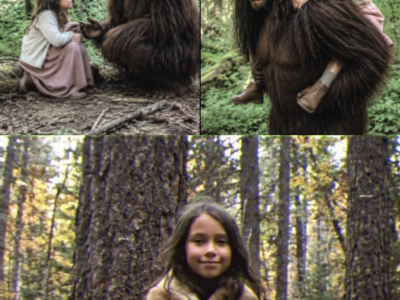
Old Woman Rescued 2 Baby Dogman Puppies in Distress, Dogman Family Surrounded Her House
Old Woman Rescued 2 Baby Dogman Puppies in Distress, Dogman Family Surrounded Her House
The crying came from the ditch after midnight—two tiny, broken sounds beneath the rain. Margaret Halloway thought she was rescuing abandoned puppies. By sunrise, every window of her farmhouse was surrounded by things that were not dogs.
For forty-three years, Margaret had lived alone at the edge of Black Pine Road, a narrow strip of cracked asphalt that cut through the wooded hills of northern Michigan like a scar. Her husband had died in that house. Her children had moved away from it. Her neighbors had slowly disappeared, replaced by locked vacation cabins, empty fields, and “For Sale” signs that leaned in the wind. By the time she turned seventy-eight, Margaret had become part of the landscape itself: the old woman in the white farmhouse, the one who fed stray cats, waved at logging trucks, and kept a lantern burning on the porch every night.
People said she was stubborn.
Margaret called it survival.
She had outlived hard winters, medical scares, two break-ins, a barn fire, and the kind of loneliness that can make even a strong person start speaking to the walls. She was not easily frightened. When coyotes screamed beyond the tree line, she slept through it. When the power failed, she lit oil lamps. When something scratched at the back door one winter, she opened it with a shotgun in one hand and a flashlight in the other.
But nothing in her life prepared her for the crying in the ditch.
It happened on a cold October night, just after a storm rolled over the hills. Rain hammered the roof. Wind shook the old maple beside the kitchen window. Margaret had gone to bed early, but sleep would not come. Her joints ached when weather changed, and the house seemed restless. At 12:17 a.m., according to the clock on her stove, she heard the first cry.
At first, she thought it was a baby.
That was what made her sit up.
Not an animal howl. Not a fox scream. Not a cat fighting in the weeds. A thin, helpless sound, high and trembling, coming from somewhere near the road. Margaret froze in her nightgown, listening. The sound came again—two cries this time, one after the other, both weak, both desperate.
She put on her robe, slipped into rubber boots, grabbed a flashlight, and stepped onto the porch.
The rain had softened to a mist. Water ran in silver lines along the gravel driveway. The woods across the road were black, thick, and silent. Margaret shone the flashlight toward the ditch and called out.
“Hello?”
No answer.
Then the crying came again.
She crossed the yard slowly, one hand gripping the flashlight, the other holding her robe closed against the cold. The sound was coming from the drainage ditch near the mailbox, where stormwater collected before running under the road. As Margaret approached, she saw movement among the wet leaves.
Two small shapes were huddled together beside a rusted culvert pipe.
At first glance, they looked like puppies.
They were no larger than young German shepherd pups, soaked to the skin, trembling violently. Their fur was dark gray, almost black, but with patches of lighter silver around the neck and face. Their ears were too pointed. Their front paws looked too large. Their eyes, when the flashlight touched them, flashed amber instead of the dull green she expected from dogs.
Still, they were babies.
That was all Margaret saw.
One tried to stand and collapsed. The other bared tiny teeth, then whimpered as if the effort had hurt. Their bodies were thin, ribs showing beneath wet fur. One had a shallow cut along its shoulder. The other seemed unable to use its back leg properly.
Margaret forgot fear.
“Oh, you poor things,” she whispered.
She ran back to the house for an old quilt, wrapped both creatures inside it, and carried them against her chest. They were heavier than she expected, dense and hot despite the cold rain. One pressed its face into her robe and made a low clicking sound deep in its throat. The other watched her the entire way back to the house.
Inside, Margaret laid them near the wood stove on towels. She warmed goat milk in a small pan, added a little broth, and tried to feed them with a spoon. At first they refused. Then hunger won. The injured one lapped weakly. The smaller one swallowed too fast and coughed. Margaret cleaned the cut, wrapped the bad leg, and spoke to them in the same soft voice she had once used for her children.
By 2:00 a.m., both had stopped shaking.
That was when Margaret noticed the claws.
They were not puppy claws. They were curved, black, and much longer than they should have been, set into paws that looked almost like hands when they flexed. The front limbs bent strangely. The shoulders were broad. Their muzzles were canine, but their faces carried an expression too aware, too watchful, as if they were not merely reacting but studying her.
Margaret sat back slowly.
One of the creatures raised its head.
For a moment, old woman and strange animal stared at each other across the warm kitchen light.
Then something outside hit the porch.
The sound was heavy.
Not a branch. Not a raccoon. Not wind.
A single thud.
Margaret turned toward the front door.
The puppies reacted before she did. Both lifted their heads, ears snapping forward. The injured one made a sound that began as a whine and ended as something deeper. The smaller one crawled behind Margaret’s boot and pressed itself against her ankle.
Another thud came from the porch.
Then another.
Something was walking across the boards.
Margaret stood and reached for the shotgun she kept above the pantry door.
The porch light flickered.
Outside the kitchen window, something passed through the darkness.
It was taller than a man.
Margaret did not scream. Later, when people asked how she stayed calm, she said fear had simply moved too deep to make sound. Her hands knew what to do even when her mind refused to understand. She loaded the shotgun, backed toward the hallway, and turned off the kitchen lamp.
The house fell into near darkness, lit only by the glow of the stove.
The puppies began to cry again.
But this time, the sound was answered.
From the yard came a low, rolling growl.
It did not sound like one animal. It sounded like several, positioned around the house, communicating through the dark. Margaret could hear movement in the wet grass. Something brushed against the siding near the living room. Something sniffed loudly under the back door. Something stepped onto the porch again and stopped directly outside the kitchen.
Then came the smell.
Wet fur. Musk. Rotting leaves. Blood.
Margaret stood in the hallway, shotgun pointed toward the front door, while the two creatures trembled at her feet. The house, which had always felt old but sturdy, suddenly seemed thin as paper. Every window was a weakness. Every door was a question. Outside, the things moved with terrible patience.
Then the kitchen window fogged from the outside.
A face appeared.
Margaret saw only part of it at first: a long muzzle, dark fur, a jaw lined with teeth, breath steaming against the glass. Then it lowered itself, and two amber eyes filled the window.
The creature was enormous.
It stood upright.
Not like a bear balancing awkwardly. Not like a dog stretching against a fence. Upright with intention, shoulders high, head tilted, one clawed hand resting against the side of the house. Its ears were pointed. Its chest was massive. Its fur was black with gray along the muzzle, and its eyes were fixed not on Margaret, but on the two trembling young behind her.
That was when she understood.
They were not hunting her.
They had come for the babies.
The problem was that they did not know whether she had saved them or stolen them.
Margaret lowered the shotgun an inch.
The creature outside made no aggressive move. It simply stared through the glass, breathing slowly, as if trying to decide what kind of human stood inside the house.
Another shape moved behind it.
Then another.
The Dogman family had surrounded the farmhouse.
Margaret had heard stories, of course. Everyone in that part of Michigan had. Stories of the Michigan Dogman, the upright wolf creature said to appear along back roads, in forests, near rivers, and beside farms where dogs refused to go outside at night. As a young woman, Margaret had laughed at those tales. Men in diners exaggerated. Hunters mistook bears for monsters. Teenagers invented things after drinking too much. The woods could make fools of people.
But the thing outside her window was not a story.
It was taller than her husband had been. Taller than the front door. And when it shifted its weight, the porch boards groaned.
Margaret had two choices.
Hold the babies and risk being torn apart.
Or give them back.
But there was a third thought, one so strange and gentle that it surprised her even then: what if the adult creatures were afraid too?
She looked down at the injured young. The larger one had crawled toward the kitchen, dragging the bandaged leg. It stared at the window and made a soft yipping sound. The adult outside answered immediately, not with a roar, but with a low rumble that made the glass vibrate.
A mother’s sound.
Margaret knew it in her bones.
She slowly set the shotgun against the wall.
“Easy now,” she whispered, though she did not know whether she was speaking to the creatures or herself. “I didn’t hurt them.”
She picked up the quilt with both young inside and walked toward the back door, because it had no steps and opened directly onto the yard. Every instinct screamed not to open it. A human being does not survive by opening doors to monsters. But Margaret had lived long enough to know that fear is not always wisdom. Sometimes mercy asks for the impossible.
She unlocked the door.
The deadbolt slid back with a sound that seemed far too loud.
Outside, the growling stopped.
Margaret opened the door six inches.
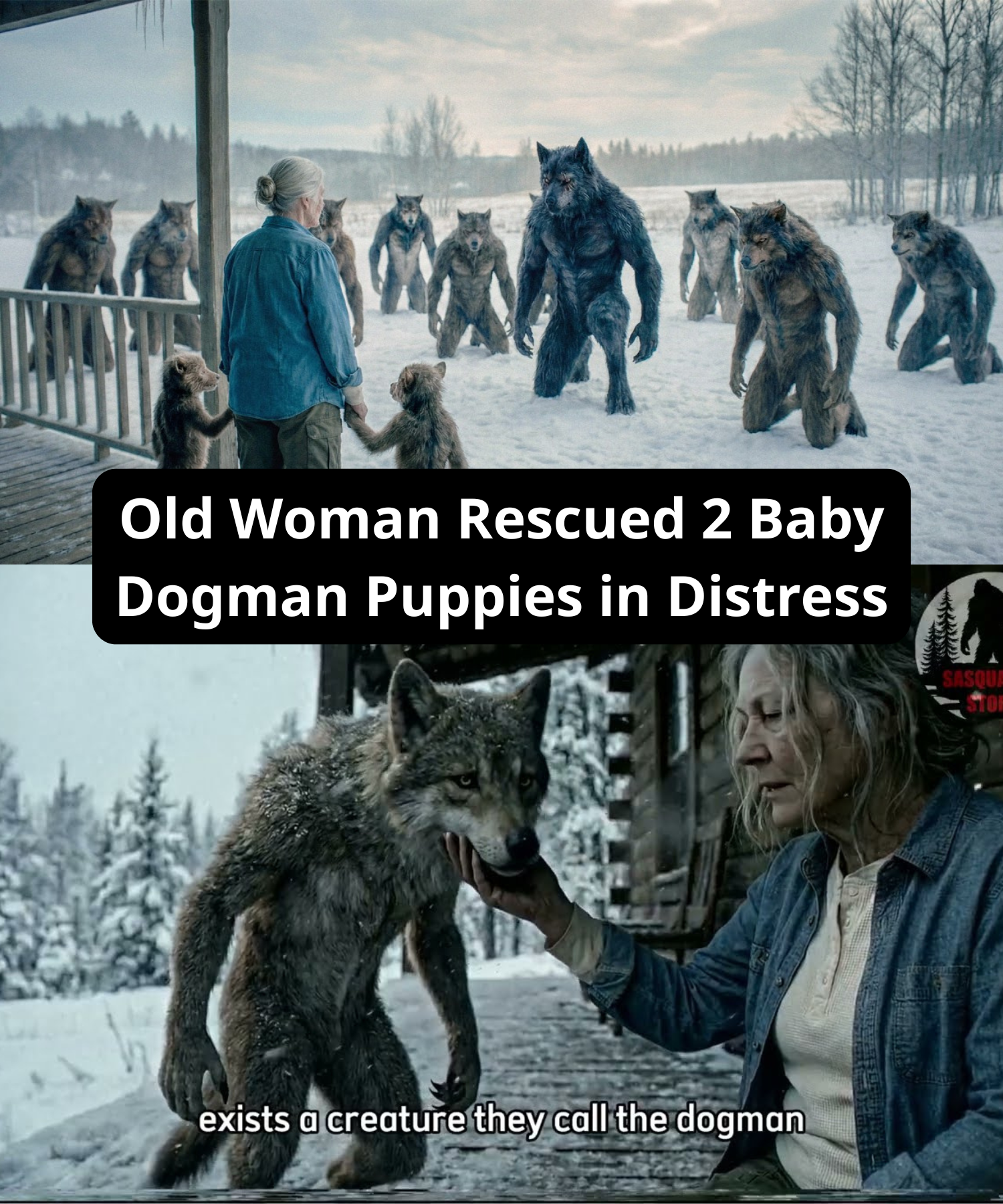
Cold air entered the house. So did the smell of wet fur and wild earth. In the yard, beyond the yellow spill of kitchen light, at least five shapes stood among the rain-dark grass. Two were massive adults. Another was smaller but still taller than a man. Two more moved low near the ground, circling.
The largest one stepped forward.
Margaret’s heart slammed against her ribs.
The creature stopped ten feet from the door.
Up close, it was worse and more beautiful than she expected. Its face was wolf-like, but the eyes were almost human in their attention. Scars crossed one shoulder. Its hands ended in claws, yet it held them slightly open, not raised to strike. Margaret could see intelligence there, but not human intelligence. Something older. Something family-bound, territorial, and fiercely alive.
She knelt slowly, ignoring the pain in her knees, and placed the quilt on the threshold.
The injured pup crawled out first.
It tried to move toward the adult and stumbled. Margaret reached automatically to help it. The massive creature growled, and she froze. Then, after a moment, she gently lifted the pup under its chest and set it outside.
The adult watched every movement.
The smaller pup followed, slipping on the wet floor before tumbling onto the grass. It shook itself, then ran crookedly toward the largest creature. The adult lowered its head and touched its muzzle to the pup’s back.
The sound it made was almost heartbreaking.
Not monstrous.
Relieved.
The injured pup struggled to follow. Margaret took one step outside, picked it up again, and carried it into the yard. The nearest adult tensed, muscles rising beneath wet fur. Margaret stopped and spoke softly.
“He’s hurt. I wrapped the leg.”
She knew the creature could not understand her words.
But maybe it understood tone.
Maybe it understood intent.
Maybe all mothers, human or not, recognize the shape of care.
She placed the pup down carefully. The large adult moved forward and sniffed the bandage. Its breath washed hot over Margaret’s hands. For one terrible second, she thought it would bite. Instead, it looked up at her.
Margaret looked back.
The yard was silent except for rain dripping from the eaves.
Then the creature bowed its head.
Not fully. Not like a trained animal. Just a slight lowering, slow and deliberate, before turning away with the pups gathered close.
The family moved toward the tree line.
But before disappearing into the woods, the largest Dogman stopped and looked back at the house.
Margaret stood barefoot now in the wet grass, robe soaked, hands shaking, shotgun forgotten inside.
The creature opened its mouth, showing teeth that could have split bone.
Then it made a low, mournful sound that rolled across the yard and into the forest.
The others answered from the darkness.
And then they were gone.
By morning, Margaret almost convinced herself she had dreamed the whole thing. Old age, storm, loneliness, maybe a stray dog, maybe fear. But the towels by the stove were still wet. The bowl of milk was empty. Muddy prints covered the kitchen floor—small ones, clawed and strange. Outside, the grass was torn where the larger creatures had stood. One print near the porch was nearly fourteen inches long, pressed deep into the mud.
Margaret did not call the police.
What would she say? That upright wolf creatures had surrounded her house because she rescued their children? That one had thanked her? That she had opened the door and lived?
No one would believe her.
But someone had already seen something.
Her nearest neighbor, Carl Benson, lived half a mile down the road and kept trail cameras around his property because of deer. One camera, pointed toward an old logging path, captured five dark figures moving through the trees at 3:11 a.m. Two large. One medium. Two small. The footage was blurry, partially blocked by rain and branches, but the shapes moved upright for several steps before dropping lower near the ridge.
Carl showed up at Margaret’s house that afternoon, pale and nervous.
“You hear anything last night?” he asked.
Margaret looked at him for a long moment.
Then she said, “They got their babies back.”
Carl never laughed at her again.
Within a week, rumors spread along Black Pine Road. A farmer found deer remains arranged strangely near the wood line, almost like an offering. Another resident reported hearing low howls behind her barn, followed by scratching at the door, but nothing entered. Carl’s dog refused to leave the porch after sunset. Margaret found a rabbit placed neatly beside her back steps one morning, its neck broken cleanly, no blood spilled.
She understood.
A gift.
After that, the woods changed around her house.
Not in a way outsiders would notice. Birds still came to the feeders. Deer still crossed the field. Snow eventually fell. But Margaret no longer felt alone on the land. Sometimes at night, she heard movement at the edge of the yard. Not threatening. Watching. Once, in January, during a heavy storm, she saw an enormous dark shape standing near the maple tree, facing the road as if guarding the house.
By spring, Margaret stopped locking the porch screen.
Not because she was foolish.
Because she understood boundaries.
They had their world. She had hers. For one night, those worlds had touched through helpless cries in a ditch. She had chosen mercy, and something ancient had remembered.
The story might have remained local legend if Carl’s trail camera footage had not been uploaded by his grandson. The clip spread quickly under titles like “Dogman Family Caught Near Michigan Farm” and “Old Woman Protected by Werewolf Creatures After Saving Their Babies.” Most viewers mocked it. Some said it was bears. Others called it a hoax. A few argued the figures were people in costumes. Cryptid researchers contacted Margaret, but she refused interviews at first.
When she finally spoke, she did not try to convince anyone.
“I don’t care what people call them,” she said. “Monster, Dogman, animal, demon, whatever makes them feel smart. I know what I saw. I know what I held in my arms. And I know a mother when I see one.”
That line became the heart of the legend.
Because the story was not terrifying only because Dogmen surrounded a farmhouse. It was terrifying because the creatures were not mindless beasts. They were organized. Emotional. Protective. Capable of restraint. Capable, perhaps, of gratitude. That possibility unsettles people more than pure violence. A monster that attacks can be dismissed as animal horror. A monster that recognizes mercy forces us to ask what else may be hidden inside the forests we think we understand.
For Margaret, the answer was simple.
The woods were never empty.
Humans only acted as if they owned everything because most of nature stayed silent.
Years later, after Margaret passed away peacefully in the same farmhouse, her children returned to clear the property. They found her old journal in the kitchen drawer. Most entries were ordinary: weather notes, grocery lists, memories of her husband, complaints about aching knees. But one section, written after that October night, described the rescue in careful detail.
At the end, she had written:
“I was afraid when I opened the door. But those babies were afraid too. Maybe that is what people forget. The unknown is not always evil. Sometimes it is only wild, wounded, and trying to get home.”
Her children buried her beside her husband in the small cemetery outside town.
That winter, after the funeral, Carl Benson claimed he saw tracks in the snow around her empty farmhouse. Large tracks. Upright tracks. Circling the house once, then leading back into the woods.
Near the back steps, someone—or something—had left a deer antler.
No one could prove what it meant.
But the people on Black Pine Road believe the Dogman family came back one last time.
Not to threaten.
Not to hunt.
To say goodbye to the old woman who heard crying in the ditch and chose kindness before fear.