This Muslim Wasn’t Ready For This Quote From The Quran…
This Muslim Wasn’t Ready For This Quote From The Quran…
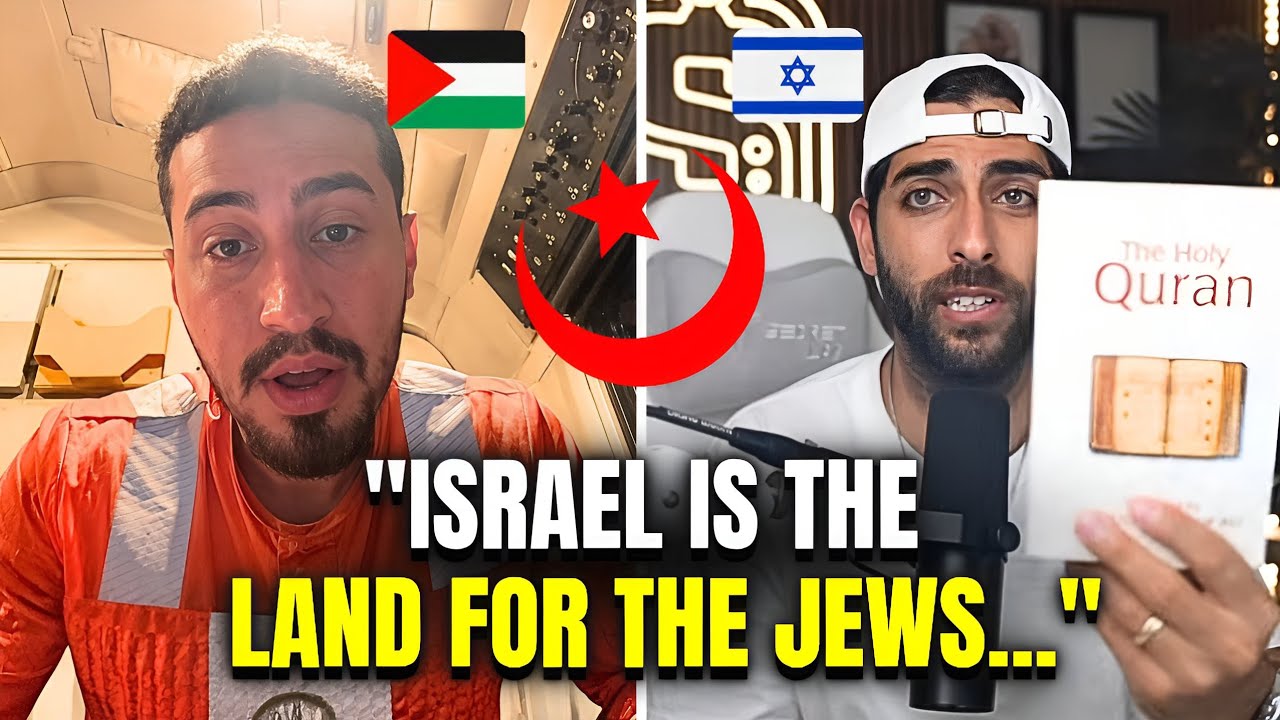
A tense livestream exchange between an Israeli commentator and a Syrian Muslim participant has become the latest viral flashpoint in the global debate over Israel, Gaza, Palestinian identity, religious history, and the emotional power of online political confrontation.
The conversation, captured in a widely circulated transcript, begins like many modern internet debates: two strangers on a live platform, separated by geography, history, language, and trauma, trying to compress one of the world’s most complicated conflicts into a few heated minutes. What follows is not a calm academic discussion, nor a diplomatic exchange. It is raw, impatient, deeply emotional, and at times confrontational.
At the center of the debate are several explosive questions: Who has historical and religious claim to the Holy Land? How should the deaths of civilians in war be discussed? Why does the world respond differently to some conflicts than others? And can ancient scripture, modern nationalism, and present-day suffering ever be separated in conversations about Israel and Palestine?
The exchange begins when the Israeli host asks the Syrian man where he is from. The participant says he is from Syria, opening the door to a brief discussion about the Syrian civil war, refugees, and the devastating destruction caused by years of conflict. The Israeli commentator points to the suffering of Syrians under Bashar al-Assad, referencing mass death, ruined cities, and displaced families. He appears to be making a broader argument: that the world has not protested Syria’s tragedy with the same intensity it has shown over Palestine.
But the Syrian participant quickly turns the accusation back toward Israel. He argues that Israel has no moral right to speak about dead children while Palestinian children are dying in Gaza. The conversation immediately shifts from Syria to Gaza, from one war’s victims to another’s, and from historical comparison to moral confrontation.
This moment sets the tone for the entire exchange. Neither side is willing to let the other frame the conflict first. The Israeli speaker wants to ask why Palestinian suffering receives more global attention than Syrian suffering. The Syrian participant wants to ask why Israel justifies its military actions while civilians are being killed. Each side sees hypocrisy in the other. Each side believes the other is avoiding the most painful truth.
The Israeli host asks whether there has ever been a war in history where civilians and children did not die. His argument is not that civilian deaths are acceptable, but that war itself inevitably produces civilian suffering. The Syrian participant rejects this framing, insisting that what is happening in Gaza is not simply the tragic result of combat, but a deliberate campaign against vulnerable people.
That disagreement captures one of the central divides in global discussion of the Gaza war. Supporters of Israel often frame the conflict around security, Hamas, October 7, hostages, rockets, and the need to prevent future attacks. Critics of Israel often frame it around civilian casualties, destruction, displacement, and the overwhelming imbalance of power between the Israeli military and Palestinians in Gaza.
Both frames contain emotional force. Both are repeated daily across media platforms. And both can harden into positions that leave little room for the other side’s grief.
The Israeli commentator then asks the Syrian participant why Israel is in Gaza. When the participant pushes the question back, the host answers by pointing to the October 7 attacks, naming Hamas and other militant groups as the reason Israel entered the territory militarily. He argues that Hamas attacked Israel because of an Islamist ideology that rejects Jewish sovereignty over land once controlled by Muslims.
The Syrian participant challenges that explanation. For him, the central issue is not ideology but land, occupation, and the suffering of Palestinians. He repeatedly asks whether the land belongs to Israel and rejects the idea that religious claims can justify killing civilians.
From there, the exchange moves into religious scripture. The Israeli commentator argues that the Quran itself contains passages referring to the Holy Land being assigned to Moses and the people of Moses, commonly identified as Banu Israel. He directs the Syrian participant to verses in Surah Al-Ma’idah, describing them as evidence that Islamic scripture acknowledges a connection between the Children of Israel and the land.
The Syrian participant is skeptical. At first, he questions the translation and suggests the version being read may not be the original Arabic text. The host seizes on that hesitation, asking whether the participant is suggesting there are different versions of the Quran or that the text is corrupted. The Syrian participant pushes back, saying he wants to read it in Arabic for himself.
This part of the conversation becomes especially charged because it moves beyond politics into religious legitimacy. The Israeli speaker is not merely arguing from modern history or security. He is attempting to use the other participant’s own religious tradition to challenge his position. The Syrian participant, meanwhile, is trying to defend both his faith and his political stance while navigating the difficulty of translation, interpretation, and live debate pressure.
When the verses are read, the Syrian participant does not fully accept the host’s conclusion. He acknowledges that the text refers to land but asks which land is being discussed. The Israeli speaker responds that it refers to the Holy Land assigned to Moses and the people of Moses. He argues that this supports Jewish historical and religious attachment to the region.
But even at this point, the Syrian participant refuses to concede that such an argument justifies Israel’s actions in Gaza. He returns to the issue of civilian deaths. In his view, even if one accepts a historical or religious connection, that does not grant permission to kill children or destroy communities.
That distinction is crucial. Many debates about Israel and Palestine collapse because participants shift between different categories of argument without acknowledging the change. One side may speak about ancient connection and legal sovereignty. The other may speak about present suffering and military conduct. Both may be addressing real issues, but they are not always answering the same question.
The Israeli commentator insists that Israel is not in Gaza simply to kill civilians or take land. He says Israel is trying to deter Hamas, stop rocket attacks, and disarm the group. He adds that if Israel must control territory for security reasons, then it may do so. The Syrian participant remains unconvinced, warning that Israel’s government will face consequences and predicting that the situation will look different in several years.
As the debate grows more heated, the Syrian participant uses threatening language about returning to Gaza and seeing the Israeli side there in the future. The Israeli host responds by asking whether Israel’s repeated military victories over Arab armies might suggest divine favor toward the Jews rather than the Arabs. The Syrian participant refuses to answer directly, saying he is not allowed to make such a claim.
Advertisements
The conversation ends without resolution, as the Syrian participant says he has to go to work and leaves the exchange. But by that point, the clip has already delivered the kind of confrontation that tends to spread rapidly online: sharp religious claims, accusations of hypocrisy, references to dead children, scriptural argument, historical grievance, and predictions of future conflict.
What makes the video compelling is also what makes it troubling. It condenses immense suffering into a contest of rhetorical victory. The Syrian participant carries the anger of a region that sees Gaza through the lens of Palestinian pain, Arab identity, and Muslim solidarity. The Israeli host carries the anger of a country still shaped by the trauma of October 7, historical persecution, and the belief that Jewish sovereignty must be defended against enemies who openly reject it.
Neither side enters the conversation as a neutral observer. Both arrive with wounds.
The Syrian participant’s experience cannot be separated from Syria’s own tragedy. When the host mentions Assad and the killing of Syrians, the participant does not deny suffering. But he resists what he sees as an attempt to use Syrian pain to deflect from Palestinian pain. For many people from war-torn societies, comparisons between conflicts can feel like a moral trap. They may hear the question not as “Why did the world ignore you?” but as “Why do you care about them?”
The Israeli host’s position is also shaped by a sense of double standards. He argues that the world mobilizes more loudly for Palestinians than it did for Syrians, even though Syria experienced catastrophic destruction and mass civilian death. This argument is common among Israel’s defenders, who often claim that outrage over Gaza is driven not only by humanitarian concern but by hostility toward Israel or Jews.
The truth is more complex. Global attention is shaped by many factors: media access, political symbolism, religious significance, social media activism, geopolitical alliances, diaspora communities, and the long history of the Israeli-Palestinian conflict as a central issue in Middle Eastern and international politics. The fact that one tragedy receives more attention than another does not mean one is real and the other is not. It may mean that the world is inconsistent, selective, overwhelmed, or politically divided.
The problem is that inconsistency can become emotional ammunition. Instead of expanding compassion, people use neglected suffering to challenge compassion for someone else.
That pattern appears repeatedly in the debate. Syrian children are invoked against Palestinian children. Israeli children are invoked against Gazan children. Historical Jewish claims are invoked against Palestinian national claims. Modern civilian suffering is invoked against ancient religious attachment. The result is a conversation where every grief becomes a weapon.
Online platforms reward this kind of exchange. A thoughtful discussion of international law, civilian protection, religious interpretation, and historical memory would require time, patience, and expertise. But viral media rewards the moment when one speaker appears to corner another, when a question produces hesitation, or when a provocative statement triggers outrage. The clip becomes entertainment, even though the subject is death, displacement, and war.
This is one of the deepest dangers of conflict content online. It turns human suffering into debate performance. Viewers choose sides, cheer the argument that confirms their worldview, and rarely leave with greater understanding. The people at the center of the conflict—families in Israel, civilians in Gaza, displaced Syrians, grieving parents, frightened children—become symbols in a rhetorical contest.
The religious dimension makes the exchange even more combustible. The Israeli host’s use of Quranic verses is intended to challenge Muslim opposition to Jewish claims in the land. But religious texts are rarely self-explanatory in political debates. They are interpreted through traditions, languages, historical contexts, and theological frameworks. A verse that one person reads as divine confirmation of Jewish land rights may be interpreted differently by another, especially when modern borders, statehood, occupation, and war are involved.
Likewise, the Syrian participant’s rejection of Israel’s actions cannot simply be dismissed as ignorance of scripture. His concern is focused on present-day Palestinians and the moral meaning of military force. Even if ancient texts establish a connection between Banu Israel and the Holy Land, that does not by itself answer the modern questions of governance, citizenship, sovereignty, refugees, settlements, security, occupation, and civilian protection.
That is why religious arguments often intensify rather than resolve political conflict. They raise the stakes from policy to destiny. They make compromise feel like betrayal. And they can make each side believe that history, God, and justice all stand exclusively with them.
The livestream also reveals how difficult it is to discuss civilian deaths in asymmetric warfare. The Israeli commentator insists that civilian deaths occur in every war and that Hamas’s actions forced Israel into Gaza. The Syrian participant insists that Israel’s military power creates responsibility for the scale of destruction. These arguments are not new, but they remain painfully unresolved.
International humanitarian law attempts to create rules for war, including distinction, proportionality, and precautions to protect civilians. But in public debate, these legal concepts often get replaced by emotional absolutes. One side says Israel has the right to defend itself. The other says Palestinians have the right to live free from bombardment and blockade. Both statements can be true in principle, yet the clash comes in how they apply when rockets, tunnels, hostages, airstrikes, militants, civilians, and destroyed neighborhoods become part of the same battlefield.
The debate ends with prediction rather than persuasion. The Syrian participant warns that Israel’s government will fall or that the balance of power will change in a few years. The Israeli host challenges him with Israel’s military victories and suggests that success itself proves something about divine favor. Neither claim offers a path toward peace. Both point toward continued confrontation.
That may be the saddest part of the exchange. No one leaves with a new understanding. No one acknowledges the full humanity of the other side’s fear. No one pauses long enough to say that Israeli children and Palestinian children, Syrian children and Lebanese children, Jewish families and Arab families, all deserve to live without being turned into proof points.
Instead, the conversation becomes another artifact of the war of narratives.
Still, the video matters because it shows what millions of people are experiencing in real time. The Israeli-Palestinian conflict is not only being fought through weapons, diplomacy, and international institutions. It is being fought through livestreams, comment sections, translations, religious claims, short clips, and emotional confrontations between strangers. Every viral exchange becomes part of a larger battle over legitimacy.
For supporters of Israel, the clip may appear to show a Muslim participant struggling to respond to Quranic evidence and historical arguments. For supporters of Palestinians, it may appear to show an Israeli speaker deflecting from civilian suffering by turning the debate toward theology and comparison with Syria. For neutral viewers, it may show how impossible meaningful dialogue becomes when both sides enter with pain and leave with certainty.
A better conversation would require more than winning points. It would require acknowledging that Jewish attachment to the land is real and ancient, while also acknowledging that Palestinian attachment to the land is real and deeply rooted. It would require recognizing the horror of October 7 while also recognizing the devastation experienced by civilians in Gaza. It would require condemning Hamas’s violence without treating all Palestinians as Hamas, and criticizing Israeli military policy without denying Jewish history or Israeli fear.
That kind of conversation is rare online because it does not produce easy applause.
Yet it is the only kind of conversation that has any chance of reducing hatred rather than deepening it.
The viral livestream clash is therefore not just a debate between an Israeli and a Syrian. It is a snapshot of a world trapped between memory and rage. Each side carries history. Each side carries trauma. Each side suspects the other of hypocrisy. And each side fears that if it gives an inch in language, it will lose something sacred in reality.
The tragedy is that while online audiences argue over who won the exchange, real people continue to lose homes, loved ones, safety, and hope.
The question left behind is not whether one speaker defeated the other. The question is whether public debate can still make room for grief without turning it into a weapon.
Until that happens, the livestreams will continue, the clips will spread, and the conflict will keep being fought not only on the ground, but in the minds of millions watching from their screens.