The Black Pharaohs Vanished For A Reason Nobody Expected — DNA Just Exposed It
The Black Pharaohs Vanished For A Reason Nobody Expected — DNA Just Exposed It
They did not vanish.
That is the first shock. For generations, the story of the Black Pharaohs was told like a disappearance: powerful Nubian kings rose from the south, conquered Egypt, wore the double crown, restored temples, defied empires, and then seemed to fade from history as suddenly as they had appeared. But the closer scientists look — at bones, ancestry, migration, burial grounds, and the genetic memory of the Nile Valley — the more unsettling the truth becomes.
The Black Pharaohs were not erased because their bloodline simply died out.
They were buried under a story written by their enemies.
For centuries, ancient Egypt was imagined as if its greatness flowed only from north to south, from the Mediterranean inward, from Cairo and Memphis and Thebes down toward Nubia like civilization descending into shadow. But the 25th Dynasty broke that illusion. The kings of Kush came from the south, from the lands of Nubia in what is now Sudan and southern Egypt, and they did something no outsider was supposed to do.
They became pharaohs.
They did not merely raid Egypt. They ruled it. They restored old religious traditions. They built monuments. They claimed legitimacy not as foreign invaders, but as protectors of ancient order. They honored Amun. They wore Egyptian crowns. They placed themselves inside the long sacred chain of kingship. For a brief but unforgettable moment, the Nile flowed politically in the opposite direction.
And that is why their “vanishing” has always felt suspicious.
The popular version is simple: the Black Pharaohs came, ruled, lost Egypt, and disappeared. But history is rarely that clean. DNA, archaeology, and modern reexamination of Nubia now suggest a deeper truth. The end of their rule in Egypt was not the end of their people. It was not the disappearance of their civilization. It was a retreat, a transformation, a shift in political gravity from Egypt back to Kush.
The Black Pharaohs vanished from Egyptian royal lists more than they vanished from the world.
That difference changes everything.
The story begins in Kush, a kingdom rooted along the Nile south of Egypt. This was not an empty frontier waiting for Egyptian influence. Nubia had its own deep traditions, powerful chiefs, wealthy trade networks, skilled archers, gold resources, cattle cultures, and sacred landscapes. Long before the Kushite kings took Egypt, Nubia had been both rival and partner to Egyptian power. Egypt wanted Nubian gold, soldiers, trade routes, and control of the southern Nile. Nubia absorbed Egyptian influence but never became merely Egyptian.
It watched.
It learned.
It waited.
By the 8th century BCE, Egypt itself was fractured. Local rulers competed for power. The old unity of the pharaonic state had weakened. Temples remained, but authority was divided. The prestige of Egypt was still enormous, but the political body was sick. From the south, King Piye of Kush saw an opportunity. He marched north not only as a conqueror, but as a man convinced he was restoring divine order.
That is what makes Piye so fascinating.
He did not present himself as a barbarian taking a prize. He presented himself as a legitimate pharaoh cleansing Egypt of disorder. His victory inscription is filled with religious seriousness. He stops to purify himself. He honors temples. He scolds Egyptian rulers not simply for rebellion, but for moral and ritual failure. To Piye, Egypt was not just territory. It was sacred responsibility.
That made the Kushite conquest more powerful than a military campaign.
It was a religious statement.
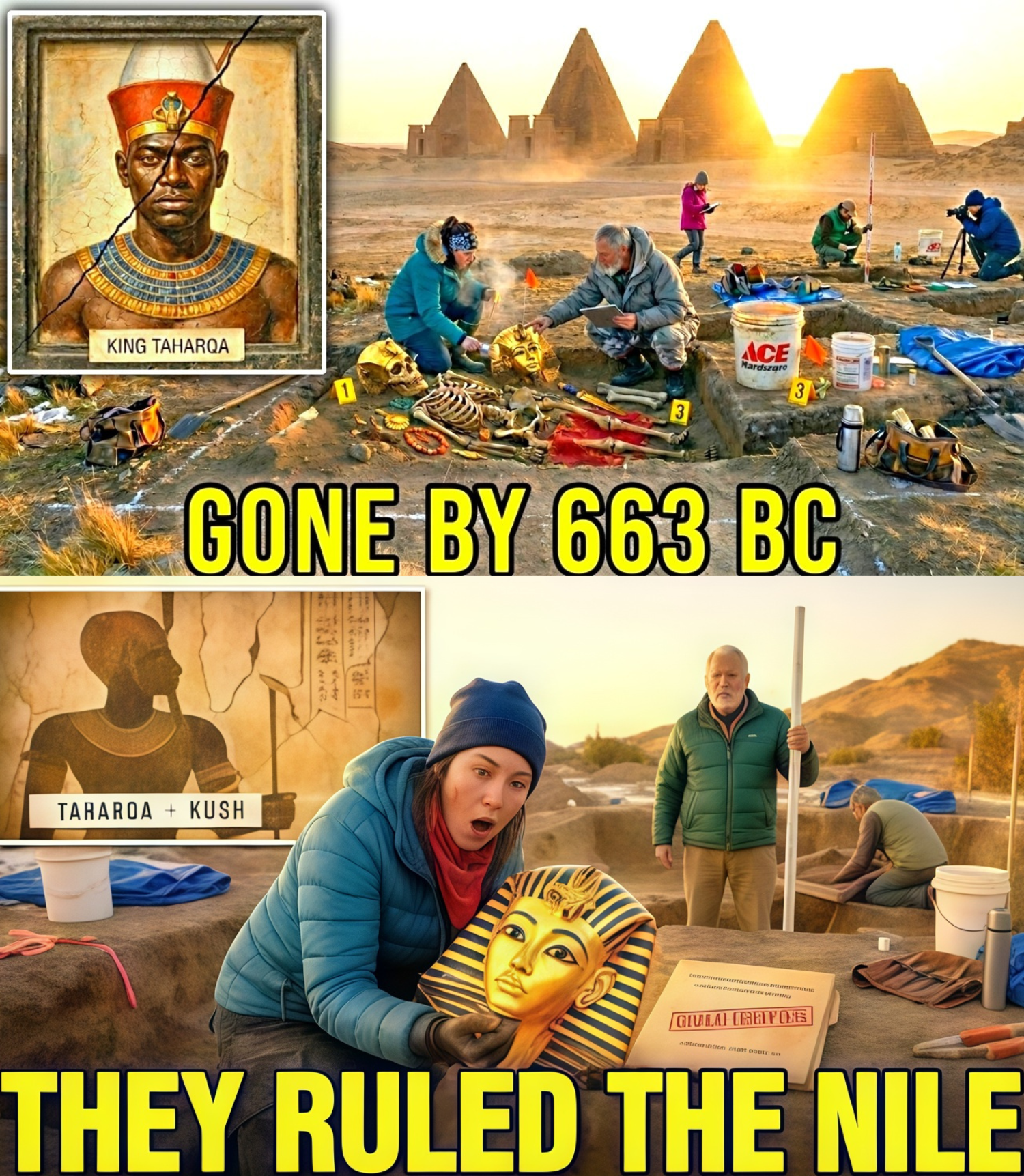
After Piye, kings such as Shabaka, Shebitku, Taharqa, and Tantamani carried the Kushite dynasty forward. They ruled a realm stretching from Nubia into Egypt. They supported monumental building. They revived older styles. They connected themselves to Egypt’s ancient past. To later viewers, they can look like a strange interruption in Egyptian history. But that is the wrong lens. They were not interrupting Egypt. They were participating in a long Nile Valley world where culture, power, blood, and belief had moved both ways for centuries.
Then came Assyria.
This is the part of the story that feels like the beginning of the disappearance. The Assyrian Empire was one of the most formidable military powers of the ancient Near East. Its armies had iron weapons, siege experience, imperial organization, and a brutal reputation. When Assyria pushed into Egypt, the Kushite rulers faced something different from local Egyptian rivals. They were no longer dealing with divided Nile politics. They were facing a war machine from the east.
Taharqa, the most famous of the Kushite pharaohs, resisted Assyrian pressure fiercely. He was remembered in both Egyptian and biblical contexts. He built, fought, lost ground, returned, and fought again. His reign carried grandeur, but also crisis. The Assyrians invaded Egypt. Memphis fell. Control shifted. The Kushite hold on the north weakened.
Tantamani, the last Kushite ruler to make a serious attempt to reclaim Egypt, pushed north again after Taharqa. For a moment, the old dream seemed alive. But Assyrian power struck back with devastating force. Thebes itself, one of Egypt’s holiest and most ancient cities, was sacked in 663 BCE. That event sent a message no one in the Nile Valley could ignore.
The age of Kushite rule over Egypt was ending.
But ending is not the same as extinction.
This is where the old story misleads people. Because the Black Pharaohs lost Egypt, many readers assume they vanished. But after losing control of Egypt, Kush did not disappear into dust. The kingdom continued south. Its centers of power shifted. Napata remained important. Later, Meroe rose as a major capital and royal burial center. Kushite civilization survived for centuries after the 25th Dynasty lost Egypt.
That is the revelation.
The Black Pharaohs did not vanish because their civilization collapsed overnight.
They vanished from the Egyptian throne because imperial war, shifting politics, and the rise of new powers pushed them back south. Then their kingdom continued, changed, and became more distinctly Kushite.
The DNA angle makes that even more powerful.
Ancient DNA from Nubia is difficult and still limited, especially for the exact era of the 25th Dynasty. The heat, time, burial conditions, and preservation challenges of the region mean scientists do not yet have a clean genetic map of Piye, Taharqa, or their immediate royal family. So the sensational claim that “DNA has finally solved the disappearance of the Black Pharaohs” needs caution.
But DNA from later Nubian populations has already changed the conversation.
Studies of ancient individuals from Nubia show that the Nile Valley was never a simple racial borderland divided cleanly between “Egyptian” and “African,” “north” and “south,” “foreign” and “native.” It was a corridor. People moved. Families mixed. Communities changed across time. Local African ancestry, northeastern African ancestry, and ancestry connected to neighboring regions interacted over centuries. The genetic story is layered, not binary.
That matters because the older telling of the Black Pharaohs often treated them as outsiders who briefly invaded Egypt and then disappeared. DNA pushes against that simplification. It shows a Nile Valley world shaped by continuity and movement. It suggests that the people of Nubia were not a footnote to Egypt, but part of a long human landscape with its own deep roots and its own complex connections.
The Black Pharaohs were not a temporary anomaly.
They were the visible royal face of a much older southern Nile power.
That may be the reason their story was minimized for so long. Ancient history was often filtered through later prejudice. European scholars of earlier centuries sometimes struggled to accept that a powerful African kingdom had conquered and ruled Egypt. Nubia was treated as secondary, derivative, or peripheral, even when the evidence said otherwise. The monuments of Meroe, the pyramids of Kush, the royal inscriptions, the temples, and the military power of the Nubian kings were all there. But interpretation can bury evidence almost as effectively as sand.
The “vanishing” of the Black Pharaohs was partly a modern invention.
They vanished because historians did not always know how to place them.
They vanished because Egypt was treated as separate from the rest of Africa.
They vanished because the story of African power made some people uncomfortable.
They vanished because defeat by Assyria was mistaken for disappearance.
They vanished because the later kingdom of Kush was not given the same attention as Egypt.
But the stones remembered.
In Sudan, the pyramids of Meroe still rise from the desert, sharper and smaller than the pyramids of Giza, but no less haunting. They are royal tombs, witnesses to a civilization that did not end when the 25th Dynasty lost the Egyptian throne. The desert around them is not empty. It is crowded with the remains of kings, queens, temples, chapels, and a culture that fused Egyptian inheritance with Nubian identity until it became something unmistakably its own.
The Kushites kept building.
They kept ruling.
They kept burying their dead with royal grandeur.
They kept writing in scripts scholars still struggle to fully understand.
That is not disappearance.
That is transformation.
The DNA evidence, when understood carefully, does not reveal a shocking extinction. It reveals the opposite. It exposes the mistake of expecting ancient peoples to remain frozen in one form forever. The Kushites did not need to keep ruling Egypt to remain historically important. They did not need to look exactly like their 25th Dynasty ancestors forever to be their heirs. Populations shift. Kingdoms move. Languages change. Capitals rise and fall. Royal lines marry, split, and merge. Identity survives by adapting.
The Black Pharaohs vanished only if we expected them to remain on Egypt’s throne forever.
But no dynasty does.
Even native Egyptian dynasties rose and fell. Capitals changed. Foreign rulers came and went. Persians ruled Egypt. Greeks ruled Egypt. Romans ruled Egypt. Yet no one says Egypt vanished every time a dynasty ended. The Kushites deserve the same historical seriousness. Losing Egypt did not erase Kush any more than losing a province erases an empire’s people.
The more we learn, the more the old question changes.
It is not “Where did the Black Pharaohs go?”
It is “Why did we stop following them after they left Egypt?”
That question is uncomfortable.
Because it reveals how much of history is shaped by attention. When the Kushite kings ruled Egypt, they entered a story the world already cared about. When they returned south, many popular histories turned away. But Kush did not stop mattering just because Egypt was no longer its stage. In Meroe, the kingdom became a major African power, connected to trade routes, iron production, temple building, and royal women who could wield extraordinary authority.
Some of the most remarkable rulers of later Kush were queens or queen mothers, often known by the title Kandake. These women were not decorative figures. In some periods, they held real political and military importance. One Kushite queen, Amanirenas, is remembered for resistance against Rome. Think about that for a moment. Long after the so-called disappearance of the Black Pharaohs, Kushite power was still strong enough to confront one of the greatest empires in the world.
That is not an ending.
That is a sequel most people were never taught.
The DNA story also warns us against turning ancient people into modern slogans. The phrase “Black Pharaohs” is powerful because it restores attention to African rulers who were wrongly marginalized. But ancient identity was not built exactly like modern identity. The Kushite kings were Nubian, African, Nile Valley rulers who adopted and reshaped Egyptian kingship. They were Black in the broad historical and visual sense often used to describe Nubian pharaohs, but their world cannot be reduced to one modern racial category.
They belonged to Kush.
They belonged to the Nile.
They belonged to a political and religious universe where kingship, ancestry, gods, land, and legitimacy mattered in ways modern language only partly captures.
DNA can help us understand ancestry, movement, and biological relationships. But it cannot fully explain identity, culture, or power by itself. A genome does not tell us what a person prayed, feared, believed, spoke, or fought for. It does not reveal the emotion of a coronation, the sound of temple hymns, the smell of incense at Napata, or the fear in Memphis when Assyrian armies approached.
DNA is evidence.
It is not the whole soul of history.
Still, it has exposed something astonishing: the Nile Valley was always more connected, more African, more mixed, and more dynamic than many older narratives admitted. The Black Pharaohs were not strange intruders into Egyptian history. They were rulers from a neighboring Nile civilization that had been entangled with Egypt for millennia. Their rise was dramatic, but not random. Their fall was violent, but not final.
That is the truth hidden behind the title.
They did not vanish because of a mysterious curse.
They did not vanish because their bloodline evaporated.
They did not vanish because they were never truly powerful.
They vanished from one throne because the politics of the ancient world changed. Then they continued as part of the longer story of Kush.
The reason nobody expected is simple: the disappearance was never really biological.
It was historical.
It was narrative.
It was the failure of later generations to keep looking south.
Picture Taharqa at the height of his power. A Nubian king wearing the crown of Egypt, building temples, facing Assyria, standing at the intersection of African and Near Eastern history. Then picture the same royal tradition after retreat, no longer ruling from Memphis, but still alive in Napata and Meroe. The crown changed context. The people did not vanish. The river kept flowing.
That image matters.
Because history has often treated defeat as erasure. But people survive defeat. Cultures survive defeat. They move, adapt, rebuild, remember, and sometimes become something new. Kush did exactly that. Its later civilization was not simply “Egyptian influence in Africa.” It was African creativity using, transforming, and outlasting Egyptian forms.
The pyramids of Meroe are the perfect symbol of this.
They look familiar enough to remind us of Egypt, but different enough to reject imitation. They rise steeply from Sudanese sands like declarations. They say: we knew Egypt, we ruled Egypt, we honored Egypt, but we were never only Egypt.
That is what the Black Pharaohs left behind.
Not disappearance.
A challenge.
A challenge to the way history is told.
A challenge to the borders drawn between civilizations.
A challenge to the idea that African power must be explained as borrowed.
A challenge to the assumption that a dynasty ends when outsiders stop watching.
The DNA evidence is only beginning to speak, and it must be handled carefully. More ancient genomes from Nubia, Egypt, and the wider Nile Valley will sharpen the picture. Future discoveries may reveal more about royal families, migrations, marriages, and population continuity. But even now, the direction is clear enough to unsettle the old story.
The Black Pharaohs were not a vanished race.
They were part of a living, changing Nile Valley world.
Their political rule in Egypt ended under the pressure of Assyria and Egyptian realignment. Their kingdom continued south. Their culture evolved. Their descendants and related populations became part of later Nubian histories. Their monuments still stand. Their memory, once pushed aside, is returning with force.
So the real mystery is not why they vanished.
The real mystery is why anyone believed they had.
Maybe because history prefers clean endings. Maybe because defeated kings are easier to forget. Maybe because Nubia stood in the shadow of Egypt in too many textbooks. Maybe because the phrase “ancient Egypt” became so powerful that everything south of it was treated as background.
But the sand is shifting now.
Archaeology is turning south.
Genetics is complicating the map.
Meroe is speaking again.
And the Black Pharaohs are stepping out of the shadow, not as a lost curiosity, but as one of the most important royal lines of the ancient world.
The final truth is more astonishing than the myth.
They did not vanish.
They were waiting for history to remember where to look.